From Surf Wiki (app.surf) — the open knowledge base
Chromate and dichromate
Chromium(VI) anions
Chromium(VI) anions
the salts of the chromium(VI) anion
Chromate salts contain the chromate anion, . Dichromate salts contain the dichromate anion, . They are oxyanions of chromium in the +6 oxidation state and are moderately strong oxidizing agents. In an aqueous solution, chromate and dichromate ions can be interconvertible.
Chemical properties
Potassium-chromate-sample.jpg|Potassium chromate Potassium-dichromate-sample.jpg|Potassium dichromate Chromates react with hydrogen peroxide, giving products in which peroxide, , replaces one or more oxygen atoms. In acid solution the unstable blue peroxo complex Chromium(VI) oxide peroxide, , is formed; it is an uncharged covalent molecule, which may be extracted into ether. Addition of pyridine results in the formation of the more stable complex .
Acid–base properties
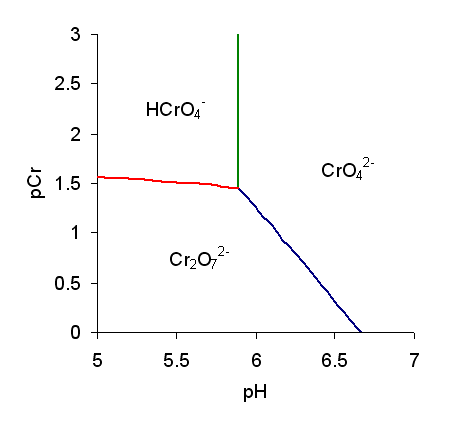
In aqueous solution, chromate and dichromate anions exist in a chemical equilibrium. : The predominance diagram shows that the position of the equilibrium depends on both pH and the analytical concentration of chromium.pCr is equal to the negative of the decimal logarithm of the molar concentration of chromium. Thus, when pCr = 2, the chromium concentration is 10−2 mol/L.
The chromate ion is the predominant species in alkaline solutions, but dichromate can become the predominant ion in acidic solutions.
Further condensation reactions can occur in strongly acidic solution with the formation of trichromates, , and tetrachromates, . All polyoxyanions of chromium(VI) have structures made up of tetrahedral units sharing corners.
The hydrogen chromate ion, , is a weak acid: :; pKa ≈ 5.9 It is also in equilibrium with the dichromate ion: : This equilibrium does not involve a change in hydrogen ion concentration, which would predict that the equilibrium is independent of pH. The red line on the predominance diagram is not quite horizontal due to the simultaneous equilibrium with the chromate ion. The hydrogen chromate ion may be protonated, with the formation of molecular chromic acid, , but the pKa for the equilibrium : is not well characterized. Reported values vary between about −0.8 and 1.6.
The dichromate ion is a somewhat weaker base than the chromate ion: :, pKa = 1.18 The pKa value for this reaction shows that it can be ignored at pH 4.
Oxidation–reduction properties
The chromate and dichromate ions are fairly strong oxidizing agents. Commonly three electrons are added to a chromium atom, reducing it to oxidation state +3. In acid solution the aquated ion is produced. : ε0 = 1.33 V In alkaline solution chromium(III) hydroxide is produced. The redox potential shows that chromates are weaker oxidizing agent in alkaline solution than in acid solution. : ε0 = −0.13 V
Applications

Approximately 136000 tonne of hexavalent chromium, mainly sodium dichromate, were produced in 1985. Chromates and dichromates are used in chrome plating to protect metals from corrosion and to improve paint adhesion. Chromate and dichromate salts of heavy metals, lanthanides and alkaline earth metals are only very slightly soluble in water and are thus used as pigments. The lead-containing pigment chrome yellow was used for a very long time before environmental regulations discouraged its use. When used as oxidizing agents or titrants in a redox chemical reaction, chromates and dichromates convert into trivalent chromium, , salts of which typically have a distinctively different blue-green color.
Natural occurrence and production

The primary chromium ore is the mixed metal oxide chromite, , found as brittle metallic black crystals or granules. Chromite ore is heated with a mixture of calcium carbonate and sodium carbonate in the presence of air. The chromium is oxidized to the hexavalent form, while the iron forms iron(III) oxide, : :
Subsequent leaching of this material at higher temperatures dissolves the chromates, leaving a residue of insoluble iron oxide. Normally the chromate solution is further processed to make chromium metal, but a chromate salt may be obtained directly from the liquor.
Chromate containing minerals are rare. Crocoite, , which can occur as spectacular long red crystals, is the most commonly found chromate mineral. Rare potassium chromate minerals and related compounds are found in the Atacama Desert. Among them is lópezite – the only known dichromate mineral.
As chromate is isostructural to sulfate, sulfate and chromate minerals can form solid solutions such as hashemite, and chromate minerals are often listed alongside sulfate minerals in mineral classification schemes such as Nickel-Strunz classification.
Toxicity
Hexavalent chromium compounds can be toxic and carcinogenic (IARC Group 1). Inhaling particles of hexavalent chromium compounds can cause lung cancer. Also positive associations have been observed between exposure to chromium (VI) compounds and cancer of the nose and nasal sinuses.{{cite book |author-link = International Agency for Research on Cancer |orig-year = 17–24 March 2009 |access-date = 2020-01-05 |archive-date = 2020-03-17 |archive-url = https://web.archive.org/web/20200317095517/https://publications.iarc.fr/_publications/media/download/3026/50ed50733f7d1152d91b30a803619022ef098d59.pdf |url-status = dead
Notes
References
References
- {{Greenwood&Earnshaw2nd
- (2021-02-01). "Effect of solution acidity on the crystallization of polychromates in uranyl-bearing systems: synthesis and crystal structures of Rb2[(UO2)(Cr2O7)(NO3)2] and two new polymorphs of Rb2Cr3O10". Zeitschrift für Kristallographie - Crystalline Materials.
- {{Greenwood&Earnshaw2nd
- [http://www.acadsoft.co.uk/scdbase/scdbase.htm IUPAC SC-Database]. A comprehensive database of published data on equilibrium constants of metal complexes and ligands.
- Brito, F.. (1997). "Equilibria of chromate(VI) species in acid medium and ab initio studies of these species". Polyhedron.
- {{Holleman&Wiberg.
- Worobec, Mary Devine. (1992). "Toxic Substances Controls Guide: Federal Regulation of Chemicals in the Environment". BNA Books.
- (2005). "Ullmann's Encyclopedia of Industrial Chemistry". Wiley-VCH.
- Papp, John F.. (2006). "Industrial Minerals & Rocks: Commodities, Markets, and Uses". SME.
- (February 2020). "Mines, Minerals and More".
This article was imported from Wikipedia and is available under the Creative Commons Attribution-ShareAlike 4.0 License. Content has been adapted to SurfDoc format. Original contributors can be found on the article history page.
Ask Mako anything about Chromate and dichromate — get instant answers, deeper analysis, and related topics.
Research with MakoFree with your Surf account
Create a free account to save articles, ask Mako questions, and organize your research.
Sign up freeThis content may have been generated or modified by AI. CloudSurf Software LLC is not responsible for the accuracy, completeness, or reliability of AI-generated content. Always verify important information from primary sources.
Report