From Surf Wiki (app.surf) — the open knowledge base
Christology
Theological study of Jesus Christ

Theological study of Jesus Christ
Christology is a branch of Christian theology that concerns Jesus. Different denominations have different opinions on questions such as whether Jesus was human, divine, or both, and as a messiah what his role would be in the freeing of the Jewish people from foreign rulers or in the prophesied Kingdom of God, and in the salvation from what would otherwise be the consequences of sin.
The earliest Christian writings gave several titles to Jesus, such as Son of Man, Son of God, Messiah, and grc, which were all derived from Hebrew scripture. These terms centered around two opposing themes, namely "Jesus as a preexistent figure who becomes human and then returns to God", versus adoptionism—the idea that Jesus was a human who was "adopted" by God at his baptism, crucifixion, or resurrection. Prior to 2007, the scholarly consensus was that the divinity of Christ was a later development, though most scholars now argue that a high Christology existed prior to Paul.
From the second to the fifth centuries, the relation of the human and divine nature of Christ was a major focus of debates in the early church and at the first seven ecumenical councils. The Council of Chalcedon in 451 issued a formulation of the hypostatic union of the two natures of Christ, one human and one divine, "united with neither confusion nor division", affirmed by most of the major branches of Western Christianity and Eastern Orthodoxy, and rejected by the Oriental Orthodox Churches which subscribe to Miaphysitism as articulated by Second Council of Ephesus, where it affirmed the first Council of Ephesus's doctrine of one composite divine-human nature after the union.
Definition and approaches
Christology (from the Greek and ), literally 'the understanding of Christ', is the study of the nature (person) and work (role in salvation){{efn-la|name="work"|The work of Jesus Christ:
- Veli-Matti Kärkkäinen: "soteriology, the doctrine of salvation"
- biblicaltraining.org: "The Past Work of Christ, The Atoning Savior"; "Present work of Christ: work as mediator and Lord"; "Future work of Christ: work as coming judge and reigning king"}} of Jesus Christ.
- Bart Ehrman: "the understanding of Christ"; "the nature of Christthe question of Christology"
- Bird, Evans & Gathercole (2014): "New Testament scholars often speak about "Christology", which is the study of the career, person, nature, and identity of Jesus Christ."
- Raymond Brown (1994): "[C]hristology discusses any evaluation of Jesus in respect to who he was and the role he played in the divine plan."
- Bernard L. Ramm (1993): "Christology is the reflective and systematic study of the person and work of Jesus Christ."
- Matt Stefon, Hans J. Hillerbrand (Encyclopedia Britannica): "Christology, Christian reflection, teaching, and doctrine concerning Jesus of Nazareth. Christology is the part of theology that is concerned with the nature and work of Jesus, including such matters as the Incarnation, the Resurrection, and his human and divine natures and their relationship."
- Catholic Encyclopedia: "Christology is that part of theology which deals with Our Lord Jesus Christ. In its full extent it comprises the doctrines concerning both the person of Christ and His works." It studies Jesus Christ's humanity and divinity, and the relationship between these two aspects; as well as the role he plays in salvation.
Ontological Christology analyzes the nature or being of Jesus Christ. Functional Christology analyzes the works of Jesus Christ, while soteriological Christology analyzes the "salvific" standpoints of Christology.
Theologians may take several different approaches to Christology. For example:
- Christology from above or high Christology emphasizes approaches that include aspects of divinity (such as titles like "Lord" and "Son of God") and the idea of the pre-existence of Christ as the Logos ('the Word'), (as expressed in the prologue to the Gospel of John.) These approaches interpret the works of Christ in terms of his divinity. According to Pannenberg, Christology from above "was far more common in the ancient Church, beginning with Ignatius of Antioch and the second century Apologists".
- Christology from below or low Christology takes as its starting point the human aspects and the ministry of Jesus (including the miracles, parables, etc.) and moves towards his divinity and the mystery of incarnation.
{{anchor|Person of Christ}}Person of Christ

A fundamental Christological teaching describes Jesus Christ as possessing two natures: human and divine; debates have emerged regarding the unity of these natures. According to post-Chalcedonian definitions, the human and divine natures of Jesus Christ apparently (prosopic) form a duality, as they coexist within one person (hypostasis). In the Oriental Orthodox paradigm, these two natures unite to create one composite nature that is fully human and fully divine. There are no direct discussions in the New Testament regarding the dual nature of Christ as both divine and human, and since the early days of Christianity, theologians have debated various approaches to the understanding of these natures, at times resulting in ecumenical councils, and in schisms.
Some historical christological doctrines gained broad support:
- Monophysitism (Monophysite controversy, 3rd–8th centuries): After the union of the divine and the human in the historical incarnation, Jesus Christ had only a single nature. The Council of Chalcedon and Third Council of Ephesus condemned Monophysitism as heretical in 451 AD and 475 AD, respectively.
- Miaphysitism (Oriental Orthodox churches): In the person of Jesus Christ, divine nature and human nature are united in a compound nature ('physis').
- Dyophysitism (Eastern Orthodox Church, Catholic Church, Church of the East, Lutheranism, Anglicanism, and the Reformed Churches): Christ maintained two natures, one divine and one human, after the Incarnation; articulated by the Chalcedonian Definition.
- Monarchianism (including Adoptionism and Modalism): God as one, in contrast to the doctrine of the Trinity. Condemned as heretical in the Patristic era but followed today by certain groups of Nontrinitarians.
Influential Christologies broadly condemned as heretical{{efn-la|Heretical Christologies:
- Docetism (3rd–4th centuries) taught that the phenomenon of Jesus, his historical and bodily existence, and above all the human form of Jesus, was mere semblance without any true reality. Broadly it is taken as the belief that Jesus only seemed to be human, and that his human form was an illusion. Docetic teachings were attacked by Ignatius of Antioch and were eventually abandoned by proto-orthodox Christians.
- Arianism, which viewed Jesus as primarily an ordinary mortal, was condemned as heretical in 325, exonerated in 335, and eventually re-condemned as heretical at the First Council of Constantinople (381).
- Nestorianism opposed the concept of hypostatic union, and emphasized a radical distinction between the two natures (human and divine) of Jesus Christ. It was condemned by the Council of Ephesus (431).
- Monothelitism held that although Christ has two natures (Dyophysitism), his will is united. The doctrine was promoted by Emperor Heraclius and Ecumenical Patriarch Sergius I as a compromise position between Chalcedonianism and various minority christologies. It was condemned as heretical by the Third Council of Constantinople (681). include:
- Docetism (3rd–4th centuries) claimed the human form of Jesus was mere semblance without any true reality.
- Arianism (4th century) viewed the divine nature of Jesus, the Son of God, as distinct and inferior to God the Father, e.g., by having a beginning in time.
- Nestorianism (5th century) considers the two natures (human and divine) of Jesus Christ to subsist separately.
- Monothelitism (7th century), considered Christ to have only one will.
As councils were convened, some theological positions were rejected as heresies, yet the acceptance of these councils remains partial. Notably, certain Christological views reemerged in later centuries, such as the beliefs of Jehovah's Witnesses, which reflect elements of Arianism.
Salvation
Main article: Salvation in Christianity, Atonement in Christianity
In Christian theology, atonement is the method by which human beings can be reconciled to God through Christ's sacrificial suffering and death. Atonement is the forgiving or pardoning of sin in general and original sin in particular through the suffering, death and resurrection of Jesus,Collins English Dictionary, Complete & Unabridged 11th Edition, atonement , retrieved 3 October 2012: "2. (often capital) Christian theol
a. the reconciliation of man with God through the life, sufferings, and sacrificial death of Christ
b. the sufferings and death of Christ" enabling the reconciliation between God and his creation. Due to the influence of Gustaf Aulén (1879–1978), whose book Christus Victor came out in English translation in 1931, the various theories or paradigmata of atonement are often grouped under the headings of the "classical paradigm", the "objective paradigm", and the "subjective paradigm":Vincent Taylor, The Cross of Christ (London: Macmillan & Co, 1956), pp. 71–77
2
- Classical paradigm:
- Ransom theory of atonement, which teaches that the death of Christ was a ransom sacrifice, usually said to have been paid to Satan or to death itself, in some views paid to God the Father, in satisfaction for the bondage and debt on the souls of humanity as a result of inherited sin. Gustaf Aulén reinterpreted the ransom theory, calling it the Christus Victor doctrine, arguing that Christ's death was not a payment to the Devil, but defeated the powers of evil, which had held humankind in their dominion.;
- Recapitulation theory, which says that Christ succeeded where Adam failed. Theosis ('divinization') is a "corollary" of the recapitulation.
- Objective paradigm:
- Satisfaction theory of atonement, developed by Anselm of Canterbury (1033/4–1109), which teaches that Jesus Christ suffered crucifixion as a substitute for human sin, satisfying God's just wrath against humankind's transgression due to Christ's infinite merit.
- Penal substitution, also called "forensic theory" and "vicarious punishment", which was a development by the Reformers of Anselm's satisfaction theory.{{efn-la|name="Penal substitution"|Penal substitution:
- Vincent Taylor (1956): "the four main types, which have persisted throughout the centuries. The oldest theory is the Ransom Theory[...] It held sway for a thousand years[...] The Forensic Theory is that of the Reformers and their successors."
- Packer (1973): "Luther, Calvin, Zwingli, Melanchthon and their reforming contemporaries were the pioneers in stating it [i.e. the penal substitutionary theory][...] What the Reformers did was to redefine satisfactio (satisfaction), the main mediaeval category for thought about the cross. Anselm's Cur Deus Homo?, which largely determined the mediaeval development, saw Christ's satisfactio for our sins as the offering of compensation or damages for dishonour done, but the Reformers saw it as the undergoing of vicarious punishment (poena) to meet the claims on us of God's holy law and wrath (i.e. his punitive justice)."}} Instead of considering sin as an affront to God's honour, it sees sin as the breaking of God's moral law. Penal substitution sees sinful man as being subject to God's wrath, with the essence of Jesus' saving work being his substitution in the sinner's place, bearing the curse in the place of man.
- Governmental theory of atonement, "which views God as both the loving creator and moral Governor of the universe."
- Subjective paradigm:
- Moral influence theory of atonement, developed, or most notably propagated, by Abelard (1079–1142), who argued that "Jesus died as the demonstration of God's love", a demonstration which can change the hearts and minds of the sinners, turning back to God.
- Moral example theory, developed by Faustus Socinus (1539–1604) in his work De Jesu Christo servatore (1578), who rejected the idea of "vicarious satisfaction". According to Socinus, Jesus' death offers humanity a perfect example of self-sacrificial dedication to God.
Other theories are the "embracement theory" and the "shared atonement" theory.
Early Christologies (1st century)
Early notions of Christ
The earliest christological reflections were shaped by both the Jewish background of the earliest Christians, and by the Greek world of the eastern Mediterranean in which they operated. The earliest Christian writings give several titles to Jesus, such as Son of Man, Son of God, Messiah, and Kyrios, which were all derived from Hebrew scripture. According to Matt Stefon and Hans J. Hillerbrand:
Historically in the Alexandrian school of thought (fashioned on the Gospel of John), Jesus Christ is the eternal Logos who already possesses unity with the Father before the act of Incarnation. In contrast, the Antiochian school viewed Christ as a single, unified human person apart from his relationship to the divine.
- Alexandria: Logos assumes a general human nature;
- Antioch: Logos assumes a specific human being.}}
Pre-existence
The notion of pre-existence is deeply rooted in Jewish thought, and can be found in apocalyptic thought and among the rabbis of Paul's time, but Paul was most influenced by Jewish-Hellenistic wisdom literature, where Wisdom' is extolled as something existing before the world and already working in creation. According to Witherington, Paul "subscribed to the christological notion that Christ existed prior to taking on human flesh[,] founding the story of Christ[...] on the story of divine Wisdom".
''Kyrios''
The title Kyrios for Jesus is central to the development of New Testament Christology. In the Septuagint it translates the Tetragrammaton, the holy Name of God. As such, it closely links Jesus with God – in the same way a verse such as Matthew 28:19, "The Name (singular) of the Father, the Son, and the Holy Spirit".
Kyrios is also conjectured to be the Greek translation of Aramaic arc, which in everyday Aramaic usage was a very respectful form of polite address, which means more than just 'teacher' and was somewhat similar to 'rabbi'. While the term arc expressed the relationship between Jesus and his disciples during his life, the Greek Kyrios came to represent his lordship over the world.
The early Christians placed Kyrios at the center of their understanding, and from that center attempted to understand the other issues related to the Christian mysteries. The question of the deity of Christ in the New Testament is inherently related to the Kyrios title of Jesus used in the early Christian writings and its implications for the absolute lordship of Jesus. In early Christian belief, the concept of Kyrios included the pre-existence of Christ, for they believed if Christ is one with God, he must have been united with God from the very beginning.
Development of "low Christology" and "high Christology"
Main article: Exaltation of Jesus
Two fundamentally different Christologies developed in the early Church, namely a "low" or adoptionist Christology, and a "high" or "incarnation" Christology. The chronology of the development of these early Christologies is a matter of debate within contemporary scholarship. There is no consensus on the continuity or discontinuity of earthly Jesus and post-Easter christology.
The "low Christology" or "adoptionist Christology" is the belief "that God exalted Jesus to be his Son by raising him from the dead", thereby raising him to "divine status". According to the "evolutionary model" or evolutionary theories, the Christological understanding of Jesus developed over time, as witnessed in the Gospels, with the earliest Christians believing that Jesus was a human who was exalted, or else adopted as God's Son, when he was resurrected. Later beliefs shifted the exaltation to his baptism, to his birth, and subsequently to the idea of his pre-existence, as witnessed in the Gospel of John. This "evolutionary model" was proposed by proponents of the Religionsgeschichtliche Schule, especially Wilhelm Bousset's influential Kyrios Christos (1913). This evolutionary model was very influential, and the "low Christology" has long been regarded as the oldest Christology.{{efn-la|Ehrman:
- "The earliest Christians held exaltation Christologies in which the human being Jesus was made the Son of Godfor example, at his resurrection or at his baptismas we examined in the previous chapter."
- "Here I'll say something about the oldest Christology, as I understand it. This was what I earlier called a 'low' Christology. I may end up in the book describing it as a 'Christology from below' or possibly an 'exaltation' Christology. Or maybe I'll call it all three things[...] Along with lots of other scholars, I think this was indeed the earliest Christology."}}
The other early Christology is "high Christology", which is "the view that Jesus was a pre-existent divine being who became a human, did the Father's will on earth, and then was taken back up into heaven whence he had originally come", and from where he appeared on earth. According to Bousset, this "high Christology" developed at the time of Paul's writing, under the influence of Gentile Christians, who brought their pagan Hellenistic traditions to the early Christian communities, introducing divine honours to Jesus. According to Casey and Dunn, this "high Christology" developed after the time of Paul, at the end of the first century CE when the Gospel of John was written.
Since the 1970s, these late datings for the development of a "high Christology" have been contested, and a majority of scholars argue that this "high Christology" existed already before the writings of Paul. According to the "New Religionsgeschichtliche Schule", or the Early High Christology Club, which includes Martin Hengel, Larry Hurtado, N. T. Wright, and Richard Bauckham, this "incarnation Christology" or "high Christology" did not evolve over a longer time, but was a "big bang" of ideas which were already present at the start of Christianity, and took further shape in the first few decades of the church, as witnessed in the writings of Paul.
New Testament scholar Larry Hurtado supports this early high Christology position, emphasizing that devotional practices directed toward Jesus, such as prayer, hymns, invocation of his name, and the Aramaic liturgical expression Maranatha emerged remarkably early, likely within the first months or years following Jesus’ crucifixion. Hurtado argues that this reverence arose initially within Jewish-Christian communities in Roman Judea and involved assigning to Jesus divine prerogatives previously reserved for God alone, such as participation in worship and the divine throne. He views this as a historically unprecedented development in Jewish monotheistic devotion.
There is a controversy regarding whether Jesus himself claimed to be divine. In Honest to God (1963), then-Bishop of Woolwich, John A. T. Robinson, questioned the idea. John Hick, writing in 1993, and separately Gerd Ludemann, cited "broad agreement" that scholars do not today support the view that Jesus claimed to be God and that the proclamation of the divinity of Jesus was a development within the earliest Christian communities. Larry Hurtado, who argues that the followers of Jesus within a very short period developed an exceedingly high level of devotional reverence to Jesus. N. T. Wright points out that arguments over the claims of Jesus regarding divinity have been passed over by more recent scholarship, which sees a more complex understanding of the idea of God in first century Judaism. Andrew Loke has argued that this "high Christology" may go back to Jesus himself. Loke argues that if Jesus did not claim and show himself to be truly divine and risen from the dead, the earliest Christian leaders who were devout ancient monotheistic Jews would have regarded Jesus as merely a teacher or a prophet; they would not have come to the widespread agreement that he was truly divine, which they did; on which Larry Hurtado commented "I don't find Loke's case persuasive." Brant Pitre also argues that the Historical Jesus claimed to be divine and was the origin of high Christology. According to Dale Allison, writing for The New Cambridge Companion to Jesus, the historical Jesus held an exalted self-conception comparable to divine agents in other Second Temple Jewish texts, such as the Son of man.
New Testament writings
The study of the various Christologies of the Apostolic Age is based on early Christian documents.
Paul
.jpg)
The oldest Christian sources are the writings of Paul. According to most scholars, the central Christology of Paul conveys the notion of Christ's pre-existence Although this is disputed by a minority of scholars. and the identification of Christ as Kyrios. Both notions likely existed before him in the early Christian communities, and Paul deepened them and used them for preaching in the Hellenistic communities.
What exactly Paul believed about the nature of Jesus cannot be determined decisively. In Philippians 2, Paul possibly implies that Jesus was preexistent and came to Earth "by taking the form of a servant, being made in human likeness". This sounds like an incarnation Christology according to the view of most scholars. Although this interpretation has been disputed by a few scholars. In Romans 1:4, however, Paul states that Jesus "was declared with power to be the Son of God by his resurrection from the dead", which sounds like an adoptionistic Christology, where Jesus was a human being who was "adopted" after his death. Different views would be debated for centuries by Christians and finally settled on the idea that he was both fully human and fully divine by the middle of the 5th century in the Council of Ephesus. Paul's thoughts on Jesus' teachings, versus his nature and being, are more defined, in that Paul believed Jesus was sent as an atonement for the sins of everyone.
The Pauline epistles use Kyrios to identify Jesus almost 230 times, and express the theme that the true mark of a Christian is the confession of Jesus as the true Lord. Paul viewed the superiority of the Christian revelation over all other divine manifestations as a consequence of the fact that Christ is the Son of God.
The Pauline epistles also advanced the "cosmic Christology" later developed in the Gospel of John, elaborating the cosmic implications of Jesus' existence as the Son of God: "Therefore, if anyone is in Christ, he is a new creation. The old has passed away; behold, the new has come." In the Epistle to the Colossians, which purports to be written by Paul (though this is disputed), relevant claims are made: "Through him God was pleased to reconcile to himself all things, whether on earth or in heaven"; "He is the image of the invisible God, the firstborn of all creation".
The Gospels
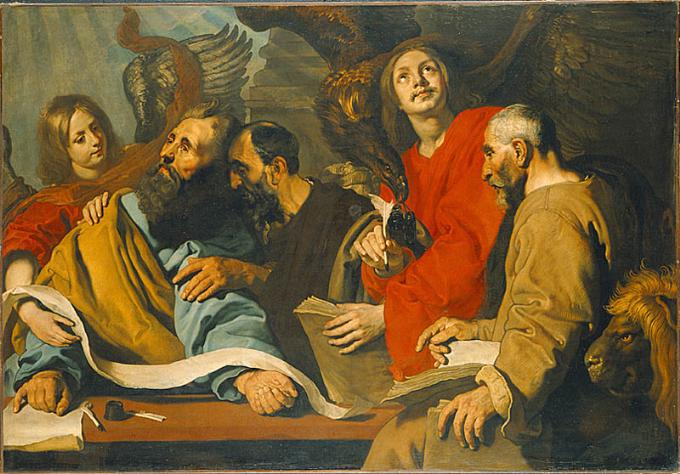
The synoptic Gospels date from after the writings of Paul. They provide episodes from the life of Jesus and some of his works, but the authors of the New Testament show little interest in an absolute chronology of Jesus or in synchronizing the episodes of his life, and as in John 21:25, the Gospels do not claim to be an exhaustive list of his works.
Christologies that can be gleaned from the three synoptic Gospels generally emphasize the humanity of Jesus, his sayings, his parables, and his miracles. The Gospel of John provides a different perspective that focuses on his divinity. The first 14 verses of the Gospel of John are devoted to the divinity of Jesus as the Logos, usually translated as "Word", along with his pre-existence, and they emphasize the cosmic significance of Christ, e.g.: "All things were made through him, and without him was not any thing made that was made." In the context of these verses, the Word made flesh is identical with the Word who was in the beginning with God, being exegetically equated with Jesus.
Controversies and ecumenical councils (2nd–8th century)
Main article: First seven ecumenical councils
Post-Apostolic controversies===
Following the Apostolic Age, from the second century onwards, a number of controversies developed about how the human and divine are related within the person of Jesus. As of the second century, a number of different and opposing approaches developed among various groups. In contrast to prevailing monoprosopic views on the Person of Christ, alternative dyoprosopic notions were also promoted by some theologians, but such views were rejected by the ecumenical councils. For example, Arianism did not endorse divinity, Ebionism argued Jesus was an ordinary mortal, while Gnosticism held docetic views which argued Christ was a spiritual being who only appeared to have a physical body. The resulting tensions led to schisms within the church in the second and third centuries, and ecumenical councils were convened in the fourth and fifth centuries to deal with the issues.
Although some of the debates may seem to various modern students to be over a theological iota, they took place in controversial political circumstances, reflecting the relations of temporal powers and divine authority, and certainly resulted in schisms, among others that separated the Church of the East from the Church of the Roman Empire.
First Council of Nicaea (325) and First Council of Constantinople (381)
In 325, the First Council of Nicaea defined the persons of the Godhead and their relationship with one another, decisions which were ratified at the First Council of Constantinople in 381. The language used was that the one God exists in three persons (Father, Son, and Holy Spirit); in particular, it was affirmed that the Son was homoousios (of the same being) as the Father. The Nicene Creed declared the full divinity and full humanity of Jesus. After the First Council of Nicaea in 325 the Logos and the second Person of the Trinity were being used interchangeably.
First Council of Ephesus (431)
In 431, the First Council of Ephesus was initially called to address the views of Nestorius on Mariology, but the problems soon extended to Christology, and schisms followed. The 431 council was called because in defense of his loyal priest Anastasius, Nestorius had preferred that the title Christokos (Christ-bearer) be used over Theotokos (God-bearer) for Mary and later contradicted Proclus during a sermon in Constantinople. Pope Celestine I (who was already upset with Nestorius due to other matters) wrote about this to Cyril of Alexandria, who orchestrated the council. During the council, Nestorius defended his position by arguing that there are two distinct and separate natures of Christ, one human and the other divine, hence Mary gave birth only to the human nature, suggesting that the title Theotokos (God-bearer) is insufficient to fully describe the Incarnation, as it does not encompass Christ's humanity. The debate about the single or dual nature of Christ ensued in Ephesus.
The First Council of Ephesus debated miaphysitism (two natures united as one after the hypostatic union) versus dyophysitism (coexisting natures after the hypostatic union) versus monophysitism (only one nature) versus Nestorianism (two hypostases). From the Christological viewpoint, the council adopted grc ('but being made one', κατὰ φύσιν) – Council of Ephesus, Epistle of Cyril to Nestorius, i.e. 'one nature of the Word of God incarnate' (μία φύσις τοῦ θεοῦ λόγου σεσαρκωμένη, grc). In 451, the Council of Chalcedon affirmed dyophysitism. The Oriental Orthodox rejected this and subsequent councils and continued to consider themselves as miaphysite according to the faith put forth at the Councils of Nicaea and Ephesus. The council also confirmed the Theotokos title and excommunicated Nestorius.
Council of Chalcedon (451)

The 451 Council of Chalcedon was highly influential, and marked a key turning point in the christological debates. It is the last council which many Lutherans, Anglicans and other Protestants consider ecumenical.
The Council of Chalcedon fully promulgated the Western dyophysite understanding put forth by Pope Leo I of Rome of the hypostatic union, the proposition that Christ has one human nature (physis) and one divine nature (physis), each distinct and complete, and united with neither confusion nor division. Most of the major branches of Western Christianity (Roman Catholicism, Anglicanism, Lutheranism, and Reformed), Church of the East, Eastern Catholicism and Eastern Orthodoxy subscribe to the Chalcedonian Christological formulation, while Oriental Orthodoxy (in Antioch, Alexandria, Ethiopia, Eritrea, and Armenia) reject it.
Although the Chalcedonian Creed did not put an end to all christological debate, it did clarify the terms used and became a point of reference for many future Christologies. But it also broke apart the church of the Eastern Roman Empire in the fifth century, and unquestionably established the primacy of Rome in the East over those who accepted the Council of Chalcedon. This was reaffirmed in 519, when the Eastern Chalcedonians accepted the Formula of Hormisdas, anathematizing all of their own Eastern Chalcedonian hierarchy, who died out of communion with Rome from 482 to 519.
Fifth–Seventh Ecumenical Council (553, 681, 787)
The Second Council of Constantinople in 553 interpreted the decrees of Chalcedon, and further explained the relationship of the two natures of Jesus. It also condemned the alleged teachings of Origen on the pre-existence of the soul, and other topics.
The Third Council of Constantinople in 681 declared that Christ has two wills of his two natures, human and divine, contrary to the teachings of the Monothelites, with the divine will having precedence, leading and guiding the human will.
The Second Council of Nicaea was called under the Empress Regent Irene of Athens in 787. It affirmed the veneration of icons while forbidding their worship. It is often referred to as "The Triumph of Orthodoxy".
9th–11th century
Eastern Christianity
Main article: East–West Schism, Eastern Orthodox Church
Western medieval Christology
The Franciscan piety of the 12th and 13th centuries led to "popular Christology". Systematic approaches by theologians, such as Thomas Aquinas, are called "scholastic Christology".
In the 13th century, Thomas Aquinas provided the first systematic Christology that consistently resolved a number of the existing issues. In his Christology from above, Aquinas also championed the principle of perfection of Christ's human attributes.
The Middle Ages also witnessed the emergence of the "tender image of Jesus" as a friend and a living source of love and comfort, rather than just the Kyrios image.
Reformation
Article 10 of the Belgic Confession, a confessional standard of the Reformed faith, subscribes to Nicene orthodoxy regarding the deity of Christ. The article places emphasis on the eternal generation of the Son and the eternal divine nature of Christ as Creator.We believe that Jesus Christ, according to his divine nature, is the only begotten Son of God, begotten from eternity, not made nor created (for then He should be a creature), but co-essential and co-eternal with the Father, "the express image of His person, and the brightness of His glory" (), equal unto him in all things. He is the Son of God, not only from the time that He assumed our nature, but from all eternity, as these testimonies, when compared together, teach us. Moses says that God created the world; and John saith that "all things were made by that Word" (), which he calls God. And the apostle says that God made the worlds by His Son (); likewise, that "God created all things by Jesus Christ" (). Therefore, it must needs follow, that he who is called God, the Word, the Son, and Jesus Christ did exist at that time, when all things were created by him. Therefore, the prophet Micah says, "His goings forth have been from of old, from everlasting" (). And the apostle: "He has neither beginning of days, nor end of life" (). He therefore is that true, eternal, and almighty God, whom we invoke, worship and serve.John Calvin maintained there was no human element in the Person of Christ which could be separated from the Person of the Word. Calvin also emphasized the importance of the "Work of Christ" in any attempt at understanding the Person of Christ and cautioned against ignoring the works of Jesus during his ministry.
Modern developments
Liberal Protestant theology
The 19th century saw the rise of Liberal Protestant theology, which questioned the dogmatic foundations of Christianity, and approached the Bible with critical-historical tools. The divinity of Jesus became of less emphasis or importance, and was replaced with a focus on the ethical aspects of his teachings.
Roman Catholicism
Catholic theologian Karl Rahner sees the purpose of modern Christology as to formulate the Christian belief that "God became man and that God-made-man is the individual Jesus Christ" in a manner that this statement can be understood consistently, without the confusions of past debates and mythologies. Rahner pointed out the coincidence between the Person of Christ and the Word of God, referring to Mark 8:38 and Luke 9:26 which state whoever is ashamed of the words of Jesus is ashamed of the Lord himself.
Hans von Balthasar argued the union of the human and divine natures of Christ was achieved not by the "absorption" of human attributes, but by their "assumption". Thus, in his view, the divine nature of Christ was not affected by the human attributes and remained forever divine. The same distinction is recorded in the Second Vatican Council's pastoral constitution, Gaudium et spes: "in Him, human nature was assumed, not absorbed".
Pope Francis, in his 2024 encyclical letter Dilexit nos, refers to the "divinity and plenary humanity" of Jesus.
Topics
Nativity and the Holy Name
The Nativity of Jesus impacted the Christological issues about his person from the earliest days of Christianity. Luke's Christology centers on the dialectics of the dual natures of the earthly and heavenly manifestations of existence of the Christ, while Matthew's Christology focuses on the mission of Jesus and his role as the savior. The salvific emphasis of Matthew 1:21 later impacted the theological issues and the devotions to Holy Name of Jesus.
Matthew 1:23 provides a key to the "Emmanuel Christology" of Matthew. Beginning with 1:23, the Gospel of Matthew shows a clear interest in identifying Jesus as "God with us" and in later developing the Emmanuel characterization of Jesus at key points throughout the rest of the Gospel. The name 'Emmanuel' does not appear elsewhere in the New Testament, but Matthew builds on it in Matthew 28:20 ("I am with you always, even unto the end of the world") to indicate Jesus will be with the faithful to the end of the age. According to Ulrich Luz, the Emmanuel motif brackets the entire Gospel of Matthew between 1:23 and 28:20, appearing explicitly and implicitly in several other passages.
Crucifixion and resurrection
Main article: Crucifixion of Jesus, Resurrection of Jesus
The accounts of the crucifixion and subsequent resurrection of Jesus provides a rich background for christological analysis, from the canonical Gospels to the Pauline Epistles.
A central element in the christology presented in the Acts of the Apostles is the affirmation of the belief that the death of Jesus by crucifixion happened "with the foreknowledge of God, according to a definite plan". In this view, as in Acts 2:23, the cross is not viewed as a scandal, for the crucifixion of Jesus "at the hands of the lawless" is viewed as the fulfilment of the plan of God.
Paul's Christology has a specific focus on the death and resurrection of Jesus. For Paul, the crucifixion of Jesus is directly related to his resurrection and the term "the cross of Christ" used in Galatians 6:12 may be viewed as his abbreviation of the message of the Gospels. For Paul, the crucifixion of Jesus was not an isolated event in history, but a cosmic event with significant eschatological consequences, as in 1 Corinthians 2:8. In the Pauline view, Jesus, obedient to the point of death (Philippians 2:8), died "at the right time" (Romans 5:6) based on the plan of God. For Paul, the "power of the cross" is not separable from the resurrection of Jesus.
Threefold office
Main article: Threefold office
The threefold office (Latin munus triplex) of Jesus Christ is a Christian doctrine based upon the teachings of the Old Testament. It was described by Eusebius and more fully developed by John Calvin. It states that Jesus Christ performed three functions (or "offices") in his earthly ministry – those of prophet, priest, and king. In the Old Testament, the appointment of someone to any of these three positions could be indicated by anointing him or her by pouring oil over the head. Thus, the term messiah, meaning "anointed one", is associated with the concept of the threefold office. While the office of king is that most frequently associated with the Messiah, the role of Jesus as priest is also prominent in the New Testament, being most fully explained in chapters 7 to 10 of the Book of Hebrews.
Mariology
Main article: Mariology, Roman Catholic Mariology
Some Christians, notably Roman Catholics, view Mariology as a key component of Christology."Mariology Is Christology", in Vittorio Messori, The Mary Hypothesis, Rome: 2005. http://www.zenit.org/article-14658?l=english In this view, not only is Mariology a logical and necessary consequence of Christology, but without it, Christology is incomplete, since the figure of Mary contributes to a fuller understanding of who Christ is and what he did.
Protestants have criticized Mariology because many of its assertions lack any Biblical foundation. Strong Protestant reaction against Roman Catholic Marian devotion and teaching has been a significant issue for ecumenical dialogue.
Joseph Cardinal Ratzinger (later Pope Benedict XVI) expressed this sentiment about Roman Catholic Mariology when in two separate occasions he stated, "The appearance of a truly Marian awareness serves as the touchstone indicating whether or not the christological substance is fully present" and "It is necessary to go back to Mary, if we want to return to the truth about Jesus Christ."
Notes
References
Sources
;Printed sources
- Chilton, Bruce. "The Son of Man: Who Was He?" Bible Review. August 1996, 35+.
- Cullmann, Oscar (1980). The Christology of the New Testament. trans. Louisville: Westminster John Knox Press.
- Fuller, Reginald H. (1965). The Foundations of New Testament Christology. New York: Scribners.
- Greene, Colin J.D. (2004). Christology in Cultural Perspective: Marking Out the Horizons. Grand Rapids: Eerdmans Publishing.
- Hodgson, Peter C. (1994). Winds of the Spirit: A Constructive Christian Theology. Louisville: Westminster John Knox Press.
- Kingsbury, Jack Dean (1989). The Christology of Mark's Gospel. Philadelphia: Fortress Press.
- Letham, Robert. The Work of Christ. Contours of Christian Theology. Downer Grove: IVP, 1993,
- MacLeod, Donald (1998). The Person of Christ: Contours of Christian Theology. Downer Grove: IVP,
- Wolfhart Pannenberg, Systematic Theology, T & T Clark, 1994 Vol.2.
- Schwarz, Hans (1998). Christology. Grand Rapids: Eerdmans Publishing.
;Web-sources
References
- [[Gerd Lüdemann]], [http://wwwuser.gwdg.de/~gluedem/download/pope_review.pdf "An Embarrassing Misrepresentation"] {{Webarchive. link. (24 March 2019 , ''[[Free Inquiry]]'', October / November 2007: "the broad consensus of modern New Testament scholars that the proclamation of Jesus's exalted nature was in large measure the creation of the earliest Christian communities.")
- (2000). "Growth in Agreement II. Reports and Agreed Statements of Ecumenical Conversations at World Level 1982–1998". World Council of Churches.
- "The Universal Church and Schisms – Coptic Orthodox Diocese of the Midlands, U.K.".
- Bobichon, Philippe. (2011-01-01). "Filiation divine du Christ et filiation divine des chrétiens dans les écrits de Justin Martyr". In: Patricio de Navascués Benlloch – Manuel Crespo Losada – Andrés Sáez Gutiérrez (dir.), Filiación. Cultura pagana, religión de Israel, orígenes del cristianismo, vol. III, Madrid, pp. 337–378.
- ''Introducing Christian Doctrine'' by Millard J. Erickson, L. Arnold Hustad 2001, p. 234
- Nestorius. (2002). "The Bazaar of Heracleides". Wipf and Stock Publishers.
- "Atonement". Cross, F. L., ed. ''The Oxford dictionary of the Christian church''. New York: Oxford University Press. 2005
- [[Gustaf Aulen]], ''Christus Victor: An Historical Study of the Three Main Types of the Idea of Atonement'', E.T. London: SPCK; New York: Macmillan, 1931
- Leon Morris, 'Theories of the Atonement' in ''Elwell Evangelical Dictionary''.
- Tuomala, Jeffrey. (1993). "Christ's Atonement as the Model for Civil Justice". American Journal of Jurisprudence.
- Jeremiah, David. 2009. ''Living With Confidence in a Chaotic World,'' pp. 96 & 124. Nashville, Tennessee: Thomas Nelson, Inc.
- Massengale, Jamey. 2013.''Renegade Gospel, The Jesus Manifold''
- {{bibleverse. Acts. 17:16–34
- ''Creation and redemption: a study in Pauline theology'' by John G. Gibbs 1971 Brill Publishers pp. 151–153
- ''Mercer Commentary on the New Testament'' by Watson E. Mills 2003 {{ISBN. 0-86554-864-1 pp. 1109–1110
- Charles T. Waldrop (1985). ''Karl Barth's christology'' {{ISBN. 90-279-3109-7 pp. 19–23
- (2000). "Historical Theology: An Introduction".
- {{bibleverse. Matthew. 28:19. NIV
- (January 1959). "The Christology of the New Testament". Westminster John Knox Press.
- Johnson, Mini S.. (2005-01-01). "Christology: Biblical And Historical". Mittal Publications.
- (January 1959). "The Christology of the New Testament". Westminster John Knox Press.
- (2022). "The Jesus Handbook". William. B. Eerdmans Publishing Company.
- Bart Ehrman, ''How Jesus became God'', Course Guide
- Geza Vermez (2008), ''The Resurrection'', pp. 138–139
- {{bibleverse. Galatians. 2:1–2
- {{bibleverse. Acts. 9:26–28
- {{bibleverse. Acts. 15:2
- Pitre, Brant. (2024). "Jesus and Divine Christology". Eerdmans.
- (2022-12-14). "Jesus Worship".
- Robinson, John A. T. (1963), ''Honest to God'', p. 72.
- link. (14 December 2023. "A further point of broad agreement among New Testament scholars{{nbsp[...] is that the historical Jesus did not make the claim to deity that later Christian thought was to make for him: he did not understand himself to be God, or God the Son, incarnate.{{nbsp[...] such evidence as there is has led the historians of the period to conclude, with an impressive degree of unanimity, that Jesus did not claim to be God incarnate.")
- Hurtado, Larry W.. (2005). "How on earth did Jesus become a god?: historical questions about earliest devotion to Jesus". Wm. B. Eerdmans Publishing Company.
- Wright, N. T.. (1999). "The challenge of Jesus : rediscovering who Jesus was and is". InterVarsity Press.
- Allison, Dale. (2024). "The New Cambridge Companion to Jesus". Cambridge University Press.
- Dunn, James D. G.. (2011). "Christology in the making: a New Testament inquiry into the origins of the doctrine of the incarnation". Eerdmans.
- Fuller, Reginald. (1965). "The Foundations of New Testament Christology". Scribner.
- Talbert, Charles H.. (1967-06-01). "The Problem of Pre-Existence in Philippians 2:6-11". Journal of Biblical Literature.
- Sanders, E. P.. (1977). "Paul and Palestinian Judaism". Fortress Press.
- Dunn, James D. G.. (1990). "Jesus, Paul, and the Law: Studies in Mark and Galatians". Westminster John Knox Press.
- "St. Paul the Apostle – Theological views".
- Larry R. Helyer (2008). ''The Witness of Jesus, Paul and John: An Exploration in Biblical Theology''. {{ISBN. 0-8308-2888-5 p. 282
- (1975). "John and Jesus". [[Zeitschrift für die Neutestamentliche Wissenschaft.
- {{bibleverse. 2 Corinthians. 5:17. KJV
- {{bibleverse. Colossians. 1:20
- Zupez, John. (2014). "Celebrating God's Plan of Creation/Salvation". Emmanuel.
- {{bibleverse. Colossians. 1:15. KJV
- [[Karl Rahner]] (2004). ''Encyclopedia of theology: a concise Sacramentum mundi'' {{ISBN. 0-86012-006-6 p. 731
- {{bibleverse. John. 1:3. KJV
- "Internet History Sourcebooks: Medieval Sourcebook".
- The Seven Ecumenical Councils of the Undivided Church, trans H. R. Percival, in Nicene and Post-Nicene Fathers, 2nd Series, ed. P. Schaff and H. Wace, (repr. Grand Rapids MI: Wm. B. Eerdmans, 1955), XIV, pp. 192–142
- Jonathan Kirsch, ''God Against the Gods: The History of the War Between Monotheism and Polytheism'' (2004)
- Charles Freeman, ''The Closing of the Western Mind: The Rise of Faith and the Fall of Reason'' (2002)
- [[Edward Gibbon]], ''The Decline and Fall of the Roman Empire'' (1776–1788), p. 21
- (2004). "A concise dictionary of theology". A&C Black.
- Marthaler, Berard L.. (1993). "The Creed: The Apostolic Faith in Contemporary Theology". Twenty-Third Publications.
- (June 2010). "''Mary and the Saints'' by James P. Campbell, 2005, pp. 17–20". Loyola Press.
- González, Justo L.. (2005-01-01). "Essential Theological Terms". Westminster John Knox Press.
- Hall, Stuart George. (1992). "Doctrine and Practice in the Early Church". Wm. B. Eerdmans Publishing.
- Chafer, Lewis Sperry. (1993-01-01). "Systematic Theology". Kregel Academic.
- Parry, Ken. (2010-05-10). "The Blackwell Companion to Eastern Christianity". John Wiley & Sons.
- Baker, Kenneth. (1982). "Fundamentals of Catholicism: God, Trinity, Creation, Christ, Mary". Ignatius Press.
- ''Mary, Mother of God'' by Carl E. Braaten and Robert W. Jenson 2004 {{ISBN. 0802822665 p. 84
- (1999). "The Story of Christian Theology: Twenty Centuries of Tradition Reform". InterVarsity Press.
- (1983). "The Westminster Dictionary of Christian Theology".
- Johnson, Mini S.. (2005-01-01). "Christology: Biblical And Historical". Mittal Publications.
- Gilson, Etienne. (1994). "The Christian Philosophy of Saint Thomas Aquinas". University of Notre Dame Press.
- Johnson, Mini S.. (2005-01-01). "Christology: Biblical And Historical". Mittal Publications.
- Goris, Harm J. M. J.. (2002). "Aquinas as Authority: A Collection of Studies Presented at the Second Conference of the Thomas Insituut Te Utrecht, December 14-16, 2000". Peeters Publishers.
- ''Christology: Key Readings in Christian Thought'' by Jeff Astley, David Brown, [[Ann Loades]] 2009 {{ISBN. 0-664-23269-8 p. 106
- (2021). "The Three Forms of Unity". Canon Press.
- ''Calvin's Christology'' by Stephen Edmondson 2004 {{ISBN. 0-521-54154-9 p. 217
- ''Calvin's First Catechism'' by I. John Hesselink 1997 {{ISBN. 0-664-22725-2 p. 217
- ''Encyclopedia of Theology: a concise Sacramentum mundi'' by Karl Rahner 2004 {{ISBN. 0-86012-006-6 p. 1822
- ''The eschatology of Hans Urs von Balthasar'' by Nicholas J. Healy 2005 {{ISBN. 0-19-927836-9 pp. 22–23
- Second Vatican Council, ''Pastoral Constitution Gaudium et Spec'', 22, version quoted by Neuner, J. and Dupuis, J., ''The Christian Faith in the Doctrinal Documents of the Catholic Church'', Revised Edition (1983), Collins: London, {{ISBN. 0-00-599706-2 p. 191
- Pope Francis, [https://www.vatican.va/content/francesco/en/encyclicals/documents/20241024-enciclica-dilexit-nos.pdf Dilexit nos], paragraph 49, published on 24 October 2024, accessed on 11 December 2024
- ''Theology of the New Testament'' by Georg Strecker 2000 {{ISBN. 0-664-22336-2 pp. 401–403
- ''Matthew'' by [[Grant R. Osborne]] 2010 {{ISBN. 0-310-32370-3 p. lxxix
- ''Matthew 1–13'' by Manlio Simonetti 2001 {{ISBN. 0-8308-1486-8 p. 17
- ''Matthew 1-2/ Luke 1–2'' by Louise Perrotta 2004 {{ISBN. 0-8294-1541-6 p. 19
- ''All the Doctrines of the Bible'' by Herbert Lockyer 1988 {{ISBN. 0-310-28051-6 p. 159
- ''Matthew's Emmanuel'' by David D. Kupp 1997 {{ISBN. 0-521-57007-7 pp. 220–224
- 0-664-25752-6 p. 17
- ''The theology of the Gospel of Matthew'' by Ulrich Luz 1995 {{ISBN. 0-521-43576-5 p. 31
- ''Who do you say that I am? Essays on Christology'' by Jack Dean Kingsbury, Mark Allan Powell, David R. Bauer 1999 {{ISBN. 0-664-25752-6 p. 106
- ''New Testament christology'' by Frank J. Matera 1999 {{ISBN. 0-664-25694-5 p. 67
- ''The speeches in Acts: their content, context, and concerns'' by Marion L. Soards 1994 {{ISBN. 0-664-25221-4 p. 34
- ''Christology'' by Hans Schwarz 1998 {{ISBN. 0-8028-4463-4 pp 132–134
- Paul Haffner, 2004 ''The mystery of Mary'' Gracewing Press {{ISBN. 0-85244-650-0 p. 17
- Walter A. Elwell, ''Evangelical Dictionary of Theology'', Second Edition (Grand Rapids, Michigan, United States: Baker Academic, 2001), p. 736.
- Erwin Fahlbusch et al., "Mariology", The Encyclopedia of Christianity (Grand Rapids, Michigan, United States; Leiden, Netherlands: Wm. B. Eerdmans; Brill, 1999–2003), p. 409.
- [[Communio]], 1996, Volume 23, p. 175
- Raymond Burke, 2008 ''Mariology: A Guide for Priests, Deacons, seminarians, and Consecrated Persons'' {{ISBN. 1-57918-355-7 p. xxi
- ''Theology for Today'' by [[Elmer Towns. Elmer L. Towns]] 2008 {{ISBN. 0-15-516138-5 p. 173
- "[[Angel of the Lord]]" by T. E. McComiskey in ''The Evangelical Dictionary of Theology'' 2001 {{ISBN. 0-8010-2075-1 p. 62
This article was imported from Wikipedia and is available under the Creative Commons Attribution-ShareAlike 4.0 License. Content has been adapted to SurfDoc format. Original contributors can be found on the article history page.
Ask Mako anything about Christology — get instant answers, deeper analysis, and related topics.
Research with MakoFree with your Surf account
Create a free account to save articles, ask Mako questions, and organize your research.
Sign up freeThis content may have been generated or modified by AI. CloudSurf Software LLC is not responsible for the accuracy, completeness, or reliability of AI-generated content. Always verify important information from primary sources.
Report