From Surf Wiki (app.surf) — the open knowledge base
Christmas market
Street market that is associated with the celebration of Christmas

Street market that is associated with the celebration of Christmas
A Christmas market is a street market associated with the celebration of Christmas during the four weeks of Advent. These markets originated in Germany, but are now held in many countries. Some in the U.S. have adapted the German name to quasi-English Christkindlmarket, swapping German Markt and market.
Christmas markets date to the Late Middle Ages in the German-speaking part of Europe and in many parts of the former Holy Roman Empire, which included many eastern regions of modern France. Dresden's Striezelmarkt was first held in 1434 and one of the first true Christmas markets; earlier markets of the season were "December markets". Early mentions of these "December markets" can be found in Vienna (1298), Munich (1310), Bautzen (1384), and Frankfurt (1393).
In many towns of Germany, Switzerland, and Austria, Advent is usually ushered in with the opening of the Christmas market or Weihnachtsmarkt. In southern Germany, Switzerland and Austria, it is called a Christkind(e)l(s)(i)markt (German language, literally meaning "Christ child market"). Traditionally held in the town square, the market offers food, drinks and seasonal items for sale from open-air stalls, accompanied by traditional singing and dancing. On opening night at the Christkindlesmarkt in Nuremberg, and in some other towns, onlookers welcome the Christkind (originally boy Jesus, but often depicted as an angel-like girl), acted by a local child.
History

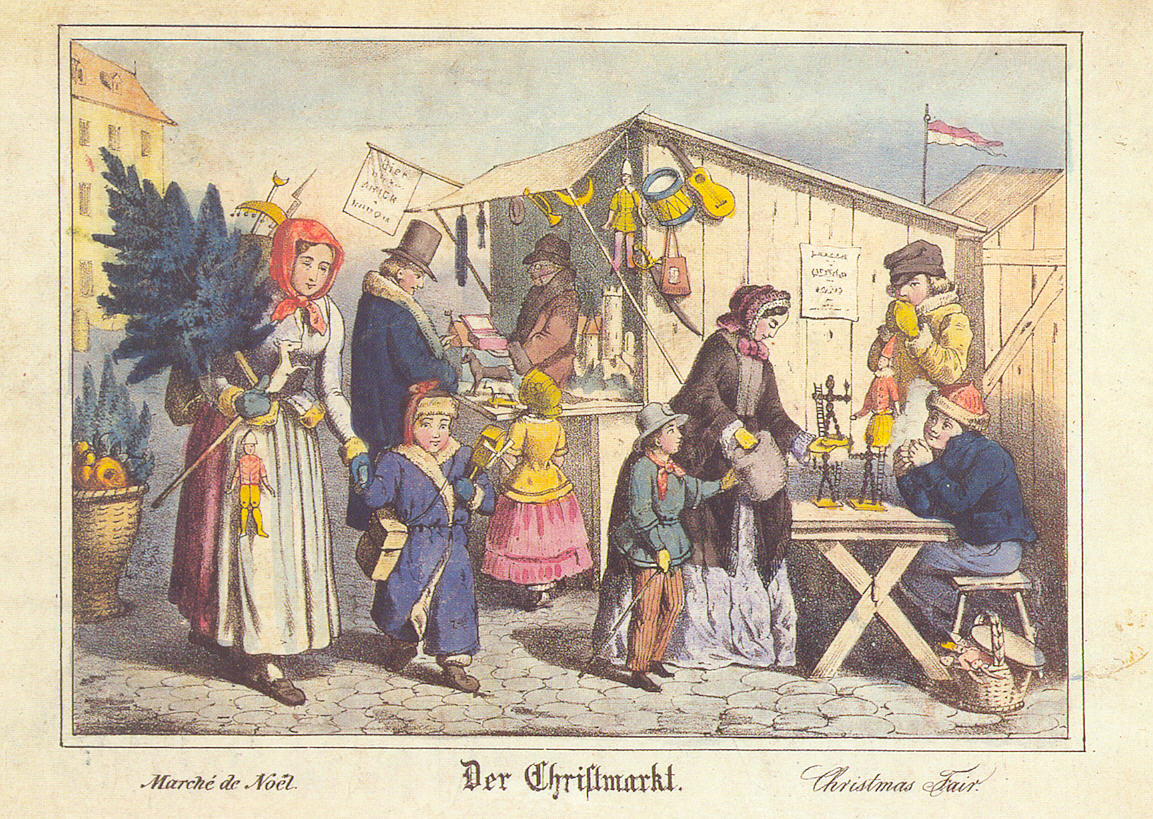

Origins and medieval times
The first traces of Christmas markets in the German-speaking part of Europe and in many parts of the former Holy Roman Empire go back to late medieval sales fairs and—often one-day—markets, which gave citizens the opportunity to stock up on meat and winter necessities at the beginning of the cold season. In 1296, Duke Albert I of Austria granted the Viennese traders the privilege of holding a "December market" to supply the local population.
In the 14th century, the custom arose of allowing craftsmen such as toy makers, basket weavers and confectioners to set up stalls under the name "Saint Nicholas market" to sell the little things that children received as Christmas gifts. There were also stands selling roasted chestnuts, nuts and almonds. A Saint Nicholas market in Munich was first mentioned in a document in 1310. In 1384, King Wenceslas granted the town of Bautzen the right to hold a free meat market on Saturdays from St. Michael's Day (29 September) until Christmas.
Over time, the tradition spread throughout the German-speaking world. The first document reporting a Christmas market is dated 1434 during the reign of Frederick II of Saxony, mentioning a Striezelmarkt, which took place in Dresden on the Monday before Christmas. Later, the Reformation continued the tradition by renaming it Christkindlmarkt ("Christ Child market") to combat the cult of saints. The Strasbourg Christmas market dates from 1570, that of Nuremberg from 1628.
Development and revival
In the 19th century, the Christkindelsmärik (in Alsatian) of Strasbourg was held at the Frohnhof () between the Cathedral of Our Lady, the Palais Rohan and the Œuvre Notre-Dame Museum (current Place du Château) and took place eight days before Christmas and until midnight mass.
Since around the first half of the 20th century, markets have become an integral element of pre-Christmas customs. A revival took place in the mid-1990s. Many cities in Europe have established their own Christmas market with chalets and sometimes attractions (ephemeral ice rink, Ferris wheel, etc.), thus offering a more commercial market.
Terrorism and safety
In the 21st century, Christmas markets in Western Europe have occasionally been the targets of terror attacks, with completed or thwarted attacks occurring in Dijon, Nantes, Berlin, Ludwigshafen, Potsdam, Vienna, Strasbourg, Magdeburg and Dingolfing. Christmas markets increasingly have security procedures such as bollards, uniformed and plainclothes police officers, and surveillance to protect visitors.
Attractions and stalls

Popular attractions at the markets include the Nativity Scene (a crèche or crib), Zwetschgenmännle (figures made of decorated dried plums), Nussknacker (carved Nutcrackers), Gebrannte Mandeln (candied, toasted almonds), traditional Christmas cookies such as Lebkuchen and Magenbrot (both forms of soft gingerbread), Bratwurst, and Glühwein, hot mulled wine (with or without a shot of brandy), or Eierpunsch (an egg-based warm alcoholic drink) – both a highlight of the market for many visitors. Both help stave off the cold winter air which sometimes dips below freezing. More regional food specialties include Christstollen (Stollen), a sort of bread with candied fruit in Saxony, and hot Apfelwein and Frankfurter Bethmännchen in Hesse.
Major Christmas markets
Austria

Christmas markets are popular traditions in Austria, and are held in Vienna, Salzburg, Innsbruck, Linz, and Graz. The first "December Market" was held in Vienna in 1298. Vienna holds 20 different Christmas markets around the city. Most Christmas markets open in late November and last through December, closing between Christmas Day and New Year's Day, with a few staying open for New Year's.
The largest Christmas market and one of the most well known is the Vienna Christmas World on Rathausplatz, near the Rathaus, Vienna's historic city hall. The market draws 3 million people each year and includes 150 unique stalls that offer traditional Austrian foods, Christmas decorations and ornaments, handicrafts, and drinks. The Vienna Christmas World on Rathausplatz also features an advent theme park called the Adventzauber with workshops and cultural performances that cater to families and young children. Visitors to the Vienna Christmas World can also ice skate on a 3000 m2 ice rink and on frozen paths that run through the Rathausplatz Park.
Other famous Christmas markets include the Christmas Market at Schönbrunn Palace, the Art Advent on Karlsplatz, the Christmas Village at Belvedere Palace, and the Christmas Village on Maria-Theresien-Platz. The Christmas Market at Schönbrunn Palace, “Kultur-und-Weihnachtsmarkt,” takes place in front of the imperial palace. It features Austrian handicrafts and goods as well as a cultural program with activities and workshops. The Art Advent on Karlsplatz offers artisan goods, a children's program, and a petting zoo. Popular food specialities include Kinderpunsch (a non-alcoholic punch), Glühwein, Baumstriezel (a Hungarian pastry coated in cinnamon and sugar), Kartoffelpuffer (potato pancakes), Lángos (savory deep fried dough), Schaumkuss (chocolate covered marshmallows), Stollen (bread with candied fruit), Maroni (roasted chestnuts), Bratkartoffel (roasted potato wedges), Lebkuchen (Austrian gingerbread), and baked potatoes.
France
Christmas markets are traditional in Alsace, France, and most of the towns there have their local Christmas market. Strasbourg has been holding a Christmas market, "Christkindelsmärik," around its cathedral since 1570, when the city was part of the Holy Roman Empire of the German Nation.
Germany

Famous Christmas markets are held in the cities of Augsburg, Dresden, Erfurt, Frankfurt, Nuremberg, and Stuttgart, making them popular tourist attractions during the Christmas holiday season. The Nuremberg and Dresden markets draw about two million people each year; the Stuttgart and Frankfurt markets attract more than three million visitors.
The two most visited Christmas markets in Germany are found in Dortmund, with more than three and a half million visitors of 300 stalls around a gigantic Christmas tree that stands 45 m tall, and in Cologne with 4 million people. Additionally, Berlin claims more than 70 markets, which open in late November and close just after Christmas.
Italy

Christmas in Italy begins on 8 December with the Feast of the Immaculate Conception, the day on which traditionally Christmas trees are erected, and ends on 6 January of the following year with Epiphany.
In Italy, the oldest Christmas market is considered to be that of Bologna, held for the first time in the 18th century and linked to the feast of Saint Lucia. The tradition of the markets has however spread in Italy predominantly especially since the 1990s, with the birth of the first modern markets: among these, the first ever was that of Bolzano, born in 1991, which was followed by others in the area of Alto Adige, in particular in Merano, Bressanone, Vipiteno and Brunico.
The Trento Christmas market, established in 1993, is renowned in Trentino. In Naples, where the tradition of the Neapolitan nativity scene has been famous for centuries, the exhibition of the nativity scenes made in the city's artisan shops is held every year in via San Gregorio Armeno. Noteworthy are the Christmas markets at Piazza Navona in Rome, in Verona, in Gubbio, in Alberobello, in Aosta, in Turin, in Asti, in Arezzo, in Florence, in Trieste, in Livigno, in Santa Maria Maggiore, Arco and in Cison di Valmarino.
United Kingdom
Main article: Winter wonderland
In 1982, Lincoln, England, established an annual Christmas market in early December. This remains one of the most extensive such market by area in the United Kingdom, with a claimed total of over 300 stalls attracting more than 100,000 visitors over its four days. Starting in 1997, Frankfurt Christmas Markets were established with support from Frankfurt in Birmingham, Edinburgh, Leeds, and Manchester. Other large Christmas markets have been held in England in Bath (since 2000) and Liverpool (since 2006). The Christmas markets are such a success that they are becoming a major pull factor to increase trade and visitor numbers to towns and cities.
Birmingham's Christmas Market, primarily located on New Street between the Bullring shopping centre and the Council House, is the "largest outdoor Christmas market in the UK" as well as the "largest authentic German Christmas market outside of Germany or Austria". The market also offers live entertainment on the main stage. The market is held for approximately six weeks every year and usually closes around 23 December. Manchester's Christmas Markets have also been successful, with 300 stalls over eight city locations, with each location being themed to create a different atmosphere such as French, World, and German, with European-themed stalls on the Albert Square, Manchester proving to be the most popular.
United States
German immigrants carried Christmas market celebrations to the United States. It is celebrated in such cities as Chicago, Denver, Salt Lake City, Tulsa, and Grand Rapids.
Other countries
As noted, other countries have also established such markets. The Christmas market of Barcelona starts on 13 December, Saint Lucy's Day, and is called Fira de Santa Llúcia. It has been held in the square of Barcelona Cathedral since 1786.
The GUM-Fair was opened on the Red Square in Moscow, Russia, in 2013. It has been running ever since from December to March and is the biggest and most popular Christmas market in Russia.
A traditional Christmas market was held for the first time in Sibiu, Romania, in 2007.
The annual Christmas market in Riga, Latvia, is held from late November to early January in the square next to the Riga Cathedral. It has consistently been recognised as one of Europe's most affordable Christmas market destinations, according to the Post Office Travel Money report.
Gallery
File:Christmas market (Tallinn, Estonia).jpg|Tallinna Jõuluturg in Tallinn, Estonia File:ChristmasMarketJena.jpg|Christmas market in Jena, Germany File:Colmar (31633763397).jpg|Christmas market in Colmar, France File:Christmas market, Strasbourg (5226804625).jpg|Christkindelsmärik in Strasbourg, France File:Frankfurt am Main - Frankfurter Weihnachtsmarkt (2025) 4.jpg|Christmas market in Frankfurt, Germany File:PIAZZA DE NAVONA, ROME.JPG|Christmas market at Piazza Navona in Rome, Italy File:Senaatintorin joulumarkkinat.jpg|Tuomaan Markkinat at the Senate Square in Helsinki, Finland File:Christkindlmarkt Bozen 03.JPG|Christmas market in Bolzano, Italy File:Marché de Noël de la place Rouge et magasin Goum (1).jpg|GUM-fair at the Red Square in Moscow, Russia File:Stortorget in Gamla Stan, Stockholm, Sweden, 2022 December - 8.jpg|Julmarknad ("Christmas market") in Gamla stan, Stockholm, Sweden File:Weihnachtsmarkt Dom 2011 1.jpg|Christmas market in Cologne, Germany File:SibiuChristmasMarket2012Opening.jpg|Sibiu Christmas market in Sibiu, Romania File:Mercado de Navidad, Plaza del Mercado, Breslavia, Polonia, 2017-12-20, DD 41-49 HDR PAN.jpg|Christmas market in Wrocław, Poland File:Wien - Christkindlmarkt, Rathausplatz.JPG|Christmas market in Vienna, Austria File:Waddesdon Manor's Christmas Fair.jpg|alt=80 stalls at Waddesdon Manor's Christmas Market|Christmas market at Waddesdon Manor, UK File:Christmas market at Esplanāde park in Riga.jpg|Christmas market in Riga, Latvia
Notes
References
References
- (11 November 2012). "German Christmas markets: Seasonal shopping at its finest". [[The Independent]].
- "The Christkindlmarket 2022".
- "Christkindlmarket".
- (2020). "The Oxford Handbook of Christmas". Oxford University Press.
- "Christmas Markets in Germany and Europe".
- "Geschichte des Wiener Christkindlmarkts - Weihnachts- und Adventmarkt".
- "Christmas markets in Vienna". Austrian National Tourist Office.
- Darmstadt, IDL Software GmbH. "Weihnachtsmarkt in Bautzen - Weihnachten 2016".
- (27 December 2014). "Frankfurt Christmas Markets in Great Britain {{!}} Frankfurt Tourism".
- Wahle, Stephan. (2018). "Die stillste Nacht. Das Fest der Geburt Jesu von den Anfängen bis heute". Herder.
- (2020-11-19). "Teil 10: Die ältesten Weihnachtsmärkte der Welt - WELT".
- Manfred Becker-Huberti: ''Feiern, Feste, Jahreszeiten. Lebendige Bräuche im ganzen Jahr.'' (in German), Herder Verlag, Freiburg/Basel/Vienna, 2001, ISBN 3-451-27702-6, p. 147.
- "Wenzelsmarkt".
- (2016-12-10). "ÄLTESTER WEIHNACHTSMARKT {{!}} REKORD-INSTITUT für DEUTSCHLAND".
- Thuria, Agence. "Marché de Noël à Strasbourg".
- "Nuremberg Christmas Market - christkindlesmarkt.de".
- P. J. Fargès-Méricourt, ''Description de la ville de Strasbourg'' (in French), Levrault, Strasbourg, 1840, p. 58
- (17 December 2019). "Austrian authorities foil IS-inspired terror attack on Christmas market". Times of Israel.
- (2018-12-12). "Warum gerade Weihnachtsmärkte Anschlagsziele sind". Suddeutsche Zeitung.
- (2024-12-21). "Timeline: Deadly attacks on Christmas markets in Europe". Euro News.
- (12 December 2025). "Germany: 5 arrested for suspected Christmas market plot". Deutsche Welle.
- (Dec 21, 2024). "Germany Bulked Up Christmas Market Security. An Attack Still Happened.". The New York Times.
- "Christmas Markets in Vienna".
- "Christmas Market on the Main Square in Krakow".
- (12 August 2017). "Visit Top Christmas Markets (Weihnachtsmarkt) in Vienna". European Traveler.
- "Christmas markets".
- "Vienna Christmas Market Guide and Map 2018". Vienna Unwrapped.
- "Christmas markets - Christmas in Alsace".
- [http://www.noel-strasbourg.com/ ''Noël à Strasbourg''] {{webarchive. link. (17 August 2007 Retrieved 8 July 2007)
- "Europe's oldest Christmas market is almost 600 years old".
- [http://www.christkindlesmarkt.de/english ''Christmas City Nuremberg''] Stadt Nürnberg. Retrieved 8 July 2007
- [http://www.stuttgart-tourist.de/ENG/leisure/weihnachtsmarkt.htm ''Stuttgart Christmas Market''] {{webarchive. link. (22 April 2008 Stuttgart Marketing. Retrieved 8 July 2007)
- "Weihnachtsmärkte: Köln ist Publikumsmagnet : Topnews". Topnews.de.
- Innes said.... (26 December 2011). "Top Berlin Christmas Markets". On London Time.
- (November 25, 2013). "The Best Christmas Traditions in Italy".
- (16 November 2021). "Mercatini di Natale a Bologna e in Emilia-Romagna: dove sono e le regole per visitarli".
- "30 anni e non sentirli".
- "Mercatini originali Alto Adige - Südtirol".
- "Mercatini di Natale di Trento".
- "San Gregorio Armeno, la via dei Presepi".
- "Il Mercatino di Natale a piazza Navona".
- "I MERCATINI DI NATALE PIÙ BELLI IN ITALIA".
- "Alla scoperta dei 10 mercatini di Natale più belli d'Italia".
- (10 November 2022). "Mercatini di Natale 2023: la nostra wishlist".
- "Frankfurt Christmas Markets Great Britain Scotland England". Frankfurt-tourismus.de.
- Bentley, David. (20 September 2018). "These are the dates for Birmingham German Christmas Market 2018". birminghammail.
- "Frankfurt Christmas Market Birmingham {{!}} 15 November 2018 to 23 December 2018".
- Denise Evans. (18 November 2012). "Manchester Christmas Markets 2012: A guide to the city's festive stalls - Manchester Evening News". Menmedia.co.uk.
- (2 November 2012). "Mapped: Manchester set for 'biggest and best ever' Christmas markets - Manchester Evening News". Menmedia.co.uk.
- [http://www.christkindlmarkt.org/ ''CHRISTKINDLMARKT BETHLEHEM''] ArtsQuest (2006). Retrieved 8 July 2007
- [http://www.christkindlmarket.com/facts.htm ''Christkindlmarket Chicago''] {{webarchive. link. (3 March 2007 German American Chamber of Commerce of the Midwest, 17 November 2006. Retrieved 8 July 2007)
- [http://www.denverchristkindlmarket.com/ ''Denver Christkindl Market''] {{Webarchive. link. (4 December 2020 German American Chamber of Commerce Colorado Chapter. (2006). Retrieved 8 July 2007)
- Donner. "Mifflinburg Christkindl Market".
- [http://home.att.net/~gastulsa01/Christkindlmarkt.htm ''Christkindlmarkt 2007''] {{webarchive. link. (17 December 2007 German-American Society of Tulsa, 1 May 2007. Retrieved 8 July 2007)
- "Christkindlmarkt SLC".
- "Grand Rapids Christkindl Markt".
- "Christmas in Barcelona 2022 ~ Christmas Markets, Events & Traditions".
- [http://en.firadesantallucia.cat/historia.php History]
- (2013-12-02). "Новогодняя ГУМ-Ярмарка на Красной площади".
- "ГУМ-ярмарка на Красной площади в Москве 2024-2025: дата проведения, расписание, программа, участники".
- "Târgul de Crăciun din Sibiu".
- "Riga Christmas Market".
- "Christmas Markets Barometer {{!}} Travel Money {{!}} Post Office".
This article was imported from Wikipedia and is available under the Creative Commons Attribution-ShareAlike 4.0 License. Content has been adapted to SurfDoc format. Original contributors can be found on the article history page.
Ask Mako anything about Christmas market — get instant answers, deeper analysis, and related topics.
Research with MakoFree with your Surf account
Create a free account to save articles, ask Mako questions, and organize your research.
Sign up freeThis content may have been generated or modified by AI. CloudSurf Software LLC is not responsible for the accuracy, completeness, or reliability of AI-generated content. Always verify important information from primary sources.
Report