From Surf Wiki (app.surf) — the open knowledge base
Christmas dinner
Meal traditionally eaten at Christmas

Meal traditionally eaten at Christmas
meal
.jpg)
Christmas dinner is a meal traditionally eaten at Christmas. This meal can take place any time from the evening of Christmas Eve to the evening of Christmas Day itself. The meals are often particularly rich and substantial, in the tradition of the Christian feast day celebration, and form a significant part of gatherings held to celebrate the arrival of Christmastide. In many cases, there is a ritual element to the meal related to the religious celebration, such as the saying of grace.
The actual meal consumed varies in different parts of the world with regional cuisines and local traditions. In many parts of the world, particularly former British colonies, the meal shares some connection with the English Christmas dinner involving roasted meats and pudding of some description. The Christmas pudding and Christmas cake evolved from this tradition.
Asia
India
Long established Christian communities such as Goan Catholics have pork dishes and beef dishes as part of their main course of their Christmas dinner. These include pork vindaloo and sarapatel. For dessert, a dish called bebinca is popular. The largest Christian community in India, plum cake is a famous dessert in Kerala and family come together and cut the cake after the midnight mass, the cutting of plum cakes after Christmas mass is treated as a tradition in Kerala. Occasionally, wines commonly made from grapes as well as pineapples, gooseberries or other fruit, are consumed.
Japan

Japanese Christmas cake, a white sponge cake covered with cream and decorated with strawberries, is often consumed, and Stollen cake, made locally, is widely available. A successful advertising campaign in the 1970s made eating at KFC around Christmas a national custom. Its chicken meals are so popular during the season that stores take reservations months in advance.
Lebanon
Lebanese Christians celebrate Christmas dinners. The feast, usually on the night of the 24th and lunch on the 25th, is a big one. The family gets together at both meals, and some have the leftovers from the dinner prior to the lunch the next day. The traditional offering for Christmas is sugar-coated almonds. Roast turkey is the most common choice of meal. Roasted duck, Lebanese salad (Tabbouleh) and pastries such as honey cake are common. Beirut celebrates Christmas by conducting glamorous and big Christmas parties. Western-style poinsettias, community Christmas trees, and Christmas lights are very popular.
Philippines
Christmas dinner in the Philippines is called Noche Buena following Hispanic custom, and is held towards midnight of 24 December. This usually comes after the entire family has attended the late evening Mass called the Misa de Gallo ("Mass of the Rooster"). The centerpiece of the Noche Buena is often the hamón, which is usually a cured leg of pork. This is usually served with queso de bola, literally a ball of edam cheese covered in red wax. Other ubiquitous dishes are pasta and, for dessert, fruit salad. The dinner would usually be accompanied by tsokolate or hot cocoa, made with pure, locally grown cacao beans. Some families prefer tsokolate prepared from tablea or pressed cocoa powder tablets that are either pure or slightly sweetened. Most of the foods served on Noche Buena are fresh and usually prepared the day of Christmas Eve. Middle-class and affluent families tend to prepare sumptuous feasts. Less well-off families would opt for a more economical Noche Buena; the organising of even a simple gathering despite financial difficulties reflects the paramount importance in Filipino culture of familial (and, by extension, communal) unity.
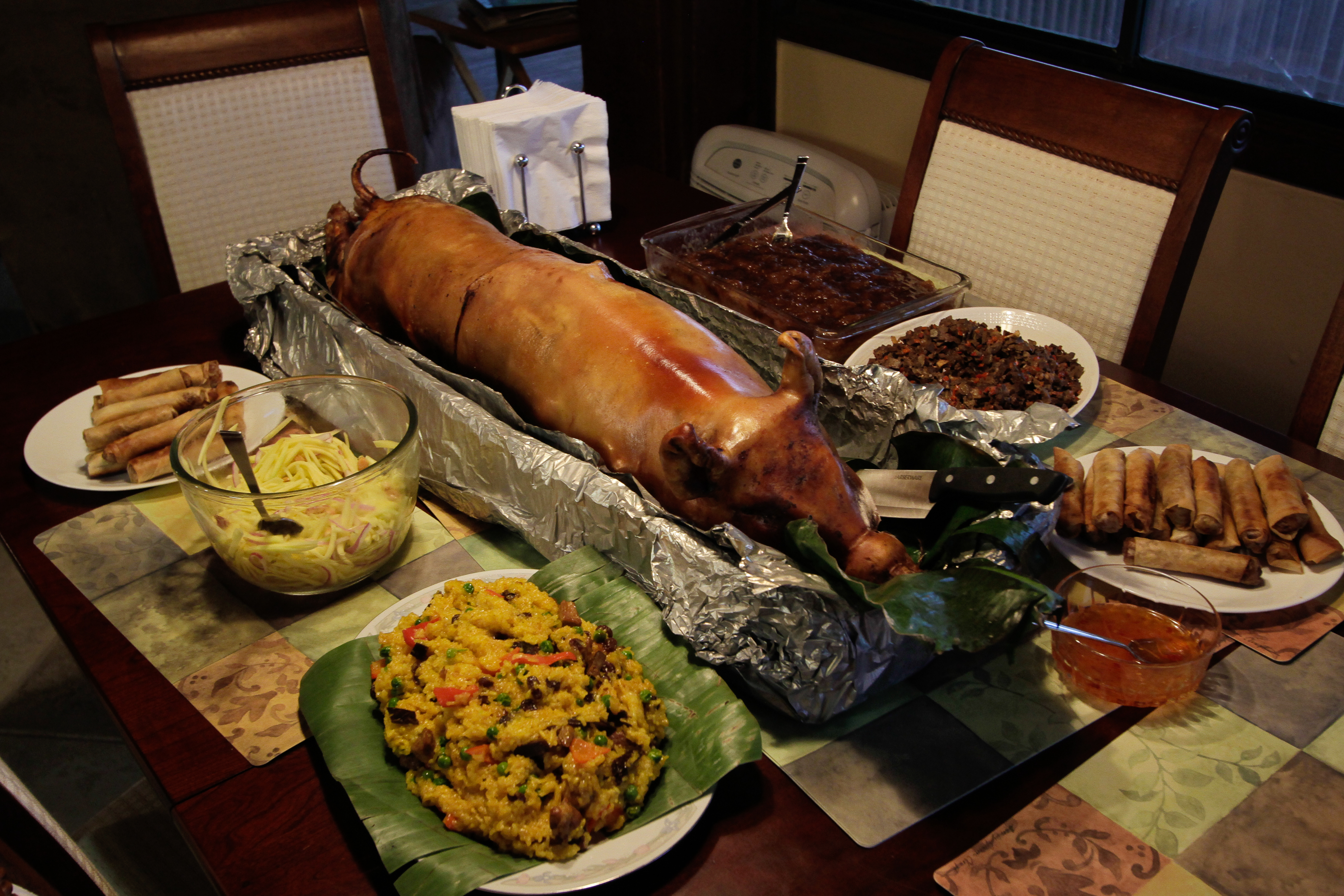
Common traditional dishes served for the main course in the noche buena include: lechón, various types of pancit (noodles), Filipino spaghetti, hamonado, jamón, queso de bola, morcón, embutido, chicken galantina, almondigas (meatballs), paelya (arroz valenciana, bringhe, etc.), lumpia, menudo, mechado, caldereta, callos, chicken pastel, relyenong bangús (stuffed milkfish), lengua estofado, adobo, and various types of barbecue (inihaw). Almost all of these dishes are eaten with white rice. Desserts and side dishes include úbe halayá, turon, leche flan, macaroni salad, membrilyo, fruit salad, buko salad, crema de fruta, ensaymada, champorado, mango float, fruitcake, castañas (roasted chestnuts), and various other kakanin (rice cakes) like puto bumbong, bibingka, suman, biko, and sapin-sapin. Popular beverages are tsokolate as well as coffee, soda, wine, beer, alcoholic drinks, and fruit juices. This focus on the family is common to all Filipino socio-economic classes and ethnic groups that observe Christmas. Most – if not all – members from the branches or extended families in a clan are expected to partake of the Noche Buena. Relatives living abroad, especially OFWs, are highly encouraged to return home for the occasion, as it is the most important Filipino Christian holiday of the year. Most families prefer to exchange Christmas presents right after dinner, contrary to the Western custom of opening presents on Christmas morning.
Europe
Austria
In Austria, Christmas Eve is the celebration of the end of the pre-Christmas fast. Christmas is usually celebrated only by Christians. Christmas Eve is historically the day that the tree is decorated and lit with real candles, so that the Christkindl may visit. Christmas Day is a national holiday in Austria and most Austrians spend the day feasting with their family. Fried carp, Sachertorte, and Christmas biscuits (Lebkuchen and Weihnachtssterne) are eaten, as are many other chocolate delicacies including edible Christmas ornaments. Christmas dinner is usually goose, ham served with Gluhwein, Rumpunsch, and chocolate mousse.
Czech Republic
A traditional Christmas meal in the Czech Republic is fried carp and potato salad which are eaten during Christmas dinner on the evening of 24 December. It is often accompanied by a fish soup prepared from carp leftovers (head or bones), a traditional Czech mushroom dish Kuba or Černá omáčka ("Black sauce") made from dried fruits, nuts, wine and gingerbread. Many households also prepare a great variety of unique Christmas biscuits to offer to visitors. These are prepared many days before the feast and take a long time to decorate. It is also common to hang for children wrapped chocolate sweets on the Christmas tree as decoration.
Denmark
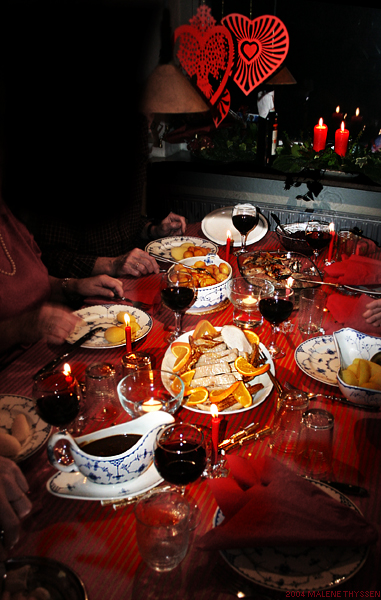
In Denmark, the traditional Christmas meal served on 24 December consists, according to one representative study, of duck (66% of households surveyed), roast pork with crackling (43%), turkey (8%), or goose (7%). The figures total more than 100% because it was found that some families prepare more than one kind of meat for Christmas dinner. The meat is served with boiled potatoes (some of which are caramelized, some roasted), red cabbage, and gravy. The main course is followed by a dessert of Risalamande, rice pudding served with cherry sauce or strawberry sauce, often with a whole almond hidden inside. The lucky finder of the almond is entitled to an extra present, the almond gift. Christmas drinks are Gløgg (mulled wine) and traditional Christmas beers, specially brewed for the season and which usually have a high alcohol content.
Finland
Main article: Joulupöytä

Joulupöytä (translated "Christmas table") is the name of the traditional food board served at Christmas in Finland, similar to the Swedish smörgåsbord. It contains many different dishes, most of them typical for the season. The main dish is usually a large Christmas ham, which is eaten with mustard or bread along with the other dishes. Fish is also served (often lutefisk and gravlax or smoked salmon), and with the ham there are also different casseroles usually with potatoes, rutabaga (swedes), or carrots. The traditional Christmas beverage is mulled wine (glögi in Finnish), which may be either alcoholic or non-alcoholic.
Germany
In Germany, the primary Christmas dishes are roast goose and roast carp, although suckling pig, duck, or venison may also be served. Typical side dishes include roast potatoes and various forms of cabbage such as kale, Brussels sprouts, and red cabbage. In some regions, the Christmas dinner is traditionally served on Christmas Day rather than Christmas Eve. In this case, dinner on Christmas Eve is a simpler affair, consisting of sausages (such as Bockwurst or Wiener) and potato salad. Sweets and Christmas pastries are all but obligatory and include marzipan, gingerbread (Lebkuchen), several types of bread, and various fruitcakes and fruited loaves of bread such as Christstollen and Dresdener Stollen.
Italy


In Italy, the Christmas Eve meal is usually called cenone ( 'big dinner'). The culinary tradition is distinct in Northern and Southern Italy: the "cenone" is celebrated in the South, while in the North, Christmas Eve is a common working day and the main event takes place lunchtime Christmas Day. According to tradition, the Christmas Eve dinner must not contain meat. A popular Christmas Day dish in Naples and in Southern Italy is female eel or capitone. A traditional Christmas Day dish from Northern Italy is capon (gelded chicken). Abbacchio is more common in Central Italy.
The Christmas Day dinner traditionally consists of typical Italian Christmas dishes, such as agnolini, cappelletti, Pavese agnolotti, pandoro, panettone, torrone, panforte, struffoli, mustacciuoli, bisciola, cavallucci, veneziana, pizzelle, zelten, or others, depending on the regional cuisine. Christmas day is celebrated with a family lunch, also consisting of different types of pasta and meat dishes, cheese and local sweets.
Panettone is originally from Milan and is usually prepared and enjoyed for Christmas and New Year in Western, Southern, and Southeastern Europe, as well as in South America, Eritrea, Australia, the United States and Canada. It is served in wedge shapes, vertically cut, accompanied with sweet hot beverages or a sweet wine, such as Asti or Moscato d'Asti. In some regions of Italy, it is served with crema al mascarpone, a cream made by combining eggs, mascarpone, and a sweet liqueur.
Pandoro is an Italian sweet bread, most popular around Christmas and New Year. Typically a product of the city of Verona, Veneto, pandoro traditionally has an eight-pointed shape. It is often dusted with vanilla scented icing sugar, which is said to resemble the snowy peaks of the Alps during Christmas. The first citation of a dessert clearly identified as pandoro dates to the 18th century.
Norway
In Norway there are three main schools of traditional main Christmas meals, likely caused by the differences in which proteins were regionally available. The eastern inland region where the country is flat was well suited for raising pigs and growing grains. Along the mountainous western coast, sheep would be a better suited livestock, and fish would be readily available year-round. Turkey is a modern adoption likely related to extensive immigration to the United States in the early 1900s.
According to a survey from 2021 the percentage of Norwegians eating the tradional main meals would be:
- 49% pork ribs or steak.
- 35 % pinnekjøtt, a type of lamb ribs.
- 7 % cod unpreserved or boknafisk or lutefisk.
- 7 % turkey.
- 4% vegetarian.
- 4% undefined.
- 4% rice porridge, often eaten as a mid-day meal, or as part of a buffet.
- 4% frozen pizza
Portugal
.jpg)
Traditionally in Portugal, the family gets together around the table on Christmas Eve to eat boiled dried-salted cod accompanied with boiled cabbage or greens varying with what they have in the garden leftover, boiled potatoes, boiled onions, boiled eggs, and chickpeas. Sometimes a simple dressing is made with onions, garlic, or parsley. This meal is accompanied by generous amounts of olive oil.
There are variations across the country and, traditionally, turkey and the famous Portuguese bacalhau. Many regions serve octopus (and possibly pork, depending on the locale) for lunch on the 25th.
Spain
In Spanish, Christmas Eve is called "Nochebuena," literally translated as "Good Night." In Spain, it is celebrated with a large family feast, which is eaten late in the evening and can last a couple of hours; some families attend midnight mass before or after the meal. In Spain, Christmas Eve is a time for celebrating in neighbourhood bars and cafes and around the table with family and friends. It is a time for gift exchanges or Santa Claus. However, it is mainly performed on Epiphany, which occurs on 6 January.
In medieval Catalan cuisine, poultry was served for Christmas dinner, and other dishes with salsa de pago were followed by a course of lamb and bacon stew. The last course was formatge torrador (similar to provoleta in modern Argentinian cuisine), neula and clarea (also called "white sangria", similar to hippocras).
Sweden
Main article: Julbord

The Swedish Christmas dinner or Julbord often consists of five or more courses. The first three courses are a variety of fish, usually different types of pickled herring and salmon, smoked salmon, eaten with boiled potatoes or crisp bread and lutfisk. The fourth is cold cuts of meat, with the Christmas ham being the most important. Smoked sausages, brawn, apple sauce, and leverpastej are also common. The fifth course consists of warm dishes such as meatballs, small fried sausages and Janssons frestelse. Finally, a cheese plate and dessert plate are served. The most popular dessert is rice pudding (risgrynsgröt) with a whole almond hidden inside. The finder of the almond is expected to get married before next Christmas. In some homes, the courses above are served like a buffet where all family members can pick and take the food in no dish order.
Common drinks are Christmas beer, julmust and snaps.
United Kingdom

Christmas dinner in the United Kingdom usually consists of roasted turkey, stuffing, gravy, Yorkshire puddings, pigs in blankets, bread sauce, cranberry sauce or redcurrant jelly, roast potatoes; vegetables (particularly Brussels sprouts, broccoli, carrots, and parsnips) with dessert of Christmas pudding, mince pies (both served with brandy butter, custard or cream) or trifle.
In 2021, it was estimated that nine million turkeys were consumed at Christmas in the United Kingdom. This represented a halving of consumed turkeys since 1996, as younger adults opt for alternatives. Pork, beef, chicken, goose, and duck are also popular.
In England, throughout the 16th and 17th centuries, goose or capon was commonly served, and the rich sometimes dined upon peacock and swan. The turkey appeared on Christmas tables in England in the 16th century. The 16th-century farmer Thomas Tusser noted that by 1573 turkeys were commonly served at English Christmas dinners. The tradition of turkey at Christmas rapidly spread throughout England in the 17th century, A famous English Christmas dinner scene appears in Charles Dickens' A Christmas Carol (1843), where Scrooge sends Bob Cratchitt a large turkey. The pudding course of a British Christmas dinner may often be Christmas pudding, which dates from medieval England. Trifle, mince pies, Christmas cake or a yule log are also popular. By the 21st century, some British citizens were changing their Christmas dinner traditions with a growing number selecting vegetarian and vegan versions of traditional UK Christmas meals.
North America

Canada
In English-speaking Canada, Christmas dinner is similar to that of Britain. Traditional Christmas dinner features turkey with stuffing, mashed potatoes, gravy, cranberry sauce, and vegetables. A Christmas dinner is typically very similar to a Thanksgiving Dinner. Other types of poultry, roast beef, or ham, are also used. Pumpkin or apple pie, raisin pudding, Christmas pudding, or fruitcake are staples for dessert. Eggnog, a milk-based punch often infused with alcohol, is also popular around the holiday season. Other Christmas items include Christmas cookies, butter tarts, and shortbread, which are traditionally baked before the holidays and served to visiting friends at Christmas and New Year parties, as well as on Christmas Day.
In French-speaking Canada, traditions may be more like those of France. (See Réveillon.) Other ethnic communities may continue to use old-world traditions as well.
United States

Christmas traditions in the United States have eclectic origins. Traditions from the United Kingdom are kept in most states, with others celebrated as well, due to many years of influence from Europe (Spain, Scandinavia, Italy, France, the Netherlands, Germany, etc.) and more recent influences from people of Latin American and Caribbean origin in states such as Florida. Therefore, the substrate of the meal usually is British in origin: roasted root vegetables as a side dish, mashed potatoes, gravy, and the centerpiece being a stuffed roasted fowl (pheasant, goose, duck, or turkey) or an expensive cut of roasted beef or beef Wellington. In the South, an area that has a very high concentration of people of UK extraction from centuries past, Christmas is the time of year in which many variations on a country ham or Christmas ham get served. This is an older British tradition that would predate the Victorian tradition of Dickens and his turkey and go back into medieval England, brought by poorer classes who could not afford the turkey that was fashionable among wealthier men in the Stuart era. Cookies of many kinds have been present in America for hundreds of years and often are either gingerbread, snickerdoodles, or sugar cookies baked throughout December and fashioned into many shapes and figures.
Fruitcake serves more as a national joke, often lampooned as an unwanted Christmas gift. The comic Johnny Carson once quipped, "The worst Christmas gift is fruitcake… There is only one fruitcake in the entire world, and people keep sending it to each other, year after year." Many foreigners are skeptical of this fact, but indeed there is some truth to it: Manitou Springs, Colorado, holds an annual event in which unwanted fruitcakes are tossed in a contest to see who can throw the "gift" the farthest, with the locals building trebuchets and contraptions that are forbidden to have an electric motor. An elderly gentleman from Tecumseh, Michigan once made national news when he presented his countryman with the fact that he still had a fruitcake his great-grandmother baked in 1878, and thus was over 130 years old. As of 2018, the same fruitcake is believed to be still at large in the care of one of his grandchildren, proving Mr. Carson had a point.
Alcohol and cocktails (alcoholic and non-alcoholic) of all kinds are staples for both Christmas parties and family gatherings, where harder drinking is done amongst adults and children usually get served soft drinks or a non-alcoholic version of what their parents drink, drinks like the Shirley Temple. A typical menu would include any combination of planter's punch, Kentucky bourbon and the cocktails that can be made from it, wines from California, Washington, Virginia, or New York of many varying vintages meant to complement the meal prepared by the host, Prosecco from Italy, hard cider from New England and California, wassail, Puerto Rican or Jamaican rum, champagne and other domestic sparkling white wines, and for individual cocktails the alcoholic version of eggnog, the poinsettia, and the Puerto Rican coquito, a cocktail composed of large amounts of coconut milk and rum.

West of the Mississippi, Mexicans have had a great influence over the way the meal is prepared, including roasting corn in its husk and serving biscochitos.
Further regional meals offer diversity. Virginia has oysters, ham pie, and fluffy biscuits, a nod to its English 17th-century founders. The Upper Midwest includes dishes from predominantly Scandinavian backgrounds such as lutefisk and mashed rutabaga or turnip. In the Lowcountry region, rice is often served instead of potatoes, and on the Gulf Coast, shrimp and other seafood are usual appetizers, and Charlotte Russe chilled in a bed of Lady Fingers (called just Charlotte) is a traditional dessert, along with pumpkin and pecan pies. In some rural areas, game meats like elk or quail may grace the table, often prepared with old recipes: similar foodstuffs likely graced the tables of early American settlers on their first Christmases.
An Italian-American meal for Christmas Eve can be the Feast of the Seven Fishes, Panettone and struffoli are favored desserts in such cases.
It is a common tradition among many Jewish Americans to eat American Chinese food on Christmas because these are often the only establishments open on the holiday in many cities.
Oceania
Australia and New Zealand
Christmas dinner, although eaten at lunch time, in Australia and in New Zealand, is based on the traditional English versions. However, due to Christmas falling in the heat of the Southern Hemisphere's summer, meats such as ham, turkey and chicken are sometimes served cold with cranberry sauce, accompanied by side salads or roast vegetables. Barbecues are also a popular way of avoiding the heat of the oven. Seafood such as prawns, lobster, oysters and crayfish are common, as are barbecued cuts of steak or chicken breasts, drumsticks and wings. In summer, Australians and Kiwi are also fond of pavlova, a dessert composed of fruit such as strawberries, kiwifruit and passionfruit atop a baked meringue, with whipped cream. Trifle is also a favourite in Australia at Christmas time. Fresh fruits of the season include cherries and mangoes, plums, nectarine and peaches. Introduced by Italian Australians, panettone is widely available in shops, particularly in Sydney and Melbourne.
South America
Brazil
In Brazil, the Christmas meal (traditionally served on Christmas Eve) offers large quantities of food, including a wide variety of dishes such as roast turkey, fresh vegetables, fruits, and Brazil nuts. Accompanying these are bowls of colorful rice and platters filled with ham and fresh salad (sometimes cold potato salad is also served). Also, some parts of Brazil feature roast pork or chicken. Red wine, white wine, and apple cider are common alcoholic beverages. Other Christmas items include a variety of desserts such as lemon tart, nuts pie, chocolate cake and Panettone.
Peru
On Christmas Eve (Noche Buena), the extended family join for a dinner of roast turkey and white rice seasoned with garlic. Roast potatoes and cooked sweetened apple puree are often served as well. The main dessert is panettone. It is usually accompanied by a cup of thick hot chocolate. Less common desserts include a special marzipan made out of Brazil nuts (due to the scarcity and expense of almonds in Peru) and assorted bowls with raisins and peanuts. At midnight, a toast is made, and good wishes and hugs are exchanged. A designated person runs to put Child Jesus in the Nativity scene. Then, the family members take their seats in the dining room while singing Christmas Carols.
Uruguay
In Uruguay, Christmas dinner is served on Christmas Eve. The holiday is celebrated with a large family feast, where traditionally asado and other dishes such as vitello tonnato are eaten, along with salads, such as Olivier salad. However, the consumption of picada —a fusion of Italian antipasto and Spanish tapas— on Christmas Eve and of asado at Christmas lunch on the 25th has become widespread. For dessert, panettone and turrón are eaten, which were introduced to Uruguayan cuisine by Spanish and Italian immigrants in the 19th and 20th centuries.
At midnight, a toast is made with champagne or cider.
References
References
- Kagan, Sarah. (6 December 2016). "What Time Should I Serve Christmas Dinner?".
- Cunningham, Genevieve. (20 December 2018). "Christmastide: The Celebration Has Just Begun!".
- "13 Traditional Dinner Prayers for Saying Grace".
- "Goa Christmas Food". mapsofindia.com.
- (8 August 2018). "India's president praises contribution of Christian community".
- "Holiday Binge Drinking: Statistics & Data".
- Whipp, Lindsay. (19 December 2010). "All Japan wants for Christmas is Kentucky Fried Chicken". Japan Today.
- (2001). "The Christmas Encyclopedia". McFarland.
- Brown, Sarah. (5 December 2012). "The Philippines shows the world how to celebrate Christmas". [[CNN]].
- (23 December 2023). "A Filipino Christmas Feast: 11 Nostalgic Food to Serve on Noche Buena". Tatler.
- (29 September 2023). "17 Traditional Filipino Christmas Foods That Every Filipino Should've Had At Least Once".
- (19 November 2023). "Here's What Christmas Dinner Looks Like In The Philippines". Food Republic.
- (24 December 2018). "12 Uniquely Filipino Christmas Dishes during Noche Buena". The Filipino Times.
- (2001). "The Christmas Encyclopedia". McFarland.
- "Fried Carp, Symbol of Czech Christmas". Czechspecials.cz.
- (20 December 2011). "3,6 millioner danskere spiser and juleaften". politiken.dk.
- [https://www.hk.fi/joulu/nain-kuorrutat-joulukinkun/ Näin kuorrutat joulukinkun] – ''[[HKScan. HK]]'' (in Finnish)
- [https://www.hartwall.fi/inspiroidu/trendit/2019/glogi-tiesitko-nama-8-asiaa-joulun-suosikkijuomasta/ Glögi – tiesitkö nämä 8 asiaa joulun suosikkijuomasta?] – ''[[Hartwall]]'' (in Finnish)
- [http://www.californiamall.com/holidaytraditions/traditions-germany.htm Holiday Traditions — Germany] {{webarchive. link. (11 July 2006 . Retrieved 1 July 2006)
- (10 December 2022). "Menù della Vigilia di Natale: 50 ricette per il Cenone".
- (1 December 2022). "I piatti della tradizione natalizia italiana, da Nord a Sud".
- (19 December 2020). "La triade golosa del Natale italiano: cappone, abbacchio e capitone".
- (25 December 2002). "Food: Italian Christmas Eve Fish Dinner". Sicilian Culture.
- "Christmas in Eritrea".
- (4 December 2017). "Negli Usa tutti pazzi per il panettone, è boom vendite".
- (2023-12-07). "Pandoro And Panettone: The Staples Of An Italian Christmas".
- Høberg, Eva Narten. (2025-10-03). "norsk julemat". Store norske leksikon.
- storbyuniversitetet, OsloMet-. "Dette spiser vi til jul – og det er gode grunner til det".
- "Dette skal nordmenn spise til jul i år".
- Dias, João de Almeida. "Podemos ser pobres, mas peru no Natal não nos falta".
- (19 December 2014). "What is Nochebuena? All About The Hispanic Christmas Eve Tradition". The International Business Times.
- "Pedralbes". Universidad de Barcelona.
- (29 May 2013). "Swedish Christmas". The Swedish Institute.
- (26 November 2017). "The great Christmas taste test 2017". The Guardian.
- Thompson, Rachel. (24 December 2018). "I ate 100 different 'pigs in blankets' at a sausage party and it was painfully delicious".
- (24 December 2021). "Cold Turkey:is a Christmas tradition coming to an end".
- (1991). "Oxford Symposium on Food & Cookery, 1990". Oxford Symposium.
- Davis, Karen (2001) [https://books.google.com/books?id=NxHN2RKmI3gC&dq=Turkey+-+Christmas+16th+century+England&pg=PA54 More than a meal: the turkey in history, myth, ritual, and reality] Lantern Books, 2001
- Whittaker, Andrew (2009) [https://books.google.com/books?id=7Hf7NBTjNvEC&dq=henry+VIII+-+eat+Turkey&pg=PT313 Britain: be fluent in British life and culture] Thorogood Publishing, 2009
- Andrew F. Smith (2009). [https://books.google.com/books?id=hzhsLb4y4KUC&dq=english+christmas+dinner&pg=PA38 "The Turkey: An American Story"]. p.38 University of Illinois Press,
- and it also became common to serve [[Goose as food. goose]] which remained the predominant roast until the [[Victorian era]].[http://www.historic-uk.com/HistoryUK/England-History/VictorianChristmas.htm Victorian Christmas] Retrieved 1 December 2010
- Charles Dickens (1843) [https://archive.org/details/achristmascarol00leecgoog/page/n176 A Christmas carol in prose, being a ghost story of Christmas] p.156. Bradbury & Evans
- Broomfield, Andrea (2007) [https://books.google.com/books?id=fJ_JDp9OgJEC&dq=christmas+pudding+england&pg=PA149 Food and cooking in Victorian England: a history] pp.149-150. Greenwood Publishing Group, 2007
- Muir, Frank (1977) ''Christmas customs & traditions'' p.58. Taplinger Pub. Co., 1977
- Michel, Christopher. (29 September 2021). "Need Plant-Based Options at Christmas Dinner? These Dishes Are Entirely Vegan".
- (25 December 2022). "Vegan chef shares two tips for plant-based Christmas dinner".
- Herbert, Samantha. (14 December 2022). "London's top vegan Christmas dinners, from Mallow to Refuel Your Soul".
- (1 December 2023). "We tried a vegan pizzeria's Christmas menu".
- (17 December 2013). "Is turkey still king? How Canadian holiday food traditions are changing". cbc.ca.
- [http://www.californiamall.com/holidaytraditions/traditions-england.htm Holiday Traditions — England] {{webarchive. link. (11 July 2006 . Retrieved 1 July 2006.)
- "The History of The Classic Christmas Ham Tradition".
- (17 December 2014). "Fruitcake: The most maligned holiday treat in the history of the world".
- Fulton, Wil. (12 December 2018). "How Did the Fruitcake Become a National Joke, and Can It Be Redeemed?".
- "The Great Fruitcake Toss - Manitou Springs Chamber of Commerce".
- "Caring for 137-year-old fruitcake becomes a stale family tradition".
- Matley, Heather. (10 December 2021). "Classic American Christmas Food Ideas for the Holidays – Instacart".
- Simon, Katie Machol. (29 June 2010). "Mexican-style grilled corn recipe: A union of sweet, smoky and salty goodness".
- [http://www.californiamall.com/holidaytraditions/traditions-america.htm Holiday Traditions — United States] {{webarchive. link. (11 July 2006 Retrieved 1 July 2006.)
- (23 December 2014). "Why American Jews Eat Chinese Food on Christmas".
- (24 December 2014). "'Tis the Season: Why Do Jews Eat Chinese Food on Christmas?".
- (5 December 2014). "Movies and Chinese Food: The Jewish Christmas Tradition".
- Cameron Brown [https://books.google.com/books?id=6w6u6YTsDdcC&q=Australian+Christmas+dinnerChristmas&pg=PA69 Facts, Figures & Fun] AAPPL, 2006
- "Christmas In Australia". the-north-pole.com.
- "Disney Family - Recipes, Crafts and Activities". Disney Family.
- (16 May 1986). "Christmas Around The Globe: Traditional Holiday Meals". Essortment.
- "Cena de Navidad al estilo peruano". Aboutespanol.
- (2018-06-14). "¿La ensalada rusa es en realidad rusa?".
- (2022-01-29). "La historia del vitel toné: el plato navideño que de a poco se olvida en su tierra".
- (2024-12-24). "¿Cuáles son las comidas típicas de los uruguayos en Navidad?".
- (2022-12-16). "Un clásico navideño: la historia del pan dulce, cómo elegirlo bien y su "abuelo" el panettone".
- "4 curiosidades sobre el brindis y cómo lo hacemos en América Latina y España".
This article was imported from Wikipedia and is available under the Creative Commons Attribution-ShareAlike 4.0 License. Content has been adapted to SurfDoc format. Original contributors can be found on the article history page.
Ask Mako anything about Christmas dinner — get instant answers, deeper analysis, and related topics.
Research with MakoFree with your Surf account
Create a free account to save articles, ask Mako questions, and organize your research.
Sign up freeThis content may have been generated or modified by AI. CloudSurf Software LLC is not responsible for the accuracy, completeness, or reliability of AI-generated content. Always verify important information from primary sources.
Report