From Surf Wiki (app.surf) — the open knowledge base
Christianity in Malaysia
none

none
| Field | Value |
|---|---|
| group | Malaysian Christians |
| native_name | (Malay: Orang Kristian Malaysia) |
| image | St. Paul's Church Malacca 2012.JPG |
| image_caption | St. Paul's Church, Malacca, Malaysia |
| population | 2,941,049 (2020 census) |
| regions | SabahSarawakPeninsular Malaysia |
| langs | MalayEnglish |
| Bornean languagesChineseIndian | |
| rels | Catholicism (50%)Protestantism (40%)Oriental OrthodoxyEastern Orthodoxy |
Bornean languagesChineseIndian | related-c =
Christianity is the third-largest religion in Malaysia. In the 2020 census, 9.1% of the Malaysian population identified themselves as Christians. About two-thirds of Malaysia's Christian population lives in East Malaysia, in the states of Sabah and Sarawak. Adherents of Christianity represent a majority (50.1%) of the population in Sarawak, which is Malaysia's largest state by land area. Christianity is one of four major religions, including Islam, Hinduism, and Buddhism, that have a freedom protected by the law in Malaysia based on diversity law especially in East Malaysia.
In 2020, half of Malaysian Christians were Catholic, 40% were Protestant and 10% belonged to other denominations.
In 2008, the major Christian denominations in the country included Catholics, Anglicans (represented by the Church of the Province of South East Asia, which also covers Anglicans in Singapore and Brunei), Baptists, Brethren, non-denominational churches, independent Charismatic churches, Lutherans, Methodists, Presbyterians and Sidang Injil Borneo.
History
Early Christian presence in the Malay Archipelago can be traced to Persian and Turkic traders with Nestorian origins from as early as the 7th century and to early Arab Christian, Persian and Nestorian traders in Malacca prior to the Portuguese conquest in 1511. The British acquired Penang in 1786, and in 1795 took over Malacca, which had been conquered by the Dutch in 1641. Catholic priests from Thailand established the Major Seminary in Penang in 1810. The LMS was based in Malacca and Penang from 1815, but most Protestant missions collapsed after 1842 when it became possible to enter China. Catholic leadership remained, but was divided between Portuguese and French. Open Brethren ministry dates from 1860 and Methodist from 1885. Presbyterianism grew through Chinese churches in Johore and expatriate congregations in Penang, Ipoh and Kuala Lumpur. Mission to Sengoi indigenous people began in 1932. Pentecostalism became a larger influence through the Charismatic Movement of the 1970s, but North American and Ceylon Pentecostal Mission missionaries (Pentecostal Church of Malaysia) had been active from 1935.
Anglicanism and Catholicism came to North Borneo in 1882 after the establishment of British North Borneo, albeit there were earlier attempts such as the Catholic mission led by a Spanish mariner turned priest, Carlos Cuarteroni in 1857 in Labuan, with stations established in Brunei and Looc Porin (now Kota Kinabalu), however with lesser success. A more extensive missionary movement, for example the Catholic Mill Hill Missionaries started in 1882, focused mainly on the Chinese and indigenous communities, such as the Kadazan-Dusun people. Migration was also an important factor in the spread of Christianity. The Basel Mission also worked in Sabah in 1882 among migrant Hakka Chinese, many of whom were Christian. Tamil migrants to Malaya included Catholics, Lutherans, Anglicans, and Methodists. Migration increased after the Boxer Rebellion, particularly to Sitiawan and Sibu, still strong Chinese Methodist centres. Mar Thoma and Syriac Orthodox Churches were established in the 1930s following migration from the Kerala Coast of India.
In Sarawak the rule of Rajah Brooke included support for an Anglican ministry from 1847 and Catholics were later admitted. In 1928 the Australian Borneo Evangelical Mission began work with modest resources which nevertheless resulted in the largest indigenous church in Malaysia today, the Sidang Injil Borneo (Borneo Evangelical Church).

World War II saw the removal of expatriate leadership and a path towards an indigenous church was more clearly set. The Malayan Christian Council (MCC), founded in 1948, coordinated mission groups during the Malayan Emergency. Chinese relocated into 'New Villages' were served by missionaries, sometimes ex-China, who worked alongside local Christians in social and medical work. However, after independence in 1957, many churches were overdependent on expatriates. In the 1970s churches developed structures independent of Singapore as well as of overseas support. Recent growth in independent churches is another sign of a desire to establish a Malaysian Christian identity.
Christian commitment to education has been strong through Anglican, Catholic and Methodist schools, now part of the government education system. Social concern is expressed through medical work, and organisations such as Malaysian CARE. The Salvation Army and YMCA/YWCAs make distinctive contributions.
Since 1983 the National Evangelical Christian Fellowship (NECF) has provided a focus for evangelical and independent congregations. The Christian Federation of Malaysia incorporating the Christian Council of Malaysia (formerly MCC), Catholics, and the NECF was formed in 1986. The Sabah Council of Churches and Association of Churches of Sarawak fulfil similar functions in East Malaysia.
Malaysia is a multi-religious context where Western theological preoccupations are not always relevant. Lay leadership has developed strongly in most churches. Although there are many challenges through changing political and economic circumstances, like Malaysia itself, the churches are beginning to see that they have a contribution to make on a larger stage.
Church buildings
Portions of the Bible had been translated into the Malay language as early as 1612 and were also published in the Netherlands in 1629. The Malay language was one of the first Eastern Asian languages to have the Bible translated. Due to the linguistic and cultural similarities of both Malaysia and Indonesia, a lot of early language and literature work was shared by the two territories and the legacy remains today.
As a Muslim majority country, opinions on whether the Indonesian-language Bible and Malay-language Bible, both known by the name Alkitab, should be banned, are polarised. The word rendered 'Lord' in English translations is given in Malay as 'Tuhan' while the word 'God' in English is translated as 'Allah'. It was claimed that there is no closer translation from the original Hebrew since both Arabic and the Hebrew word for God come from the same Semitic root, and Arabic-speaking Christians and Maltese-speaking Christians also use the word 'Allah' for God.
Other Christian materials in the Malay language have been banned at various times for similar reason. However, Abdullah Ahmad Badawi, Prime Minister of Malaysia, clarified in April 2005 that there was no ban on Bibles translated into Malay, although they are required to be stamped with a "Not for Muslims" disclaimer.
A lawsuit was filed by the Archdiocese of Kuala Lumpur against the Government of Malaysia at the High Court of Malaya to seek a declaratory relief that the archdiocesan newspaper, The Herald, was entitled to use the word Allah and that the word should not exclusive to Islam.
The Iban Bible named Bup Kudus was also banned for using the term Allah Taala for God. Eventually, it was explained to the government that there was no other comparable term in Iban. As such, the ban was not enforced further, although neither was it officially repealed. The ban was later lifted only for usage by the Iban people, after protests from various Christian leaders.
Education
Christian Missionary schools are part of education system in Malaysia today and administered by Ministry of Education with little interference by the churches where they belong to. Missionary schools are partially government-funded while teachers and administration staff are provided by the government. Most of the missionary schools were constructed before Malaysia was formed. Christian religious symbols such as crucifixes are visible to many Christian missionary schools. However, display of crucifixes to non-missionary schools are normally disallowed.
There are no official school subjects for Christian students. However, Christian and other non-Muslim students are allowed to take Bible Knowledge subject, the only Christian-related subject in SPM (Sijil Pelajaran Malaysia or Malaysia Certificate of Education) for secondary school. There are various non-official Christian school subjects, but it mostly caters for Christians and non-Muslims.
Music
There are many Christian songwriters in Malaysia, but the market is still fresh and not widespread. A network called the Malaysian Christian Songwriters Network, has been set up to promote the Malaysian Christian music scene.
Films
Mel Gibson's 2004 film The Passion of The Christ saw a restricted release in Malaysia. Officially, the movie was open only to Christians. Attendance was discouraged as tickets were not carried by the usual box offices. Christian groups such as the National Evangelical Christian Fellowship arranged block bookings of cinemas and distributed tickets to various churches. An initial run of two-months was extended, making it appear doubtful that only Christians viewed the film.
The Daughters of St. Paul is a Christian film advertiser that makes investments in Malaysia. Their work in advertising includes The Passion of the Christ and Maria Goretti, both films are only available on DVD in Malaysia, and are most popular in Sabah and Sarawak. The Daughters of St. Paul has locations in Malaysia in Petaling Jaya, Kuala Lumpur, Kota Kinabalu, and Kuching. They are allowed to advertise Christian news, films, and music since they also contribute to the states' economy. However in Peninsular Malaysia they have the limitations to do their work whilst in East Malaysia they have no limitations due to the Keningau Oath Stone and also the Diversity and Harmony that is protected by law in both Sabah and Sarawak.
Activities
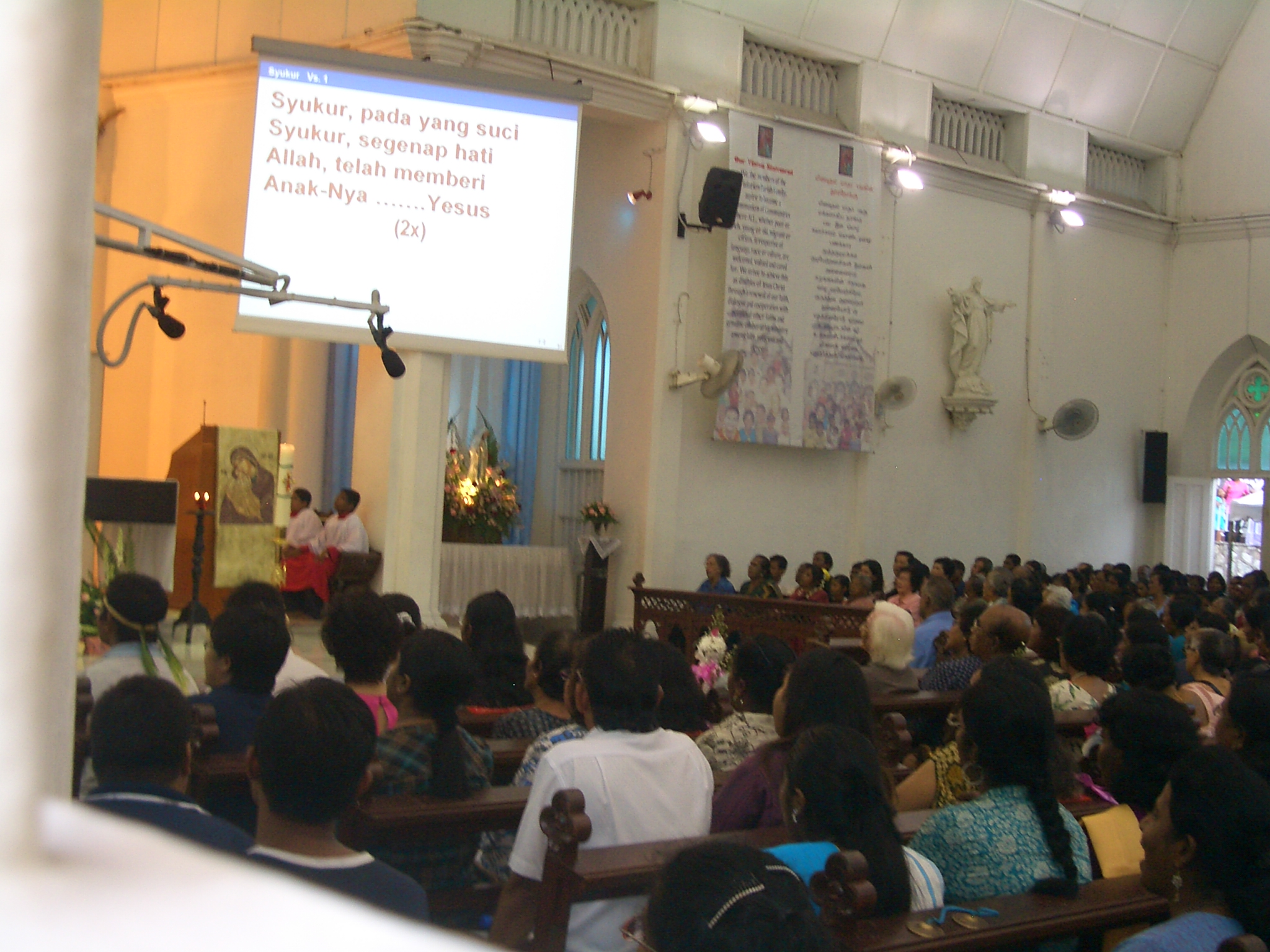
Actual modes of worship such as the liturgy used and the sermons are not actively censored or controlled by the government. Occasional surveillance of worship by clandestine operatives does occur.
It has been reported that several public secondary schools and universities have unofficially banned on-campus Christian activities, such as Christian Fellowship (CF).
Holidays
Christmas
Christmas is a public holiday in Malaysia, though much of the public celebration is commercial in nature and has no overt religious overtones. Occasionally, Christians do buy newspaper adverts on Christmas or Easter, but this is largely only allowed in English-language newspapers and permission is not given every year. The adverts themselves are usually indirect statements.
In 2004 the government organised a national-level Christmas celebration but allegedly imposed an unofficial ban on all Christian religious symbols and hymns that specifically mention Jesus Christ. The event was jointly organised by the Arts, Culture and Heritage ministry, the government of the state of Selangor and the Christian Federation of Malaysia (CFM). It was reported in advance that the Prime Minister, the Sultan of Selangor and his consort, as well as assorted cabinet ministers would be in attendance, and that the event would be televised.
O.C. Lim, a former lawyer turned Jesuit priest and director of the Catholic Research Centre (also assistant parish priest of St Francis Xavier's Church) lodged a formal complaint. He also stated that "To exclude (such) carols and to use (Christmas) for political gain is outrageous, scandalous and sacrilegious." He also said "To call it a cultural event (as rationalised by Christian politicians who are more politician than Christian) is to downgrade Jesus to a cultural sage such as Confucius."
CFM general secretary Rev. Dr. Hermen Shastri stated that the government wanted "nothing that insults Islam" during the open house.
Arts, Culture and Heritage Minister Dr Rais Yatim later denied that any such ban had been "issued officially or unofficially". He also added that there is "nothing wrong in singing songs such as 'Silent Night' and 'Merry Christmas'" as they are "joyous songs for the festival."
Lee Min Choon, legal adviser to the CFM and the National Evangelical Christian Fellowship issued a statement which said "It means that churches can celebrate Christmas as they have been doing all along. Otherwise, the very meaning of the occasion will be lost." "Now, everybody should take the government at its word and celebrate Christmas the way they normally celebrate and express their religious faith."
Good Friday
Good Friday is not a federal public holiday, but is a state public holiday in Sabah, and also in Sarawak, where Christianity is the largest religion; both states were granted some level of greater autonomy than other states in the Federation, as they were considered polities on par with Malaya when they merged with it and Singapore to form Malaysia. But it is a school holiday for some schools (or specifically, non-Muslim-majority schools).
However, there is no evidence that this theological objection plays any role in the non-inclusion of Good Friday as a holiday. On the contrary, Good Friday is probably not a public holiday because, as a whole in the federation, Christians constitutes 9.2% of the population according to the 2010 Census. The other two significant religious minorities in Malaysia, Buddhists and Hindus, also receive just one federal public holiday each - Wesak Day and Deepavali respectively. Deepavali however, is not a federal holiday in the state of Sarawak.
Independence Day/Malaysia Day fasting
Malaysian Christians sometimes hold fasts ending on Independence Day or Malaysia Day and pray for Muslims. A number of explanations have been given for doing so including a desire to show patriotism, promoting religious harmony, and celebrating freedom of religion. Since 2000 the National Evangelical Christian Fellowship, with 2,800 member churches organizing fasts. Though all previous fasts had ended on Independence Day, the 2010 fast was followed by Malaysia Day and thus for the first time coincided with Ramadan.
Distribution of Christians
According to the 2020 census, there were 2,941,049 people self-identifying as Christians (representing 9.1% of total Malaysian population).
By gender
The 2020 Population and Housing Census Report gives the following statistics:
| Male | Female | % of Total Male | % of Total Female |
|---|---|---|---|
| 1,491,696 | 1,449,353 | ||
| 8.8% | 9.4% |
By ethnic group
| Bumiputra | Chinese | Indian | Other Ethnicities | Non-Malaysian Citizens | % of total Bumiputra | % of total Chinese | % of total Indian | % of total Other Ethnicities | % of total Non-Malaysian Citizens | |
|---|---|---|---|---|---|---|---|---|---|---|
| 1,549,193 (59.2%) | 706,479 (26.9%) | 114,281 (4.4%) | 22,870 (0.8%) | 224,336 (8.6%) | ||||||
| 8.8% | 11.0% | 6.0% | 12.1% | 9.7% |
By state or federal territory
Malaysian Population and Housing Census Report from 1970 to the recent 2020 census gives the following statistics, showing the number of Christians in each states and their percentage out of the total population of each states.
| State | 1970 | 1980 | 1991 | 2000 | 2010 | 2020 | Number | % | Number | % | Number | % | Number | % | Number | % | Number | % |
|---|---|---|---|---|---|---|---|---|---|---|---|---|---|---|---|---|---|---|
| Johor | 25,437 | 2.0% | 22,169 | 1.4% | 34,074 | 1.7% | 51,153 | 2.0% | 107,204 | 3.3% | 121,466 | 3.0% | ||||||
| Kedah | 7,986 | 0.8% | 7,289 | 0.7% | 9,546 | 0.7% | 11,885 | 0.8% | 14,693 | 0.8% | 16,273 | 0.8% | ||||||
| Kelantan | 1,912 | 0.3% | 2,009 | 0.2% | 2,917 | 0.2% | 2,203 | 0.2% | 4,212 | 0.3% | 6,850 | 0.4% | ||||||
| Malacca | 16,093 | 4.0% | 16,376 | 3.7% | 18,391 | 3.7% | 22,268 | 3.7% | 23,878 | 3.0% | 26,282 | 2.6% | ||||||
| Negeri Sembilan | 12,189 | 2.5% | 12,198 | 2.2% | 17,322 | 2.5% | 22,709 | 2.7% | 23,736 | 2.4% | 31,323 | 2.6% | ||||||
| Pahang | 5,094 | 1.0% | 6,127 | 0.8% | 9,289 | 0.9% | 14,147 | 1.2% | 26,938 | 1.9% | 24,164 | 1.5% | ||||||
| Perak | 45,088 | 2.9% | 43,984 | 2.5% | 54,927 | 2.9% | 60,324 | 3.1% | 98,848 | 4.3% | 75,586 | 3.0% | ||||||
| Perlis | 453 | 0.4% | 665 | 0.5% | 1,041 | 0.6% | 1,017 | 0.5% | 1,345 | 0.6% | 1,670 | 0.6% | ||||||
| Penang | 35,146 | 4.5% | 31,645 | 3.5% | 36,279 | 3.4% | 44,584 | 3.6% | 78,089 | 5.1% | 75,345 | 4.3% | ||||||
| Sabah | 157,422 | 24.2% | 258,606 | 27.2% | 470,371 | 27.6% | 690,455 | 28.0% | 831,451 | 26.7% | 843,734 | 24.7% | ||||||
| Sarawak | 171,335 | 19.3% | 351,361 | 28.5% | 598,940 | 36.6% | 853,165 | 42.4% | 1,020,390 | 42.5% | 1,229,653 | 50.1% | ||||||
| Selangor | 70,216 | 4.3% | 47,880 | 3.4% | 90,600 | 3.9% | 166,443 | 4.2% | 206,008 | 3.9% | 344,082 | 4.9% | ||||||
| Terengganu | 1,283 | 0.3% | 1,531 | 0.3% | 4,528 | 0.6% | 2,483 | 0.3% | 2,206 | 0.2% | 2,928 | 0.3% | ||||||
| FT Kuala Lumpur | – | – | 41,150 | 4.5% | 57,360 | 5.1% | 71,757 | 5.5% | 92,242 | 5.8% | 127,695 | 6.4% | ||||||
| FT Labuan | – | – | – | – | 6,595 | 12.3% | 8,911 | 12.6% | 10,426 | 12.4% | 13,118 | 13.8% | ||||||
| FT Putrajaya | – | – | – | – | – | – | – | – | 588 | 0.9% | 880 | 0.8% | ||||||
| Total Malaysian population | 549,654 | 5.3% | 842,990 | 6.4% | 1,412,180 | 8.1% | 2,023,504 | 9.1% | 2,542,254 | 9.2% | 2,941,049 | 9.1% |
By urban-rural strata
The 2000 Population and Housing Census Report indicates that approximately 11.5% of the rural population and 7.6% of the urban population are adherents to Christianity making Christians the 2nd largest and 4th largest faith community in their respective population strata.
Freedom of religion
The freedom of religion for Christianity and other religions in Malaysia was written in the Keningau Oath Stone (protected by Malaysia Borneo government), however it is only mentioned and confirmed by the two states of Malaysia located in Borneo (East Malaysia).
In 2023, the country was ranked as the 43rd worst country in the world to be a Christian, but it was recorded only in West Malaysia (due to political intervene on religion) meanwhile in East Malaysia still not the worst to be a Christian (not included in rank) because of diversity and harmony tradition protected by both the Sabah and Sarawak governments that also written in Keningau Oath Stone.
References
References
- (2021-04-04). "Workbook: 1202". Tableau.dosm.gov.my.
- "Malaysia Christians pray for peace, equality, freedom - UCA News".
- [https://www.thearda.com/world-religion/national-profiles?u=139c World Religion Database at the ARDA website, retrieved 2023-08-08]
- "Operation World: Malaysia". WEC International.
- Hermen Shastri. (2005). "Christianity". Editions Didier Millet.
- Brian E., Colless. (1969–1970). "The Traders of the Pearl. The Mercantile and Missionary Activities of Persian and Armenian Christians in South East-Asia". Abr-Nahrain.
- Hunt, Robert. (1992). "Christianity in Malaysia – A Denominational History". Pelanduk Publications.
- Whinfrey-Koepping, Elizabeth. (30 September 2017). "Food, Friends and Funerals: On Lived Religion". LIT Verlag Münster.
- "Part 6: The Borneo Mission – Mill Hill Missionaries".
- "The Mill Hill Missionaries - St.Josephs Missionary Society".
- "Assessment for Kadazans in Malaysia".
- Saunders, Graham. (1991). "Bishops and Brookes: Anglican Mission and the Brooke Raj in Sarawak, 1848–1941". Oxford University Press.
- Lees, Shirley, 'Drunk before Dawn', OMF, {{ISBN. 0-85363-128-X
- Daniel, Ho. (1996). "Church in Asia Today: Challenges and Opportunities". Asia Lausanne Committee for World Evangelization.
- (11 September 2005). "Malay converts to Christianity "cannot renounce Islam"". AsiaNews C.F..
- (2004). "Doing The Right Thing: A Practical Guide on Legal Matters for Churches in Malaysia". Kairos Research Centre.
- (22 October 2011). "What is Himpun about?". The Star.
- (30 June 2014). "YouTube".
- VoiceOfTheMartyrsUSA. (31 January 2012). "Malaysia: Christians, Tortured for Their Faith".
- "Akidah: Ajaran Sesat". Chief Minister's Department, Sabah State Government.
- Soesilo, Daud. (2001). "Mengenal Alkitab Anda". Lembaga Alkitab Indonesia.
- (June 1989). "The History of the Translation of the Bible into Malay". Journal of the Malayan Branch of the Royal Asiatic Society.
- AsiaNews.it. "MALAYSIA No Bible in local languages".
- Spero News] {{webarchive. link. (2 April 2008)
- "Home".
- "Religious Club Closures in Schools Touch Nerve in Malaysia".
- (11 December 2004). "Rev Lim: Excluding carols with Jesus' name is scandalous". Mkini Dotcom Sdn Bhd.
- Christians fast this Ramadan 'for the country', by Boo Su-Lyn, Malaysian Insider, 20 August 2010
- "Taburan Penduduk dan Ciri-ciri Asas Demografi". Jabatan Perangkaan Malaysia.
- (2021-04-04). "Workbook: 1202". Tableau.dosm.gov.my.
- Department of Statistics, Malaysia. (2005). "General Report of the Population and Housing Census 2000". Department of Statistics, Malaysia.
- [https://www.dailyexpress.com.my/news/220070/oath-stone-s-rich-history/ Oath Stone’s rich history]
- [https://www.dailyexpress.com.my/news/220070/oath-stone-s-rich-history/ Oath Stone’s rich history]
- [https://www.opendoorsuk.org/persecution/world-watch-list/malaysia/ Open Doors website, retrieved 2023-08-08]
- [https://www.dailyexpress.com.my/news/220070/oath-stone-s-rich-history/ Oath Stone’s rich history]
This article was imported from Wikipedia and is available under the Creative Commons Attribution-ShareAlike 4.0 License. Content has been adapted to SurfDoc format. Original contributors can be found on the article history page.
Ask Mako anything about Christianity in Malaysia — get instant answers, deeper analysis, and related topics.
Research with MakoFree with your Surf account
Create a free account to save articles, ask Mako questions, and organize your research.
Sign up freeThis content may have been generated or modified by AI. CloudSurf Software LLC is not responsible for the accuracy, completeness, or reliability of AI-generated content. Always verify important information from primary sources.
Report