From Surf Wiki (app.surf) — the open knowledge base
Christ Pantocrator
Depiction of Jesus
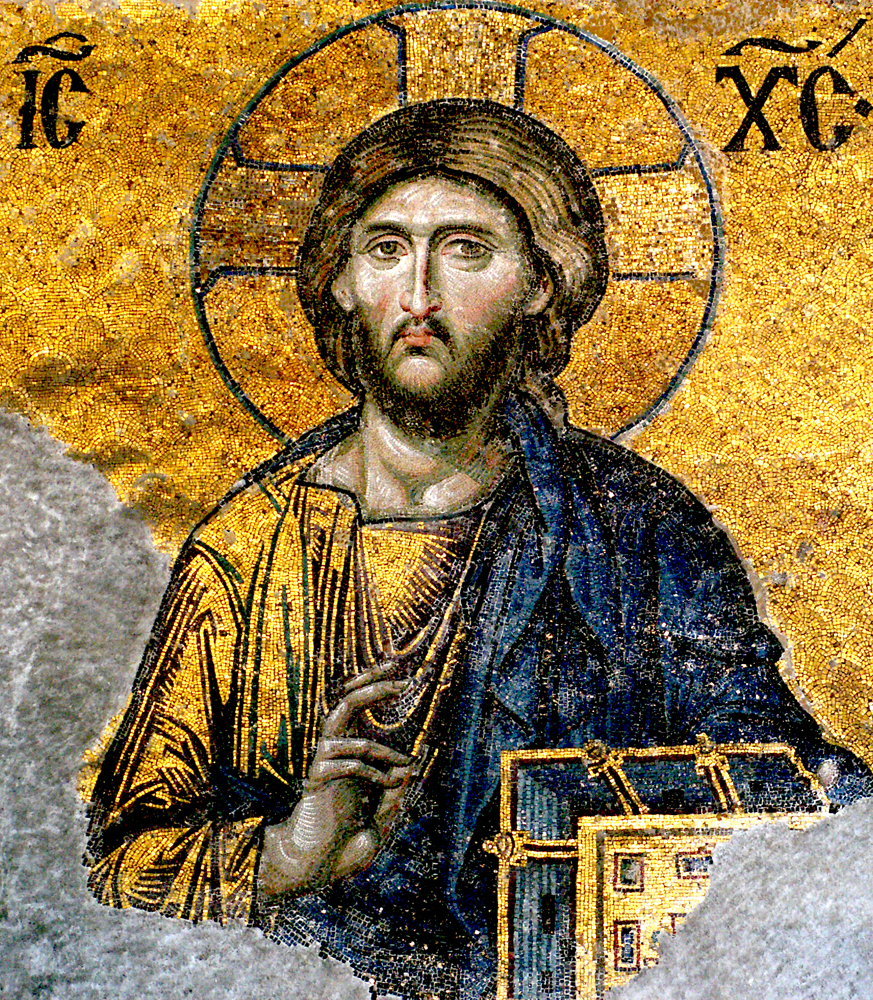
Depiction of Jesus

In Christian iconography, Christ Pantocrator (, ) is a specific depiction of Christ. Pantocrator or Pantokrator, literally 'ruler of all', but usually translated as 'almighty' or 'all-powerful', is derived from one of many names of God in Judaism.
The Pantokrator is largely an Eastern Orthodox, Eastern Catholic or Eastern Lutheran theological conception and is less common under that name in Latin Catholicism and Western Lutheranism. In the West, the equivalent image in art is known as Christ in Majesty, which developed a rather different iconography. Christ Pantocrator has come to suggest Christ as a benevolent, though also stern and all-powerful, judge of humanity.
When the Hebrew Bible was translated into Greek as the Septuagint, Pantokrator was used both for YHWH Sabaoth (צבאות) "Lord of Hosts" and for El Shaddai "God Almighty". In the New Testament, Pantokrator is used once by Paul () and nine times in the Book of Revelation: , , , , , , , , and . The references to God the Father and God the Son in Revelation are at times interchangeable, but Pantokrator appears to be reserved for the Father except, perhaps, in .
Meaning

The most common translation of Pantocrator is "Almighty" or "All-powerful". In this understanding, Pantokrator is a compound word formed from the Greek words πᾶς, grc (GEN παντός grc), i.e. "all" and κράτος, grc, i.e. "strength", "might", "power". This is often understood in terms of potential power; i.e., ability to do anything, omnipotence. Christ pantocrator signifies Christ in Glory during his second coming seated on his throne.
Another, more literal translation is "Ruler of All" or, less literally, "Sustainer of the World". In this understanding, Pantokrator is a compound word formed from the Greek for "all" and the verb meaning "To accomplish something" or "to sustain something" (κρατεῖν, grc). This translation speaks more to God's actual power; i.e., God does everything (as opposed to God can do everything).
Iconography

The image of Christ Pantocrator was one of the first images of Christ developed in the Early Christian Church and remains a central icon of the Eastern Orthodox Church. In the half-length image, Christ holds the New Testament in his left hand and makes the gesture of teaching or of blessing with his right. The typical Western Christ in Majesty is a full-length icon. In the early Middle Ages, it usually presented Christ in a mandorla or other geometric frame, surrounded by the Four Evangelists or their symbols.
The oldest known surviving example of the icon of Christ Pantocrator was painted in encaustic on panel in the sixth or seventh century, and survived the period of destruction of images during the Iconoclastic disputes that twice racked the Eastern church, 726 to 787 and 814 to 842. It was preserved in Saint Catherine's Monastery, in the remote desert of the Sinai. The gessoed panel, finely painted using a wax medium on a wooden panel, had been coarsely overpainted around the face and hands at some time around the thirteenth century. When the overpainting was cleaned in 1962, the ancient image was revealed to be a very high-quality icon, probably produced in Constantinople.
The icon, traditionally half-length when in a semi-dome, which became adopted for panel icons also, depicts Christ fully frontal with a somewhat melancholy and stern aspect, with the right hand raised in blessing or, in the early encaustic panel at Saint Catherine's Monastery, the conventional rhetorical gesture that represents teaching. The left hand holds a closed book with a richly decorated cover featuring the Cross, representing the Gospels. An icon where Christ has an open book is called "Christ the Teacher", a variant of the Pantocrator. Christ is bearded, his brown hair centrally parted, and his head is surrounded by a halo. The icon usually has a gold ground comparable to the gilded grounds of Byzantine mosaics.
Often, the name of Christ is written on each side of the halo, as IC and XC. Christ's fingers are depicted in a pose that represents the letters IC, X and C, thereby making the Christogram ICXC (for "Jesus Christ"). The IC is composed of the Greek characters iota (Ι) and lunate sigma (C; instead of Σ, ς)—the first and last letters of 'Jesus' in Greek (Ἰησοῦς); in XC the letters are chi (Χ) and again the lunate sigma—the first and last letters of 'Christ' in Greek (Χριστός).
In many cases, Christ has a cruciform halo inscribed with the letters Ο Ω Ν, i.e. ὁ ὤν "The Existing One".
File:The_Greek_Pantokrator_on_the_Hungarian_Holy_Crown.jpg|The Pantokrator on the Hungarian Holy Crown, File:Pantocràtor de Taüll.jpg|Pantocràtor de Taüll, Sant Climent de Taüll Church, Catalonia. (Now at MNAC-Museu Nacional d'Art de Catalunya, Barcelona) File:Christ Pantocrator, Church of the Holy Sepulchre.png|Christ Pantocrator mosaic from the dome of the Church of the Holy Sepulchre in Jerusalem File:Sankt Petersburg Auferstehungskirche innen 2005 d.jpg|Christ Pantocrator inside the dome of Church of the Saviour on the Blood (Храм Спаса на Крови), St. Petersburg File:Christ Pantocrator - Capela Palatina - Palermo - Italy 2015.JPG|Mosaic of Palatine Chapel in Palermo File:Mosaico di cristo in trono tra gli apostoli e le ss. prudenziana e prassede, 410 dc ca. 01.jpg|Christ Pantocrator in the church of Santa Pudenziana in Rome, Roman mosaic, File:Jesus in Sacred Heart Church (Berlin).jpg|Christ Pantocrator inside the Sacred Heart Church (Berlin), File:Russian Jewelled Icon of Christ Pantocrator.jpg|A miniature Russian icon of Christ Pantocrator, richly decorated with pearls and enamel, –1908 File:KWGK Mosaik 04.jpg|Damaged mosaic of Christ Pantocrator inside the Kaiser Wilhelm Memorial Church, Berlin File:Пантократор (Св. Богородица,Битола).jpg|Roof fresco of Christ Pantocrator, Nativity of the Theotokos Church, Bitola, North Macedonia File:Christ Pantocrator (Church of St. Alexander Nevsky, Belgrade).jpg|Christ Pantocrator in the Orthodox Church of St. Alexander Nevsky, Belgrade, Serbia File:Pantokrator_Adalbert-Gresgnigt_Mosteiro-Sao-Bento-Sao-Paulo_1922.jpg|Christ Pantocrator painted by Adelbert Gresnigt, Beuron Art School Mosteiro de São Bento (São Paulo), Brazil
Statuary

In certain churches of Western Christianity, Christ Pantocrator has been depicted. A prominent example is the topmost statue in the ornate altarpiece of Saint Martin's Lutheran Church in Næstved.
References
Footnotes
Bibliography
- Latourette, Kenneth Scott, 1975. A History of Christianity, Volume 1, "Beginnings to 1500". Revised edition. (San Francisco: HarperCollins)
- Christopher Schonborn, Lothar Kraugh (tr.) 1994. God's Human Face: The Christ Icon. Originally published as Icôn du Christ: Fondements théologiques élaborés entre le Ie et IIe Conciles de Nicée (Fribourg) 1976
References
- {{LSJ. pantokra/twr. παντοκράτωρ. ref
- [[:s:Catholic Encyclopedia (1913)/First and Second Books of Kings. 2 Kings]] ([[Books of Samuel. 2 Samuel]]) 7:8 and [[Book of Amos. Amos]] 3:13
- [[Book of Job. Job]] 5:17, 15:25 and 22:25
- {{LSJ. πᾶς. ref
- {{LSJ. kra/tos1. κράτος. ref
- Borges, Jason. (2019-01-12). "Pantocrator: The Most Important Icon".
- ''God's Human Face: The Christ-Icon'' by Christoph Schoenborn (1994) {{ISBN. 0-89870-514-2 page 154
- ''Sinai and the Monastery of St. Catherine'' by John Galey (1986) {{ISBN. 977-424-118-5 page 92
- Eduard Syndicus; ''Early Christian Art''; pp. 96–99; Burns & Oates, London, 1962. Hall pp. 78–80; James Hall, ''A History of Ideas and Images in Italian Art'', pp. 91–97, 1983, John Murray, London, {{ISBN. 0-7195-3971-4
- Manolis Chatzidakis and Gerry Walters, "An Encaustic Icon of Christ at Sinai", ''The Art Bulletin'' '''49'''.3 (September 1967) pp. 197–208.
- Galey, John, Forsyth, George, and [[Kurt Weitzmann. Weitzmann, Kurt]], ''Sinai and the Monastery of St. Catherine'', p. 92, Doubleday, New York, 1980, {{ISBN. 0385171102
- Otherwise the size of the figure would have to be greatly reduced to avoid the head appearing at the flattening top of the semi-dome.
- (29 October 2020). "Sculpture and the Decorative in Britain and Europe: Seventeenth Century to Contemporary". Bloomsbury Publishing.
This article was imported from Wikipedia and is available under the Creative Commons Attribution-ShareAlike 4.0 License. Content has been adapted to SurfDoc format. Original contributors can be found on the article history page.
Ask Mako anything about Christ Pantocrator — get instant answers, deeper analysis, and related topics.
Research with MakoFree with your Surf account
Create a free account to save articles, ask Mako questions, and organize your research.
Sign up freeThis content may have been generated or modified by AI. CloudSurf Software LLC is not responsible for the accuracy, completeness, or reliability of AI-generated content. Always verify important information from primary sources.
Report