From Surf Wiki (app.surf) — the open knowledge base
Chow mein
Chinese stir-fried noodles

Chinese stir-fried noodles
| Field | Value |
|---|---|
| name | Chow mein |
| image | Homemade Chow mein with shrimps and meat with a choy and Choung.jpg |
| caption | A plate of chow mein |
| country | China |
| region | Guangdong |
| course | Main course |
| served | Hot |
| main_ingredient | Noodles, soy sauce, vegetables |
| variations | Chicken, pork, beef, shrimp, tofu |
| module | {{Infobox Chinese |
| child | yes |
| t | 炒麵 |
| s | 炒面 |
| h | cauˋ mien |
| p | chǎo miàn |
| mi | |
| j | caau2 min6 |
| y | cháau mihn |
| ci | |
| poj | chhá-mī |
| l | "Stir-fried noodles" |
| showflag | h |
Chow mein ( and , ; Cantonese Yale: cháaumihn, Pinyin: chǎomiàn) is a dish of Chinese stir-fried noodles with vegetables and sometimes meat or tofu. Over the centuries, variations of chǎomiàn were developed in many regions of China; there are several methods of frying the noodles and a range of toppings can be used. It was introduced in other countries by Chinese immigrants. The dish is popular throughout the Chinese diaspora and appears on the menus of most Chinese restaurants abroad. It is particularly popular in India, Nepal, the UK, and the US.
Etymology
'Chow mein' is the Americanization of the Chinese term for fried noodles (). Its pronunciation comes from the Cantonese pronunciation "chaomin"; the term first appeared in English (US) in 1906. The term 'chow mein' means 'stir-fried noodles', also loosely translated as "fried noodles" in English, chow () meaning 'stir-fried' (or "sautéed") and mein () meaning "noodles".
Regional cuisine
American Chinese cuisine


Chaomian was introduced from China into the United States by Chinese immigrants who came from the Guangdong provinces in the California gold rush era, bringing their Cantonese style of cooking.
In American Chinese cuisine, it is a stir-fried dish consisting of noodles, meat (chicken being most common but pork, beef, shrimp or tofu sometimes being substituted), onions and celery. It is often served as a specific dish at westernized Chinese restaurants. Vegetarian or vegan chow mein is also common.
In the American market, two types of chow mein include crispy chow mein and steamed chow mein.
The steamed chow mein has a softer texture, while the former is crisper and drier. Crispy chow mein uses fried, flat noodles, while soft chow mein uses long, rounded noodles.
Crispy chow mein either has onions and celery in the finished dish or is served "strained", without any vegetables. Steamed chow mein can have many different kinds of vegetables in the finished dish, most commonly including onions and celery but sometimes carrots, cabbage and mung bean sprouts as well. Crispy chow mein is usually topped with a thick brown sauce, while steamed chow mein is mixed with soy sauce before being served.
There is a regional difference in the US between the East and West Coast use of the term "chow mein". On the East Coast, "chow mein" is always the crispy kind. At some restaurants located in those areas, the crispy chow mein noodles are sometimes deep fried and could be crispy "like the ones in cans" or "fried as crisp as hash browns". At a few East Coast locations, "chow mein" is also served over rice. There, the steamed style using soft noodles is a separate dish called "lo mein". On the West Coast, "chow mein" is always the steamed style, and the term "lo mein" is not widely used.
The crispy version of chow mein can also be served in a hamburger-style bun as a chow mein sandwich.
There are also variations on how either one of the two main types of chow mein can be prepared as a dish. When ordering "chow mein" in some restaurants in Chicago, a diner might receive "chop suey poured over crunchy fried noodles". In Philadelphia, Americanized chow mein tends to be similar to chop suey but has crispy fried noodles on the side and includes much celery and bean sprouts and is sometimes accompanied with fried rice. Jeremy Iggers of the Star Tribune describes "Minnesota-style chow mein" as "a green slurry of celery and ground pork topped with ribbons of gray processed chicken". Bay Area journalist William Wong made a similar comment about what is sold as chow mein in places like Minnesota. Note: The essay in this book was original published in the July 21, 1988, issue of the East-West News as an article titled "Minnesota Chow Mein". A published recipe for Minnesota-style chow mein includes generous portions of celery and bean sprouts. Another Minnesotan variant includes ground beef and cream of mushroom soup. In Louisiana, "Cajun chow mein" is a noodle-less rice dish that is a variation of jambalaya.
Food historians and cultural anthropologists have noted that chow mein and other dishes served in Chinese American restaurants located away from areas without any significant Asian American population tend to be very different from what is served in China and are heavily modified to fit the taste preference of the local dominant population. As an example, the chow mein gravy favored in the Fall River area more closely resembles that used in local New England cooking than that used in traditional Chinese cooking. The creator of canned chow mein, who founded the food manufacturer Chun King, admits to using Italian spices to make his product more acceptable to Americans whose ancestors came from Europe.

In 1946, one of the first companies to market "chow mein" in a can was Chun King. The product's creator was Jeno Paulucci, the son of Italian immigrants, who developed a recipe based mostly upon Italian spices that would be better catered to the food preferences of European immigrants and some Americans of similar ethnic origins. To keep cost down, Paulucci replaced expensive water chestnuts with lower-cost celery stalks that were originally destined for cattle feed. Paulucci's company became so successful selling canned chow mein and chop suey that President Gerald Ford quipped, "What could be more American than a business built on a good Italian recipe for chop suey?" when praising Paulucci's accomplishments with Chun King. After Paulucci sold Chun King in 1966, the company was sold several more times more until it was dissolved in 1995.
By 1960, Paulucci told The New York Times that "At Chun King we have turned out a 'stew-type' chow mein. I'd guess this type has been around for thirty—maybe forty—years. To make it, all the meat, seasonings and vegetables are dumped into a kettle and stewed for hours—until everything is cooked."
Outside of Chinese restaurants, what is labeled as chow mein is frequently a chop suey-like stew that has little resemblance to actual chow mein. For example, the official U.S. military recipe (employed by cooking facilities of all four American military services) does not include noodles, comes with instructions to serve the dish over steamed rice, and can serve 100 persons per batch.
Australian cuisine
Outside of Asian communities, many Australians appear to confuse chow mein with chop suey. The most common Australian version contains minced beef (called ground beef in North America) and curry powder and sometimes served over rice instead of fried noodles. This version has been promoted by the Australian Institute of Sport, on ABC radio, and a popular Australian women's magazine since the mid-1960s and during the 21st century.
A chicken chow mein recipe that was published in a major Melbourne newspaper in 1963 had a recipe list that included a can of condensed cream of mushroom soup, a can of pineapple pieces, and cooked noodles or macaroni that were combined and baked in an oven.
Canadian Chinese cuisine
Canadian westernized Chinese restaurants may offer up to three different types of chow mein, none of which is identical to either of the two types of American chow mein. Cantonese style chow mein contains deep-fried crunchy golden egg noodles, green peppers, pea pods, bok choy, bamboo shoots, water chestnuts, shrimp, Chinese roast pork (char siu), chicken, and beef, and is served in a thick sauce. Plain chow mein is similar to other Western chow meins, but contains far more mung bean sprouts; some regional recipes may substitute bean sprouts for noodles completely. The Japanese Canadian community also have their own version of chow mein that might include dried seaweed and pickle ginger and could be served in a bun.
In Newfoundland, their version of chow mein does not contain any noodles. In place of noodles, cabbage cut in such a way to resemble noodles are used as a substitute. Although no one knows the reason why this change had occurred, it is believed that the island's remoteness in the North Atlantic during its history as an independent self-governing British dominion contributed to the lack of availability of the necessary ingredients from the rest of North America or from Europe.
Caribbean Chinese cuisine

Many West Indian people include chow mein in their cuisine, especially peoples from islands like Trinidad and Tobago and Jamaica, which include a significant ethnic Chinese population; much of the cooking has infused itself into the population in general. As well, in the South American Caribbean countries Guyana and Suriname (known by its Dutch name "tjauw min" or "tjauwmin"). These chow mein dishes are cooked in a similar manner, with green beans, carrots, peas, onions and sometimes other vegetables. Meat used is mostly chicken but sometimes pork or shrimp. The Surinamese version may use a pork sausage as the meat. The main difference is that local spices are added, and the dish is often served with hot Scotch bonnet peppers or pepper sauce.
In Cuba, aside from the foreign-owned tourist hotels which often serve Western-style Chinese food, local Chinese restaurants can be found in Havana that offer a distinct Cuban style.
Central America
In Panama, chow mein is prepared with a mixture of onions, peppers, celery and carrots with pork or chicken and stir fried with noodles. Another recipe includes canned corn. In El Salvador, chow mein may contain carrots, cabbage or broccoli. Another Salvadoran recipe includes potato and chayote. In Guatemala, chow mein (or chao mein) is usually prepared with chayote and carrots and served on a corn tostada.
Indian Chinese cuisine
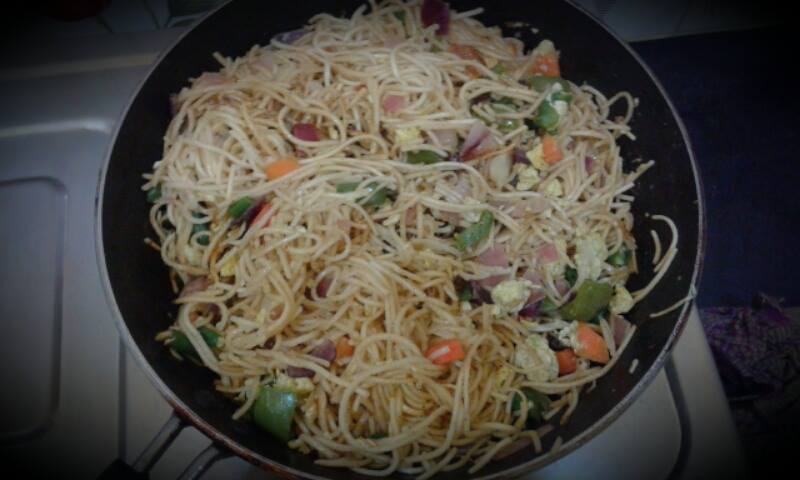
Chow mein is also common in Indian Chinese. In India, it was introduced by the Chinese of Calcutta. Chow mein always refers to soft, boiled noodles. When the noodles are lightly fried, the chow mein is referred to as "Hakka style". Crispy fried noodles are also often available, but under the name "chop suey" or "American chop suey". All styles always include a medley of vegetables including cabbage, bamboo shoots, pea pods, green peppers, chilli peppers and carrots. Common proteins are chicken and scrambled eggs, but pork and shrimp are also used. In the New Delhi area, chow mein can sometimes include paneer with the mixture of noodles and vegetables.
In Kolkata, the home city of Indian-Chinese cuisine, the dish is sold out of thousands of street carts lining every neighborhood, often spelled as "chowmin" and involves heavy use of green chilli and garlic. The Pakistani version includes carrots, cabbage, peppers, spring onions, chilies, and ginger garlic paste.
Indonesian Chinese cuisine
There are two Indonesian versions of chow mein. One is Mie goreng, which is (sometimes spicy) stir-fried noodle dish with variants of toppings, and the other is a crispy noodle dish topped with sauce that is pretty popular and existed in virtually all Chinese restaurant in Indonesia. It goes popular with the name of Ifumi or Mi Siram, literally means drenched noodle, in Indonesian Chinese cuisine. In Indonesia, ifumi is usually served with thick egg sauce with cauliflower, broccoli, mushroom, kekkian or prawn cake, and chicken. Several varieties does exists such as vegetarian and seafood that contains squid, prawn and fish instead of kekkian. The dish is often confused with Lo mein.
Mauritian cuisine
In Mauritius, Mauritian chow mein is known as "mine frire", "mine frite", "mine frit" and "minn frir". The term is a combination of Cantonese/Hakka word for noodles "mein" () and French word for "fried". It was likely introduced in Mauritius by Chinese immigrants who mostly came from the Southeast part of China (mostly from the Cantonese regions) at the end of the 19th century. It was mainly eaten by the Chinese community who settled in Mauritius and eventually evolved in a distinctively Mauritian dish diverging from the original recipe. It is a classical Sino-Mauritian dish which is eaten by all Mauritians regardless of ethnicity, reflecting the influence of Chinese and Sino-Mauritian community despite being one the smallest community on the island. It is a very common street food and can be found in almost all restaurants on the island.
Mexican Chinese cuisine
Chow mein has gained popularity in Mexico, which received waves of Chinese immigrants in the past, particularly in northwestern Mexico. Mexicali, a city in Baja California, is known for its distinct style of chow mein, which typically use Mexican ingredients as substitutes for traditional Chinese ones, an adaption that was made by Chinese immigrants settling the area.
Nepalese cuisine

Tibetans who settled in Nepal during the 1960s introduced chow mein into Nepal. It is a popular fast food in Nepal. The Newari people of the Kathmandu Valley use water buffalo meat and chicken in their cuisine, and chow mein in Nepal is often cooked with onion, vegetables and buff (water buffalo meat).
Peruvian Chinese cuisine

Main article: Tallarín saltado
Chinese food (chifa) is very popular in Peru and is now a part of mainstream Peruvian culture. Chow mein is known to Peruvians as tallarín saltado ("sautéed noodles") and may contain peppers, onions, green onions, and tomatoes. Chicken or beef are the preferred meats used in this Peruvian variant.
References
References
- Smith, Andrew F.. (2013). "The Oxford encyclopedia of food and drink in America". Oxford University Press.
- Cho, Lily. (2010). "Eating Chinese". University of Toronto Press.
- Bindloss, Joseph. (2010). "Nepal: Country Guide Series, Lonely Planet guidebooks". Lonely Planet.
- Mason, Laura. (2004). "Food Culture in Great Britain". Greenwood Publishing Group.
- Wilkinson, Endymion Porter. (2000). "Chinese history : a manual". Published by the Harvard University Asia Center for the Harvard-Yenching Institute.
- . (September 23, 2008). ["The pounds – of noodles – pile up at chow mein factory"](http://www.madeinfallriver.com/content/pounds-noodles-pile-chow-mein-factory). *GateHouse Media, Inc.*.
- . (January 17, 2007). ["Recipes: Beef Chow Mein Hot Dish"](http://www.startribune.com/lifestyle/taste/11461161.html). *[[Minneapolis Star Tribune]]*.
- Bodin, Merlin. "Cajun Chow Mein". A Cajun Family's Recipe Collection.
- Maher, Jessica. "Cajun Chow Mein". Kitchen Belleicious.
- (1994). "Origins and Destinations: 41 Essays on Chinese America". Chinese Historical Society of Southern California, UCLA Asian American Studies Center.
- "Chicken Chow Mein (Cooked diced)". Armed Forces Recipe Service.
- O'Connell, Jan. (September 1880). "1887 Chop suey described in Australia". Australian Food Timeline.
- "Chow Mein". [[Australian Sports Commission]].
- (March 7, 2007). "Chow Mein - gluten free". [[Australian Broadcasting Corporation]].
- (September 29, 1965). "When teenagers give a party".
- (May 9, 2022). "Beef chow mein".
- (July 19, 1963). "Easy Chicken Chow Mein (Illustrated)". [[The Age]].
- Sakauye, Russell. (May 29, 2013). "The Legacy of the Cumberland Chow Mein". Japanese Canadian Citizens Association.
- Heintz, Lauryn. (April 16, 2016). "Chop Suey Nation: A road trip uncovers the lives behind small-town Chinese-Canadian food".
- Tremonti, Anna Maria (host). (January 31, 2019). "Chinese immigrants developed dishes to appeal to Western palates, says Ann Hui".
- Hui, Ann. (September 4, 2019). "Book Excerpts: In Newfoundland, You Have to Ask for Noodles in Your Chow Mein". [[Eater (website).
- "Spicy Chicken Chow Mein Recipe". Jamaican Medium Foods.
- Wong, Craig. (October 26, 2017). "Jerk Chicken Chow Mein".
- (April 30, 2011). "Guyanese chow mein: A traditional Guyanese dish that reveals a fusion of Asian influences". The Christian Science Monitor.
- (January 14, 2018). "Chicken and Shrimp Chow Mein - Guyanese Style".
- Woei, Patrick. (December 2019). "'Tjauwmin', a Surinamese favorite with a Chinese origin". [[Surinam Airways]].
- (January 30, 2024). "Wat is Surinaamse Tjauw min?". Smaakvol NH.
- "Chow mein de pollo". Recetas de Panamá.
- (May 16, 2019). "Choe mein de Puerco". elistmopty.
- Montenegro, Nayla. (March 30, 2007). "El "Chow Mein" es panameño". Panamá América.
- "Chao mein con pollo salvadoreño". Recetas del Salvador.
- (December 9, 2019). "Chow mein salvadoreño". SaborlLatino503.
- (March 10, 2024). "Chicken Chow Mein Salvadoran Style (Chow Mein Salvadoreño)". Flourish With G.
- Esparza, Bill. (August 19, 2014). "Essential T: Chow Mein Tostadas at Guatemalteca Bakery & Restaurant".
- Stewart, Jade Yamazaki. (June 30, 2021). "Kent offers fantastic Guatemalan food, satisfying birria tacos and affordable sushi". [[Seattle Times]].
- Giron, Rudy. (January 31, 2012). "Guatemalan chow mein tostada". Antigua Daily Photo.
- Shaw, Kanchan. (March 17, 2010). "Egg Hakka Chowmein".
- Brar, Ranveer. "Shrimp Chowmein".
- Srivastava, Tanvi. (August 9, 2021). "Paneer Chowmein". Sinfully Spicy.
- Bhattacharya, Chandrima S.. (June 21, 2015). "Long live chow mein: Hakka or gravy, Dacres Lane or Tangra, Chandrima S. Bhattacharya traces the journey of the ubiquitous Calcutta chowmin". [[Calcutta Telegraph]].
- Athar, Ayesha. (May 10, 2019). "Recipe: Pakistani Style Chicken Chow Mein". National Courier.
- "Indonesia’s Most Famous Noodle Dishes".
- "Chinese fried noodles-".
- "Top 10 Most Popular Mauritian Dishes".
- Maurice, Recette Ile. (January 24, 2021). "Mine frit de l'ile Maurice".
- "Republic of Mauritius- Mauritian Cuisine".
- (2015). "Multiculturalism, Mauritian Style: Cultural Diversity, Belonging, and a Secular State". American Behavioral Scientist.
- (December 28, 2018). "Mine frit : un grand classique de la cuisine sino-mauricienne -".
- "Chinese Cuisine".
- "Mine Frite (Fried Noodles) Recipe".
- Baral, Binod. (December 2, 2023). "The humble Nepali chowmein". The Annapurna Express.
- Tamang, Alina. (August 9, 2019). "How to Make Mouthwatering Nepali Style Chicken Chowmein?". Utsav 360.
- (December 12, 2020). "35 must try food in Nepal – List of most popular Nepali food". Nepal101.
- Vaidya, Bikram. (October 22, 2020). "Why do Newar's eat Water Buffalo?". Bikram Vaidya.
- "Buff Chowmein (Nepali Style Chowmein)". Kathmandu MoMo House & Bar.
- (April 1, 2020). "Buff Chowmein Recipe {{!}} Buff Sukuti Chowmein". Listy Recipe.
- (April 9, 2020). "Nepali-Style Chow Mein". Paris Kathmandu.
- . (July 6, 2012). ["Lunch Bunch: A Peruvian twist; Andes fare meets Mexican eatery"](http://www.timesrecordnews.com/news/2012/jul/06/lunch_bunch/). *[[Times Record News]]*.
- (May 6, 2020). "Tallarin Saltado Recipe – Peruvian Stir-Fried Noodles". EatPeru.
- (May 24, 2018). "Tallarin Saltado". Chewing Happiness.
- (April 13, 2016). "Tallarín Saltado Criollo". Comidas Peruanas.
- (September 30, 2020). "Tallarín saltado criollo [receta completa y video]". [[La República (Peru).
This article was imported from Wikipedia and is available under the Creative Commons Attribution-ShareAlike 4.0 License. Content has been adapted to SurfDoc format. Original contributors can be found on the article history page.
Ask Mako anything about Chow mein — get instant answers, deeper analysis, and related topics.
Research with MakoFree with your Surf account
Create a free account to save articles, ask Mako questions, and organize your research.
Sign up freeThis content may have been generated or modified by AI. CloudSurf Software LLC is not responsible for the accuracy, completeness, or reliability of AI-generated content. Always verify important information from primary sources.
Report