From Surf Wiki (app.surf) — the open knowledge base
Chogyal
Monarchs of the former Kingdom of Sikkim
Monarchs of the former Kingdom of Sikkim
| Field | Value |
|---|---|
| royal_title | Chogyal |
| realm | Sikkim |
| coatofarms | Achievement of Sikkim.jpg |
| coatofarmssize | 120px |
| coatofarmscaption | Emblem of Sikkim |
| image | Palden Thondup Namgyal.jpg |
| caption | Palden Thondup Namgyal |
| first_monarch | Phuntsog Namgyal |
| last_monarch | Palden Thondup Namgyal |
| residence | Tsuklakhang Palace, Gangtok |
| began | |
| ended | |
| pretender | Wangchuk Namgyal |
The Chogyal ("Dharma Kings", ) were the monarchs of the former Kingdom of Sikkim, which belonged to the Namgyal dynasty (). The Chogyal was the absolute monarch of Sikkim from 1642 to 1973, and the constitutional monarch from 1973 to 1975, when the monarchy was abolished and the Sikkimese people voted in a referendum to make Sikkim the 22nd state of India.
History

From 1642 to 1975, Sikkim was ruled by the monarchy founded by Phuntsog Namgyal, the fifth-generation descendant of Guru Tashi, a prince from the Minyak House who came to Sikkim from the Kham region of Eastern Tibet. Chogyal means 'righteous ruler', and was the title conferred upon Sikkim's Buddhist kings during the reign of the Namgyal Monarchy.
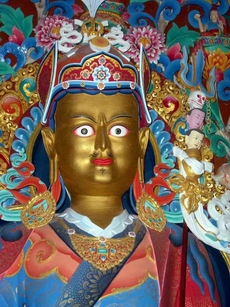
The reign of the Chogyal was foretold by the patron saint of Sikkim, Guru Rinpoche. The 8th-century saint had predicted the rule of the kings when he arrived in the state. In 1642, Phuntsog Namgyal was crowned as Sikkim's first Chogyal in Yuksom. The crowning of the king was a great event and he was crowned by three revered lamas who arrived there from three different directions, namely the north, west, and south.
Chogyal kings of Sikkim
List of chogyals
(aged 65–66) (aged 55–56) (aged 29–30) (aged 25–26) (aged 46–47) (aged 23–24) (aged 77–78) (aged 54–55) (aged 53–54) (aged 34–35)
Titular chogyals
The son from the first marriage of Palden Thondup Namgyal, Wangchuk Namgyal (; born 1 April 1953), was named the 13th Chogyal after his father's death on 29 January 1982, and crowned on 19 February 1982; the Government of India did not recognize this coronation, and the position no longer confers any official authority.
| Name | Reign start | Reign end | Notes |
|---|---|---|---|
| Palden Thondup Namgyal | 10 April 1975 | 29 January 1982 | Son of Tashi Namgyal |
| Wangchuk Namgyal | 29 January 1982 | Incumbent | Son of Palden Thondup Namgyal |
Family tree
A01=Phuntsog Namgyal I (1) r. 1642–1670|boxstyle_A01=border-color:#DC143C}}
A01=Tensung Namgyal (2) r. 1670–1700|boxstyle_A01=border-color:#DC143C}}
A01=Chakdor Namgyal (3) r. 1700–1717|boxstyle_A01=border-color:#DC143C}}
A01=Gyurmed Namgyal (4) r. 1717–1733|boxstyle_A01=border-color:#DC143C}}
A01=Phuntsog Namgyal II (5) r. 1733–1780|boxstyle_A01=border-color:#DC143C}}
A01=Tenzing Namgyal (6) r. 1780–1793|boxstyle_A01=border-color:#DC143C}}
A01=Tsugphud Namgyal (7) r. 1793–1863|boxstyle_A01=border-color:#DC143C}}
A01=Sidkeong Namgyal (8) r. 1863–1874|boxstyle_A01=border-color:#DC143C| A02=Thutob Namgyal (9) r. 1874–1914|boxstyle_A02=border-color:#DC143C}}
A01=Sidkeong Tulku Namgyal (10) r. 1914|boxstyle_A01=border-color:#DC143C| A02=Tashi Namgyal (11) r. 1914–1963|boxstyle_A02=border-color:#DC143C}}
A01=Palden Thondup Namgyal (12) r. 1963–1975 – Titular – r. 1975–1982|boxstyle_A01=border-color:#DC143C}}
A01=Wangchuk Namgyal (13) – Titular – r. 1982–present|boxstyle_A01=border-color:#DC143C}}
Royal flag
File:Royal flag of Sikkim.svg|Royal flag of Sikkim 1877–1975
Rulers of other Himalayan kingdoms
Druk Gyalpo of Bhutan
Main article: Zhabdrung Rinpoche, Druk Desi, Druk Gyalpo

In Bhutan, "dharmaraja" or "Righteous King" is a title which was also conferred upon a special class of temporal and spiritual rulers. In Bhutan, the Chogyal were given the respectful title Zhabdrung. In this context, the Chogyal was a recognised reincarnation (or succession of reincarnations) of Shabdrung Ngawang Namgyal, the 17th century Tibetan-born founder of Bhutan. A position of supreme importance, the Bhutanese Chogyal was above both the highest monastic authority, the Je Khenpo, and the highest temporal ruler, the Deb Raja or Druk Desi. There were two main lines of Zhabdrung incarnations in Bhutan.
Gyalpo of Ladakh
Main article: Namgyal dynasty of Ladakh
The region of Ladakh was ruled by a separate line of the Namgyal dynasty that lasted from 1460 to 1842 and were titled the Gyalpo of Ladakh.
Notes
References
References
- G. T.. (1 March 1975). "Trouble in Sikkim". Index on Censorship.
- (16 April 1975). "Sikkim Votes to End Monarchy, Merge With India". [[The New York Times]].
- Measuroo.com States and Territories of India series. Online: [http://www.measuroo.com/Acr-S/Sikkim.php] (accessed: 14 May 2008)
- "John Claude White – career". [[King's College London]].
- (5 April 1965). "Maharaja and His U.S. Bride Crowned Amid Pomp in Sikkim". [[The New York Times]].
- (30 January 1982). "Palden Thondup Namgyal, Deposed Sikkim King, Dies". [[The New York Times]].
- (2017-04-23). "From monarch to monk: Scion of Sikkim dynasty who became a spiritual recluse".
- Norbu, Namkhai (1988, 2000). ''The Crystal and the Way of Light: The Teachings of Namkhai Norbu''. (Snow Lion Publications) pg.20 and Notes.
- Teg Bahadur Kapur. (1987). "Ladakh, the Wonderland A Geographical, Historical, and Sociological Study". Mittal Publications.
This article was imported from Wikipedia and is available under the Creative Commons Attribution-ShareAlike 4.0 License. Content has been adapted to SurfDoc format. Original contributors can be found on the article history page.
Ask Mako anything about Chogyal — get instant answers, deeper analysis, and related topics.
Research with MakoFree with your Surf account
Create a free account to save articles, ask Mako questions, and organize your research.
Sign up freeThis content may have been generated or modified by AI. CloudSurf Software LLC is not responsible for the accuracy, completeness, or reliability of AI-generated content. Always verify important information from primary sources.
Report