From Surf Wiki (app.surf) — the open knowledge base
Chitin
Long-chain polymer of a N-acetylglucosamine
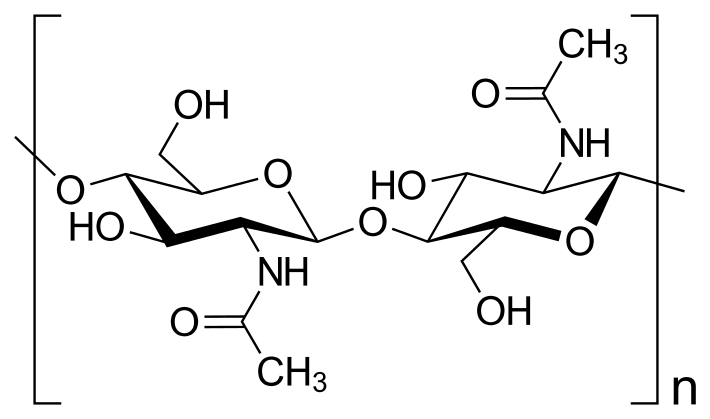
Long-chain polymer of a N-acetylglucosamine


Chitin (C8H13O5N)n ( ) is a long-chain polymer of N-acetylglucosamine, an amide derivative of glucose. Chitin is the second most abundant polysaccharide in nature (behind only cellulose); an estimated 1 billion tons of chitin are produced each year in the biosphere. It is a primary component of cell walls in fungi (especially filamentous and mushroom-forming fungi), the exoskeletons of arthropods such as crustaceans and insects, the radulae, cephalopod beaks and gladii of molluscs and in some nematodes and diatoms. It is also synthesised by at least some fish and lissamphibians. Commercially, chitin is extracted from the shells of crabs, shrimps, shellfish and lobsters, which are major by-products of the seafood industry. The structure of chitin is comparable to cellulose, forming crystalline nanofibrils or whiskers. It is functionally comparable to the protein keratin. Chitin has proved useful for several medicinal, industrial and biotechnological purposes.
Etymology
The English word chitin comes from the French word chitine, which was derived in 1821 from the Greek word χιτών () meaning 'covering'.
A similar word, "chiton", refers to a marine animal with a protective shell.
Chemistry, physical properties and biological function

The structure of chitin was determined by Albert Hofmann in 1929. Hofmann hydrolyzed chitin using a crude preparation of the enzyme chitinase, which he obtained from the snail Helix pomatia.
Chitin is a modified polysaccharide that contains nitrogen; it is synthesized from units of N-acetyl-D-glucosamine (to be precise, 2-(acetylamino)-2-deoxy-D-glucose). These units form covalent β-(1→4)-linkages (like the linkages between glucose units forming cellulose). Therefore, chitin may be described as cellulose with one hydroxyl group on each monomer replaced with an acetyl amine group. This allows for increased hydrogen bonding between adjacent polymers, giving the chitin-polymer matrix increased strength.
In its pure, unmodified form, chitin is translucent, pliable, resilient, and quite tough. In most arthropods, however, it is often modified, occurring largely as a component of composite materials, such as in sclerotin, a tanned proteinaceous matrix, which forms much of the exoskeleton of insects. Combined with calcium carbonate, as in the shells of crustaceans and molluscs, chitin produces a much stronger composite. This composite material is much harder and stiffer than pure chitin, and is tougher and less brittle than pure calcium carbonate. Another difference between pure and composite forms can be seen by comparing the flexible body wall of a caterpillar (mainly chitin) to the stiff, light elytron of a beetle (containing a large proportion of sclerotin).
In butterfly wing scales, chitin is organized into stacks of gyroids constructed of chitin photonic crystals that produce various iridescent colors serving phenotypic signaling and communication for mating and foraging. The elaborate chitin gyroid construction in butterfly wings creates a model of optical devices having potential for innovations in biomimicry. Scarab beetles in the genus Cyphochilus also utilize chitin to form extremely thin scales (five to fifteen micrometres thick) that diffusely reflect white light. These scales are networks of randomly ordered filaments of chitin with diameters on the scale of hundreds of nanometres, which serve to scatter light. The multiple scattering of light is thought to play a role in the unusual whiteness of the scales. In addition, some social wasps, such as Protopolybia chartergoides, orally secrete material containing predominantly chitin to reinforce the outer nest envelopes, composed of paper.
Chitosan is produced commercially by deacetylation of chitin by treatment with sodium hydroxide. Chitosan has a wide range of biomedical applications including wound healing, drug delivery and tissue engineering. Due to its specific intermolecular hydrogen bonding network, dissolving chitin in water is very difficult. Chitosan (with a degree of deacetylation of more than ~28%), on the other hand, can be dissolved in dilute acidic aqueous solutions below a pH of 6.0 such as acetic, formic and lactic acids. Chitosan with a degree of deacetylation greater than ~49% is soluble in water.
Humans and other mammals
Humans and other mammals have chitinase and chitinase-like proteins that can degrade chitin; they also possess several immune receptors that can recognize chitin and its degradation products, initiating an immune response.
Chitin is sensed mostly in the lungs or gastrointestinal tract where it can activate the innate immune system through eosinophils or macrophages, as well as an adaptive immune response through T helper cells. Keratinocytes in skin can also react to chitin or chitin fragments.
Plants
Plants also have receptors that can cause a response to chitin, namely chitin elicitor receptor kinase 1 and chitin elicitor-binding protein. When the receptors are activated by chitin, genes related to plant defense are expressed, and jasmonate hormones are activated, which in turn activate systemic defenses. Commensal fungi have ways to interact with the host immune response that, , were not well understood.
Some pathogens produce chitin-binding proteins that mask the chitin they shed from these receptors.
Fossil record
Chitin was probably present in the exoskeletons of Cambrian arthropods such as trilobites. The oldest preserved (intact) chitin samples thus far reported are dated to the Oligocene, about , from specimens encased in amber where the chitin has not completely degraded.{{Cite journal
Uses
Agriculture
Chitin is a good inducer of plant defense mechanisms for controlling diseases. It has potential for use as a soil fertilizer or conditioner to improve fertility and plant resilience that may enhance crop yields.
Industrial
Chitin is used in many industrial processes. Examples of the potential uses of chemically modified chitin in food processing include the formation of edible films and as an additive to thicken and stabilize foods and food emulsions. Processes to size and strengthen paper employ chitin and chitosan.
Research
Chitin is deacetylated chemically or enzymatically to produce chitosan, a highly biocompatible polymer which has found a wide range of applications in the biomedical industry. Chitin and chitosan have been explored as a vaccine adjuvant due to its ability to stimulate an immune response.
Chitin and chitosan are under development as scaffolds in studies of how tissue grows and how wounds heal, and in efforts to invent better bandages, surgical thread, and materials for allotransplantation. Sutures made of chitin have been experimentally developed, but their lack of elasticity and problems making thread have prevented commercial success so far.
Chitosan has been demonstrated and proposed to make a reproducible form of biodegradable plastic. Chitin nanofibers are extracted from crustacean waste and mushrooms for possible development of products in tissue engineering, drug delivery and medicine.
References
References
- Nelson, D.L., Cox, M.M.. (2017). "Lehninger Principles of Biochemistry". McMillan Learning.
- (2022-12-02). "Polysaccharide-based hydrogels for drug delivery and wound management: a review". Expert Opinion on Drug Delivery.
- (2024-01-01). "Polysaccharide-based hydrogels for medical devices, implants and tissue engineering: A review". International Journal of Biological Macromolecules.
- (2015). "Chitin is endogenously produced in vertebrates". Curr Biol.
- (2019-12-01). "Applications of chitosan in food, pharmaceuticals, medicine, cosmetics, agriculture, textiles, pulp and paper, biotechnology, and environmental chemistry". Environmental Chemistry Letters.
- Odier, Auguste. (1823). "Mémoire sur la composition chimique des parties cornées des insectes". presented: 1821.
- Hofmann, A.. (1929). "Über den enzymatischen Abbau des Chitins und Chitosans". University of Zurich.
- (1929). "Polysaccharide XXXIX. Über den enzymatischen Abbau von Chitin and Chitosan I". Helvetica Chimica Acta.
- (2008). "In Memoriam: Albert Hofmann (1906-2008)". University of Zurich.
- Campbell, N. A. (1996) ''Biology'' (4th edition) Benjamin Cummings, New Work. p.69 {{ISBN. 0-8053-1957-3
- Gilbert, Lawrence I.. (2009). "Insect development: morphogenesis, molting and metamorphosis". Elsevier/Academic Press.
- (2010). "Structure, function, and self-assembly of single network gyroid (I4132) photonic crystals in butterfly wing scales". Proc Natl Acad Sci U S A.
- Dasi Espuig M. (16 August 2014). "Beetles' whiteness understood". BBC News: Science and Environment.
- (2014). "Bright-white beetle scales optimise multiple scattering of light". Scientific Reports.
- (2001-10-01). "Nest materials and some chemical characteristics of nests of a New World swarm-founding polistine wasp, Polybia paulista (Hymenoptera Vespidae)". Ethology Ecology & Evolution.
- (May 2017). "Bio-based materials with novel characteristics for tissue engineering applications - A review.". International Journal of Biological Macromolecules.
- (2000-12-01). "Preparation and Solubility in Acid and Water of Partially Deacetylated Chitins". Biomacromolecules.
- (2019-01-01). "5 - Recent advances in application of chitosan and its derivatives in functional finishing of textiles". Woodhead Publishing.
- (1 March 2017). "Chitin and Its Effects on Inflammatory and Immune Responses.". Clinical Reviews in Allergy & Immunology.
- (March 2015). "The battle for chitin recognition in plant-microbe interactions.". FEMS Microbiology Reviews.
- (21 November 2013). "A Review of the Applications of Chitin and Its Derivatives in Agriculture to Modify Plant-Microbial Interactions and Improve Crop Yields". Agronomy.
- (December 2016). "Convergent evolution of filamentous microbes towards evasion of glycan-triggered immunity.". The New Phytologist.
- (2010). "Chitosan in plant protection". Marine Drugs.
- (2016-04-21). "Chitin mixed in potting soil alters lettuce growth, the survival of zoonotic bacteria on the leaves and associated rhizosphere microbiology". Frontiers in Microbiology.
- (1996-05-01). "Effects of chitin amendment of soil on microorganisms, nematodes, and growth of white clover (''Trifolium repens'' L.) and perennial ryegrass (''Lolium perenne ''L.)". Biology and Fertility of Soils.
- (August 2011). "Oil-in-water emulsions stabilized by chitin nanocrystal particles". Food Hydrocolloids.
- (1999). "Food applications of chitin and chitosans". Trends in Food Science & Technology.
- (May 1990). "Biodegradable film derived from chitosan and homogenized cellulose". Industrial & Engineering Chemistry Research.
- (July 2005). "Packaging-related properties of protein- and chitosan-coated paper". Packaging Technology and Science.
- (June 2019). "Effect of degree of deacetylation on solubility of low-molecular-weight chitosan produced via enzymatic breakdown of chitosan". Polymer International.
- (2021). "Review of the Structure of Chitosan in the Context of Other Sugar-Based Polymers". Springer International Publishing.
- (2015). "Chitosan: An Update on Potential Biomedical and Pharmaceutical Applications". Marine Drugs.
- (2011). "Comprehensive biomaterials". Elsevier.
- (6 May 2014). "Team creates bioplastic made from shrimp shells".
- (2014). "Chitin and Chitosan Nanofibers: Preparation and Chemical Modifications". Molecules.
This article was imported from Wikipedia and is available under the Creative Commons Attribution-ShareAlike 4.0 License. Content has been adapted to SurfDoc format. Original contributors can be found on the article history page.
Ask Mako anything about Chitin — get instant answers, deeper analysis, and related topics.
Research with MakoFree with your Surf account
Create a free account to save articles, ask Mako questions, and organize your research.
Sign up freeThis content may have been generated or modified by AI. CloudSurf Software LLC is not responsible for the accuracy, completeness, or reliability of AI-generated content. Always verify important information from primary sources.
Report