From Surf Wiki (app.surf) — the open knowledge base
Chinese sausage
Various types of sausage from China
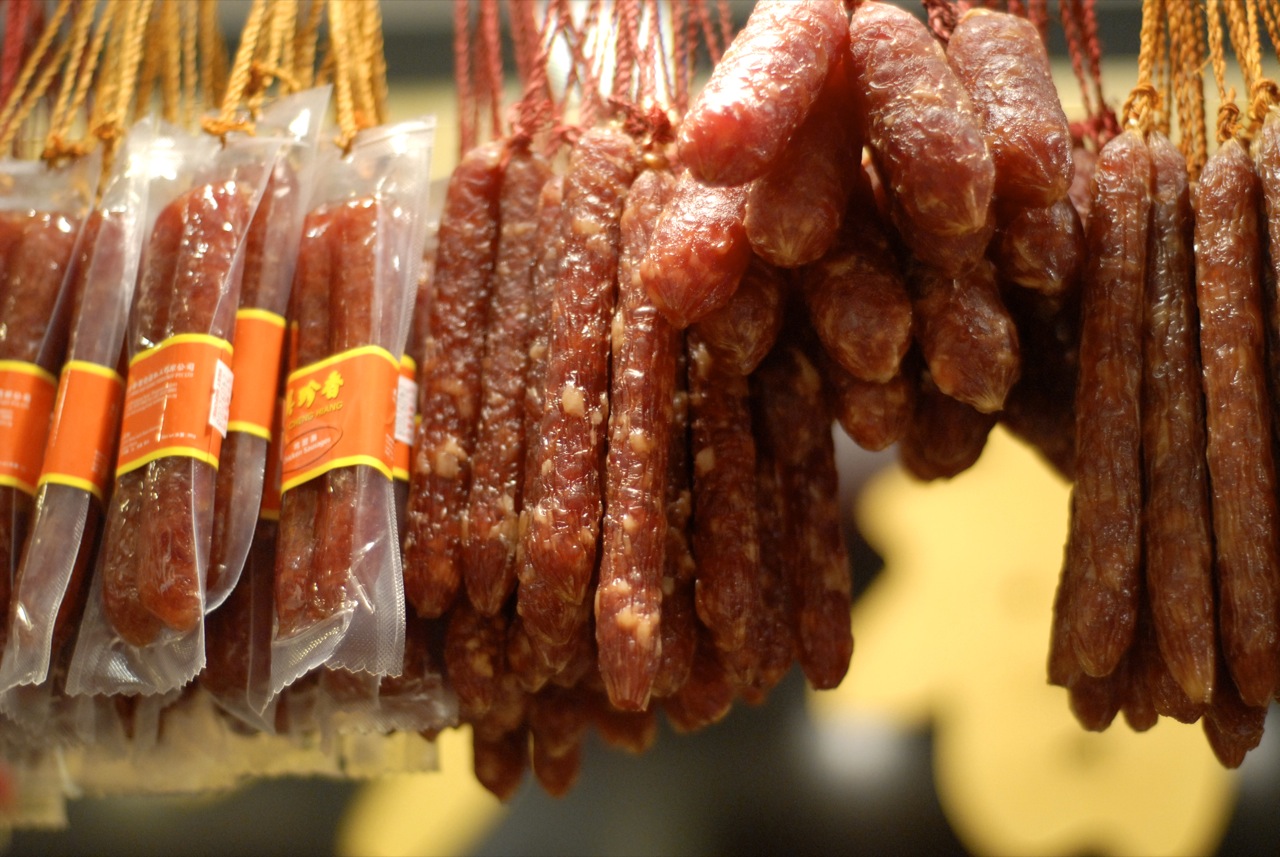
Various types of sausage from China
| Field | Value |
|---|---|
| name | Dried Chinese sausages |
| image | Chinese dried sausages in Hong Kong.jpg |
| caption | Dried Chinese sausages |
| alternate_name | lap cheong, lap chong |
| country | China |
| type | Sausage |
| main_ingredient | fresh pork or liver |
Chinese sausages are many different types of sausages with ties to China, the Sinosphere or the Chinese diaspora.
Varieties
There is a choice of fatty or lean sausages. There are different kinds ranging from those made using fresh pork to those made using pig livers, duck livers and even turkey livers. Usually a sausage made with liver will be darker in color than one made without liver. Recently, there have even been countries producing chicken Chinese sausages. Traditionally they are classified into two main types. It is sometimes rolled and steamed in dim sum.
- Lap cheong (Cantonese, or ) is a dried, hard sausage usually made from pork and pork fat. It is normally smoked, sweetened, and seasoned with rose water, rice wine and soy sauce.
- Yun chang () is made using duck liver.
- Xiang chang () is a fresh and plump sausage consisting of coarsely chopped pieces of pork and un-rendered pork fat. The sausage is rather sweet in taste.
- Nuomi chang () is a white-colored sausage consisting of glutinous rice and flavoring stuffed into a casing and then steamed or boiled until cooked. The nuomi chang of some Chinese cultures have blood as a binding agent similar to Korean sundae.
- Xue chang () are Chinese sausages that have blood as the primary ingredient.
- Bairouxue chang () is a type of sausage popular in northeast China that includes chopped meat in the blood mixture.
- Guan chang () is a long, red sausage made of fresh meat.
Regional
Lap cheong


Lap cheong, or Chinese sausage, is a type of cured meat product commonly found in southern regions of China such as Jiangsu, Zhejiang, Sichuan, and Guangdong.
The southern flavor of Chinese sausage is commonly known by its Cantonese name yue (or yue, ). Chinese sausage is used as an ingredient in a number of dishes in the southern Chinese provinces of Guangdong, Fujian, Jiangxi, Sichuan, and Hunan, and also Hong Kong and Taiwan.
Sichuan sausage
Sichuan sausage contains and is flavored by red chili powder, Sichuan pepper powder, and Pixian bean sauce. Two common examples of such dishes include fried rice and lo mai gai. The traditional unpackaged forms are usually found in street markets or wet markets.
Harbin-style sausage

In northeast China, especially Heilongjiang's largest city Harbin, Harbin-style sausage (), a popular regional specialty, is a coarsely ground, smoked savory red sausage similar to Polish "country" kielbasa and Lithuanian skilandis. It was first manufactured in March 1909 by Lithuanian staff in a Russian-capitalized factory named Churin Sausage Factory, located in Harbin's Daoli District. An alternative name is lidaosi (), from Russian колбаса литовская (kolbasa litovskaya, "Lithuanian sausage"). Harbin-style sausage subsequently became popular in China, especially in northern regions. A sweeter dried version similar to southern Chinese sausages is also produced.
Production
Traditional Chinese sausage is made by stuffing seasoned pork into natural casings made from animal intestines, then air-drying it naturally. However, in modern factory production, artificial casings are often used, and hot-air drying is employed to enhance production efficiency. Lap cheong can be eaten on its own and is also widely used as an ingredient in various Cantonese dishes.
Chinese sausage is believed to have originated during the Wei, Jin, and Northern and Southern Dynasties, or even earlier. Its earliest documented method appears in the Qimin Yaoshu, an agricultural text from the Northern Wei period.
The main ingredients for Chinese sausage are pork and sausage casings. First, the pork is finely chopped and mixed according to the desired ratio of fat to lean meat. Salt, sugar, rice wine, soy sauce, and other seasonings are added. The seasoned meat is then stuffed into casings, compressed, and segmented using string into desired lengths. One end is tied off, while the other end is fitted with a string for hanging. The sausages are then dehydrated using either natural air drying or hot-air drying, allowing for long-term preservation.
Uses
Compared to other types of preserved meats, Chinese sausage retains its pork fat better due to the casing that encases the meat mixture. In Guangdong and Hong Kong, Chinese sausage is a key ingredient in making lap mei fan (claypot rice with preserved meats). Whole sausages are placed on top of uncooked rice and steamed together. Once cooked, the rich, flavorful oils from the Chinese sausage infuse the rice, giving it a distinctive aroma and taste.
Chinese sausage buns (lap cheong bao) are steamed buns made with whole sausages inside. Sliced Chinese sausage can also be stir-fried with vegetables or mixed into other dishes. It is a common ingredient in a variety of Cantonese foods, including stir-fried glutinous rice, lo mai gai (sticky rice in lotus leaf), and turnip cake.
Health concerns
Because Chinese sausage is a processed food made from pork, it is often difficult for consumers to determine whether the source of the ingredients and the production methods meet hygiene standards. In the past, some producers were exposed for using pigs of unknown cause of death as raw material. Others added inedible dyes or excessive preservatives to make the sausages appear more visually appealing to consumers.
On September 14, 2006, Hong Kong’s Food and Environmental Hygiene Department released chemical and microbiological test results for seasonal festive foods. One sample of "Fengcheng Sliced Pork Sausage" produced in Macau was found to contain rhodamine B, a banned dye also known colloquially as “flower red powder.” This substance can cause chest discomfort, vomiting, and damage to the central nervous system.
In January 2013, a business in Zhejiang Province was exposed for using pigs of unknown cause of death to produce Chinese sausage. A total of 7,500 kilograms of the resulting “toxic sausage” was distributed to various nearby provinces and cities. The responsible party was sentenced on August 23 of that year.
In other countries

Vietnam
In Vietnamese, Chinese sausage is called lạp xưởng or lạp xường. It has been incorporated into a variety of dishes from simple omelets to more complex main courses. Due to the salty taste of the sausages, they are used in moderation with other ingredients to balance the flavor. The sausages are made from pork (lạp xưởng heo) or chicken (lạp xưởng gà), the latter of which yields a leaner taste. Tung lò mò (Cham: ꨓꨭꩂ ꨤꨟꨯꨱꨥ tung lamaow) is a similar sausage made from beef by the Chams (who are Muslim) in southern Vietnam. The province of Sóc Trăng is the largest producer of these sausages, with other production areas including Cái Lậy District. In local cuisine, dried pork sausage is commonly used as a filling in dumplings, pillow cakes (bánh gối), wontons, spring rolls (bánh tráng cuốn), mooncakes, and sticky rice dumplings (bánh chưng or bánh tét).
Myanmar
In Burmese, the sausage is called either kyet u gyaung (chicken sausage; ကြက်အူချောင်း) or wet u gyaung (pork sausage; ဝက်အူချောင်း). The sausages made in Myanmar are more meaty and compact compared to those in Singapore or China. They are usually used in fried rice and along with fried vegetables, mostly cabbage.
Philippines
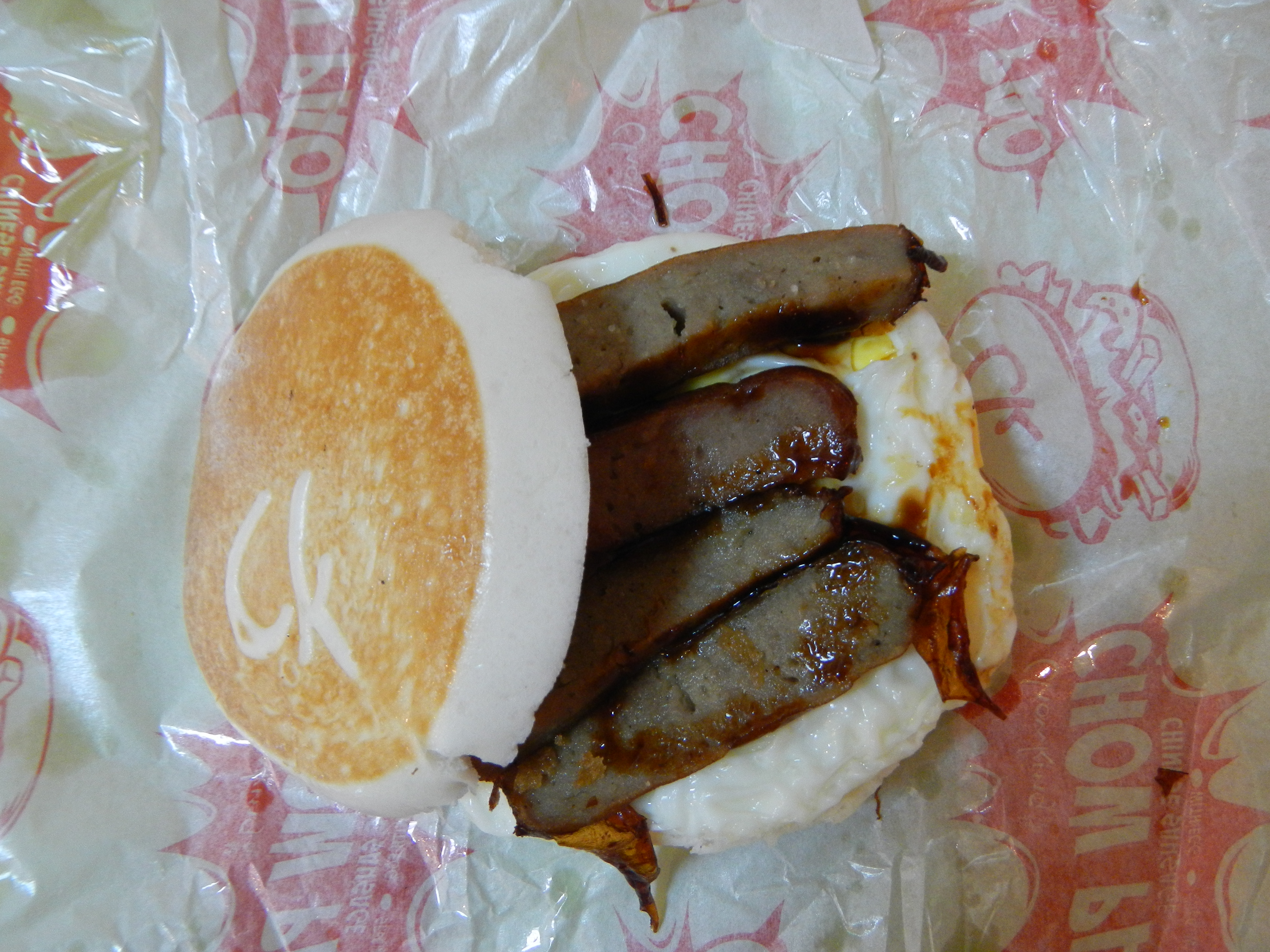
In the Philippines, Chinese sausage is an ingredient in some Chinese-Filipino dishes like siopao bola-bola. It is sometimes confused with and used in place of the native sausage chorizo de Macao (which is also sometimes known as "Chinese chorizo"). The latter is not derived from the Chinese sausage, but derives its name from the use of star anise, which is associated with Chinese cuisine in the Philippines.
Taiwan
Taiwan also produces a similar form of sausage; however, they are rarely dried in the manner of Cantonese sausages. The fat and meat may be emulsified, and a larger amount of sugar may be used, yielding a sweeter taste. These sausages are usually produced by local butchers and sold at markets or made at home. This variant of Chinese sausage is known as xiangchang ({{linktext|香腸}}) in Mandarin Chinese, literally meaning fragrant sausage.
Singapore
Singapore produces innovative Chinese sausages that could be considered healthier than the traditional variety. Examples include low-fat, low-sodium, and high-fibre Chinese sausages.
Thailand

In Thai, Chinese sausage is called kun chiang () after its name in the Teochew Min (贯肠, kwan chiang), the dominant Chinese language within the Thai Chinese community. It is used in several Chinese dishes by the sizeable Thai Chinese community, and also in some Thai dishes such as yam kun chiang, a Thai salad made with this sausage. There is also Chinese sausage made with snakehead fish (pla chon; ).
Suriname
In Suriname, Chinese sausage is referred to by a Hakka Chinese word (花肠, fa1 cong3, 'motled sausage') rendered as fatjong, fachong,{{cite book |editor-last1= Van Binnendijk |editor-first1= Chandra |editor-last2= Faber |editor-first2= Paul |trans-title= Sranan. Culture in Suriname |trans-chapter= Own associations and integration |access-date= December 28, 2018 |archive-url= https://web.archive.org/web/20180508125432/http://www.dbnl.org/tekst/binn011sran01_01/binn011sran01_01.pdf |archive-date= May 8, 2018 |url-status= live | trans-title = Colourful festival of Surinamese | access-date = December 28, 2018 fa-chong, fashong, or fasjong in colloquial spelling. It is part of the dish moksi meti tyawmin (mixed meat chow mein).
Other regions
Chinese sausages are generally available in Asian supermarkets outside Asia, mostly in a vacuum-packaged form, although some Chinese groceries sell the unpackaged varieties as well. These tend to be made domestically due to prohibitions on import of meat products from overseas. For example, many of the Chinese sausages sold in Canada are produced by a number of manufacturers based in Vancouver and Toronto. Lap cheong is also a very popular sausage in Hawaii due to large numbers of Chinese in Hawaii who have incorporated it into local cuisine.
Images
File:Chinese dried sausages in Hong Kong.jpg|Chinese dried sausages from Hong Kong File:Lachang Cantonese short.jpg|Short Cantonese Lachang File:Chinese sausages drying.jpg|Chinese sausages drying
References
References
- CNN Go [http://www.cnngo.com/hong-kong/none/40-things-eat-hong-kong-coronary-arrest-820489 40 Hong Kong foods we can't live without] {{Webarchive. link. (2012-11-05 13 July 2011. Retrieved 2011-10-09)
- 广式腊肠的历史起源_加工 [https://www.sohu.com/a/304044761_120101487 Origin and Processing of Cantonese Lap Cheong.] www.sohu.com. March 27, 2019.
- {{lang. (29 September 2011). "Bǎinián hā'ěrbīn hóng cháng fāzhǎn shǐ". {{lang.
- "блюда традиционной местной кухни". 哈尔滨市人民政府.
- "31 dishes: A guide to China's regional specialties". CNN Travel.
- 天然肠衣和胶原蛋白肠衣哪些事儿 [https://scjgj.cq.gov.cn/bkzs/xfts/202501/t20250127_14245826.html All About Natural Casings and Collagen Casings] – 重庆市市场监督管理局.Chongqing Municipal Administration for Market Regulation. scjgj.cq.gov.cn. January 27, 2025.
- 腊肠. [https://www.28228.cn/mingcai/sucai/372.html Lap Cheong.] www.28228.cn. September 21, 2021.
- 手切腊肠尝真味 [http://hk.apple.nextmedia.com/supplement/food/art/20131213/18548418 Hand-Cut Chinese Sausage for Authentic Flavor] ([https://web.archive.org/web/20170119172017/http://hk.apple.nextmedia.com/supplement/food/art/20131213/18548418 archived] copy, stored at the [[Internet Archive]]), Apple Daily, December 13, 2013.
- 广式腊肠煲仔饭 [https://www.gd.gov.cn/zjgd/lnms/gzms/content/post_111448.html Cantonese Chinese Sausage Claypot Rice.] 广东省人民政府门户网站 ''Guangdong Provincial Government Portal''. www.gd.gov.cn. [April 21, 2025].
- Ho, Christine. 迷你臘腸卷【美心特約食譜】[https://www.christinesrecipes.com/2013/11/steamed-chinese-sausage-rolls.html? Steamed Chinese Sausage Rolls.[Maxim’s Sponsored Recipe]] 简易食谱 - 基丝汀: 中西各式家常菜谱. ''Easy Recipes – Christine's Recipes: Easy-to-Follow Chinese & Western Home Cooking''.
- 臘味:香港的冬季滋味.[https://guide.michelin.com/mo/zh_HK/article/features/chinese-cured-meat-winter-delight-hong-kong Preserved Meats: Hong Kong’s Winter Delicacies.] MICHELIN Guide
- 含“若丹明B” 恶心呕吐 奇华腊肠致癌回收 [http://the-sun.on.cc/channels/news/20060115/20060115024257_0000.html Contains "Rhodamine B" — Nausea and Vomiting; Kee Wah Chinese Sausages Recalled Due to Carcinogenic Risk] ([https://web.archive.org/web/20160305072209/http://the-sun.on.cc/channels/news/20060115/20060115024257_0000.html archived] copy, stored at the [[Internet Archive]]). ''The Sun'', January 15, 2006.
- 黑心老板用病死猪肉制售7500多斤“毒腊肠” [http://news.qq.com/a/20140823/015995.htm Corrupt Businessman Used Meat from Diseased Pigs to Produce Over 7,500 Jin of “Toxic Chinese Sausage”] ([https://web.archive.org/web/20190612053745/http://news.qq.com/a/20140823/015995.htm archived] copy, stored at the [[Internet Archive]]). ''Tencent News'', August 23, 2014.
- "Chinese Sausage Chow Pao with Egg - Side Dish".
- [http://www.sp.edu.sg/wps/portal/vp-spws/!ut/p/c0/04_SB8K8xLLM9MSSzPy8xBz9CP0os_hQD1NXIzdTEwN_UwsLA09_C28Ti5AwI-9gU_2CbEdFAFO4vBc!/ Low Fat Sausages - Singapore Polytechnic] {{Webarchive. link. (2016-04-01 .)
- [http://www.sp.edu.sg/wps/portal/vp-spws/!ut/p/c0/04_SB8K8xLLM9MSSzPy8xBz9CP0os_hQD1NXIzdTEwN_UwsLA09_C28Ti5AwI28DY_2CbEdFADYNu3s!/ Shitake Sausages - Singapore Polytechnic] {{Webarchive. link. (2016-04-02 .)
- "Processed meat – uncooked". Australian Government Department of Agriculture, Fisheries, and Forestry.
- "FSIS Issues Public Health Alert for Ineligible Imported Meat and Poultry Products from China {{!}} Food Safety and Inspection Service". USDA FSIS.
- (9 April 2015). "Conditions for importing meat products from China". Government of Canada Canadian Food Inspection Agency.
- (11 June 2008). "Is that a sausage in your suitcase?". The Globe and Mail.
This article was imported from Wikipedia and is available under the Creative Commons Attribution-ShareAlike 4.0 License. Content has been adapted to SurfDoc format. Original contributors can be found on the article history page.
Ask Mako anything about Chinese sausage — get instant answers, deeper analysis, and related topics.
Research with MakoFree with your Surf account
Create a free account to save articles, ask Mako questions, and organize your research.
Sign up freeThis content may have been generated or modified by AI. CloudSurf Software LLC is not responsible for the accuracy, completeness, or reliability of AI-generated content. Always verify important information from primary sources.
Report