From Surf Wiki (app.surf) — the open knowledge base
Chimera (mythology)
Mythical or fictional creature with parts taken from various animals
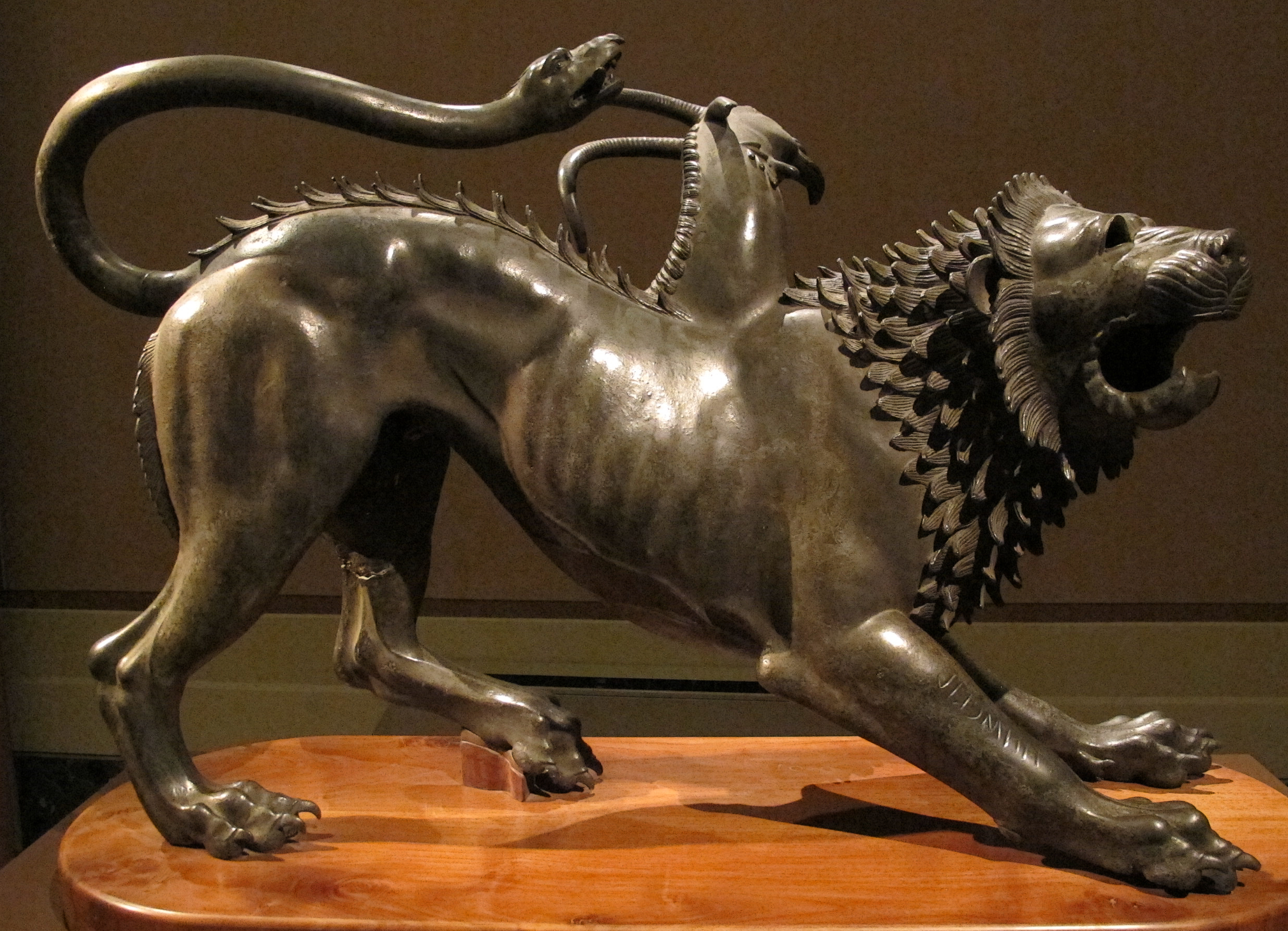
Mythical or fictional creature with parts taken from various animals
| Field | Value |
|---|---|
| type | Greek |
| image | Chimera Apulia Louvre K362.jpg |
| caption | The Chimera on a red-figure Apulian plate, BC (Musée du Louvre) |
| siblings | Lernaean Hydra, Orthrus, Cerberus |
| name | Chimera |
| offspring | Nemean lion, Sphinx |
| consort | Orthrus |
| abode | Lycia |
| parents | Typhon and Echidna |
According to Greek mythology, the Chimera, Chimaera, Chimæra, or Khimaira ( ; ) was a monstrous fire-breathing hybrid creature from Lycia, Asia Minor, composed of different animal parts. Typically, it is depicted as a lion with a goat's head protruding from its back and a tail ending with a snake's head. Some representations also include dragon's wings. It was an offspring of Typhon and Echidna, and a sibling of monsters like Cerberus and the Lernaean Hydra.
The term "chimera" has come to describe any mythical or fictional creature with parts taken from various animals.
Mythology
Family
According to Hesiod, the Chimera's mother was a certain ambiguous "she", which may refer to Echidna, in which case the father would presumably be Typhon, though possibly (unlikely) the Hydra or even Ceto was meant instead. However, the mythographers Apollodorus (citing Hesiod as his source) and Hyginus both make the Chimera the offspring of Echidna and Typhon. Hesiod also has the Sphinx and the Nemean lion as the offspring of Orthus, and another ambiguous "she", often understood as probably referring to the Chimera, although possibly instead to Echidna, or again even Ceto.
Description
.jpg)
Homer described the Chimera in the Iliad, saying that "she was of divine stock not of men, in the fore part a lion, in the hinder a serpent, and in the midst a goat, breathing forth in terrible wise the might of blazing fire." Hesiod and Apollodorus gave similar descriptions: a three-headed creature with a lion in front, a fire-breathing goat in the middle, and a serpent in the rear.
Cumaean Sibyl
In a lesser known tale, the Cumaean Sibyl encountered the Chimera in a vision, interpreting it as an omen. She advised her followers to establish harmony in their community to prevent the chaos and destruction that might have been brought about by the Chimera.
Killed by Bellerophon
.jpg)

According to Homer, the Chimera, who was reared by Araisodarus (the father of Atymnius and Maris, Trojan warriors killed by Nestor's sons Antilochus and Trasymedes) was "a bane to many men". As told in the Iliad, the hero Bellerophon was ordered by the king of Lycia to slay the Chimera (hoping the monster would kill Bellerophon). Still, the hero, "trusting in the signs of the gods", succeeded in killing the Chimera. Hesiod adds that Bellerophon had help in killing the Chimera, saying, "her did Pegasus and noble Bellerophon slay".
Apollodorus gave a more complete account of the story. Iobates, the king of Lycia, had ordered Bellerophon to kill the Chimera (who had been killing cattle and had "devastated the country") since he thought that the Chimera would instead kill Bellerophon, "for it was more than a match for many, let alone one". But the hero mounted his winged horse Pegasus (who had sprung from the blood of Medusa) "and soaring on high shot down the Chimera from the height."
Iconography

Although the Chimera was, according to Homer, situated in foreign Lycia, her representation in the arts was wholly Greek. An autonomous tradition that did not rely on the written word was represented in the visual repertory of the Greek vase painters. The Chimera first appeared early in the repertory of the proto-Corinthian pottery painters, providing some of the earliest identifiable mythological scenes that may be recognized in Greek art. After some early hesitation, the Corinthian type was fixed in the 670s BC; the variations in the pictorial representations suggest multiple origins to Marilyn Low Schmitt. The fascination with the monstrous devolved by the end of the seventh century into a decorative Chimera motif in Corinth, while the motif of Bellerophon on Pegasus took on a separate existence alone. A separate Attic tradition, where the goats breathe fire and the animal's rear is serpentine, begins with the confidence that Marilyn Low Schmitt is convinced that there must be unrecognized or undiscovered local precursors. Two vase painters employed the motif so consistently they were given the pseudonyms the Bellerophon Painter and the Chimaera Painter.
Similar creatures
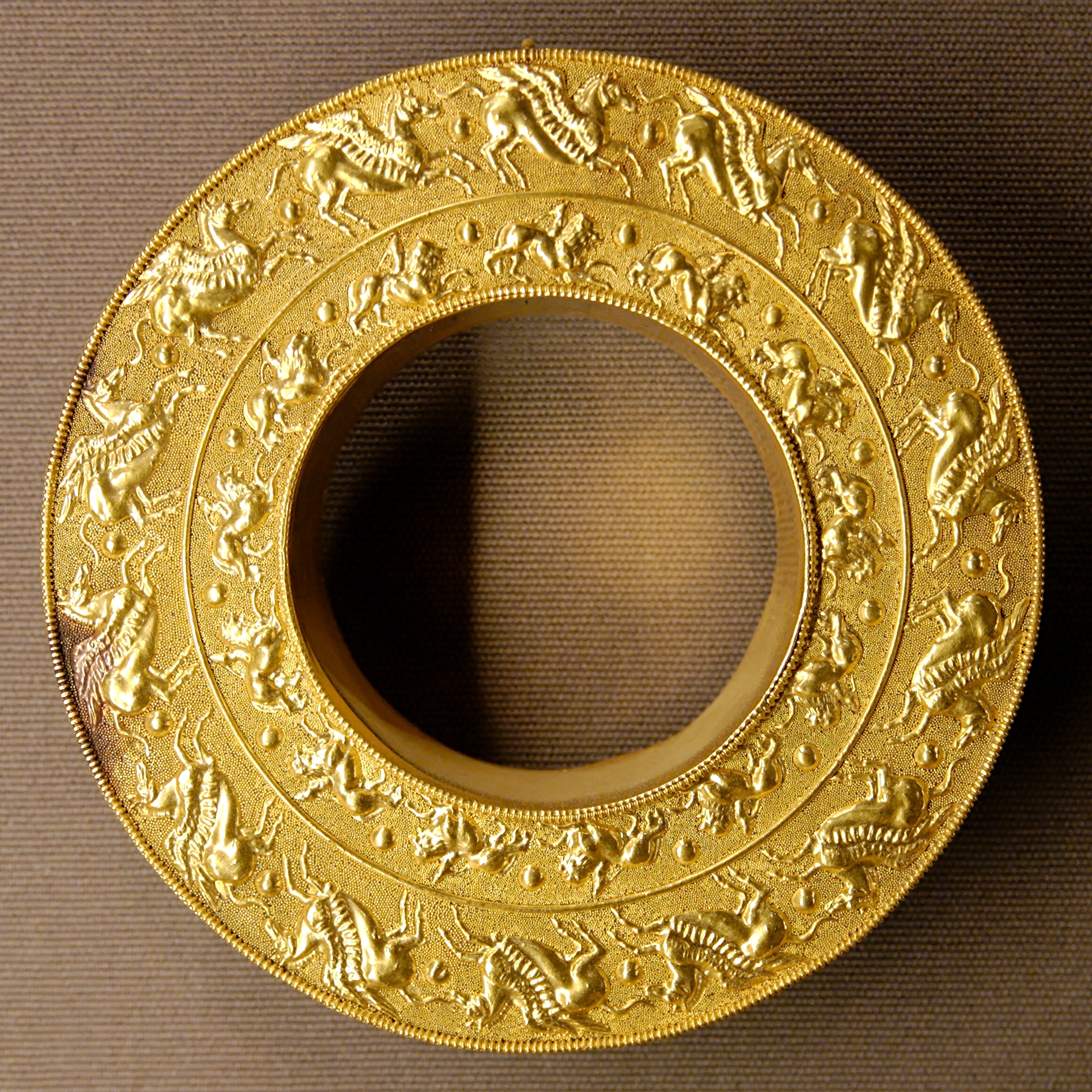
A fire-breathing lioness was one of the earliest solar and war deities in Ancient Egypt (representations from 3000 years prior to the Greeks), and influences are feasible. The lioness represented the war goddess and protector of both cultures that would unite as Ancient Egypt. Sekhmet was one of the dominant deities in upper Egypt and Bast in lower Egypt. As the divine mother, and more especially as protector, for Lower Egypt, Bast became strongly associated with Wadjet, the patron goddess of Lower Egypt.
In the Etruscan civilization, the Chimera appears in the Orientalizing period that precedes Etruscan Archaic art. The Chimera appears in Etruscan wall paintings of the fourth century BC.
In the Indus Valley Civilisation, the Chimera is depicted in many seals. There are different kinds of Chimera composed of animals from the Indian subcontinent. It is not known what the Indus people called the Chimera.
Although the Chimera of antiquity was forgotten in Medieval art, chimerical figures appear as embodiments of the deceptive, even satanic, forces of raw nature. They were depicted with a human face and a scaly tail, as in Dante's vision of Geryon in Inferno xvii.7–17, 25–27, hybrid monsters, more akin to the Manticore of Pliny's Natural History (viii.90), provided iconic representations of hypocrisy and fraud well into the seventeenth century through a symbolic representation in Cesare Ripa's Iconological.
Classical sources
The myths of the Chimera may be found in the Bibliotheca of Pseudo-Apollodorus (book 1), the Iliad (book 16) by Homer, the Fabulae 57 and 151 by Hyginus, the Metamorphoses (book VI 339 by Ovid; IX 648), and the Theogony 319ff by Hesiod.
Virgil, in the Aeneid (book 5) employs Chimaera for the name of a gigantic ship of Gyas in the ship-race, with possible allegorical significance in contemporary Roman politics.
Hypothesis about origin
Main article: Mount Chimaera

Pliny the Elder cited Ctesias and quoted Photius identifying the Chimera with an area of permanent gas vents that still may be found by hikers on the Lycian Way in southwest Turkey. Called in Turkish, Yanartaş (flaming rock), the area contains some two dozen vents in the ground, grouped in two patches on the hillside above the Temple of Hephaestus approximately 3 km north of Çıralı, near ancient Olympos, in Lycia. The vents emit burning methane thought to be of metamorphic origin. The fires of these were landmarks in ancient times and were used for navigation by sailors.

The Neo-Hittite Chimera from Carchemish, dated 850–750 BC, which is now housed in the Museum of Anatolian Civilizations, is believed to be a basis for the Greek legend. It differs, however, from the Greek version in that a winged body of a lioness also has a human head rising from her shoulders.
Use for Chinese mythological creatures
Some western scholars of Chinese art, starting with Victor Segalen, use the word "chimera" generically to refer to winged leonine or mixed species quadrupeds, such as bixie, tianlu, and even qilin.{{citation|jstor=3250032
In popular culture

The term, and often the general concept, has been adopted by various works of popular culture, and chimeras of differing description can be found in contemporary works of fantasy and science fiction.
In Heraldry, the Chimera is shown to have the head and front legs of lion, the head of a goat emerging from its back with parts of its center body being a goat as well, the hindquarters of a dragon, and a snake-headed tail.
Notes
References
- Apollodorus, Apollodorus, The Library, with an English Translation by Sir James George Frazer, F.B.A., F.R.S. in 2 Volumes. Cambridge, Massachusetts, Harvard University Press; London, William Heinemann Ltd. 1921. Online version at the Perseus Digital Library.
- Caldwell, Richard, Hesiod's Theogony, Focus Publishing/R. Pullins Company (June 1, 1987). .
- Clay, Jenny Strauss, Hesiod's Cosmos, Cambridge University Press, 2003. .
- Gantz, Timothy, Early Greek Myth: A Guide to Literary and Artistic Sources, Johns Hopkins University Press, 1996, Two volumes: (Vol. 1), (Vol. 2).
- Hard, Robin, The Routledge Handbook of Greek Mythology: Based on H.J. Rose's "Handbook of Greek Mythology", Psychology Press, 2004, . Google Books.
- Hesiod, Theogony, in The Homeric Hymns and Homerica with an English Translation by Hugh G. Evelyn-White, Cambridge, Massachusetts, Harvard University Press; London, William Heinemann Ltd. 1914. Online version at the Perseus Digital Library.
- Homer, The Iliad with an English Translation by A.T. Murray, Ph.D. in two volumes. Cambridge, Massachusetts, Harvard University Press; London, William Heinemann, Ltd. 1924. Online version at the Perseus Digital Library.
- Hyginus, Gaius Julius, Fabulae in Apollodorus' Library and Hyginus' Fabulae: Two Handbooks of Greek Mythology, Translated, with Introductions by R. Scott Smith and Stephen M. Trzaskoma, Hackett Publishing Company, 2007. .
- Most, G.W., Hesiod, Theogony, Works and Days, Testimonia, Edited and translated by Glenn W. Most, Loeb Classical Library No. 57, Cambridge, Massachusetts, Harvard University Press, 2018. . Online version at Harvard University Press.
- Peck, Harry Thurston, 1898. Harpers Dictionary of Classical Antiquities: "Chimaera"
- West, M. L., Hesiod: Theogony, Oxford University Press.
References
- (2006). "Encyclopedia of World Religions". Foreign Media Group.
- Graves, Robert. (2017). "The Greek Myths: The Complete and Definitive Edition". [[Penguin Books]] Limited.
- Peck, [https://www.perseus.tufts.edu/hopper/text?doc=Perseus:text:1999.04.0062:entry=chimaera-harpers "Chimaera"].
- The referent of "she" in ''[[Theogony]]'' [https://www.loebclassics.com/view/hesiod-theogony/2018/pb_LCL057.29.xml 319] is uncertain, see Clay, [https://books.google.com/books?id=2etBN0w0NGUC&pg=PA159 p. 159, with n. 34]; Gantz, p. 22 ("Echidna ... the Hydra ... or even less probably Keto"); Most, [https://www.loebclassics.com/view/hesiod-theogony/2018/pb_LCL057.29.xml p. 29 n. 18] ("probably Echidna"); Caldwell, p. 47 lines 319-325 ("probably Echidna, not Hydra"); West, pp. 254–255 line 319 '''ἡ δὲ''' ("Echidna or Hydra?").
- [[Hyginus (Fabulae). Hyginus]], ''[[Fabulae]]'' Theogony 39, 151; [[Bibliotheca (Pseudo-Apollodorus). Apollodorus]], [http://data.perseus.org/citations/urn:cts:greekLit:tlg0548.tlg001.perseus-eng1:2.3.1 2.3.1].
- The referent of "she" at [[Hesiod]], ''Theogony'' [https://www.loebclassics.com/view/hesiod-theogony/2018/pb_LCL057.29.xml 326] is uncertain, see Clay, [https://books.google.com/books?id=2etBN0w0NGUC&pg=PA159 pp. 159–160, with n. 34]; Most, [https://www.loebclassics.com/view/hesiod-theogony/2018/pb_LCL057.29.xml p. 29 n. 20] ("Probably Chimaera"); Hard, [https://books.google.com/books?id=r1Y3xZWVlnIC&pg=PA63 p. 63] ("Chimaira (or conceivably with his mother Echidna)"); Gantz, p. 23 ("[Chimera] ... or just possibly Echidna"); Caldwell, p. 47 lines 326 ("either Echidna or Chimaira"); West 1966, p. 356 line 326 '''ἡ δ' ἄρα''' ("much more likely ... Chimaera" than Echidna).
- [[Homer]], ''[[Iliad]]'' [https://www.perseus.tufts.edu/hopper/text?doc=Perseus%3Atext%3A1999.01.0134%3Abook%3D6%3Acard%3D156 6.180–182]
- Apollodorus]], [http://data.perseus.org/citations/urn:cts:greekLit:tlg0548.tlg001.perseus-eng1:2.3.1 2.3.1]: it had the fore part of a lion, the tail of a dragon, and its third head, the middle one, was that of a goat, through which it belched fire ... a single creature with the power of three beasts".
- "VIRGIL, AENEID BOOK 6".
- "The Cumaean Sibyl".
- [[Homer]], ''[[Iliad]]'' [http://data.perseus.org/citations/urn:cts:greekLit:tlg0012.tlg001.perseus-eng1:16.306-16.350 16.317–329]; compare with [[Bibliotheca (Pseudo-Apollodorus). Apollodorus]], [http://data.perseus.org/citations/urn:cts:greekLit:tlg0548.tlg001.perseus-eng1:2.3.1 2.3.1].
- [[Homer]], ''[[Iliad]]'' [http://data.perseus.org/citations/urn:cts:greekLit:tlg0012.tlg001.perseus-eng1:6.156-6.190 6.160–183].
- [[Hesiod]], ''[[Theogony]]'' [http://data.perseus.org/citations/urn:cts:greekLit:tlg0020.tlg001.perseus-eng1:304-336 325], so also [[Pindar]], ''Olympian'' [http://data.perseus.org/citations/urn:cts:greekLit:tlg0033.tlg001.perseus-eng1:13 13.84–90].
- [[Bibliotheca (Pseudo-Apollodorus). Apollodorus]], [http://data.perseus.org/citations/urn:cts:greekLit:tlg0548.tlg001.perseus-eng1:2.3.1 2.3.1].
- "Pegasus {{!}} Greek mythology {{!}} Britannica".
- [[Bibliotheca (Pseudo-Apollodorus). Apollodorus]], [http://data.perseus.org/citations/urn:cts:greekLit:tlg0548.tlg001.perseus-eng1:2.3.2 2.3.2]; compare with [[Hyginus (Fabulae). Hyginus]], ''[[Fabulae]]'' 57.
- Homer, ''Iliad'' [https://www.perseus.tufts.edu/hopper/text?doc=Hom.+Il.+16.327 16.328–329], links her breeding to the non-Trojan ally Amisodarus of Lycia, as a plague for humans.
- Anne Roes "The Representation of the Chimaera" ''The Journal of Hellenic Studies'' '''54'''.1 (1934), pp. 21–25, adduces Ancient Near Eastern conventions of winged animals whose wings end in animal heads.
- This outline of Chimera motifs follows Marilyn Low Schmitt, "Bellerophon and the Chimaera in Archaic Greek Art" ''American Journal of Archaeology'' '''70'''.4 (October 1966), pp. 341–347.
- Later coins struck at [[Sicyon]], near Corinth, bear the chimera-motif. (Schmitt 1966:344 note.
- Schmitt 1966.
- John F. Moffitt, "An Exemplary Humanist Hybrid: Vasari's 'Fraude' with Reference to Bronzino's 'Sphinx'" ''Renaissance Quarterly'' '''49'''.2 (Summer 1996), pp. 303–333, traces the chimeric image of Fraud backward from [[Bronzino]].
- W.S.M. Nicoll, "Chasing Chimaeras" ''The Classical Quarterly'' New Series, '''35'''.1 (1985), pp. 134–139.
- (2016). "The Ashgate Encyclopedia of Literary and Cinematic Monsters". [[Routledge]].
This article was imported from Wikipedia and is available under the Creative Commons Attribution-ShareAlike 4.0 License. Content has been adapted to SurfDoc format. Original contributors can be found on the article history page.
Ask Mako anything about Chimera (mythology) — get instant answers, deeper analysis, and related topics.
Research with MakoFree with your Surf account
Create a free account to save articles, ask Mako questions, and organize your research.
Sign up freeThis content may have been generated or modified by AI. CloudSurf Software LLC is not responsible for the accuracy, completeness, or reliability of AI-generated content. Always verify important information from primary sources.
Report