From Surf Wiki (app.surf) — the open knowledge base
Chili pepper
Varieties of pepper of the genus ''Capsicum''

Varieties of pepper of the genus ''Capsicum''
Chili peppers, also spelled chile or chilli ( ), are varieties of berry-fruit plants from the genus Capsicum, which are members of the nightshade family Solanaceae, cultivated for their pungency (spicy heat). They are used as a spice to add pungency in many cuisines. Capsaicin and the related capsaicinoids give chili peppers their intensity when ingested or applied topically. Chili peppers exhibit a range of heat and flavors. This diversity is the reason behind the availability of different types of chili powder, each offering its own taste and heat level.
Chili peppers originated in Central or South America and were first cultivated in Mexico. European explorers brought chili peppers back to the Old World in the late 16th century as part of the Columbian Exchange, which led to the cultivation of multiple varieties across the world for food and traditional medicine. Five Capsicum species have been widely cultivated: annuum, baccatum, chinense, frutescens, and pubescens.
History
Origins
Capsicum plants originated in modern-day Peru and Bolivia, and have been a part of human diets since about 7,500 BC. They are one of the oldest cultivated crops in the Americas. Chili peppers were cultivated in east-central Mexico some 6,000 years ago,{{cite web |url= https://www.ucdavis.edu/news/birthplace-domesticated-chili-pepper-identified-mexico |title= Birthplace of the domesticated chili pepper identified in Mexico |author= Pat Bailey |date= April 17, 2014 |publisher= UC Davis |access-date=January 12, 2026 |url-status=live |archive-url= https://web.archive.org/web/20260112093324/https://www.ucdavis.edu/news/birthplace-domesticated-chili-pepper-identified-mexico |archive-date=January 12, 2026 }} and independently across different locations in the Americas including highland Peru and Bolivia, central Mexico, and the Amazon. They were among the first self-pollinating crops cultivated in those areas.
Peru has the highest diversity of cultivated Capsicum; it is a center of diversification where varieties of all five domesticates were introduced, grown, and consumed in pre-Columbian times. The largest diversity of wild Capsicum peppers is consumed in Bolivia. Bolivian consumers distinguish two basic forms: ulupicas, species with small round fruits including C. eximium, C. cardenasii, C. eshbaughii, and C. caballeroi landraces; and arivivis with small elongated fruits including C. baccatum var. baccatum and C. chacoense varieties.
.jpg)
Etymology
The English word is with the same meaning. The name of the plant is unrelated to that of the country Chile. While pepper originally meant the genus Piper, not Capsicum, the Oxford English Dictionary and Merriam-Webster record both usages. The three primary spellings are chili (common in North America), chile (Central America and parts of the US) and chilli (United Kingdom and former British colonies).
Distribution to Europe
When Christopher Columbus and his crew reached the Caribbean, they were the first Europeans to encounter Capsicum fruits. They called them "peppers" because, like black pepper (Piper nigrum), which had long been known in Europe, they have a hot spicy taste unlike other foods. Chilies were first brought back to Europe by the Spanish, who financed Columbus's voyages, at the start of the large-scale interchange of plants and culture between the New World and the Old World called the Columbian exchange. Chilies appear in Spanish records by 1493. Unlike Piper vines, which grow naturally only in the tropics, chilies could be grown in temperate climates. By the mid-1500s, they had become a common garden plant in Spain and were incorporated into numerous dishes. By 1526, they had appeared in Italy, in 1543 in Germany, and by 1569 in the Balkans, where they came to be processed into paprika.
Distribution to the rest of the world
The rapid introduction of chilies to Africa and Asia was likely through Portuguese and Spanish traders in the 16th century, though the details are unrecorded. The Portuguese introduced them first to Africa and Arabia, and then to their colonies and trading posts in Asia, including Goa, Sri Lanka, and Malacca. From there, chilies spread to neighboring regions in South Asia and western Southeast Asia via local trade and natural dispersal. Around the same time, the Spanish also introduced chilies to the Philippines, where they spread to Melanesia, Micronesia, and other Pacific Islands via their monopoly of the Manila galleons. Their spread to East Asia in the late 16th century is less clear, but was likely also through local trade or through Portuguese and Spanish trading ports in Canton, China, and Nagasaki, Japan.{{cite web |url= https://archive-yaleglobal.yale.edu/chili-small-fruit-sets-global-palettes-fire |title= Chili: Small Fruit Sets Global Palettes on Fire |author= Nils-Bertil Wallin |date= June 11, 2004 |publisher= Yale University |access-date=November 17, 2025 |url-status=live |archive-url=https://web.archive.org/web/20251117161724/https://archive-yaleglobal.yale.edu/chili-small-fruit-sets-global-palettes-fire |archive-date=November 17, 2025 }} The earliest known mention of the chili pepper in Chinese writing dates to 1591, though the pepper is thought to have entered the country in the 1570s.
Producing chili peppers
Cultivation
Chili peppers are the shiny, brightly coloured fruits of species of Capsicum. Botanically they are berries. The plants are small, 20 to depending on variety, making them suitable for growing in pots, greenhouses, or commercially in polytunnels. The plants are perennial, provided they are protected from cold. The fruits can be green, orange, red, or purple, and vary in shape from round and knobbly to smooth and elongated. If the fruits are picked green and unripe, more flowers develop, yielding more fruit; fruits left on the plant can become hotter in taste, and acquire their ripe coloration, at the price of a reduced harvest.
Ideal growing conditions for peppers include a sunny position with warm, loamy soil, ideally 21 to, that is moist but not waterlogged. The seeds germinate only when warm, close to 21 C. The plants prefer warm conditions, but can tolerate temperatures down to 12 C; and are sensitive to cold. The flowers can self-pollinate. However, at extremely high temperatures, 30 to, pollen loses viability, and its flowers are much less likely to result in fruit. For flowering, Capsicum is a non-photoperiod-sensitive crop.
Chilies are vulnerable to pests including aphids, glasshouse red spider mite, and glasshouse whitefly, all of which feed on plant sap. Common diseases include grey mould caused by Botrytis cinerea; this rots the tissues and produces a brownish-grey mould on the surface.
File:Achill.jpg|Young plants File:Buds and flowers of chili plants.jpg|Buds and flowers File:Chili pepper.jpg|Immature chilies in the field File:Shan Hills, Myanmar, Red chili pepper plant.jpg|Ripe chilies in the field, Myanmar File:Capsicum leaf deformated after aphids.jpg|Leaf damaged by aphids File:Chilli paper bd.jpg|Ripe chili pepper with seeds
Preparation
Harvested chilies may be used fresh, or dried, typically on the ground in hot countries, to make a variety of products. Drying enables chilies grown in temperate regions to be used in winter. For home use, chilies can be dried by threading them with cotton and hanging them up in a warm dry place to dry.
File:Chillies drying in Kathmandu.jpg|Chili peppers drying in Kathmandu, Nepal File:Andhra Chillies.jpg|Guntur chilli drying in the sun, Andhra Pradesh, India File:Red chili peppers Mesilla NM.jpg|New Mexico chiles dried on the plant in Mesilla, New Mexico File:Sundried chilli.jpg|Sundried chili at Imogiri, Yogyakarta, Indonesia File:Ristras Drying.jpg|alt=Chili peppers drying in hanging ristras|Ristras of chili peppers drying in Arizona File:Mujer chiles 3.JPG|Removing seeds and pith from dried chilies in San Pedro Atocpan, Mexico File:Chipotlestipicos.jpg|Smoke-dried chipotle
Products include whole dried chilies, chili flakes, and chili powder, Fresh or dried chilies are used to make hot sauce, a liquid condiment—usually bottled for commercial use—that adds spice to other dishes. Dried chilies are used to make chili oil, cooking oil infused with chili.
File:Inle Lake, Dried red chili (chilli) pepper, Capsicum annuum, Myanmar.jpg|Dried chili pepper flakes, Myanmar File:India - Kolkata 2 - 24 - New Market spice shops (3504585620).jpg|Chili powder, India Hot Sauce Selection At La Whole Food Store (84224397).jpeg|Brands of hot sauce, California File:Homemade Chili Oil (28909017356).jpg|Chili oil
Production
| Source: FAOSTAT of the United Nations |
|---|
In 2024, world production of green chillies and peppers (as any Capsicum or Pimenta fruits) was 45 million tonnes, with China accounting for 39% of the total and India with 12% (table).
Species and cultivars
Main article: List of Capsicum cultivars
Species of Capsicum that produce chili peppers are shown on the simplified phylogenetic tree, with examples of cultivars: The World Vegetable Center has one of the largest collection of chili peppers in the world. It has researched climate change resistant cultivars.
File:A Fat Red Cayenne Pepper.jpg|Cayenne peppers, a cultivar of Capsicum annuum File:Tabasco peppers.JPG|Tabasco peppers, a cultivar of Capsicum frutescens, fruits pointing upwards File:Habanero chile - fruits (aka).jpg|Habanero peppers, a cultivar of Capsicum chinense File:Cubanelle Peppers.jpg|Cubanelle peppers, United States File:HotPeppersinMarket.jpg|Scotch bonnets, Caribbean File:Phrik haeng.jpg|Bird's eye chilies, Thailand File:청양고추3.jpg|Cheongyang peppers, South Korea
File:Black pearl cultivar.jpg|Black Pearl cultivar of C. annuum File:Pimientos choriceros.jpg|Choricero, Spain File:Chili peppers cultivated in Myanmar.jpg|Purple chilies, Myanmar
Intensity
Capsaicin
Main article: Capsaicin
The substances that give chili peppers their pungency (spicy heat) when ingested or applied topically are capsaicin (8-methyl-N-vanillyl-6-nonenamide) and several related chemicals, collectively called capsaicinoids. Pure capsaicin is a hydrophobic, colorless, odorless, and crystalline-to-waxy solid at room temperature. The quantity of capsaicin varies by variety, and depends on growing conditions. Water-stressed peppers usually produce stronger fruits. When a habanero plant is stressed, for example by shortage of water, the concentration of capsaicin increases in some parts of the fruit.
When peppers are consumed by mammals such as humans, capsaicin binds with pain receptors in the mouth and throat, potentially evoking pain via spinal relays to the brainstem and thalamus where heat and discomfort are perceived. However, birds are unable to perceive the hotness and so they can eat some of the hottest peppers. The intensity of the "heat" of chili peppers is commonly reported in Scoville heat units (SHU), invented by American pharmacist Wilbur Scoville in 1912. Historically, it was a measure of the dilution of an amount of chili extract added to sugar syrup before its heat becomes undetectable to a panel of tasters; the more it has to be diluted to be undetectable, the more powerful the variety, and therefore the higher the rating. Since the 1980s, spice heat has been assessed quantitatively by high-performance liquid chromatography (HPLC), which measures the concentration of heat-producing capsaicinoids, typically with capsaicin content as the main measure.
Capsaicin is produced by the plant as a defense against mammalian predators. A study suggests that by protecting against attack by a hemipteran bug, the risk of disease caused by a Fusarium fungus carried by the insects is reduced. As evidence, the study notes that peppers increased the quantity of capsaicin in proportion to the damage caused by fungi on the plant's seeds.
Intensity range of commonly used cultivars
A wide range of intensity is found in commonly used peppers:
Hottest by country
The top 9 world's hottest chili peppers (by country) are:
| Country | Type | Heat (SHU) | |||||||
|---|---|---|---|---|---|---|---|---|---|
| United States | Pepper X | 2.69M | |||||||
| Wales | Dragon's Breath | 2.48M | |||||||
| United States | Carolina Reaper | 2.2M | |||||||
| Trinidad and Tobago | Trinidad moruga scorpion | 2.0M | |||||||
| India | Ghost pepper (Bhut jolokia) | url=http://yourlife.usatoday.com/fitness-food/story/2012-03-11/Chile-Pepper-Institute-studies-whats-hot/53490214/1 | title=Chile Pepper Institute studies what's hot | publisher=USA Today | work=Your life | vauthors=Joshi M | date=11 March 2012 | archive-url=https://web.archive.org/web/20120314210249/http://yourlife.usatoday.com/fitness-food/story/2012-03-11/Chile-Pepper-Institute-studies-whats-hot/53490214/1 | archive-date=14 March 2012 }} |
| Trinidad and Tobago | Trinidad Scorpion Butch T | 1.46M | |||||||
| England | Naga Viper | 1.38M | |||||||
| England | Armageddon | 1.3M | |||||||
| England | Infinity chili | 1.07M |
Safety
The volatile oil in chili peppers may cause skin irritation, requiring hand washing and care when touching the eyes or any sensitive body parts. Consuming hot peppers may cause stomach pain, hyperventilation, sweating, vomiting, and symptoms possibly requiring hospitalization.
Unscrupulous traders have illegally added at least eight different synthetic dyes, including Auramine O, Chrysoidine, Sudan stains I to IV, Para red, and Rhodamine B to chili products. All these chemicals are harmful. They can be detected by liquid chromatography used together with mass spectrometry.
As food
Nutritional value
Red hot chili peppers are 88% water, 9% carbohydrates, 2% protein, and 0.4% fat (table). In a 100 gram reference amount, chili peppers supply 40 calories, and are a rich source of vitamin C and vitamin B6.
Pungency
Due to their unique pungency (spicy heat), chili peppers constitute a crucial part of many cuisines around the world, particularly in Chinese (especially in Sichuanese food), Mexican, Thai, Indian, Yoruba, New Mexican cuisine and many other South American, Caribbean and East Asian cuisines. In 21st-century Asian cuisine, chili peppers are commonly used across many regions. Chili is a key ingredient in many curries, providing the desired amount of heat; mild curries may be flavoured with many other spices, and may omit chili altogether.
Cooking
Chilies with a low capsaicin content can be cooked like bell peppers, for example stuffing and roasting them. Hotter varieties need to be handled with care to avoid contact with skin or eyes; washing does not efficiently remove capsaicin from skin. Chilies can be roasted over very hot coals or grilled for a short time, as they break up if overcooked.
The leaves of every species of Capsicum are edible, being mildly bitter and nowhere near as hot as the fruits. They are cooked as greens in Filipino cuisine, where they are called dahon ng sili (literally "chili leaves"). They are used in the chicken soup tinola. In Korean cuisine, the leaves may be used in kimchi.
Regional cuisines
Chilies are present in many cuisines, including curries. In Peru, Papa a la huancaina is a dish of potatoes in a sauce of fresh cheese and aji amarillo chilies. In Thailand, kaeng tai pla fish curry is flavoured with a tai pla sauce made with garlic, shallots, galangal, kaffir lime, turmeric, fish paste, and bird's eye chilies. In Jamaica, jerk chicken is spiced with powerful habanero chilies and allspice. Goan vindaloo curry uses the extremely hot ghost pepper or bhut jolokia to create "perhaps [India's] hottest dish". In Bhutan, ema datshi, entirely made of chili mixed with local cheese, is the national dish. Many Mexican dishes use chilies of different types, including the jalapeño, poblano, habanero, serrano, chipotle, ancho, pasilla, guajillo, de árbol, cascabel and mulato. These offer a wide range of flavours including citrus, earthy, fruity, and grassy. They are used in many dishes and the spicy mole sauce and Mexican salsa sauces. In Yoruba cuisine, chillies are well used in many dishes including Ewa Agoyin and Obe ata. Chili dishes include arrabbiata sauce, paprikash, chiles en nogada, nam phrik, 'nduja, sambal, and som tam.--
File:Lamb Chops With Guajillo Chili Sauce and Charro Beans (cropped).jpg|Mexican lamb chops with guajillo chili sauce and charro beans File:Taj Mahal - Lamb Curry Madras.jpg|Lamb Madras curry File:Chilli pickle in a plate 2.jpg|Pickled chili in India File:Chili pepper dip Amman.JPG|Chili pepper dip in a traditional restaurant in Amman, Jordan File:Tinolang Manok.jpg|Filipino tinola chicken soup with labuyo chili leaves
Other uses
Ornamental plants
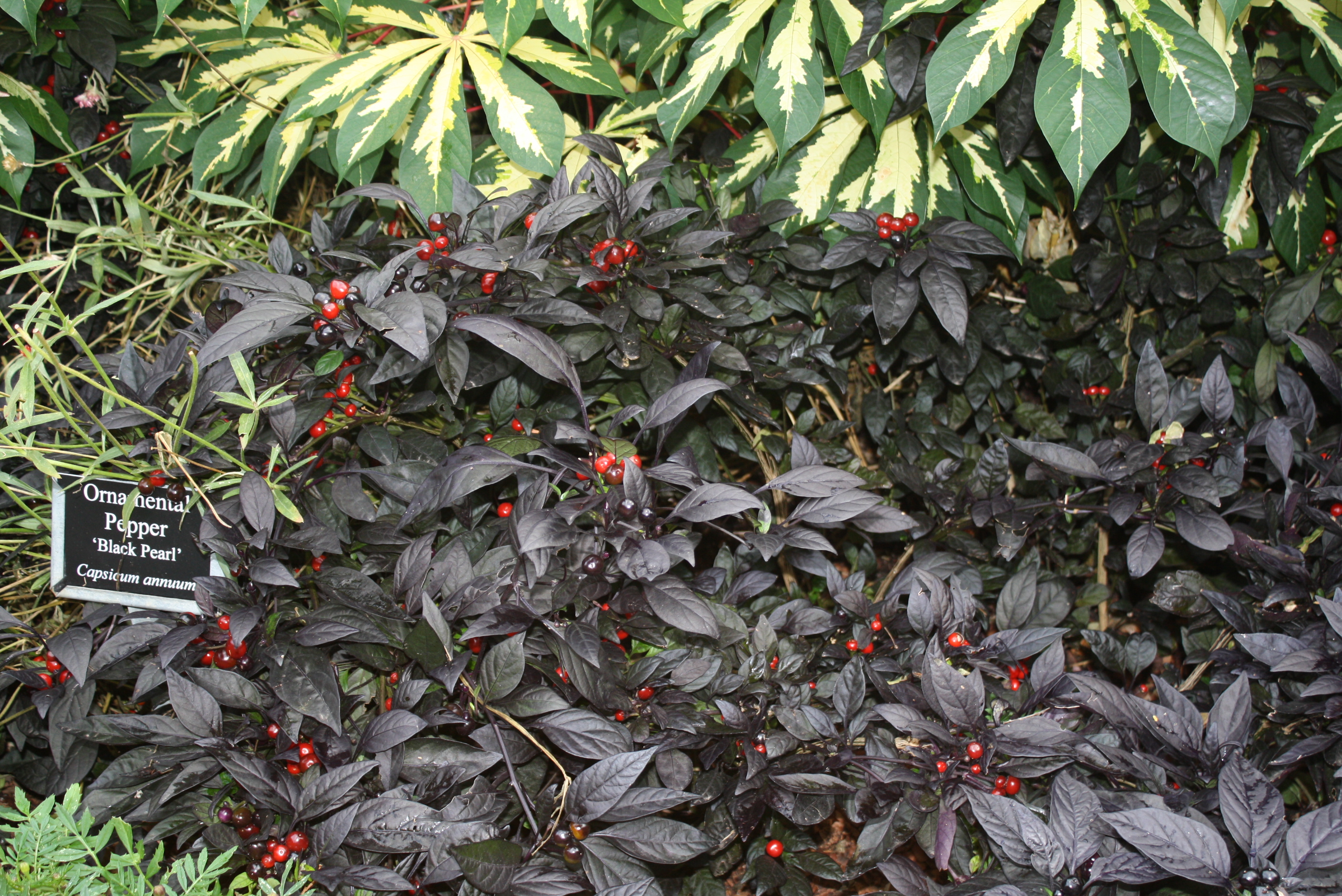
The contrast in color and appearance makes chili plants interesting to some as a purely decorative garden plant.
- Black pearl pepper: small cherry-shaped fruits and dark brown to black leaves
- Black Hungarian pepper: green foliage, highlighted by purple veins and purple flowers, jalapeño-shaped fruits
- Bishop's crown pepper, Christmas bell pepper: named for its distinct three-sided shape resembling a red bishop's crown or a red Christmas bell
Constrained risk-taking
Psychologist Paul Rozin suggests that eating ordinary chilies is an example of a "constrained risk" like riding a roller coaster, in which extreme sensations like pain and fear can be enjoyed because individuals know that these sensations are not actually harmful. This method lets people experience extreme feelings without any significant risk of bodily harm.
Topical use and health research
Capsaicin, the pungent chemical in chili peppers, is used as an analgesic in topical ointments, nasal sprays, and dermal patches to relieve pain. A 2022 review of preliminary research indicated that regular consumption of chili peppers was associated with weak evidence for a lower risk of death from cardiovascular diseases and cancer.
Chemical irritants
Capsaicin extracted from chilies is used in pepper sprays and some tear gas formulations as a chemical irritant, for use as less-lethal weapons for control of unruly individuals or crowds. Such products have considerable potential for misuse, and may cause injury or death.
In Africa and Asia, elephants nightly destroy crops and endanger people. Chilis are effective at keeping elephants away, as capsaicin irritates their large and sensitive olfactory and nasal system. Farmers can plant a few rows of the fruit around valuable crops; or they may burn chili dung bombs, bricks of dung and chili, creating a noxious smoke.
Birds do not have the same sensitivity to capsaicin as mammals, as they lack a specific pain receptor. Some species in the chili peppers' natural range eat the fruits, possibly dispersing the seeds.
Supposed aphrodisiac

The 16th century Spanish missionary and naturalist José de Acosta noted the supposed aphrodisiac power of chilies, but wrote that they were harmful to people's spiritual health. In the 1970s, the government of Peru forbade prison inmates to consume chilies, their explanation being that these were "not appropriate for men forced to live a limited lifestyle."
In space
The 2021 Plant Habitat-04 experiment aboard the International Space Station grew four chili plants in 137 days, producing twenty-six peppers across two harvests. Most were eaten by the crew; twelve were returned to Earth for study. The plants were a specially dwarfed variety of the Hatch cultivar. This was the "first generally recognized fruiting crop in space", following harvests of leaf crops such as lettuce and kale from 2014 onwards.
Notes
References
References
- B Pickersgill. (December 1971). "Relationships Between Weedy and Cultivated Forms in Some Species of Chili Peppers (Genus Capsicum)". Evolution; International Journal of Organic Evolution.
- PW Bosland. (1998). "Progress in New Crops". ASHS Press.
- (18 August 2022). "How The Chili Became Hot". [[The New York Times]].
- (April 2014). "Multiple lines of evidence for the origin of domesticated chili pepper, Capsicum annuum, in Mexico". Proceedings of the National Academy of Sciences of the United States of America.
- (16 December 2014). "A Systematic Approach to Species-Level Identification of Chile Pepper (Capsicum spp.) Seeds: Establishing the Groundwork for Tracking the Domestication and Movement of Chile Peppers through the Americas and Beyond". New York Botanical Garden Press.
- (July 2016). "Phylogenetic relationships, diversification and expansion of chili peppers ( Capsicum, Solanaceae)". Annals of Botany.
- (2015). "Screening Genetic Resources of Capsicum Peppers in Their Primary Center of Diversity in Bolivia and Peru". PLOS ONE.
- "chili (n.)". [[Online Etymology Dictionary]].
- (1913). "Pepper". [[Clarendon Press]].
- {{cite Merriam-Webster. pepper
- {{Cite Merriam-Webster. Chili
- ''The [[Canadian Oxford Dictionary]]'' lists ''chili'' as the main entry.
- (August 1990). "Seed To Civilization: The Story of Food". Harvard University Press.
- {{Cite Merriam-Webster. chile
- (1933). "Chilli, chilly". Clarendon Press.
- "Fall in exports crushes chilli prices in Guntur". Thehindubusinessline.com.
- "Chilli, Capsicum and Pepper are spicy plants grown for the pod. Green chilli is a culinary requirement in any Sri Lankan household". [[The Sunday Times (Sri Lanka).
- (2000). "Peppers: Vegetable and Spice Capsicums". [[Centre for Agriculture and Bioscience International.
- "The Story of Chile Peppers".
- (2017). "Historical Geography of Crop Plants A Select Roster". CRC Press.
- S Raghavan. (2006). "Handbook of Spices, Seasonings, and Flavorings". CRC Press.
- (2020). "Chile Peppers A Global History". University of New Mexico Press.
- (February 2006). "Curry". Oxford University Press.
- (1 January 2007). "Spices". New India Publishing.
- Brian R. Dott. (2020). "The Chile Pepper in China". [[Columbia University Press]].
- "HORT410. Peppers – Notes". [[Purdue University]] Department of Horticulture and Landscape Architecture.
- "Growing Peppers: The Important Facts". GardenersGardening.com.
- (3 December 2025). "How to grow chilli pepper / RHS Gardening".
- (5 July 2022). "The Effect of Extreme Temperatures on the Tomato and Pepper Crop". King's Printer for Ontario, 2012–24, Canada.
- (2005). "Handbook of Food Science, Technology, and Engineering". [[Taylor & Francis]].
- (1998). "Spices, Condiments and Seasonings". [[Chapman & Hall]].
- (2012-04-24). "Hot Sauce!". Storey Publishers.
- (3 June 2021). "What is chili crisp? This spicy condiment belongs on everything — even dessert".
- (2026). "Green chili production in 2024; Crops/World Regions/Production Quantity/Year from pick lists". UN Food and Agriculture Organization, Statistics Division (FAOSTAT).
- (20 November 2020). "Phylogenetic Analysis and Molecular Diversity of Capsicum Based on rDNA-ITS Region". Horticulturae.
- (2013). "Conservation of tropical plant species". [[Springer Science+Business Media.
- (16 June 2023). "The Quest to Save Chili Peppers".
- (15 October 1958). "New Species of Capsicum from South America". Brittonia.
- (1961). "Studies on the pungent principles of red pepper. Part VIII. On the chemical constitutions of the pungent principles.". Nippon Nogeikagaku Kaishi.
- (1962). "Studies on the pungent principles of red pepper. Part XI. Determination and contents of the two pungent". Journal of the Agricultural Chemical Society of Japan.
- (27 May 2023). "Capsaicin". PubChem, US National Library of Medicine.
- (1 March 2011). "Water Deficit Affects the Accumulation of Capsaicinoids in Fruits of Capsicum chinense Jacq.". HortScience.
- (October 2012). "Unravelling the mystery of capsaicin: a tool to understand and treat pain". Pharmacological Reviews.
- "History of the Scoville Scale | FAQS". Tabasco.Com.
- (2017). "Sensory properties of chili pepper heat - and its importance to food quality and cultural preference". Appetite.
- (August 2008). "Evolutionary ecology of pungency in wild chilies". Proceedings of the National Academy of Sciences of the United States of America.
- (11 October 2000). "Chile Pepper Heat Scoville Scale". Homecooking.about.com.
- Atwal S. (16 October 2023). "Pepper X dethrones Carolina Reaper as world's hottest chilli pepper".
- (22 January 2018). "The Hottest Chilli in the World was Created in Wales Accidentally". [[National Geographic]].
- (19 November 2013). "Confirmed: Smokin Ed's Carolina Reaper sets new record for hottest chilli". [[Guinness World Records]].
- (16 February 2012). "Trinidad Moruga Scorpion wins hottest pepper title". Yahoo! News.
- (11 March 2012). "Chile Pepper Institute studies what's hot". USA Today.
- (12 April 2011). "Aussies grow world's hottest chilli". Australian Geographic.
- (25 February 2011). "Title of world's hottest chili pepper stolen – again". [[The Independent]].
- (30 July 2019). "Armageddon chilli".
- (19 February 2011). ""Record-breaking" chilli is hot news". [[BBC News]].
- (8 May 2019). "How to Handle Hot Peppers and Chiles Safely". Better Homes and Gardens.
- (23 March 2007). "Goldfrank's Toxicologic Emergencies". [[McGraw Hill Education.
- (2013). "Simultaneous determination of eight illegal dyes in chili products by liquid chromatography–tandem mass spectrometry". [[Journal of Chromatography B]].
- [https://fdc.nal.usda.gov/food-details/170106/nutrients Link to USDA Database entry]
- (14 June 2007). "Chili Peppers: Global Warming".
- (20 February 2015). "What's driving the global chili pepper craze?". Forbes Media.
- (1982). "Madhur Jaffrey's Indian Cookery". [[BBC]].
- "Chili recipes".
- "Dahon ng Sili (Chili pepper leaves)". Tribo ความสุขบนเตียง.
- "Vitamin Rich Chili pepper Leaf Kimchi". Ssoft International Corporation.
- (18 February 2024). "Some like it hot: searching the seven continents for the best spicy dishes". Cathay Pacific.
- (2023-10-23). "This is what it's like hiking the newly reopened Trans-Bhutan Trail".
- (8 May 2023). "Ema Datshi".
- "Ancho to serrano: a guide to Mexican chillies".
- Chidi, Chef. (2017-11-19). "Ewa Agoyin - Yoruba Pepper Sauce for Beans".
- (2006). "New Ornamental Pepper Wins Prestigious Award".
- "Chilies as Ornamental Plants". Seedsbydesign.
- (2014). "Capsicum baccatum (pepper)". CABI Digital Library.
- (1980). "The Nature and Acquisition of a Preference for Chili Pepper by Humans". Motivation and Emotion.
- (June 2016). "Capsaicin: Current Understanding of Its Mechanisms and Therapy of Pain and Other Pre-Clinical and Clinical Uses". Molecules.
- (March 2022). "Association of pepper intake with all-cause and specific cause mortality - A systematic review and meta-analysis". American Journal of Preventive Cardiology.
- (October 2017). "Health impacts of chemical irritants used for crowd control: a systematic review of the injuries and deaths caused by tear gas and pepper spray". BMC Public Health.
- "Elephant Crop Raids Foiled by Chili Peppers, Africa Project Finds".
- (July 2001). "Seed dispersal. Directed deterrence by capsaicin in chilies". Nature.
- (2004). "Aphrodisiac Foods: Bringing Heaven to Earth". [[Gastronomica]].
- (30 November 2021). "NASA's Second Pepper Harvest Sets Record on Space Station". NASA.
This article was imported from Wikipedia and is available under the Creative Commons Attribution-ShareAlike 4.0 License. Content has been adapted to SurfDoc format. Original contributors can be found on the article history page.
Ask Mako anything about Chili pepper — get instant answers, deeper analysis, and related topics.
Research with MakoFree with your Surf account
Create a free account to save articles, ask Mako questions, and organize your research.
Sign up freeThis content may have been generated or modified by AI. CloudSurf Software LLC is not responsible for the accuracy, completeness, or reliability of AI-generated content. Always verify important information from primary sources.
Report