From Surf Wiki (app.surf) — the open knowledge base
Chilas
City in Pakistani-administered Kashmir
City in Pakistani-administered Kashmir
| Field | Value |
|---|---|
| name | Chilas |
| native_name | |
| native_name_lang | ur |
| settlement_type | City administered by Pakistan |
| image_skyline | File:River-indus-near-chilas.jpg |
| image_caption | The Indus River near Chilas |
| image_map1 | Kashmir region. LOC 2003626427 - showing sub-regions administered by different countries.jpg |
| map_caption1 | A map showing Pakistan-administered Gilgit-Baltistan shaded in sage-green colour in the disputed Kashmir region |
| mapframe | yes |
| mapframe-zoom | 4 |
| mapframe-marker | city |
| coordinates | |
| subdivision_type | Administering country |
| subdivision_name | Pakistan |
| subdivision_type1 | Autonomous state |
| subdivision_name1 | Gilgit-Baltistan |
| subdivision_type2 | District |
| subdivision_name2 | Diamer District |
| unit_pref | Metric |
| elevation_m | 1265 |
| population_total | 214,000 |
| population_as_of | 2017-2017 |
| population_density_km2 | auto |
| demographics_type1 | Languages |
| demographics1_title1 | Official |
| demographics1_info1 | Urdu, Shina |
| timezone1 | PST |
| utc_offset1 | +5 |
| postal_code_type | PIN |
| postal_code | 14100 – 1xx |
| mapframe-zoom = 4 | mapframe-marker = city
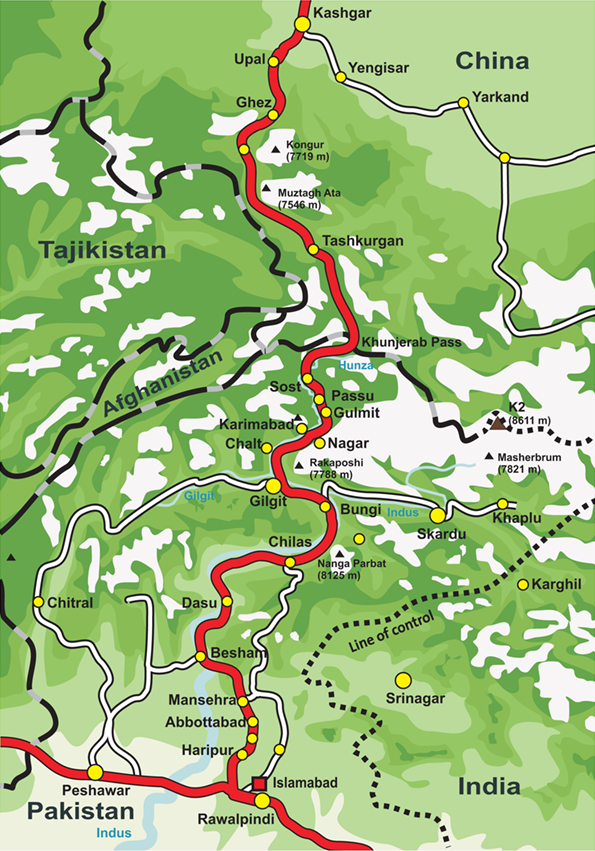
Chilas () is a city in Pakistani-administered Gilgit–Baltistan in the Kashmir region.The application of the term "administered" to the various regions of Kashmir and a mention of the Kashmir dispute is supported by the tertiary sources (a) through (d), reflecting due weight in the coverage. Although "controlled" and "held" are also applied neutrally to the names of the disputants or to the regions administered by them, as evidenced in sources (f) through (h) below, "held" is also considered politicized usage, as is the term "occupied," (see (i) below).
(a) (subscription required) Quote: "Kashmir, region of the northwestern Indian subcontinent ... has been the subject of dispute between India and Pakistan since the partition of the Indian subcontinent in 1947. The northern and western portions are administered by Pakistan and comprise three areas: Azad Kashmir, Gilgit, and Baltistan, the last two being part of a territory called the Northern Areas. Administered by India are the southern and southeastern portions, which constitute the state of Jammu and Kashmir but are slated to be split into two union territories."; (b) (subscription required) Quote: "Aksai Chin, Chinese (Pinyin) Aksayqin, portion of the Kashmir region, at the northernmost extent of the Indian subcontinent in south-central Asia. It constitutes nearly all the territory of the Chinese-administered sector of Kashmir that is claimed by India to be part of the Ladakh area of Jammu and Kashmir state."; (c) C. E Bosworth, University of Manchester Quote: "KASHMIR, kash'mer, the northernmost region of the Indian subcontinent, administered partlv by India, partly by Pakistan, and partly by China. The region has been the subject of a bitter dispute between India and Pakistan since they became independent in 1947"; (d) Quote: "Jammu and Kashmir: Territory in northwestern India, subject to a dispute betw een India and Pakistan. It has borders with Pakistan and China." (e) Quote: "We move from a disputed international border to a dotted line on the map that represents a military border not recognized in international law. The line of control separates the Indian and Pakistani administered areas of the former Princely State of Jammu and Kashmir."; (f) (subscription required) Quote: "... China became active in the eastern area of Kashmir in the 1950s and has controlled the northeastern part of Ladakh (the easternmost portion of the region) since 1962."; (g) Quote: "J&K: Jammu and Kashmir. The former princely state that is the subject of the Kashmir dispute. Besides IJK (Indian-controlled Jammu and Kashmir. The larger and more populous part of the former princely state. It has a population of slightly over 10 million, and comprises three regions: Kashmir Valley, Jammu, and Ladakh.) and AJK ('Azad" (Free) Jammu and Kashmir. The more populous part of Pakistani-controlled J&K, with a population of approximately 2.5 million. AJK has six districts: Muzaffarabad, Mirpur, Bagh, Kodi, Rawalakot, and Poonch. Its capital is the town of Muzaffarabad. AJK has its own institutions, but its political life is heavily controlled by Pakistani authorities, especially the military), it includes the sparsely populated "Northern Areas" of Gilgit and Baltistan, remote mountainous regions which are directly administered, unlike AJK, by the Pakistani central authorities, and some high-altitude uninhabitable tracts under Chinese control." (h) Quote: "Kashmir’s identity remains hotly disputed with a UN-supervised “Line of Control” still separating Pakistani-held Azad (“Free”) Kashmir from Indian-held Kashmir."; (i) Quote:"Some politicised terms also are used to describe parts of J&K. These terms include the words 'occupied' and 'held'." It is the divisional capital of Diamer Division and is located on the Indus River. It is part of the Silk Road, connected by the Karakoram Highway and N-90 National Highway to Islamabad and Peshawar in the southwest, via Hazara and Malakand divisions of Khyber Pakhtunkhwa. To the north, Chilas connects to the cities of Tashkurgan and Kashgar in Xinjiang, China, via Gilgit, Aliabad, Sust, and the Khunjerab Pass.
Chilas is the headquarters of Diamer district. The weather is hot and dry in the summer and cold and dry in the winter. It can be reached by the Karakoram Highway and also through the Kaghan valley via the Babusar Pass. Chilas is on the left bank of the Indus River. The beautiful Fairy Meadows National Park and Nanga Parbat, the ninth highest peak in the world, are also located in Chilas.
Karakoram International University has a sub-campus in Chilas.
History
Even after Kashmiri-British rule was imposed a century ago, the Indus Valley west of Chilas was a hornet’s nest of tiny republics; there was one in almost every side valley, each loosely guided by a jirga (council of tribal elders) but effectively leaderless, all at war with one another and feuding internally. Though administratively lumped with Gilgit, Chilas and its neighbours are temperamentally more like Indus Kohistani people, probably due to a similarly hostile environment and the same Sunni Muslim orthodoxy. Their ancestors were converted to Islam by a Sufi Muslim, from the Kaghan valley. Syed Noor Shah, known as Ghazi Baba, was the first man to preach Islam in Thak, and built the first mosque, which is still there. Ghazi Baba belonged to the Syed family of Kaghan. In Tangir and Darel, Islam came from the direction of Swat direction.
Chilas Fort was first garrisoned to protect British supply lines over the Babusar Pass, and beefed up after local tribes nearly overran it in 1893. Now a police post, it has put a lid on Chilas, though not on the Darel and Tangir Valleys to the west.
The Chilasis are Shina speakers, with some Pashtun settlers speaking Pashto. Urdu and some English are also spoken.
The Daram Khail family are aloso shina speakers .They are respected sub-branch of the Yashkun tribe, residing in the Chilas region of Gilgit-Baltistan
Climate
Chilas has a cold semi-arid climate (Köppen: BSk). The average temperature is 28.2 C in July and 5.6 C in January.
Ancient petroglyphs
Main article: Gilgit-Baltistan, Pakistan#Rock art and petroglyphs


More than 50,000 Buddhist petroglyphs and inscriptions line the Karakoram Highway in Gilgit-Baltistan, Pakistan. They are concentrated at ten major sites between Hunza and Shatial, but more have been found near Skardu and Shigar, where and Thewalt found the remains of a Buddhist monastery in 1984. The carvings were left by various invaders, traders and pilgrims who passed along the trade route, as well as by locals. The earliest date back to between 5000 and 1000 BC, showing single animals, triangular men and hunting scenes in which the animals sometimes are larger than the hunters. These carvings were pecked into the rocks with stone tools and are covered with a thick patina that proves their age. Later — mostly Buddhist — carvings were sometimes executed with a sharp chisel.
Jettmar tried to piece together the history of the area from various inscriptions and recorded his findings in "Rockcarvings and Inscriptions in the Northern Areas of Pakistan" and the later "Between Gandhara and the Silk Roads: Rock carvings along the Karakoram Highway".
The Kharoshthi term "Kaboa" (or Kamboa) appears in a short commemorative Kharosthi inscription found from Chilas as reported by the Archaeological Department of Pakistan. The inscription has been transcribed, translated and interpreted by Ahmad Hasan Dani, a Pakistani archaeologist, historian, and linguist, who was among the foremost authorities on South Asian archaeology and history. According to Dani, Kaboa or Kamboa of the inscription is a Kharoshthised form of Sanskrit Kamboja. Thus, it seems likely that Chilas also formed part of an ancient Kamboja kingdom.
File:Rama Krishna at Chilas.jpg|(Bala)rama and Krishna at Chilas. The Kharoshthi inscription nearby reads Rama [kri]ṣa. 1st century CE. File:Chilas petroglyphs, Buddhist stupa circa 300-350 CE.jpg|Buddhist stupa, circa 300-350 CE based on paleography. Donor with Sanskrit name venerating a stupa, Thalpan-Ziyarat, northern Pakistan, circa 7th century CE.jpg|Donor in Central Asian dress with Sanskrit name venerating a stupa, Thalpan-Ziyarat, northern Pakistan, circa 7th century CE.
Notable persons
- Muhammad Bilal Khan, journalist (1997 - 2019)
- Hussain Ahmad Journalist 1995 -
Notes

References
- Jettmar, Karl & Thewalt, Volker (1985): Zwischen Gandhāra und den Seidenstraßen: Felsbilder am Karakorum Highway: Entdeckungen deutsch-pakistanischer Expeditionen 1979-1984. 1985. Mainz am Rhein, Philipp von Zabern.
- Jettmar, Karl (1980): Bolor & Dardistan. Karl Jettmar. Islamabad, National Institute of Folk Heritage.
- Leitner, G. W. (1893): Dardistan in 1866, 1886 and 1893: Being An Account of the History, Religions, Customs, Legends, Fables and Songs of Gilgit, Chilas, Kandia (Gabrial) Yasin, Chitral, Hunza, Nagyr and other parts of the Hindukush, as also a supplement to the second edition of The Hunza and Nagyr Handbook. And An Epitome of Part III of the author's "The Languages and Races of Dardistan." First Reprint 1978. Manjusri Publishing House, New Delhi.
- Rod MacNeil: The Fight at Chilas (1893). Soldiers of the Queen (journal of the Victorian Military Society). March 1999.
References
- (15 November 2006). "INDO-IRANIAN FRONTIER LANGUAGES". Encyclopaedia Iranica.
- "Post Codes". Pakistan Post Office.
- Pamir Times August 2, 2012
- "Diamer Campus – KIU {{!}} Diamer Campus".
- Syed Noor Shah Baba
- Asad Ali Khan 1992: 291, English translation by the author
- "Chilas چلاس climate: Average Temperature, weather by month, Chilas چلاس weather averages - Climate-Data.org".
- (January 2020). "The Global Connections of Gandhāran Art".
- (2018). "Images of the Crowned Buddha along the Silk Road: Iconography and Ideology". Humanities.
- See: Volker Thewalt, Stupas und verwandte Bauwerke in Felsbildern am oberen Indus, Wiesenbach 2008, {{ISBN. 978-3-9802753-4-7
- Chilas: The City of Nanga Parvat (Dyamar), 1983, p 120, Ahmad Hasan Dani - Chilās Region (Pakistan)
- See also: The Name 'Cambyses', Pakistan Archaeology, 1991, p 123, Wojciech Skalmowski, Pakistan Dept. of Archaeology & Museums - Pakistan.
- (1997). "Many Heads, Arms, and Eyes: Origin, Meaning, and Form of Multiplicity in Indian Art". BRILL.
- (2002). "Chital petroglyphs". Wayne State University Press.
- (2017). "A Turk in the Dukhang? Comparative Perspectives on Elite Dress in Medieval Ladakh and the Caucasus". Austrian Academy of Science Press.
This article was imported from Wikipedia and is available under the Creative Commons Attribution-ShareAlike 4.0 License. Content has been adapted to SurfDoc format. Original contributors can be found on the article history page.
Ask Mako anything about Chilas — get instant answers, deeper analysis, and related topics.
Research with MakoFree with your Surf account
Create a free account to save articles, ask Mako questions, and organize your research.
Sign up freeThis content may have been generated or modified by AI. CloudSurf Software LLC is not responsible for the accuracy, completeness, or reliability of AI-generated content. Always verify important information from primary sources.
Report