From Surf Wiki (app.surf) — the open knowledge base
Chesterfield House, Westminster
Former grand London townhouse in Mayfair

Former grand London townhouse in Mayfair
the house in Mayfair

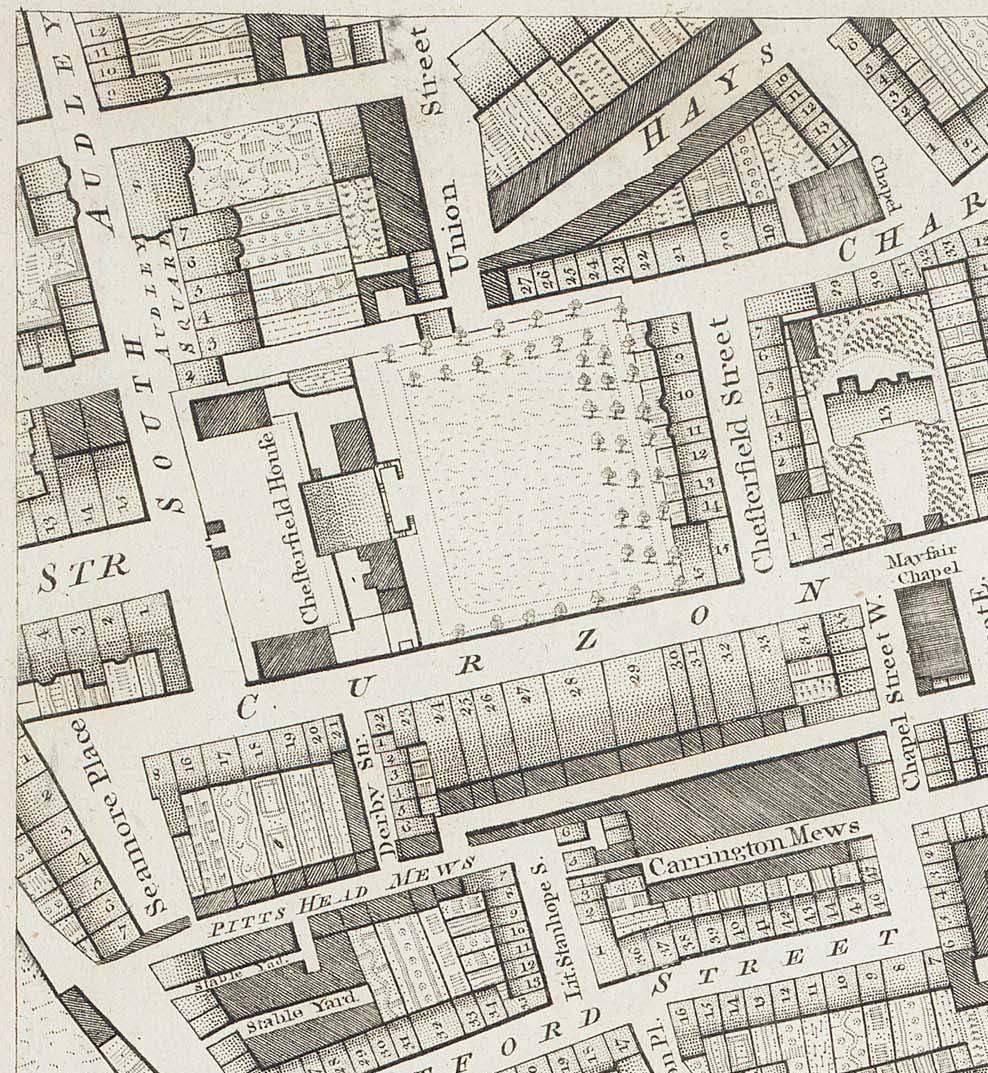
Chesterfield House was a grand London townhouse built between 1747 and 1752 by Philip Stanhope, 4th Earl of Chesterfield (1694–1773), statesman and man of letters. The exterior was in the Palladian style, the interior Baroque. It stood in Mayfair on the north side of Curzon Street, between South Audley Street and what is now Chesterfield Street. It was demolished in 1937 and on its site now stands a block of flats of the same name.
The French travel writer Pierre-Jean Grosley in his book Londres (1770, translated as Tour to London) considered the house to be equal to the hotels particuliers of the nobility in Paris.
History

The house was built on land belonging to Richard Howe, 1st Earl Howe by Isaac Ware. In his "Letters to his Son", Chesterfield wrote from "Hotel Chesterfield" on 31 March 1749: "I have yet finished nothing but my boudoir and my library; the former is the gayest and most cheerful room in England; the latter the best. My garden is now turfed, planted and sown, and will in two months more make a scene of verdure and flowers not common in London."
Ownership and Occupants
In 1850 George Stanhope, 6th Earl of Chesterfield leased the House to James Hamilton, 2nd Marquess of Abercorn (later 1st Duke of Abercorn from 1868), who occupied the property until 1869.{{cite book |access-date=2 August 2025
In 1884 Magniac sold Chesterfield House to brewing millionaire Sir Michael Bass, 1st Bt.{{cite news |access-date=2 August 2025 |url-access=subscription |access-date=2 August 2025 |url-access=subscription
Following Lord Burton's death, the Dowager Lady Burton leased the House to Henry Innes-Ker, 8th Duke of Roxburghe and his American millionaire wife Mary Goelet. The Duke and Duchess of Roxburghe loaned the House to the British Government during World War I, and the house was placed at the disposal of the Head of the American Special Mission to the United Kingdom Colonel House immediately upon his arrival in London on 7 November 1917.{{cite book |editor-last=Neumann |editor-first=Brian F. |access-date=2 August 2025 |access-date=2 August 2025 |url-access=subscription
Royal Residence: 1923-1934
The Duchess of Roxburghe relinquished her lease of Chesterfield House in 1919; in the previous year the House had purchased by Henry Lascelles, Viscount Lascelles from the Dowager Lady Burton for £140,000, |access-date=2 August 2025 and he took up residence following Colonel House's departure in 1919. Lord Lascelles (who became the Sixth Earl of Harewood in 1929) later married Princess Mary in 1923, and the House served the couple's London home until the early 1930's. The house was loaned to Princess Mary's brother and sister-in-law Prince Albert, Duke of York and Elizabeth, Duchess of York as a temporary residence during the London season of 1924.{{cite book |last=Asquith |first=Cynthia |title=The Duchess of York |location=London |publisher=Hutchinson & Co. (Publishers) Ltd. |date=1928 |page=187 |url=https://archive.org/details/in.ernet.dli.2015.527082/page/n241/mode/2up?q=%22chesterfield+house%22 |access-date=21 August 2025 |via=Internet Archive}}
In 1931, King George V and Queen Mary purchased 32 Green Street, Mayfair as a London home for Princess Mary, rendering Chesterfield House superfluous to the couple's needs.{{cite thesis |access-date=2 August 2025 |access-date=2 August 2025
Demolition
Following the sale of the house by Lord Harewood in 1934, the House was demolished and a new block of apartments had been erected on the site of the former Mansion. The new apartment building was also known as Chesterfield House, and reportedly had a rent-roll of £36,000 when it was sold to the Prudential Assurance Company in mid-1939.{{cite news |access-date=2 August 2025 |url-access=subscription
Interior Features
Library
The Quarterly Review (founded 1809), no. 125, reported:
Staircase

The columns of the screen facing the courtyard and the marble staircase with bronze balustrade came from Cannons, near Edgware, the mansion of James Brydges, 1st Duke of Chandos (d.1744) which was demolished shortly after his death, the materials being sold at auction in 1747. Chesterfield also bought at the auction the portico and railings. Chesterfield also furnished his new mansion with artefacts from the sale at Houghton Hall, the country house of Robert Walpole, including an 18-candle copper-gilt lantern. The library was hung with portraits of the earl's ancestors. As a piece of satire concerning the fashion for boasts of ancient ancestry, he placed amongst these portraits two old portraits which he inscribed "Adam de Stanhope" and "Eve de Stanhope".
Creation of Stanhope Street
Chesterfield formed Stanhope Street on adjoining land purchased from the Dean and Chapter of Westminster.
Description in 1869


The following description is reproduced in Edward Walford's Old & New London:
In another room, not far from the library, one seems to gain an idea of the noble letter-writer's daily life, for we can still see its ante-chamber, in which the aspirants for his lordship's favour were sometimes kept waiting. (This room is immortalised in the Victorian portrayal by E.M. Ward (d.1879) of Dr Johnson in the ante-room of Lord Chesterfield). On the garden-front outside is a stone or marble terrace, overlooking the large lawn, stretching out in lawn and flower-beds behind the house.}} George Capel-Coningsby, 5th Earl of Essex (d.1839) remembered seeing the earl sitting on a rustic seat in front of his mansion, basking in the sun.
Sources
- Walford, Edward. Old & New London: A Narrative of Its History, Its People & Its Places, 6 vols., London, 1878, vol 4, pp. 353–359
References
References
- Error in source Edward Walford, who states (p.353) ground purchased from "Curzon, Earl Howe", an anachronism. It is assumed he meant Richard Howe
- The Times, 'Sale of Chesterfield House', Friday, 12 September 1919, Page 10.
- Mitton, Geraldine Edith. (2010). "Mayfair, Belgravia, and Bayswater - The Fascination of London". Nabu Press.
- Western Morning News, 'Princess Mary Leaves Chesterfield House, Tuesday, 22 December 1931, Page 7.
- Edward Walford ''Old & New London: A Narrative of Its History, Its People & Its Places'', 6 vols., London, 1878, vol 4, pp.354-356
This article was imported from Wikipedia and is available under the Creative Commons Attribution-ShareAlike 4.0 License. Content has been adapted to SurfDoc format. Original contributors can be found on the article history page.
Ask Mako anything about Chesterfield House, Westminster — get instant answers, deeper analysis, and related topics.
Research with MakoFree with your Surf account
Create a free account to save articles, ask Mako questions, and organize your research.
Sign up freeThis content may have been generated or modified by AI. CloudSurf Software LLC is not responsible for the accuracy, completeness, or reliability of AI-generated content. Always verify important information from primary sources.
Report