From Surf Wiki (app.surf) — the open knowledge base
Chernyakhovsk
Town in Kaliningrad Oblast, Russia

Town in Kaliningrad Oblast, Russia
| Field | Value |
|---|---|
| en_name | Chernyakhovsk |
| ru_name | Черняховск |
| image_skyline | {{multiple image |
| perrow | 1/2 |
| border | infobox |
| total_width | 266 |
| image1 | Сквер у памятника Барклаю де Толли.jpgTown centre and a statue of Michael Barclay de Tolly |
| image2 | Руины замка Инстербург.jpgMedieval castle ruins |
| image3 | Композиция домов 14,16,18,20 на улице Театральной.jpgPreserved old tenements in the town centre |
| caption1 | Town centre and a statue of Michael Barclay de Tolly |
| caption2 | Medieval castle ruins |
| caption3 | Historic tenements}} |
| pushpin_map | Russia Kaliningrad Oblast#European Russia#Europe |
| coordinates | |
| image_flag | Flag of Chernyakhovsk (2023).svg |
| image_coa | Coat of arms of Chernyakhovsk (2019).svg |
| federal_subject | Kaliningrad Oblast |
| federal_subject_ref | |
| adm_district_jur | Chernyakhovsky District |
| adm_district_jur_ref | |
| adm_selsoviet_jur | Chernyakhovsk |
| adm_selsoviet_type | Town of district significance |
| adm_selsoviet_jur_ref | |
| adm_ctr_of1 | Chernyakhovsky District |
| adm_ctr_of1_ref | |
| adm_ctr_of2 | town of district significance of Chernyakhovsk |
| adm_ctr_of2_ref | |
| inhabloc_cat | Town |
| inhabloc_cat_ref | |
| mun_district_jur | Chernyakhovsky Municipal District |
| mun_district_jur_ref | |
| urban_settlement_jur | Chernyakhovskoye Urban Settlement |
| urban_settlement_jur_ref | |
| mun_admctr_of1 | Chernyakhovsky Municipal District |
| mun_admctr_of1_ref | |
| mun_admctr_of2 | Chernyakhovskoye Urban Settlement |
| mun_admctr_of2_ref | |
| area_km2 | 58 |
| pop_density | 628 |
| pop_latest | 36423 |
| established_date | 1337 |
| established_date_ref | |
| current_cat_date | 10 October 1583 |
| postal_codes | 238150–238154, 238158, 238165, 238169, 238170, 238816 |
| dialing_codes | 40141 |
| website | http://inster39.ru/ |
Chernyakhovsk (; ; ; ) is a town in Kaliningrad Oblast, Russia, and the administrative center of Chernyakhovsky District. With a population of 35,705 as of 2023, it is the third-largest city of the Kaliningrad Oblast (behind Kaliningrad and Sovetsk).
It is located at the confluence of the Instruch and Angrapa rivers, which unite to become the Pregolya river below Chernyakhovsk.
Founded in 1337, it is one of the main towns of the region of Lithuania Minor. It was formerly inhabited by Lithuanians, Germans, Poles and French. It was the location of a German-operated prisoner-of-war camp for Allied POWs during World War II. It has a number of preserved heritage sights, including the ruins of two medieval castles and a historic stud farm. It hosts the Chernyakhovsk Air Base.
History
Medieval period
Insterburg was founded in 1337 by the Teutonic Knights on the site of a former Old Prussian fortification when Dietrich von Altenburg, the Grand Master of the Teutonic Knights, built a castle called Insterburg following the Prussian Crusade. During the Teutonic Knights' Northern Crusades campaign against the Grand Duchy of Lithuania, the town was devastated in 1376. The castle had been rebuilt as the seat of a Procurator and a settlement also named Insterburg grew up to serve it. In 1454, Polish King Casimir IV Jagiellon incorporated the region to the Kingdom of Poland upon the request of the anti-Teutonic Prussian Confederation. During the subsequent Thirteen Years' War (1454–1466) between Poland and the Teutonic Knights, the settlement was devastated by Polish troops in 1457. After the war, since 1466, the settlement was a part of Poland as a fief held by the Teutonic Knights.
Early modern period
When the Prussian Duke Albert of Brandenburg-Ansbach in 1525 secularized the monastic State of the Teutonic Order per the Treaty of Kraków, Insterburg became part of the Duchy of Prussia, a vassal duchy of the Kingdom of Poland. The settlement was granted town privileges on 10 October 1583 by the Prussian regent Margrave George Frederick. In the early 17th century, the town had a mixed population, and had Lithuanian, German and Polish preachers.
Insterburg became part of the Kingdom of Prussia in 1701, and because the area had been depopulated by plague in the early 18th century, King Frederick William I of Prussia invited Protestant refugees who had been expelled from the Archbishopric of Salzburg to settle in Insterburg in 1732. French-language Calvinist church services were held in the town for several decades since 1731. During the Seven Years' War, the town was occupied by Russia.
Late modern period
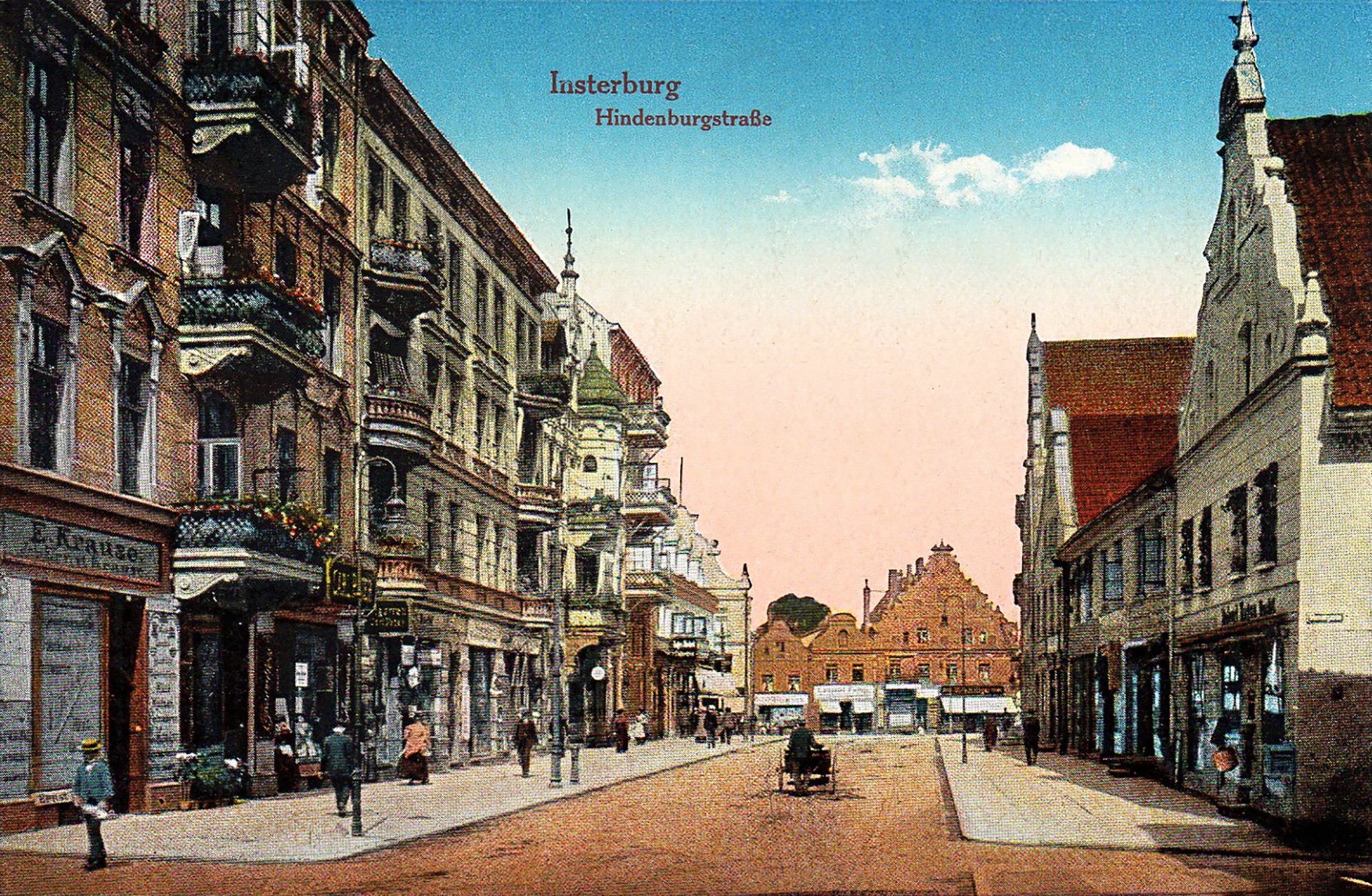
During the Napoleonic Wars, French troops passed through the town in 1806, 1807, 1811 and 1813. In 1863, a Polish secret organization was founded and operated in Insterburg, which was involved in arms trafficking to the Russian Partition of Poland during the January Uprising. Since May 1864, the leader of the organization was Józef Racewicz.

Insterburg became a part of the German Empire following the 1871 unification of Germany, and on May 1, 1901, it became an independent city separate from Insterburg District. During World War I the Russian Army seized Insterburg on 24 August 1914, but it was retaken by Germany on 11 September 1914. The Weimar Germany era after World War I saw the town separated from the rest of the country as the province of East Prussia had become an exclave. The association football club Yorck Boyen Insterburg was formed in 1921.
World War II and post-war period

During World War II, the Germans operated a Dulag Luft transit prisoner-of-war camp for Allied POWs in the town. A local branch of the Peasant Battalions was established by the Polish resistance, under the cryptonym "Wystruć", the historic Polish name of the town. Several French forced laborers cooperated with the Polish resistance. The town was heavily bombed by the British Royal Air Force on July 27, 1944. The town was stormed by Red Army troops on January 21–22, 1945. As part of the northern part of East Prussia, Insterburg was transferred from Germany to the Soviet Union after the war as previously agreed between the victorious powers at the Potsdam Conference. On 7 April 1946, Insterburg was renamed as Chernyakhovsk in honor of the Soviet World War II Army General, Ivan Chernyakhovsky, who commanded the army that first entered East Prussia in 1944.
After 1989, a group of people introduced the Akhal-Teke horse breed to the area and opened an Akhal-Teke breeding stable.
Mayovka, formerly a separate village, forms part of the town.
Administrative and municipal status
Within the framework of administrative divisions, Chernyakhovsk serves as the administrative center of Chernyakhovsky District. As an administrative division, it is, together with five rural localities, incorporated within Chernyakhovsky District as the town of district significance of Chernyakhovsk. As a municipal division, the town of district significance of Chernyakhovsk is incorporated within Chernyakhovsky Municipal District as Chernyakhovskoye Urban Settlement.
Population trends
| Year | Number |
|---|---|
| 1790 | 4,972, without military |
| 1875 | 16,303 |
| 1880 | 18,745 |
| 1885 | 22,227 |
| 1890 | 31,624, incl. 437 Catholics and 348 Jews |
| 1900 | 27,787, incl. 788 Catholics and 350 Jews |
| 1910 | 31,624, incl. 29,672 Protestants and 1,040 Catholics |
| 1925 | 39,311, incl. 36,792 Protestants, 1,174 Catholics, 86 other Christians, and 338 Jews |
| 1933 | 41,230, incl. 39,458 Protestants, 1,078 Catholics, five other Christians, and 273 Jews |
| 1939 | 43,620, incl. 40,677 Protestants, 1,388 Catholics, 563 other Christians, and 87 Jews |
| 1959 | approx. 29,100 |
| 1979 | approx. 35,600 |
| 1989 Census | 1989Census}} |
| 2002 Census | 2002Census}} |
| 2010 Census | 2010Census}} |
Military
Chernyakhovsk is home to the Chernyakhovsk naval air facility.
Coat of arms controversy
.svg)
The town's coat of arms, adopted in 2002, was based on the historic coat of arms of the town that before 1946 was known under its original Prussian name – Insterburg.
The full version of coat of arms in question has a picture of a Prussian man with a horn and the Latin initials G.F. for the Regent of Prussia George Frederick, margrave of Brandenburg-Ansbach (1543–1603), who gave Insterburg the status of town and with it his family coat of arms.
The case brought before the court follows a trend among several towns in the region that have announced their intentions to change their coat of arms as tensions mount between Russia and the West following the annexation of Crimea by the Russian Federation in 2014 and its support for pro-Russian separatists in eastern Ukraine.
Notable people
- Martin Grünberg (1665–c.1706), architect
- Johann Otto Uhde (1725–1766), composer and violinist
- Johann Friedrich Goldbeck (1748–1812), geographer and Protestant theologian
- Eduard Heinrich von Flottwell (1786–1865), politician
- Carl Friedrich Wilhelm Jordan (1819–1904), writer and politician
- Ernst Wichert (1831–1902), author
- Edward Frederick Moldenke (1836–1904) Lutheran theologian and missionary
- Hans Horst Meyer (1853–1939), pharmacologist
- Therese Malten (1855–1930), opera singer
- Hans Orlowski (1894–1967) woodcut artist and painter
- Hans Otto Erdmann (1896–1944), member of the German resistance to Nazism
- Fritz Karl Preikschat (1910–1994), engineer and inventor
- Kurt Kuhlmey (1913–1993), Bundeswehr major general
- Kurt Plenzat (1914–1998), military officer
- Traugott Buhre (1929–2009), actor
- Harry Boldt (born 1930), Olympic champion in dressage
- Anatol Herzfeld (1931–2019), German sculptor and mixed media artist
- Jürgen Schmude (1936–2025), politician (SPD)
- Hans-Jürgen Quadbeck-Seeger (born 1939), chemist
- Anatole Klyosov (born 1946), a scientist in physical chemistry, enzyme catalysis and industrial biochemistry
- Yuri Vasenin (1948–2022), Soviet football player and Russian coach
Twin towns and sister cities
Chernyakhovsk is twinned with:
- Germany Kirchheimbolanden, Germany, since 2002
References
Notes
Sources
References
- (2003). "Энциклопедия Города России". Большая Российская Энциклопедия.
- Górski, Karol. (1949). "Związek Pruski i poddanie się Prus Polsce: zbiór tekstów źródłowych". Instytut Zachodni.
- Górski, pp. 96–97, 214–215
- . (1895). "Słownik geograficzny Królestwa Polskiego i innych krajów słowiańskich, Tom XIV".
- Kętrzyński, Wojciech. (1882). "O ludności polskiej w Prusiech niegdyś krzyżackich". [[Ossolineum.
- Gresch, Eberhard. (2012). "Im Blickpunkt der Geschichte der Reformation: Evangelisch-Reformierte in (Ost-)Preußen".
- Kasparek, Norbert. (2014). "Na tułaczym szlaku... Powstańcy Listopadowi na Pomorzu". Muzeum w Koszalinie, Archiwum Państwowe w Koszalinie.
- "Wydarzenia roku 1863".
- (2022). "The United States Holocaust Memorial Museum Encyclopedia of Camps and Ghettos 1933–1945. Volume IV". [[Indiana University Press]], [[United States Holocaust Memorial Museum]].
- Brenda, Waldemar. (2007). "Pogranicze Prus Wschodnich i Polski w działaniach polskiej konspiracji w latach II wojny światowej". Komunikaty Mazursko-Warmińskie.
- Resolution #640
- Law #262
- A. E. Henning: ''Topographisch-historische Beschreibung der Stadt Insterburg''. Königsberg 1794, [https://archive.org/details/bub_gb_yNkAAAAAcAAJ/page/n100 p. 44.]
- Michael Rademacher: ''[http://www.verwaltungsgeschichte.de/insterburg.html Deutsche Verwaltungsgeschichte Ostpreußen - Kreis Insterburg]'' (2006)
- ''Meyers Koversations-Lexikon''. 6. Auflage, Band 9, Leipzig und Wien 1908, p. 873.
- {{ru-pop-ref. 1989Census
- {{ru-pop-ref. 2002Census
- {{ru-pop-ref. 2010Census
- "Russian Court Finds Illegal 'German' Coat Of Arms Of Town In Far Western Exclave".
This article was imported from Wikipedia and is available under the Creative Commons Attribution-ShareAlike 4.0 License. Content has been adapted to SurfDoc format. Original contributors can be found on the article history page.
Ask Mako anything about Chernyakhovsk — get instant answers, deeper analysis, and related topics.
Research with MakoFree with your Surf account
Create a free account to save articles, ask Mako questions, and organize your research.
Sign up freeThis content may have been generated or modified by AI. CloudSurf Software LLC is not responsible for the accuracy, completeness, or reliability of AI-generated content. Always verify important information from primary sources.
Report