From Surf Wiki (app.surf) — the open knowledge base
Chengde
Prefecture-level city in Hebei, China

Prefecture-level city in Hebei, China
| Field | Value |
|---|---|
| name | Chengde |
| native_name | 承德市 |
| native_name_lang | zh |
| other_name | Chengte, Jehol |
| settlement_type | Prefecture-level city |
| image_skyline | {{Photomontage |
| photo1a | Phillipvn2.jpg |
| photo1b | Imperial Summer Resort 避暑山庄 (28863805406).jpg |
| photo2a | Chengde_2018.jpg |
| photo3a | Sledgehammerpeak.JPG |
| photo3b | Chengde_view_from_mountain_top.jpg |
| color_border | white |
| spacing | 2 |
| color | white |
| size | 280 |
| foot_montage | }} |
| image_caption | Clockwise from top: Jinshanling, Mountain Resort, Skyline of Chengde, Putuo Zongcheng Temple, Sledgehammer Peak |
| mapframe | yes |
| mapframe-zoom | 6 |
| mapframe-point | none |
| mapsize1 | 250px |
| map_caption1 | Location of Chengde City jurisdiction in Hebei |
| pushpin_map | China Hebei#China Northern Plain#China |
| pushpin_mapsize | 225 |
| pushpin_map_caption | Location of the city centre in Hebei |
| subdivision_type | Country |
| seat_type | Municipal seat |
| seat | Shuangqiao District |
| subdivision_name | People's Republic of China |
| subdivision_type1 | Province |
| subdivision_name1 | Hebei |
| established_title | Settled |
| established_date | 1681 |
| established_title2 | Established |
| established_date2 | November 15, 1983 |
| area_total_km2 | 39519 |
| area_blank1_title | Districts |
| area_blank1_km2 | 1252.7 |
| area_urban_km2 | 724.03 |
| area_urban_footnotes | |
| population_as_of | 2020 |
| population_total | 3473200 |
| population_density_km2 | 91 |
| population_blank1_title | Districts |
| population_blank1 | 642000 |
| population_urban | 920,395 |
| population_urban_footnotes | |
| population_density_urban_km2 | auto |
| demographics_type2 | GDP |
| demographics2_title1 | Prefecture-level city |
| demographics2_info1 | CN¥ 135.9 billion |
| US$ 21.8 billion | |
| demographics2_title2 | Per capita |
| demographics2_info2 | CN¥ 38,506 |
| US$6,182 | |
| coordinates | |
| coor_pinpoint | Chengde municipal government |
| elevation_m | 327 |
| area_code | 314 |
| iso_code | CN-HE-08 |
| website | http://www.chengde.gov.cn |
| footnotes | |
| blank_name | License Plate Prefix |
| blank_info | 冀H |
| mapframe-zoom = 6 | mapframe-point = none US$ 21.8 billion US$6,182 ReceivingVirtue
Chengde, formerly known as Jehol and Rehe, is a prefecture-level city in Hebei province, situated about 225 km northeast of Beijing. It is best known as the site of the Mountain Resort, a vast imperial garden and palace formerly used by the Qing emperors as summer residence. Its local dialect is also known for being the closest to Standard Chinese, which took several inspirations from the Chengde dialect. The permanent resident population is approximately 3,473,200 in 2017. At the end of 2024, the total resident population of the city was 3,285,700, a decrease of 16,500 from the end of the previous year. The urbanization rate of the resident population is 59.77%.
History
In 1703, Chengde was made the summer residence of the Qing regime. Constructed throughout the eighteenth century, the Mountain Resort was used by the later rulers. The site is currently an UNESCO World Heritage Site. Since the seat of government followed the rulers, Chengde was a political center of the Chinese empire during these times.
The city of Jeholan early romanization of Rehe via the French transcription of the northern suffix ér as eulreached its height under the in the late 1700s. The great Putuo Zongcheng Temple, loosely based on the Potala in Lhasa, was completed after just four years of work in 1771. It was heavily decorated with gold and the emperor worshipped in the Golden Pavilion. In the temple itself was a bronze-gilt statue of Tsongkhapa, the Reformer of the Gelugpa sect.
Under the early Beiyang Republic of China, Chengde was the capital of Rehe Province. From 1933 to 1945 the city was under Japanese occupation as a part of the Manchurian puppet state. After the Sino-American defeat of the Japanese, the victorious Kuomintang government regained jurisdiction. In 1948, the People's Liberation Army took control of Chengde. It would remain a part of Rehe until 1955, when the province was abolished, and the city was incorporated into Hebei.
Geography
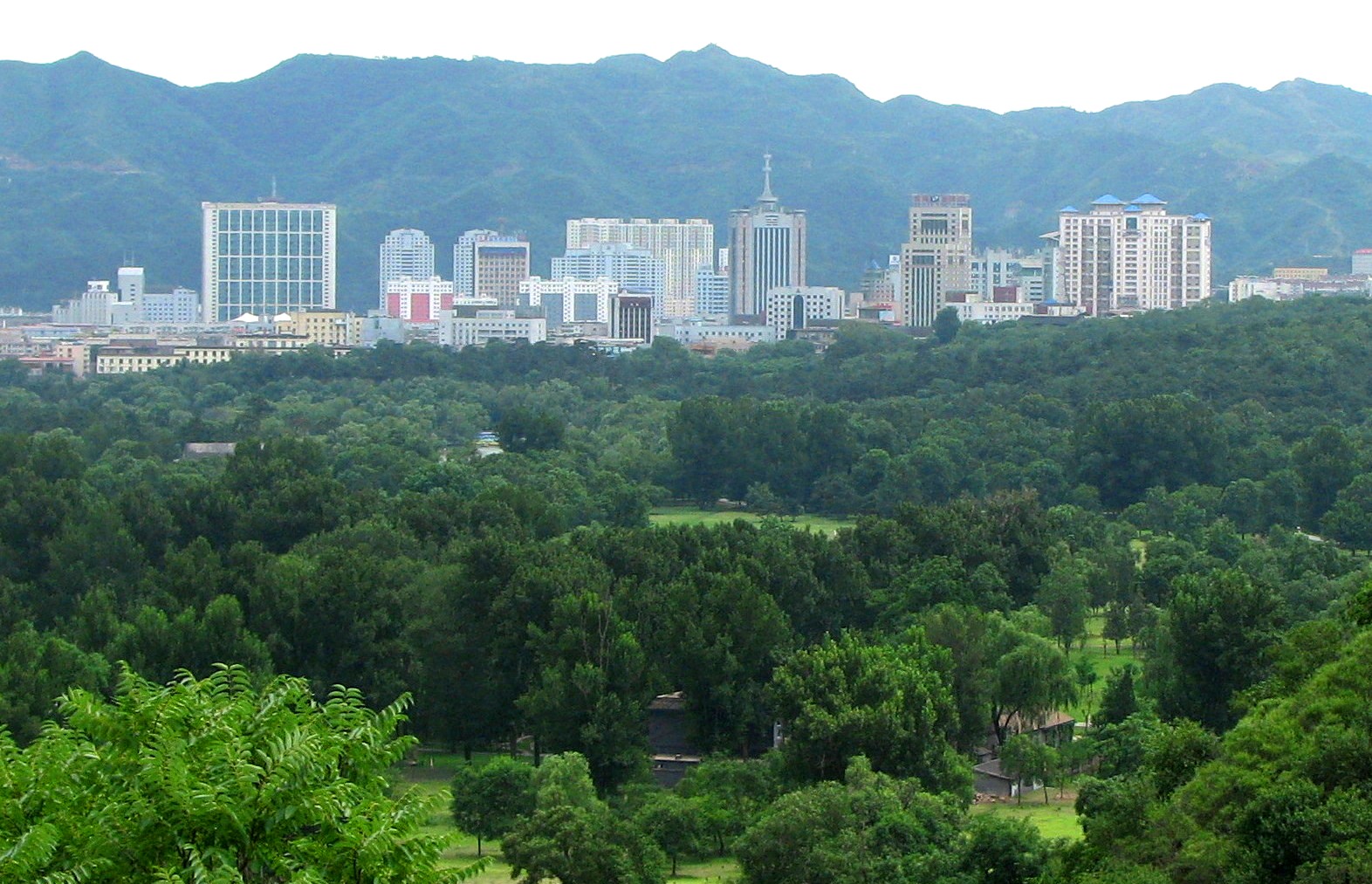
Chengde is located in the northeastern portion of Hebei, with latitude 40° 12'-42° 37' N, and longitude 115° 54'-119° 15' E, and contains the northernmost point in the province. It borders Inner Mongolia, Liaoning, Beijing, and Tianjin. Neighbouring prefecture-level provincial cities are Qinhuangdao and Tangshan on the Bohai Gulf, and land-locked Zhangjiakou. Due to its Liaoning border, it is often considered a part of both the North and Northeast China regions. From north to south the prefecture stretches 269 km, and from west to east 280 km, for a total area of 39702.4 sqkm, thus occupying 21.2% of the total provincial area. It is by area the largest prefecture in the province, though as most of its terrain is mountainous, its population density is low.
The Jehol or Rehe ("Hot River"), which gave Chengde its former name, was so named because it did not freeze in winter. Most sections of the river's former course are now dry because of modern dams.
Climate
Chengde has a four-season, monsoon-influenced humid continental climate (Köppen Dwa), with widely varying conditions through the prefecture due to its size: winters are moderately long, cold and windy, but dry, and summers are hot and humid. Near the city, however, temperatures are much cooler than they are in Beijing, due to the higher elevation: the monthly 24-hour average temperature ranges from −9.3 °C in January to 24.2 °C in July, and the annual mean is 8.93 °C. Spring warming is rapid, but dust storms can blow in from the Mongolian steppe; autumn cooling is similarly quick. Precipitation averages at about 504 mm for the year, with more than two-thirds of it falling during the three summer months. With monthly percent possible sunshine ranging from 50% in July to 69% in October, the city receives 2,746 hours of sunshine annually.
| Jan record high C = 8.8 | Jan record low C = -27.2 | Feb record high C = 20.7 | Feb record low C = -23.7 | Mar record high C = 28.4 | Mar record low C = -20.0 | Apr record high C = 34.3 | Apr record low C = -8.7 | May record high C = 39.3 | May record low C = -0.2 | Jun record high C = 41.3 | Jun record low C = 7.2 | Jul record high C = 43.3 | Jul record low C = 12.5 | Aug record high C = 38.9 | Aug record low C = 6.4 | Sep record high C = 35.4 | Sep record low C = -0.1 | Oct record high C = 32.8 | Oct record low C = -10.6 | Nov record high C = 22.3 | Nov record low C = -18.8 | Dec record high C = 12.3 | Dec record low C = -24.7 |access-date= 2024-09-22 |access-date=8 July 2025
Administrative divisions

Chengde comprises:
| Map | Name | Hanzi | Hanyu Pinyin | Population | ||
|---|---|---|---|---|---|---|
| (2004 est.) | Area (km2) | Density (/km2) | ||||
| Shuangqiao District | 双桥区 | zh | 290,000 | 311 | 932 | |
| Shuangluan District | 双滦区 | zh | 100,000 | 250 | 400 | |
| Yingshouyingzi Mining District | 鹰手营子 | |||||
| 矿区 | zh | 70,000 | 148 | 473 | ||
| Pingquan City | 平泉市 | zh | 470,000 | 3,297 | 143 | |
| Chengde County | 承德县 | zh | 470,000 | 3,990 | 118 | |
| Xinglong County | 兴隆县 | zh | 320,000 | 3,116 | 103 | |
| Luanping County | 滦平县 | zh | 320,000 | 3,195 | 100 | |
| Longhua County | 隆化县 | zh | 420,000 | 5,474 | 77 | |
| Fengning Manchu | ||||||
| Autonomous County | 丰宁满族 | |||||
| 自治县 | zh | 380,000 | 8,747 | 43 | ||
| Kuancheng Manchu | ||||||
| Autonomous County | 宽城满族 | |||||
| 自治县 | zh | 230,000 | 1,933 | 119 | ||
| Weichang Manchu and | ||||||
| Mongol Autonomous County | 围场满族 | |||||
| 蒙古族自治县 | zh | 520,000 | 9,058 | 57 |
Sport
The first ever bandy match in China was organised in Chengde in January 2015 and was played between the Russian and Swedish top clubs Baykal-Energiya and Sandviken. Chengde city was one of the initiators when the China Bandy Federation was founded in December 2014. The city hosted the 2018 Women's Bandy World Championship. While the record number of participants in previous Women's Bandy World Championships was 7, the organisers had thought out measures with the goal to attract 12 participating countries. However, in the end 8 teams participated.
Religion
Chengde is the seat of the Catholic Diocese of Chengde.
Transport
.jpg)
With road and railroad links to Beijing, Chengde has developed into a distribution hub, and its economy is growing rapidly. The newly built Jingcheng Expressway connects Chengde directly to central Beijing, and more freeways are planned for the city. The city's new airport was opened on 31 May 2017. It is located 19.5 km northeast of the city center in Tougou Town, Chengde County.
The Beijing–Harbin high-speed railway, completed in January 2021, has 5 stations within Chengde.
Sights


The project of building Chengde Mountain Resort started in 1703 and finished in 1790. The whole mountain resort covers an area 5,640,000 square meters. It is the largest royal garden in China. The wall of the mountain resort is over 10,000 meters in length. In summers, emperors of the Qing dynasty came to the mountain resort to relax themselves and escape from the high temperature in Beijing.
The whole Resort can be divided into three areas which are lakes area, plains area and hills area. The lakes area, which includes 8 lakes, covers an area of 496,000 square meters. The plains area covers an area of 607,000 square meters. The emperors held horse races and hunted in the area. The largest area of the three is the hills area. It covers an area of 4,435,000 square meters. Hundreds of palaces and temples were built on the hills in this area.
The elaborate Mountain Resort features large parks with lakes, pagodas, and palaces ringed by a wall. Outside the wall are the Eight Outer Temples (), built in varying architectural styles drawn from throughout China. One of the best-known of these is the Putuo Zongcheng Temple, built to resemble the Potala Palace in Lhasa, Tibet. The resort and outlying temples were made a UNESCO World Heritage Site in 1994. The nearby Puning Temple, built in 1755, houses the world's tallest wooden statue of the Bodhisattva Avalokiteśvara.
Another popular attraction of the Chengde area is Sledgehammer Peak (), a large rock formation in the shape of an inverted sledgehammer. A variety of other mountains, valleys, and grasslands lie within the borders of the city.
Gallery
File:Chengde Mountain Resort 1.jpg| Mountain Resort. File:Shuang ta mountain, chengde.jpg | Double towers mountain in Chengde city. File:须弥福寿之庙.JPG|Xumi Fushou Temple File:Jinshangling2.jpg |Jinshanling is a section of the Great Wall of China located in the mountainous area in Luanping County, Chengde. File:坝上 木兰围场 - panoramio - wuqiang beijing (11).jpg|Mùlán imperial hunting ground in Weichang County, northern Chengde. File:坝上 木兰围场 - panoramio - wuqiang beijing (12).jpg|Mùlán imperial hunting ground.
Sister cities
Chengde has city partnerships with the following locations:
- Brazil Santo André, São Paulo, Brazil
- Japan Takasaki, Gunma, Japan
- US Dakota County, Minnesota, United States
- Japan Kashiwa, Chiba, Japan
References
Citations
Bibliography
- .
- .
References
- (2019). "China Urban Construction Statistical Yearbook 2017". China Statistics Press.
- 河北省统计局、国家统计局河北调查总队. (2016). "《河北经济年鉴-2018》". [[China Statistics Press]].
- Hedin (1933), pp. 1, 14.
- "涨知识 {{!}} 你学的普通话其实是这个小县城的“方言”". CCTV News.
- "(河北省)承德市2024年国民经济和社会发展统计公报-红黑统计公报库".
- link. [[China Meteorological Administration]]
- "Picture of the teams from the homepage of Baykal-Energiya".
- "China Bandy Federation: China National Bandy Team". chinabandy.org.
- (February 3, 2017). "Women's World Bandy Championship awarded to China".
- "Rapport från internationella förbundets kongress".
- link. [[Harbin Sport University]]
- link
- link. (1 June 2017)
- "International Exchange". Council of Local Authorities for International Relations (CLAIR).

This article was imported from Wikipedia and is available under the Creative Commons Attribution-ShareAlike 4.0 License. Content has been adapted to SurfDoc format. Original contributors can be found on the article history page.
Ask Mako anything about Chengde — get instant answers, deeper analysis, and related topics.
Research with MakoFree with your Surf account
Create a free account to save articles, ask Mako questions, and organize your research.
Sign up freeThis content may have been generated or modified by AI. CloudSurf Software LLC is not responsible for the accuracy, completeness, or reliability of AI-generated content. Always verify important information from primary sources.
Report