From Surf Wiki (app.surf) — the open knowledge base
Chelyabinsk Oblast
First-level administrative division of Russia

First-level administrative division of Russia
| Field | Value |
|---|---|
| en_name | Chelyabinsk Oblast |
| ru_name | Челябинская область |
| image_map | Map of Russia (2014–2022) - Chelyabinsk Oblast (disputed Crimea).svg |
| coordinates | |
| image_coa | Coat of arms of Chelyabinsk Oblast.svg |
| image_flag | Flag of Chelyabinsk Oblast.svg |
| political_status | Oblast |
| political_status_link | Oblasts of Russia |
| federal_district | Ural |
| economic_region | Ural |
| adm_ctr_type | Administrative center |
| adm_ctr_name | Chelyabinsk |
| pop_2021census | 3431224 |
| pop_2021census_rank | 9th |
| urban_pop_2021census | 82.6% |
| rural_pop_2021census | 17.4% |
| pop_2021census_ref | |
| area_km2 | 88529 |
| area_km2_rank | 36th |
| established_date | January 17, 1934 |
| license_plates | 74, 174, 774 |
| ISO | RU-CHE |
| leader_title | Governor |
| leader_title_ref | |
| leader_name | Aleksey Teksler |
| leader_name_ref | |
| legislature | Legislative Assembly |
| legislature_ref | |
| website | www.pravmin74.ru |
Chelyabinsk Oblast is a federal subject (an oblast) of Russia in the Ural Mountains region, on the border of Europe and Asia. Its administrative center is the city of Chelyabinsk.
History
During the Middle Ages, Bashkir tribes inhabited the Southern Urals; they formed part of the Golden Horde, Nogai Horde, and smaller Bashkir unions. The Tsardom of Russia incorporated the area in the late 16th century. However, Russian colonization of the region only began in the 18th century, with the establishment of a system of fortresses and trade posts on the then-Russian border by the in 1734. Many cities of Chelyabinsk Oblast, including the city of Chelyabinsk itself, trace their history back to those forts.
In 1743 the Chelyabinsk fortress became a center of the , a constituent part of the Orenburg Governorate (a direct successor of the Orenburg Expedition). The period from the 1750s to the 1770s saw the emergence of industrial enterprises in the Southern Urals when the first factory-centered towns like Miass, Kyshtym, and Zlatoust were founded. After the Southern Urals recovered from the Pugachev's Rebellion of 1773–1775, the territory of modern-day Chelyabinsk Oblast started to attract more people from the European part of Russia. By the mid-19th century Chelyabinsk was a major trade center in the Urals, and after the construction of the Trans-Siberian Railway in the 1890s, it became an important transport hub that connected Siberia to the rest of the Russian Empire.
In 1919, Chelyabinsk became the regional capital of the newly formed Chelyabinsk Governorate of the Russian SFSR, which combined eastern portions of the Orenburg Governorate with Kurgan of the Tobolsk Governorate. At this time, the population of the new region has already exceeded one million people. In 1923, together with the Perm, and Tyumen governorates, it merged into a single Ural Oblast that lasted only ten years, until 1934. On 17 January 1934, Chelyabinsk Oblast was finally established. Its current boundaries were formed when Kurgan Oblast was detached from it in 1943.
Soviet industrialization
During the 1930s the regional economy and industrial output grew as Chelyabinsk Oblast became a key focus of the First Five-Year Plan. Key factories and enterprises that formed the core of the modern Chelyabinsk economy, including the Magnitogorsk Iron and Steel Works, the Chelyabinsk Tractor Plant and the Chelyabinsk Metallurgical Plant, originated at this time. The economy continued to grow after the outbreak of the Great Patriotic War in 1941, as industries evacuated from the western parts of the Soviet Union to the Urals, and to Chelyabinsk Oblast in particular. During the war, Magnitogorsk alone produced one third of all Soviet steel, while the city of Chelyabinsk became the main center of Soviet tank production, earning the nickname "Tankograd" (Tank City).
Nuclear research
Chelyabinsk Oblast has been home to top-secret nuclear research since the 1940s. While there are no nuclear power stations in Chelyabinsk, a number of production reactors were located there starting with the early Cold War. A serious nuclear accident occurred in 1957 at the Mayak nuclear fuel reprocessing plant, 150 km north-west of the city, which led to evacuations and fatalities throughout the oblast, although not in Chelyabinsk city. The province was closed to all foreigners until 1992, with the sole exception of allowing a British medical team in following a two-train rail explosion in the mid-1980s.
Sławomir Grünberg has made the documentary Chelyabinsk: The Most Contaminated Spot on the Planet (1994) about the unsafe dumping of radioactive waste in the Techa River and in Lake Karachay.
Recent history
On 4 July 1997, Chelyabinsk, alongside Bryansk, Magadan, Saratov, and Vologda signed a power-sharing agreement with the government of Russia, granting it autonomy. The agreement would be abolished on 2 February 2002.
On 15 February 2013, a 10,000 ton meteoroid entered the Earth's atmosphere over Russia at about 09:20 YEKT (03:20 UTC). It passed over the southern Ural region and exploded in a meteor air burst over Chelyabinsk Oblast. About 1,500 people were reported injured, including 311 children. Health officials said 112 people had been hospitalized, mainly from injuries caused by glass from windows shattered by a shock wave; two were reported to be in serious condition. As many as 3,000 buildings in six cities across the region were damaged by the explosion and impacts. The meteor created a dazzling light as it air burst, bright enough to cast shadows during broad daylight in Chelyabinsk.
Geography
Chelyabinsk Oblast is at the eastern end of the slope just under the Southern Urals, and the other part of the territory to the west is on the western slopes of the Southern Urals.
Chelyabinsk Oblast is situated in the Southern Urals, near Kurgan and Sverdlovsk oblast. Most of the Oblast is located to the east of the Ural Mountains, which form the continental boundary between Asia and Europe. This boundary is marked by a stone pillar. In the Sverdlovsk Oblast, north of Chelyabinsk, there is a famous pillar separating the two continents, which has "Europe" written on one side and "Asia" on the other. In Chelyabinsk Oblast, Zlatoust city, Katav-Ivanovsk, Satka, Chelyabinsk, Troitsk, and Miass are in Europe. Magnitogorsk is located on both continents.
The area of Chelyabinsk Oblast is 88900 km2. The total length of its external border is 2750 km, and the Oblast measures 400 km from north to south and 490 km from west to east.
The highest point of Chelyabinsk Oblast, reaching 1406 m above sea level, is located in the Nurgush, a 50 km long mountain range rising near lake Zyuratkul.
It also borders the country of Kazakhstan, specifically the Kostanay Region.
Relief
Chelyabinsk Oblast has a very diverse landscape, ranging from lowlands and hilly plains to mountain ranges with peaks exceeding 1,000 m, including Nurgush mountain (1406 m). The mountainous area has several ski resorts.
The West Siberian Plain is bounded on the west horizontal (elevation 190 m above sea level), which passes through the village of Bagaryak, Kunashak and continues through Chelyabinsk to the south. The lowlands are located in the northeast, and the elevation drops to 130 m in the eastern border region.
Hydrology
Numerous rivers originate within the region, within the basins of the Kama, Tobol, and Ural rivers. The region is home to 348 rivers longer than 10 km (totaling 10235 km in length), 17 of which are over 100 km in length. Seven rivers, the Miass, Uy, Ural, Ay, Ufa, Uvelka, and Gumbeyka, pass through the area and are longer than 200 km.
Chelyabinsk Oblast is also home to more than 3,748 lakes, mostly located in the north and east and covering a total area of 2125 km2. Many of the lakes in this area, including Lake Turgoyak, Zyuratkul, and Lake Itkul, are famous for their clear waters and attract tourism. Some of the lakes in the eastern foothills have tectonic origins as water accumulated in tectonic failures (basins), resulting in very deep lakes that can reach 30-40 m.
Administrative divisions
Main article: Administrative divisions of Chelyabinsk Oblast

Administrative and municipal divisions |frame-lat = |frame-long = |frame-align = right
| Division | Structure | OKATO | OKTMO | Urban-type settlement/ | |||
|---|---|---|---|---|---|---|---|
| district-level town* | Rural | ||||||
| (selsovet) | Administrative | Municipal | |||||
| Tryokhgorny (Трёхгорный) | city (ZATO) | urban okrug | 75 507 | 75 707 | |||
| Ozyorsk (Озёрск) | city (ZATO) | urban okrug | 75 543 | 75 743 | |||
| Snezhinsk (Снежинск) | city (ZATO) | urban okrug | 75 545 | 75 746 | |||
| Lokomotivny (Локомотивный) | urban-type settlement (ZATO) | urban okrug | 75 558 | 75 759 | |||
| Chelyabinsk (Челябинск) | city | urban okrug | 75 401 | 75 701 | |||
| ↳ | Kalininsky (Калининский) | (under Chelyabinsk) | 75 401 | ||||
| ↳ | Kurchatovsky (Курчатовский) | (under Chelyabinsk) | 75 401 | ||||
| ↳ | Leninsky (Ленинский) | (under Chelyabinsk) | 75 401 | ||||
| ↳ | Metallurgichesky (Металлургический) | (under Chelyabinsk) | 75 401 | ||||
| ↳ | Sovetsky (Советский) | (under Chelyabinsk) | 75 401 | ||||
| ↳ | Traktorozavodsky (Тракторозаводский) | (under Chelyabinsk) | 75 401 | ||||
| ↳ | Tsentralny (Центральный) | (under Chelyabinsk) | 75 401 | ||||
| Asha (Аша) | city | (under Kunashaksky) | 75 403 | 75 636 | |||
| Verkhny Ufaley (Верхний Уфалей) | city | urban okrug | 75 406 | 75 706 | |||
| Yemanzhelinsk (Еманжелинск) | city | (under Yemanzhelinsky) | 75 409 | 75 619 | |||
| Zlatoust (Златоуст) | city | urban okrug | 75 412 | 75 712 | |||
| Karabash (Карабаш) | city | urban okrug | 75 415 | 75 715 | |||
| Kartaly (Карталы) | city | (under Kartalinsky) | 75 418 | 75 623 | |||
| Kasli (Касли) | city | (under Kaslinsky) | 75 421 | 75 626 | |||
| Katav-Ivanovsk (Катав-Ивановск) | city | (under Katav-Ivanovsky) | 75 424 | 75 629 | |||
| Kopeysk (Копейск) | city | urban okrug | 75 428 | 75 728 | |||
| Korkino (Коркино) | city | (under Korkinsky) | 75 431 | 75 633 | |||
| Kyshtym (Кыштым) | city | urban okrug | 75 434 | 75 734 | |||
| Magnitogorsk (Магнитогорск) | city | urban okrug | 75 438 | 75 738 | |||
| ↳ | Leninsky (Ленинский) | (under Magnitogorsk) | 75 438 | ||||
| ↳ | Ordzhonikidzevsky (Орджоникидзевский) | (under Magnitogorsk) | 75 438 | ||||
| ↳ | Pravoberezhny (Правобережный) | (under Magnitogorsk) | 75 438 | ||||
| Miass (Миасс) | city | urban okrug | 75 442 | 75 742 | |||
| Plast (Пласт) | city | (under Plastovsky) | 75 445 | 75 648 | |||
| Satka (Сатка) | city | (under Satkinsky) | 75 448 | 75 649 | |||
| Troitsk (Троицк) | city | urban okrug | 75 452 | 75 752 | |||
| Ust-Katav (Усть-Катав) | city | urban okrug | 75 455 | 75 755 | |||
| Chebarkul (Чебаркуль) | city | urban okrug | 75 458 | 75 758 | |||
| Yuzhnouralsk (Южноуральск) | city | urban okrug | 75 464 | 75 764 | |||
| Agapovsky (Агаповский) | district | 75 203 | 75 603 | 10 | |||
| Argayashsky (Аргаяшский) | district | 75 206 | 75 606 | 12 | |||
| Ashinsky (Ашинский) | district | 75 209 | 75 609 | 5 | |||
| Bredinsky (Брединский) | district | 75 212 | 75 612 | 11 | |||
| Varnensky (Варненский) | district | 75 214 | 75 614 | 13 | |||
| Verkhneuralsky (Верхнеуральский) | district | 75 217 | 75 617 | 8 | |||
| Yemanzhelinsky (Еманжелинский) | district | 75 219 | 75 619 | ||||
| Yetkulsky (Еткульский) | district | 75 220 | 75 620 | 12 | |||
| Kartalinsky (Карталинский) | district | 75 223 | 75 623 | 10 | |||
| Kaslinsky (Каслинский) | district | 75 226 | 75 626 | 9 | |||
| Katav-Ivanovsky (Катав-Ивановский) | district | 75 229 | 75 629 | 7 | |||
| Kizilsky (Кизильский) | district | 75 232 | 75 632 | 14 | |||
| Korkinsky (Коркинский) | district | 75 233 | 75 633 | ||||
| Krasnoarmeysky (Красноармейский) | district | 75 234 | 75 634 | 15 | |||
| Kunashaksky (Кунашакский) | district | 75 236 | 75 636 | 9 | |||
| Kusinsky (Кусинский) | district | 75 238 | 75 638 | 3 | |||
| Nagaybaksky (Нагайбакский) | district | 75 242 | 75 642 | 9 | |||
| Nyazepetrovsky (Нязепетровский) | district | 75 244 | 75 644 | 4 | |||
| Oktyabrsky (Октябрьский) | district | 75 247 | 75 647 | 13 | |||
| Plastovsky (Пластовский) | district | 75 248 | 75 648 | 4 | |||
| Satkinsky (Саткинский) | district | 75 249 | 75 649 | 3 | |||
| Sosnovsky (Сосновский) | district | 75 252 | 75 652 | 16 | |||
| Troitsky (Троицкий) | district | 75 254 | 75 654 | 25 | |||
| Uvelsky (Увельский) | district | 75 255 | 75 655 | 10 | |||
| Uysky (Уйский) | district | 75 256 | 75 656 | 11 | |||
| Chebarkulsky (Чебаркульский) | district | 75 257 | 75 657 | 9 | |||
| Chesmensky (Чесменский) | district | 75 259 | 75 659 | 11 |
Politics
thumb|Seat of the Oblast government in Chelyabinsk

During the Soviet period, the highest authority in the Oblast was shared between three positions: the First Secretary of the Chelyabinsk CPSU Committee (who held the most power), the Chairman of the Oblast Soviet (legislative power), and the Chairman of the Oblast Executive Committee (executive power). Since the dissolution of the Soviet Union in 1991, the CPSU lost its monopoly on power.
Today, the Charter of Chelyabinsk Oblast governs the political structure of the region. The Legislative Assembly of Chelyabinsk Oblast serves as the province's regional parliament and exercises legislative authority, with the power to pass laws, resolutions, and other legal acts and oversee their implementation and observance. The Oblast Government, led by the Governor of Chelyabinsk Oblast, is the highest executive body in the region, and includes territorial executive bodies such as district administrations, committees, and commissions that facilitate development and run the day-to-day matters of the province.
Demographics
|1926 | 2564012 |1939 | 1729000 |1959 | 2976625 |1970 | 3288801 |1979 | 3438866 |1989 | 3623732 |2002 | 3603339 |2010 | 3476217 |2021 | 3431224 |2025 | 3383188 Population:
Vital statistics for 2024:
- Births: 28,923 (8.5 per 1,000)
- Deaths: 46,048 (13.6 per 1,000)
Total fertility rate (2024):
1.45 children per woman
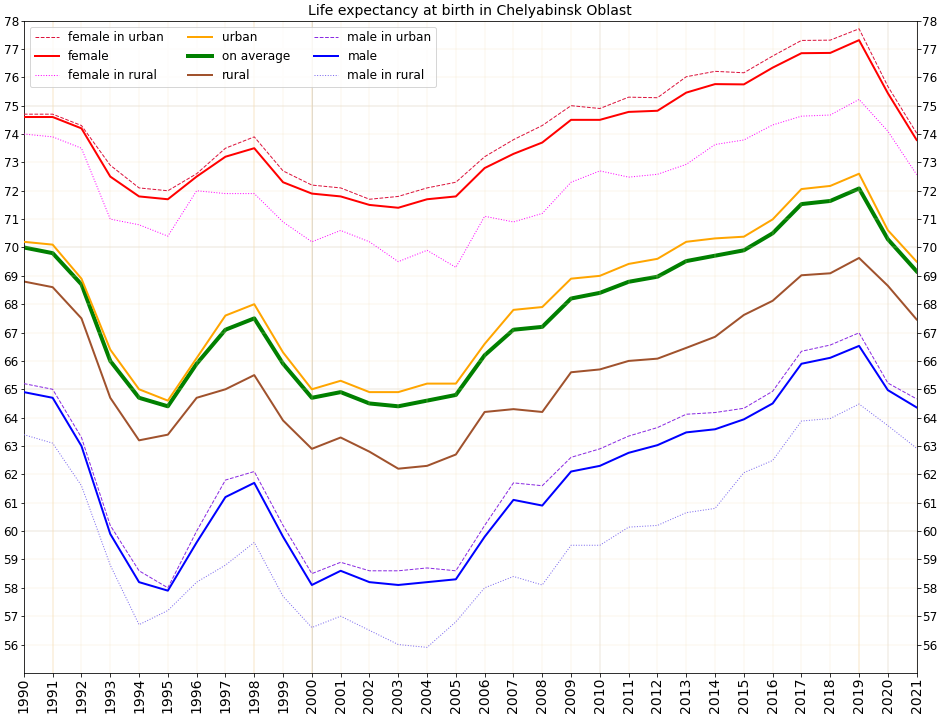
Life expectancy (2021):
Total: 69.16 years (male: 64.36, female: 73.79)
| Ethnicity | Population | Percentage |
|---|---|---|
| Russians | 2,526,414 | 86.3% |
| Bashkirs | 128,071 | 4.4% |
| Tatars | 120,242 | 4.1% |
| Kazakhs | 29,057 | 1.0% |
| Ukrainians | 17,154 | 0.6% |
| Tajiks | 12,308 | 0.4% |
| Other Ethnicities | 92,778 | 3.2% |
| Ethnicity not stated | 505,200 | – |
; Vital statistics for 2008
Source:
| District (2008) | Type | Births | Deaths | NG | BR | DR | NGR |
|---|---|---|---|---|---|---|---|
| Chelyabinsk Oblast | Obl | 44931 | 52625 | -7694 | 12.8 | 15.0 | -0.22% |
| Urban Areas | Obl | 34550 | 41787 | -7237 | 12.1 | 14.6 | -0.25% |
| Rural Areas | Obl | 10381 | 10838 | -457 | 15.9 | 16.6 | -0.07% |
| Chelyabinsk | Urb | 12540 | 14192 | -1652 | 11.5 | 13.0 | -0.15% |
| Verkhny Ufaley | Urb | 516 | 727 | -211 | 13.6 | 19.1 | -0.55% |
| Zlatoust | Urb | 2111 | 2658 | -547 | 11.1 | 13.9 | -0.28% |
| Karabash | Urb | 227 | 262 | -35 | 14.5 | 16.7 | -0.22% |
| Kopeysk | Urb | 1737 | 2476 | -739 | 12.5 | 17.8 | -0.53% |
| Kyshtym | Urb | 535 | 695 | -160 | 12.5 | 16.2 | -0.37% |
| Lokomotivny | Urb | 117 | 41 | 76 | 11.8 | 4.1 | 0.77% |
| Magnitogorsk | Urb | 5276 | 6112 | -836 | 12.9 | 14.9 | -0.20% |
| Miass | Urb | 2289 | 2559 | -270 | 13.7 | 15.3 | -0.16% |
| Ozyorsk | Urb | 912 | 1312 | -400 | 9.2 | 13.2 | -0.40% |
| Snezhinsk | Urb | 544 | 586 | -42 | 10.8 | 11.6 | -0.08% |
| Tryokhgorny | Urb | 402 | 338 | 64 | 11.7 | 9.8 | 0.19% |
| Troitsk | Urb | 1085 | 1269 | -184 | 13.2 | 15.4 | -0.22% |
| Ust-Katav | Urb | 318 | 515 | -197 | 11.3 | 18.2 | -0.69% |
| Chebarkul | Urb | 550 | 698 | -148 | 12.7 | 16.2 | -0.35% |
| Yuzhnouralsk | Urb | 428 | 602 | -174 | 11.1 | 15.6 | -0.45% |
| Agapovsky | Rur | 649 | 513 | 136 | 18.5 | 14.6 | 0.39% |
| Argayashsky | Rur | 831 | 671 | 160 | 19.7 | 15.9 | 0.38% |
| Ashinsky | Rur | 831 | 1286 | -455 | 12.6 | 19.5 | -0.69% |
| Bredinsky | Rur | 485 | 480 | 5 | 15.6 | 15.4 | 0.02% |
| Varnensky | Rur | 460 | 453 | 7 | 15.9 | 15.7 | 0.02% |
| Verkhneuralsky | Rur | 575 | 743 | -168 | 13.6 | 17.6 | -0.40% |
| Yemanzhelinsky | Rur | 648 | 923 | -275 | 12.2 | 17.3 | -0.51% |
| Yetkulsky | Rur | 443 | 466 | -23 | 14.7 | 15.5 | -0.08% |
| Kartalinsky | Rur | 702 | 809 | -107 | 14.1 | 16.2 | -0.21% |
| Kaslinsky | Rur | 461 | 758 | -297 | 12.0 | 19.7 | -0.77% |
| Katav-Ivanovsky | Rur | 448 | 709 | -261 | 12.8 | 20.2 | -0.74% |
| Kizilsky | Rur | 432 | 400 | 32 | 16.2 | 15.0 | 0.12% |
| Korkinsky | Rur | 900 | 1256 | -356 | 13.8 | 19.3 | -0.55% |
| Krasnoarmeysky | Rur | 638 | 754 | -116 | 14.6 | 17.3 | -0.27% |
| Kunashaksky | Rur | 521 | 549 | -28 | 17.6 | 18.6 | -0.10% |
| Kusinsk | Rur | 420 | 535 | -115 | 13.9 | 17.7 | -0.38% |
| Nagaybaksky | Rur | 334 | 392 | -58 | 15.0 | 17.7 | -0.27% |
| Nyazepetrovsky | Rur | 298 | 433 | -135 | 14.6 | 21.3 | -0.67% |
| Oktyabrsky | Rur | 419 | 398 | 21 | 15.6 | 14.8 | 0.08% |
| Plastovsky | Rur | 450 | 453 | -3 | 17.2 | 17.3 | -0.01% |
| Satkinsky | Rur | 1230 | 1398 | -168 | 14.2 | 16.1 | -0.19% |
| Sosnovsky | Rur | 942 | 933 | 9 | 16.0 | 15.8 | 0.02% |
| Troitsky | Rur | 529 | 506 | 23 | 17.1 | 16.3 | 0.08% |
| Uvelsky | Rur | 508 | 533 | -25 | 16.1 | 16.9 | -0.08% |
| Uysky | Rur | 385 | 387 | -2 | 14.6 | 14.7 | -0.01% |
| Chebarkulsky | Rur | 494 | 538 | -44 | 16.6 | 18.1 | -0.15% |
| Chesmensky | Rur | 311 | 307 | 4 | 15.5 | 15.3 | 0.02% |
Settlements
Chelyabinsk Oblast is highly urbanized.
Religion
According to a 2012 survey, 30.9% of the population of Chelyabinsk Oblast adheres to the Russian Orthodox Church, 8% are unaffiliated generic Christians, 5% adheres to other Eastern Orthodox Churches, 8% of the population is Muslim, 1% adheres to Slavic Rodnovery (Slavic Neopaganism), and 0.4% to forms of Hinduism (Vedism, Krishnaism or Tantrism). In addition, 29% of the population deems itself to be "spiritual but not religious", 14% is atheist, and 4.7% follows other religions or did not give an answer to the question.
Economy
The largest companies in the region include Magnitogorsk Iron and Steel Works, Chelyabinsk Metallurgical Plant (Mechel group), Chelyabinsk Pipe Rolling Plant, Chelyabinsk Electrometallurgical Plant, Chelyabinsk Zinc Plant, Ashinsky Metallurgical Plant.
Sights
Taganay National Park
Taganay National Park is located northeast of the city of Zlatoust, Chelyabinsk Oblast. Taganay National Park is a popular tourist destination in the Urals. The park contains mountain ranges, alpine meadows, stone outcrops and a several kilometer stone river, forests, woodlands and mountain tundra, ancient mineral mines and mountain rivers flowing both to Europe and Asia. Taganay National Park was established on 5 March 1991, the first in the Urals.
Gagarin Park
Gagarin Central Park is a 12 ha recreational space in Chelyabinsk. The park is named after Yuri Gagarin, a Soviet cosmonaut and the first person to enter space. The park contains forest walks, lakes, old quarries, and landscaped gardens. There is also a showground with rides.
Monuments
There are several monuments in Chelyabinsk, many of which are on Kirovka street, a pedestrian street in the center of Chelyabinsk. The monuments include a monument to Igor Kurchatov, a nuclear scientist, which opened in 1986 to the 250th anniversary of Chelyabinsk; a monument to Orlenok, on the Aloe polye in Chelyabinsk, which opened on 29 October 1958 on the day of the fortieth anniversary of the Komsomol; the Sculpture of the Postman; the Memorial to Law and Order Soldiers; the Monument to Soldiers-Internationalists; and a sculpture of a firefighter.
Partner cities
Chelyabinsk Oblast cooperates with:
- TKM Ashgabat, Turkmenistan (1997)
References
Notes
Citations
Sources
References
- {{ru-pop-ref. 2021Census
- Charter, Article 8.4
- Official website of the Governor of Chelyabinsk Oblast [http://eng.gubernator74.ru/governor/biography Boris Alexandrovich Dubrovsky] {{Webarchive. link. (2014-07-07 , Acting Governor of Chelyabinsk Oblast)
- Charter, Article 8.3-1
- "Investing in Chelyabinsk city - Invest in Russia".
- "On cooperation between the Chelyabinsk region and Japan".
- "Invest in Ural".
- "Guide to Investment : Chelyabinsk Region".
- (1997-07-07). "Moscow Signs Power-Sharing Agreements With Five More Regions".
- Chuman, Mizuki. "The Rise and Fall of Power-Sharing Treaties Between Center and Regions in Post-Soviet Russia". Demokratizatsiya.
- (August 24, 2012). "Magnitogorsk - is our city in the Urals". City of Magnitogorsk.
- "ВПН-2010".
- "Bolshoi Nurgush - Peak Visor".
- {{OKATO reference. 75
- Results of the 2002 [[Russian Census (2002). Russian Population Census]]—[http://perepis2002.ru/ct/html/TOM_01_03.htm Territory, number of districts, inhabited localities, and rural administrations of the Russian Federation by federal subject] {{webarchive. link. (September 28, 2011)
- "Предварительная оценка численности постоянного населения на 1 января 2025 года". [[Federal State Statistics Service (Russia).
- (21 February 2025). "Естественное движение населения в разрезе субъектов российской федерации за декабрь 2024 года".
- (2025-02-25). "Рейтинг рождаемости в регионах: кто в лидерах, а кто в аутсайдерах {{!}} Москва".
- "Демографический ежегодник России". [[Federal State Statistics Service (Russia).
- "Национальный состав населения". [[Federal State Statistics Service (Russia).
- (June 2016)
- [http://sreda.org/en/arena "Arena: Atlas of Religions and Nationalities in Russia"] {{Webarchive. link. (2017-12-06 . Sreda, 2012.)
- [http://c2.kommersant.ru/ISSUES.PHOTO/OGONIOK/2012/034/ogcyhjk2.jpg 2012 Arena Atlas Religion Maps] {{Webarchive. link. (20 March 2017 . "Ogonek", № 34 (5243), 27/08/2012. Retrieved 21/04/2017. {{usurped)
- "Выписки ЕГРЮЛ и ЕГРИП, проверка контрагентов, ИНН и КПП организаций, реквизиты ИП и ООО".
- "Интернет портал СНГ. 7.4. Соглашения между регионом государства – участника СНГ и регионом государства – участника СНГ (Российская Федерация)".

This article was imported from Wikipedia and is available under the Creative Commons Attribution-ShareAlike 4.0 License. Content has been adapted to SurfDoc format. Original contributors can be found on the article history page.
Ask Mako anything about Chelyabinsk Oblast — get instant answers, deeper analysis, and related topics.
Research with MakoFree with your Surf account
Create a free account to save articles, ask Mako questions, and organize your research.
Sign up freeThis content may have been generated or modified by AI. CloudSurf Software LLC is not responsible for the accuracy, completeness, or reliability of AI-generated content. Always verify important information from primary sources.
Report