From Surf Wiki (app.surf) — the open knowledge base
Cheboygan, Michigan

| Field | Value |
|---|---|
| official_name | Cheboygan, Michigan |
| settlement_type | City |
| website | |
| image_skyline | 2009-0618-Cheboygan-KingstonTheater.jpg |
| image_caption | Kingston Theater in Downtown Cheboygan |
| pushpin_map | Michigan |
| pushpin_label_position | left |
| pushpin_label | Cheboygan |
| pushpin_map_caption | Location within the state of Michigan |
| image_map | Cheboygan, MI location 2020.png |
| mapsize | 250 |
| map_caption | Location within Cheboygan County |
| subdivision_type | Country |
| subdivision_type1 | State |
| subdivision_type2 | County |
| subdivision_name | United States |
| subdivision_name1 | Michigan |
| subdivision_name2 | Cheboygan |
| leader_title | Mayor |
| leader_name | Brett A. Mallory |
| established_date | |
| unit_pref | Imperial |
| area_footnotes | |
| area_total_km2 | 18.12 |
| area_land_km2 | 17.78 |
| area_water_km2 | 0.34 |
| area_total_sq_mi | 7.00 |
| area_land_sq_mi | 6.86 |
| area_water_sq_mi | 0.13 |
| population_as_of | 2020 |
| population_total | 4770 |
| population_density_sq_mi | 695.03 |
| population_density_km2 | 268.35 |
| timezone | EST |
| utc_offset | -5 |
| timezone_DST | EDT |
| utc_offset_DST | -4 |
| elevation_ft | 591 |
| coordinates | |
| elevation_m | 180 |
| postal_code_type | ZIP code(s) |
| postal_code | 49721 |
| area_code | 231 |
| blank_name | FIPS code |
| blank_info | 26-15000 |
| blank1_name | GNIS feature ID |
| blank1_info | 0623135 |
| population_demonym | "Cheboyganite(s)" |
the city
Cheboygan ( ) is a city in the U.S. state of Michigan. It is the county seat of and the largest settlement in Cheboygan County. At the 2020 census, Cheboygan had a population of 4,770.
Cheboygan is situated on Lake Huron at the mouth of the Cheboygan River. It is the third-largest American city on Lake Huron after Port Huron and Alpena. Cheboygan is part of Northern Michigan, and is the northernmost city in Michigan's Lower Peninsula. Directly north of Cheboygan is Bois Blanc Island (part of Mackinac County), which can be accessed via ferry from Cheboygan.
History
Cheboygan was originally an Ojibwe settlement. In 1844, Jacob Sammons, a cooper from Fort Mackinac, chose the old native camping ground, known as Shabwegan, as the site for his cabin. He recruited other settlers, and a post office named "Duncan" was established in 1846. It was made the county seat in 1853.
Duncan or Duncan City was given a post office in 1850 as a result of the building of sawmills in this area. Duncan was made the county seat in 1853 and the location of the federal land office in 1855. The county seat shifted to Cheboygan in about 1870. Later Duncan was included within the expanded boundaries of Cheboygan.
The area became known as Cheboygan in 1870. It was incorporated as a village in 1871. Rail maps in 1876 show planned rail service for Cheboygan, but due to various setbacks, rail did not arrive there until 1881. There was a theater built in town in 1877.
Cheboygan was incorporated as a city in 1889.
In approximately 1890, Cheboygan became the home port for ferryboats to nearby Bois Blanc, an island in the Straits of Mackinac. Early in the 20th century, it was home to the pioneering brass era cyclecar maker, Flagler (de:Flagler Cyclecar).
In 1944, Cheboygan became the home port of the former U.S. Coast Guard cutter and icebreaker , serving from 1944 to 2006. Beginning in 2006, the port continued this role as the home dock of the new , a successor cutter.
Etymology
The name of the city shares the name of the county and probably has its origin from the Cheboygan River, although the precise meaning is no longer known. It may have come from an Ojibwe word zhaabonigan meaning "sewing needle". Alternatively, the origin may have been "Chabwegan," meaning "a place of ore."
Geography
According to the United States Census Bureau, the city has a total area of 7.00 sqmi, of which 6.80 sqmi is land and 0.20 sqmi is water.
Climate
The climate is described as Humid Continental by the Köppen Climate System, abbreviated as Dfb
|Jan record high F = 59 |Feb record high F = 62 |Mar record high F = 86 |Apr record high F = 90 |May record high F = 93 |Jun record high F = 96 |Jul record high F = 103 |Aug record high F = 104 |Sep record high F = 97 |Oct record high F = 89 |Nov record high F = 78 |Dec record high F = 64 |year record high F = 104 |Jan record low F = -30 |Feb record low F = -35 |Mar record low F = -21 |Apr record low F = -6 |May record low F = 10 |Jun record low F = 30 |Jul record low F = 32 |Aug record low F = 29 |Sep record low F = 24 |Oct record low F = 13 |Nov record low F = -6 |Dec record low F = -21 |year record low F = -35
Demographics
2010 census
As of the census of 2010, there were 4,867 people, 2,025 households, and 1,164 families residing in the city. The population density was 715.7 PD/sqmi. There were 2,415 housing units at an average density of 355.1 /sqmi. The racial makeup of the city was 90.8% White, 1.0% African American, 4.6% Native American, 0.2% Asian, 0.2% from other races, and 3.2% from two or more races. Hispanic or Latino of any race were 1.2% of the population.
There were 2,025 households, of which 28.3% had children under the age of 18 living with them, 36.7% were married couples living together, 15.2% had a female householder with no husband present, 5.6% had a male householder with no wife present, and 42.5% were non-families. 35.9% of all households were made up of individuals, and 16.1% had someone living alone who was 65 years of age or older. The average household size was 2.23 and the average family size was 2.84.
The median age in the city was 40.8 years. 22.1% of residents were under the age of 18; 10.3% were between the ages of 18 and 24; 22.6% were from 25 to 44; 26% were from 45 to 64; and 19% were 65 years of age or older. The gender makeup of the city was 47.9% male and 52.1% female.
2000 census
As of the census of 2000, there were 5,295 people, 2,146 households, and 1,349 families residing in the city. The population density was 779.5 PD/sqmi. There were 2,365 housing units at an average density of 348.2 /sqmi. The racial makeup of the city was 91.80% White, 0.51% African American, 4.12% Native American, 0.26% Asian, 0.02% Pacific Islander, 0.38% from other races, and 2.91% from two or more races. Hispanic or Latino of any race were 1.44% of the population.
There were 2,146 households, out of which 31.8% had children under the age of 18 living with them, 44.4% were married couples living together, 14.9% had a female householder with no husband present, and 37.1% were non-families. 31.6% of all households were made up of individuals, and 14.6% had someone living alone who was 65 years of age or older. The average household size was 2.35 and the average family size was 2.94.
In the city, the population was spread out, with 25.5% under the age of 18, 8.5% from 18 to 24, 27.0% from 25 to 44, 20.4% from 45 to 64, and 18.6% who were 65 years of age or older. The median age was 37 years. For every 100 females, there were 89.4 males. For every 100 females age 18 and over, there were 84.7 males.
The median income for a household in the city was $25,033, and the median income for a family was $32,692. Males had a median income of $28,417 versus $19,559 for females. The per capita income for the city was $14,318. About 15.8% of families and 19.9% of the population were below the poverty line, including 31.0% of those under age 18 and 9.1% of those age 65 or over.
Education
Public education in Cheboygan is served by the Cheboygan Area Schools district. The city is home to Cheboygan High School.
Tourist attractions
- Bois Blanc Island
- Cheboygan Crib Light
- Cheboygan State Park
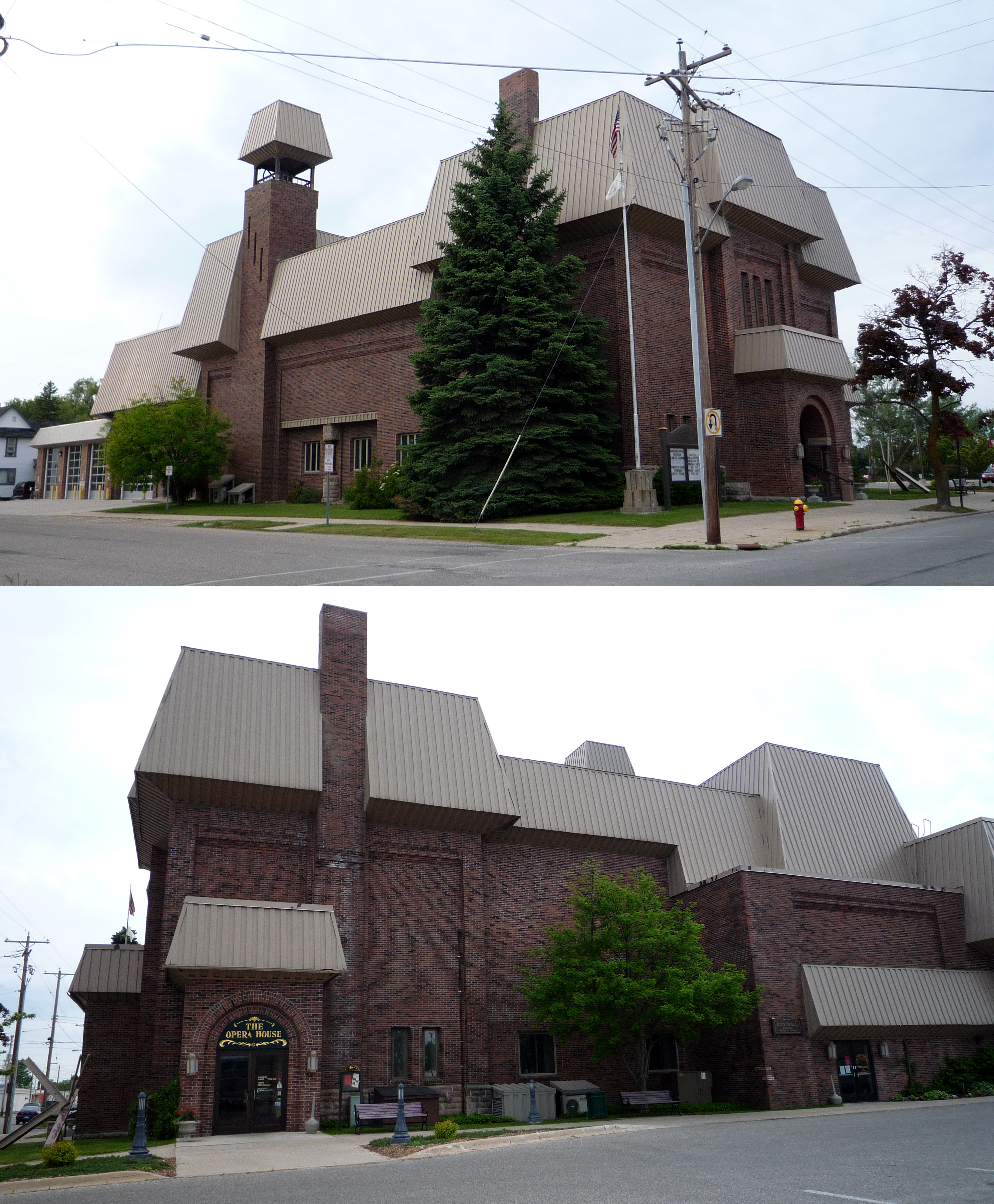
- Opera House
Media
The city and county are served by a daily newspaper, the Cheboygan Daily Tribune. A television station, WTOM-TV, is licensed to Cheboygan and maintains broadcast facilities along US Highway 23 south of the city, but this station operates as a satellite, with programming originating from parent station WPBN-TV in Traverse City.
Transportation
State trunklines
- parallels the Lake Huron shore, running primarily east–west in Cheboygan, and can be used to access Rogers City and Alpena, both southeast of Cheboygan.
- is the primary north–south thoroughfare in Cheboygan, and can be used to access Interstate 75 and M-33, both south of Cheboygan.
County-designated highways
Trails
- North Central State Trail
- North Eastern State Trail
Bus
- Indian Trails provides daily intercity bus service between St. Ignace and Bay City, Michigan. This route doubles as the Amtrak Thruway service for the area.
Notable people
- George M. Humphrey, 55th United States Secretary of the Treasury
- Debbie Massey, golfer. Winner of three LPGA Tour events
- Scott Sigler, 1988 graduate of CAHS. Contemporary American author of science fiction and horror.
References
References
- "2020 U.S. Gazetteer Files". [[United States Census Bureau]].
- "U.S. Census website". United States Census Bureau.
- (October 25, 2007). "US Board on Geographic Names". [[United States Geological Survey]].
- (1997). "Merriam-Webster's Geographical Dictionary". [[Merriam-Webster]].
- "Find a County". National Association of Counties.
- (November 17, 2016). "Bois Blanc Island".
- Johnston, Robert E.. "Ferry Service to Bois Blanc Island". Plaunt Transportation.
- Romig, Walter. (1986). "Michigan Place Names". Wayne State University Press.
- Matthew J. Friday. (2010). "The Inland Water Route". Arcatia Publishing.
- It was a 900 pd (408 kg) vehicle which cost US$450. Clymer, p.166.{{full citation needed. (April 2023)
- "USCGC ''Mackinaw'' (WLBB-30)". [[United States Coast Guard]].
- (April 15, 2014). "From Monroe to Mackinac: Lighthouse moves to Chief Wawatam Park in St. Ignace". Michigan Midwest Guest.
- "U.S. Coast Guard Sector Sault Sainte Marie". U.S. Coast Guard Sector.
- "Michigan Counties". Michigan Department of History, Arts and Libraries.
- "Bibliography on Cheboygan County". [[Clarke Historical Library]], [[Central Michigan University]].
- "US Gazetteer files 2010". United States Census Bureau.
- "Cheboygan, Michigan Köppen Climate Classification". Weatherbase.
- "NowData: NOAA Online Weather Data". National Oceanic and Atmospheric Administration.
- "Station: Cheboygan, MI". National Oceanic and Atmospheric Administration.
- "Census of Population and Housing". United States Census Bureau.
- Friday, Matthew J.. (2008). "Cheboygan". Arcadia.
- "Cheboygan Area Schools".
- (March 19, 2013). "Bay City–Alpena–Cheboygan–St. Ignace". [[Indian Trails]].
This article was imported from Wikipedia and is available under the Creative Commons Attribution-ShareAlike 4.0 License. Content has been adapted to SurfDoc format. Original contributors can be found on the article history page.
Ask Mako anything about Cheboygan, Michigan — get instant answers, deeper analysis, and related topics.
Research with MakoFree with your Surf account
Create a free account to save articles, ask Mako questions, and organize your research.
Sign up freeThis content may have been generated or modified by AI. CloudSurf Software LLC is not responsible for the accuracy, completeness, or reliability of AI-generated content. Always verify important information from primary sources.
Report