From Surf Wiki (app.surf) — the open knowledge base
Chatelaine (chain)
Decorative belt hook or clasp
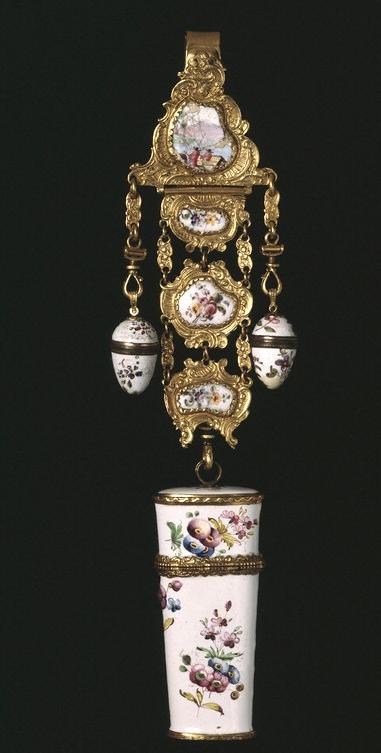
Decorative belt hook or clasp
A chatelaine is a decorative belt hook or clasp worn at the waist with a series of chains suspended from it. Each chain is mounted with useful household appendages such as scissors, thimbles, watches, keys, smelling salts, and household seals.
Etymology
The name chatelaine derives from the French term châtelaine which meant the mistress of a chateau. She would have worn a belt for her keys, which the current meaning of chatelaine derives from. The use of the term chatelaine to refer to a fashion accessory was first used in the periodical The World of Fashion in April 1828, and was followed by another reference to the accessory using this term in January 1829. Prior to this, the term had only been used to refer to the lady of the castle.
The January 1829 issue documents the new meaning of this term:...Châtelaine belongs to the female toilet; it consists in a bijou composed of various articles, and fastened together by a large chain of gold, which is fixed to the sash by a hook. A buckle, or a button falls over the skirt of the dress, to about the quarter of its length. The objects which terminate it are a very pretty gold key...a Gothic smelling bottle, in wrought gold, and some other little ornaments.
History
In the ancient world Samnite women wore chatelaines that were rectangular and had a central section consisting of mail. A number of metal spirals were present across the chain's spiral. Each one had a perforated disk of metal. This kind of clothing originated from the Picentes. Ancient Roman ladies wore chatelaines with ear scoops, nail cleaners, and tweezers. Women in Roman Britain wore 'chatelaine brooches' from which toilet sets were suspended.
The remnants of chatelaines and chatelaine bags have been found in the graves of women in the seventh and eighth century in the United Kingdom. Often found with the chatelaine artifacts would be wire rings, beads, buckles, knives and tools.
There isn't clear evidence that there were pockets in men's clothings until the late 1600s. This made the chatelaine critical as a place to hang daily necessities such as keys, a tobacco container, and a sheathed knife. In the 17th century, women primarily hung needlework tools on their chatelaine, but they could also hang things such as a perfume bottle, keys, a mirror, tweezers, or their small tools.
In the 18th century, both men and women wore chatelaines for attaching general needs or more specialized or expensive items, such as watches, seals, and other small, expensive items.
Chatelaine bags refer to bags suspended from a waistband by cord or chain, which were popular from the 1860s to the end of the 19th century.
Chatelaines were worn by many housekeepers in the 19th century.
Indicator of status
The chatelaine was also used as a woman's keychain in the 19th century to show the status of women in a wealthy household. The woman with the keys to all the many desks, chest of drawers, food hampers, pantries, storage containers, and many other locked cabinets was "the woman of the household". As such, she was the one who would direct the servants, housemaids, cooks and delivery servicemen and would open or lock the access to the valuables of the house, possessing total authority over who had access to what.
Frequently, this hostess was the senior woman of the house. When a woman married and moved into her father-in-law's house, her husband's mother would usually hold on to the keys. However, if the mother became a widow, the keys and their responsibilities and status were often passed to the oldest son's wife.
Younger women and daughters in the house often wanted the appearance of this responsibility, and would often wear decorative chatelaines with a variety of small objects in the place of keys, especially bright and glittering objects that could be used to start a conversation. In the case of the absence of a woman of the house, the controller of the keys was often a hired housekeeper.
Gallery
Roman chatelaine (FindID 132498).jpg | Incomplete Roman chatelaine Early-medieval chatelaine fitting (FindID 233670).jpg | Early Medieval chatelaine fitting
References
References
- [http://www.adin.be/en/explanation-on-chatelaine-by-adin-antique-jewelry.htm "Chatelaine."] ''Antique jewelry glossary.'' Adin antique jewelry. Accessed 29 Sept. 2012.
- [https://www.merriam-webster.com/dictionary/chatelaine ''Chatelaine''] Miriam Webster Online Dictionary. Accessed 28 June 2020
- Cummins, Genevieve E.. (1994). "Chatelaines: utility to glorious extravagance". Antique collector's club.
- (2007). "Greek and Roman dress from A to Z".
- (1996). "The Samnites of the fourth century BC : as depicted on Campanian vases and other sources". Institute of Classical Studies, School of Advanced Study, University of London and Accordia Research Centre.
- D'Ambra, Eve. (2007). "Roman Women". Cambridge University Press.
- Allason-Jones, Lindsay. (2010). "Artefacts in Roman Britain : their purpose and use". Cambridge University Press.
- (2006). "Death and Memory in Early Medieval Britain". Cambridge University Press.
- Sullivan, Kay. (2004). "Needlework tools and accessories: A Dutch tradition". Antique Collectors' Club.
- Rogers, Gay Ann. (1983). "An illustrated history of needlework tools". Murray.
- Victoria and Albert Museum, Natalie Rothstein, [[Madeleine Ginsburg]], Avril Hart, Valerie D. Mendes, and Philip Barnard. 1984. ''Four hundred years of fashion''. London: Victoria and Albert Museum in association with W. Collins. Page 174.
- [http://www.antiques-art-collectibles.com/collectible/fashion/chatelain.html "Chatelaines".] ''1Earth Antiques Appraisals''. Web. Accessed 29 Sept. 2012.
- Smith, Albert, Paul Gavarni, and John Gilbert. [https://archive.org/details/naturalhistoryf00smitgoog/page/n56 ''The Natural History of the Flirt'']. London: D. Bogue, 1848.
This article was imported from Wikipedia and is available under the Creative Commons Attribution-ShareAlike 4.0 License. Content has been adapted to SurfDoc format. Original contributors can be found on the article history page.
Ask Mako anything about Chatelaine (chain) — get instant answers, deeper analysis, and related topics.
Research with MakoFree with your Surf account
Create a free account to save articles, ask Mako questions, and organize your research.
Sign up freeThis content may have been generated or modified by AI. CloudSurf Software LLC is not responsible for the accuracy, completeness, or reliability of AI-generated content. Always verify important information from primary sources.
Report