From Surf Wiki (app.surf) — the open knowledge base
Chasmataspidida
Order of arthropods

Order of arthropods
- †Diploaspididae Størmer, 1972
- †Kiaeria Størmer, 1934 Chasmataspidids, sometime referred to as chasmataspids, are a group of extinct chelicerate arthropods that form the order Chasmataspidida. Chasmataspidids are probably related to horseshoe crabs (Xiphosura) and/or sea scorpions (Eurypterida), while more recent studies suggest that they form a clade (Dekatriata) with Eurypterida and Arachnida. Chasmataspidids are known sporadically in the fossil record through to the mid-Devonian, with possible evidence suggesting that they were also present during the late Cambrian. Chasmataspidids are most easily recognised by having an opisthosoma divided into a wide forepart (preabdomen) and a narrow hind part (postabdomen) each comprising 4 and 9 segments respectively. There is some debate about whether they form a natural (i.e. monophyletic) group.
Distribution
Chasmataspidids survived at least since Ordovician to mid-Devonian in age. As of 2019, most chasmataspidids (with a total of 9 species) are known from the Devonian strata, while the preceding Silurian and Ordovician period each have 3 and 2 species being described. Diploaspis is the only genus of chasmataspidids that unambiguously comprises species from different periods (D. casteri and D. muelleri from Devonian and D. praecursor from silurian). There was also a trace fossil composed of resting imprints with *Chasmataspis-*like outline discovered from late-Cambrian stratum in Texas, which might suggest an earlier occurrence of chasmataspidids. In addition, likely fossils from the Jiangshanian have been recorded from the Kimiltei site. However, affinities of those Cambrian records are questioned in 2023 study, identifying imprint from Texas (named Minterichnus shieldi) as made by phyllocarid, and suggesting Kimiltei fossils are also phyllocarids, while original authors argues.
Morphology
Most chasmataspidids are small arthropods with a body length that did not exceed 3 centimeters, with the ordovician species being exceptionally large, ranging between 10 (Chasmataspis) and 29 centimeters (Hoplitaspis).
File:20210202 Chasmataspidida size comparison.png|Size comparison of various chasmataspidids. File:20200919 Chasmataspidida dorsal.png|Dorsal morphology of a generalized chasmataspidid.
The streamlined body of a chasmataspidid is composed of a rigid prosoma and an externally 13-segmented opisthosoma. As in eurypterids, the dorsal side of the prosoma was covered by a rigid carapace (prosomal dorsal shield) that bore a pair of larger lateral (presumably compound) eyes and a pair of tiny median ocelli. Chasmataspidids are readily distinguished from other chelicerates by the subdivision of the 13 opisthosomal segments into a widened, 4-segmented preabdomen and a slender, 9-segmented postabdomen. the tergite (dorsal exoskeleton) of the first opisthosomal or preabdominal segment is retained as a narrow element known as 'microtergite', which is not observed in eurypterids. The posterior three preabdominal segments are well developed, forming a rigid box-like section called a 'buckler'. The postabdominal segments are cylindrical, and the last segment terminates with a spine/plate-like telson, which is usually relatively short.
Appendages
File:Hoplitaspis hiawathai life restoration.png|Reconstruction of Hoplitaspis hiawathai with ventral view (B) showing appendicular structures. File:Eurypterid and chasmataspidid sixth appendage comparison.png|Comparison of appendage VI between chasmataspidids (left) and eurypterids (right).
Since the appendages of chasmataspidid are rarely preserved in the fossil, most species have only fragile or even no appendicular structures had been described. Based on available materials, the prosoma compose of 6 appendage pairs (appendage I - VI) just like most euchelicerates, which were 1 pair of small chelicerae and 5 pairs of limb-like appendages, although the detail morphology of the former is still unclear. The coxae (basalmost limb segments) of appendage II-VI bore gnathobases. At least the posteriormost appendage pair (appendage VI) of prosoma seems to be differ between families. Appendage of Chasmataspididae known only from 2 disarticulated specimens of appendages which interpreted as appendage VI of Chasmataspis. the appendage bore exopod-like structure on the base and terminated with a chelate (pincer), similar to those of a xiphosuran. On the other hand, Appendage VI modified into a paddle that strikingly resemble to those of a eurypterine (swimming eurypterid) was discovered in some species of Diploaspididae, but the basal diploaspidid Loganamaraspis possibly did not possess this character on Appendage VI. the limb-like appendage II-V of diploaspidids are either featureless or bore rows of spines.
Opisthosomal appendages are even rarely being observed and only known from a few diploaspidid materials. they are at least present on the ventral side of preabdomen, each pair originated from one preabdominal segment. the anteriormost appendicular structure of opisthosoma was metastoma, a plate-like structure interpreted as a fused appendage pair of first opisthosomal segment, situated between the gnathobase of prosomal appendage VI. Beyond the metastoma were 3 pairs of plate-like opercula originated from the 3 buckler segments, with the first operculum pair (genital operculum) bore a medially positioned genital appendage that extend until the posterior region of second operculum pair. Some of the opercula may have book gills just like those of xiphosurans and eurypterids, but the evidence are equivocal. Previous reports of a large operculum cover the whole ventral surface of buckler are most likely a misinterpretation of the ventral buckler wall (sternites or dorsal surface of gill chamber), which were originally enclosed by the opercula in life. The metastoma, opercula and genital appendage are shared characters between chasmataspidid and eurypterid, but unlike the fused first and second operculum pair of eurypterid, the two operculum pairs seems to be unfused in chasmataspidid. Possible chasmataspidid trace fossil from cambrian have imprints resembling 6 pairs of opercula. If the interpretation is true, chasmataspidid may had extra 3 pairs of opercula on the first 3 postabdominal segment as well.
Representative genera
''Chasmataspis''

The first chasmataspidid to be discovered was Chasmataspis laurencii, described by the American palaeontologists Kenneth E. Caster and H. K. Brooks in 1956. These Ordovician fossils come from the site of the Douglas Dam in Tennessee, USA. They are the most xiphosuran-like of the known chasmataspidid species, with a horseshoe-shaped carapace. Caster & Brooks raised a new family, Chasmataspididae, to accommodate these specimens. The species was redescribed by Jason Dunlop and colleagues in 2004.
''Diploaspis''

The next species to be discovered were Diploaspis casteri and Heteroaspis novojilovi; both described by the Norwegian palaeontologist Leif Størmer from the early Devonian of Alken an der Mosel in Germany in 1972.
A revision by Markus Poschmann and co-workers in 2005 recognised H. novojilovi as a synonym of D. casteri. The two species appear to actually be preservational variants of the same species. Poschmann et al. also described a second species as Diploaspis muelleri.
A third species, Diploaspis praecursor (Late Silurian, Bertie Group, New York State), was described by Lamsdell and Briggs in 2017.
''Forfarella''

Forfarella mitchelli from the early Devonian of the Forfar region in the Midland Valley of Scotland was described by Jason Dunlop and colleagues in 1999; although the fossil had actually been recognised as a chasmataspidid and provisionally labelled as such some years previously by Charles Waterston. Forfarella mitchelli is not very well preserved, but does show the characteristic chasmataspidid body plan.
''Achanarraspis''
The stratigraphically youngest chasmataspidid is Achanarraspis reedi, described by Lyall Anderson and colleagues in 2000, from the mid-Devonian Achanarras quarry in Caithness, Scotland, a site rich in fish fossils.
''Octoberaspis''
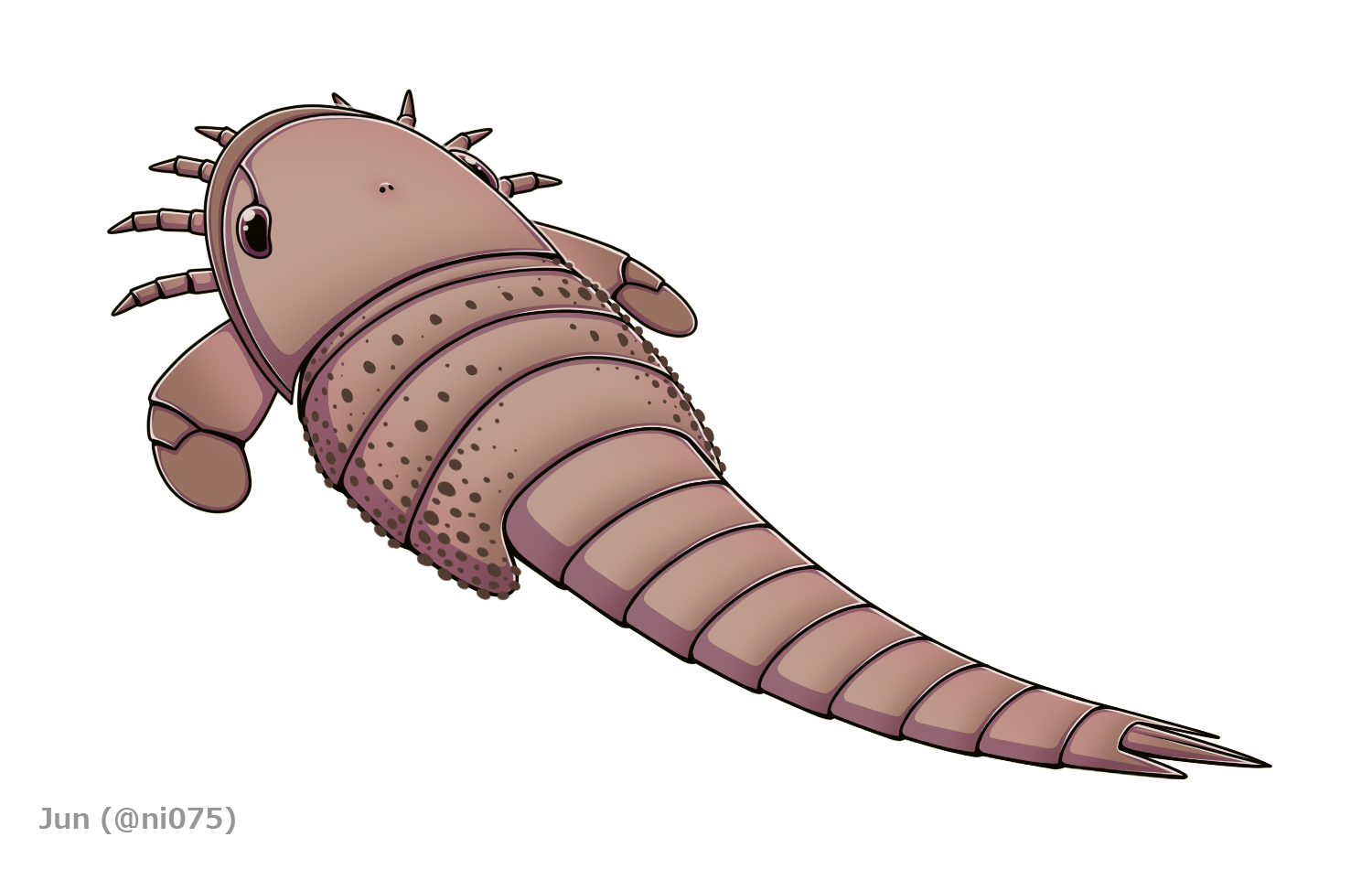
Well preserved chasmataspidids were recovered from the early Devonian of October Revolution Island, part of the Severnaya Zemlya group in the Russian Arctic. Originally briefly described as eurypterids, they were formally described as Octoberaspis ushakovi by Jason Dunlop in 2002. Octoberaspis is one of the few chasmataspidids with well-documented opisthosomal appendages, reveal some characters previously though to be eurypterid-exclusive were also shared by chasmataspidid as well.
''Loganamaraspis''
Loganamaraspis dunlopi discovered from a famous Silurian fossil locality near Lesmahagow in Scotland. Described by Erik Tetlie and Simon Braddy in 2003, it was placed in Diploaspididae, but interpreted as being somewhat more intermediate in form between the Chasmataspis and Diploaspidid body plans.
''Dvulikiaspis''

Fossils of Dvulikiaspis menneri discovered from the Imangda River of Taymyr Peninsula were originally interpreted as a species of eurypterid genus Stylonurus, and formally described as a new genus of chasmataspidid by David J. Marshall and co-authors in 2014. Dvulikiaspis menneri is one of the few well-preserved chasmataspidids, with distal morphology of appendage II-VI had been revealed.
''Hoplitaspis''
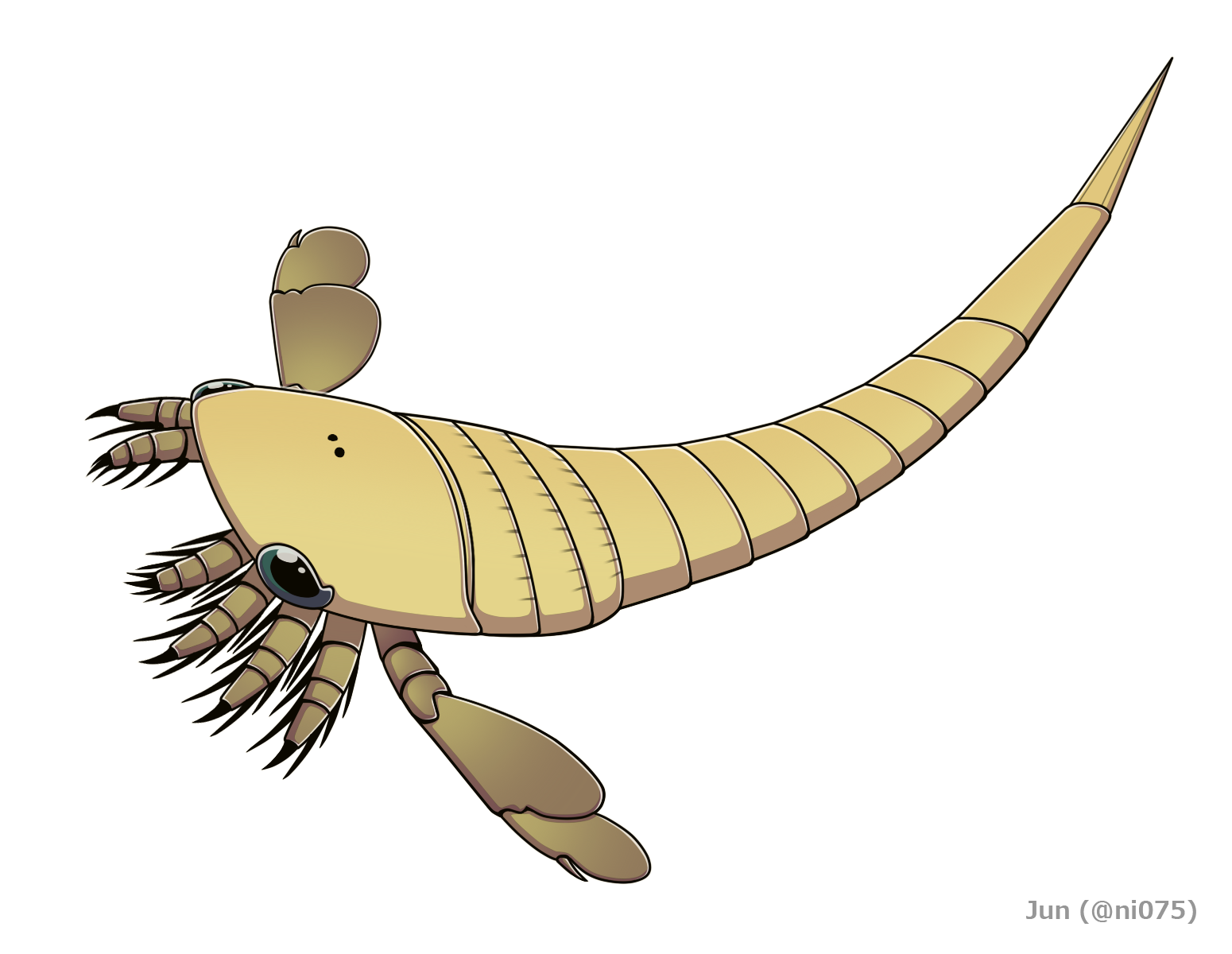
Hoplitaspis hiawathai is the second known species of Ordovician chasmataspidid, discovered from the Big Hill Lagerstätte of Michigan in United States, described by James C. Lamsdell and co-authors in 2019. With nearly complete set of appendages being observable, Hoplitaspis hiawathai is the most complete chasmataspidid known at that time. Each of the paddle of Hoplitaspis hiawathai has a claw instead of an intersegmental element like those of other diploaspidids, providing clues on the relationship between the appendage VI of Chasmataspis and diploaspidids.
Classification
Phylogenetic position
Chasmataspidids have a controversial phylogenetic position within Chelicerata. The first species to be discovered were thought to be unusual fossil xiphosuran, while later species were often based on specimens initially misidentified as eurypterids. Chasmataspidids had been interpreted as relatives/members of either xiphosurans or eurypterids, or forming a clade (Dekatriata) with eurypterids and arachnids. some xiphosurans have non-chelate limbs and unfused opisthosoma) or more likely represent a result of parallel evolution (e.g. the paddles of diploaspidids and swimming eurypterids have different component). Additionally, the monophyly of chasmataspidids could be supported by the unique component of 4-segmented preabdomen and 9-segmented postabdomen as well. As of the 2010s, many studies supports the monophyly of Chasmataspidida and Dekatriata (Chasmataspidida+Eurypterida+Arachnida).
Interrelationships
As of 2019, up to 12 genera had been associated within Chasmataspidida. With the exception of Diploaspis which compose of 3 species since 2017, all chasmataspidid genera are monotypic. The order Chasmataspidida subdivided into two families: Chasmataspididae and Diploaspididae. the former consists of Chasmataspis (and possibly also Kiaeria) while the latter include the remaining genera. Chasmataspididae is defined by a horseshoe-shaped carapace with distinct genal spines and a completely fused preabdomen; while Diploaspididae is defined by a semicircular to subquadrate carapace and a preabdomen with curved, non-trilobate segments.
†Chasmataspidida Caster & Brooks, 1956
- †Kiaeria Størmer, 1934 (might belong to Chasmataspididae)
- †Kiaeria limuloides Størmer, 1934—Silurian
- †Chasmataspididae Caster & Brooks, 1956
- †Chasmataspis Caster & Brooks, 1956
- †Chasmataspis laurencii Caster & Brooks, 1956—Ordovician
- †Chasmataspis Caster & Brooks, 1956
- †Diploaspididae Størmer, 1972
- †Achanarraspis Anderson, Dunlop & Trewin, 2000
- †Achanarraspis reedi Anderson, Dunlop & Trewin, 2000—Devonian
- †Diploaspis Størmer, 1972
- †Diploaspis casteri Størmer, 1972—Devonian
- †Diploaspis muelleri Poschmann, Anderson & Dunlop, 2005—Devonian
- †Diploaspis praecursor Selden, Lamsdell & Liu 2015—Silurian
- †Dvulikiaspis Marshall, Lamsdell, Shpinev & Braddy, 2014
- †Dvulikiaspis menneri (Novojilov, 1959) (formerly known as 'Tylopterella' menneri)—Devonian
- †Forfarella Dunlop, Anderson & Braddy, 1999
- †Forfarella mitchelli Dunlop, Anderson & Braddy, 1999—Devonian
- †Heteroaspis Størmer, 1972
- †Heteroaspis stoermeri Størmer, 1972 (formerly known as 'Eurypterus' stoermeri)—Devonian
- †Hoplitaspis Lamsdell, Gunderson & Meyer, 2019
- †Hoplitaspis hiawathai Lamsdell, Gunderson & Meyer, 2019—Ordovician
- †Loganamaraspis Tetlie & Braddy, 2004
- †Loganamaraspis dunlopi Tetlie & Braddy, 2004—Silurian
- †Nahlyostaspis Marshall, Lamsdell, Shpinev & Braddy, 2014
- †Nahlyostaspis bergstroemi Marshall, Lamsdell, Shpinev & Braddy, 2014—Devonian
- †Octoberaspis Dunlop, 2002
- †Octoberaspis ushakovi Dunlop, 2002—Devonian
- †Skrytyaspis Marshall, Lamsdell, Shpinev & Braddy, 2014
- †Skrytyaspis andersoni Marshall, Lamsdell, Shpinev & Braddy, 2014—Devonian
- †Achanarraspis Anderson, Dunlop & Trewin, 2000
References
References
- (2014). "Three-dimensional reconstruction and the phylogeny of extinct chelicerate orders". PeerJ.
- Lamsdell, James C.. (2013-01-01). "Revised systematics of Palaeozoic 'horseshoe crabs' and the myth of monophyletic Xiphosura". Zoological Journal of the Linnean Society.
- (2015). "An unusual euchelicerate linking horseshoe crabs and eurypterids, from the Lower Devonian (Lochkovian) of Yunnan, China". Zoologica Scripta.
- (2015). "A new Ordovician arthropod from the Winneshiek Lagerstätte of Iowa (USA) reveals the ground plan of eurypterids and chasmataspidids". The Science of Nature.
- Lamsdell, James C.. (2016). "Horseshoe crab phylogeny and independent colonizations of fresh water: ecological invasion as a driver for morphological innovation". Palaeontology.
- (2017). "Segmentation and tagmosis in Chelicerata". Arthropod Structure & Development.
- Naimark, E. B.. (2023-09-01). "Kimiltei Is a New Late Cambrian Lagerstätte with the Faunistic Complex of Arthropods (Euthycarcinoidae, Synziphosurina, and Chasmataspidida) in the Irkutsk Region". Doklady Earth Sciences.
- Braddy, Simon J.. (2023-09-29). "A new arthropod resting trace from the middle Cambrian of Texas". Neues Jahrbuch für Geologie und Paläontologie - Abhandlungen.
- Naimark, Elena. (2025-07-15). "Three groups of arthropods (Chasmataspidida, Offacolidae (?), and Euthycarcinoidea) cohabited a tidal zone in the late Cambrian paleobasins (495–488 Ma) of Eastern Siberia". Journal of Asian Earth Sciences.
- (2019-01-08). "A common arthropod from the Late Ordovician Big Hill Lagerstätte (Michigan) reveals an unexpected ecological diversity within Chasmataspidida". BMC Evolutionary Biology.
- (2014). "A diverse chasmataspidid (Arthropoda: Chelicerata) fauna from the Early Devonian (Lochkovian) of Siberia". Palaeontology.
- Kenneth E. Caster and H. K. Brooks. (1956). "New fossils from the Canadian–Chazan (Ordovician) hiatus in Tennessee". [[Bulletins of American Paleontology]].
- Jason A. Dunlop, Lyall I. Anderson & Simon J. Braddy. (2004). "A redescription of ''Chasmataspis laurencii'' Caster & Brooks (Chelicerata: Chasmataspidida) from the Middle Ordovician of Tennessee, USA, with remarks on chasmataspid phylogeny". Transactions of the Royal Society of Edinburgh: Earth Sciences.
- Leif Størmer. (1972). "Arthropods from the Lower Devonian (Lower Emsian) of Alken an der Mosel, Germany. Part 2: Xiphosura". [[Senckenbergiana Lethaea]].
- Markus Poschmann, Lyall I. Anderson & Jason A. Dunlop. (2005). "Chelicerate arthropods, including the oldest phalangiotarbid arachnid, from the Early Devonian (Siegenian) of the Rhenish Massif, Germany". [[Journal of Paleontology]].
- (2017). "The first diploaspidid (Chelicerata: Chasmataspidida) from North America (Silurian, Bertie Group, New York State) is the oldest species of ''Diploaspis''". Geological Magazine.
- Jason A. Dunlop, L. I. Anderson & S. J. Braddy. (1999). "A new chasmataspid (Chelicerata: Chasmataspida) from the Lower Devonian of the Midland Valley of Scotland". Transactions of the Royal Society of Edinburgh: Earth Sciences.
- Lyall I. Anderson, Jason A. Dunlop & Nigel H. Trewin. (2000). "A Middle Devonian chasmataspid arthropod from Achanarras Quarry, Caithness, Scotland". [[Scottish Journal of Geology]].
- Jason A. Dunlop. (2002). "Arthropods from the Lower Devonian Severnaya Zemlya Formation of October Revolution Island, Russia". [[Geodiversitas]].
- O. Erik Tetlie & Simon J. Braddy. (2003). "The first Silurian chasmataspid, ''Loganamaraspis dunlopi'' gen. et sp. nov. (Chelicerata: Chasmataspidida) from Lesmahagow, Scotland, and its implications for eurypterid phylogeny". Transactions of the Royal Society of Edinburgh: Earth Sciences.
- Shultz, Jeffrey W.. (2007-06-01). "A phylogenetic analysis of the arachnid orders based on morphological characters". Zoological Journal of the Linnean Society.
- (2013). "Babes in the wood – a unique window into sea scorpion ontogeny". [[BMC Evolutionary Biology]].
- (2005). "A new specimen ofWeinbergina opitzi (Chelicerata: Xiphosura) from the Lower Devonian Hunsriick Slate, Germany". Paläontologische Zeitschrift.
- Legg, David A.. (2014). "Sanctacaris uncata: the oldest chelicerate (Arthropoda)". Naturwissenschaften.
- (2017-12-21). "Mandibulate convergence in an armoured Cambrian stem chelicerate". BMC Evolutionary Biology.
- (2019). "A middle Cambrian arthropod with chelicerae and proto-book gills". Nature.
- Dunlop, J. A., Penney, D. & Jekel, D. 2018. A summary list of fossil spiders and their relatives. In World Spider Catalog. Natural History Museum Bern, online at http://wsc.nmbe.ch, version 18.5 http://www.wsc.nmbe.ch/resources/fossils/Fossils18.5.pdf (PDF).
- Lamsdell, James C.. (2019). "A chasmataspidid affinity for the putative xiphosuran Kiaeria Størmer, 1934". Paläontologische Zeitschrift.
- (December 2001). "On the Emsian (Early Devonian) arthropods of the Rhenish Slate Mountains: 3. The chasmataspididDiploaspis". PalZ.
This article was imported from Wikipedia and is available under the Creative Commons Attribution-ShareAlike 4.0 License. Content has been adapted to SurfDoc format. Original contributors can be found on the article history page.
Ask Mako anything about Chasmataspidida — get instant answers, deeper analysis, and related topics.
Research with MakoFree with your Surf account
Create a free account to save articles, ask Mako questions, and organize your research.
Sign up freeThis content may have been generated or modified by AI. CloudSurf Software LLC is not responsible for the accuracy, completeness, or reliability of AI-generated content. Always verify important information from primary sources.
Report