From Surf Wiki (app.surf) — the open knowledge base
Charlotte Coliseum
Former sports arena in Charlotte, North Carolina, United States
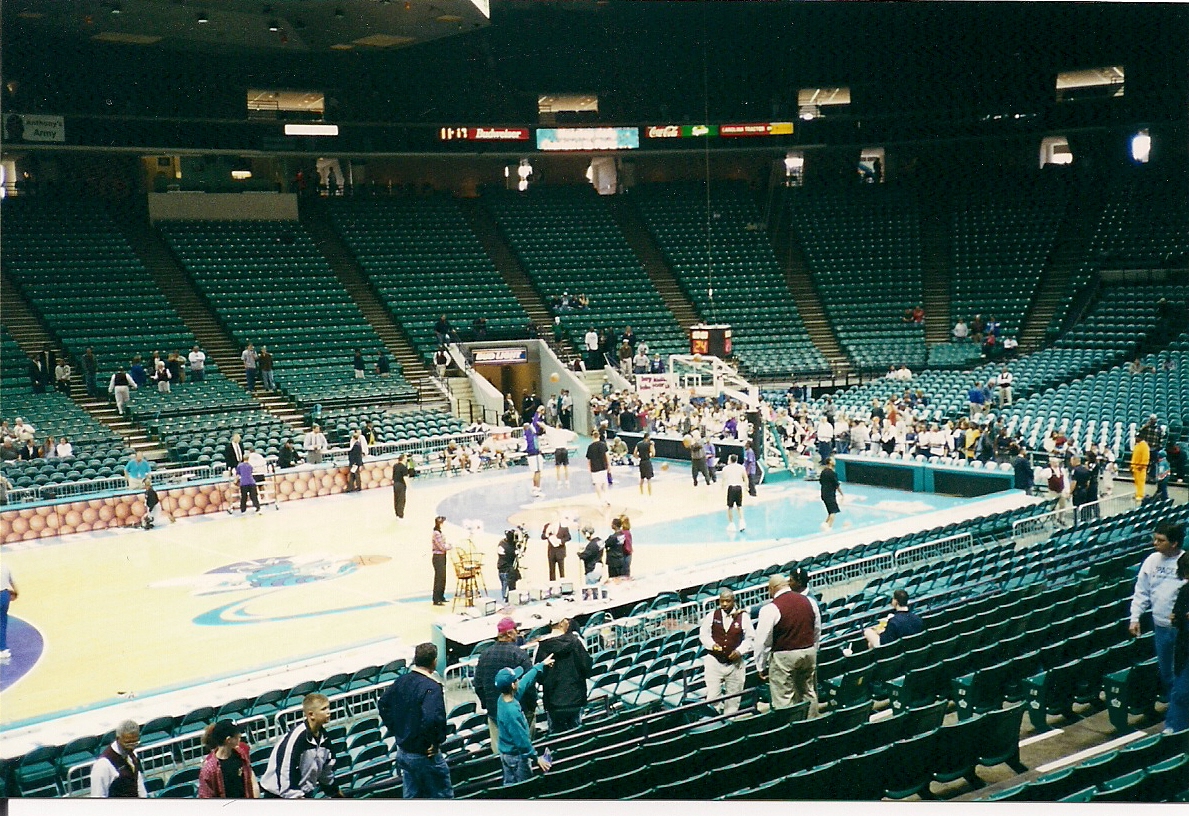
Former sports arena in Charlotte, North Carolina, United States
| Field | Value | ||
|---|---|---|---|
| name | Charlotte Coliseum | ||
| nickname | The Hive | ||
| image | File:Coliseum1988.jpg | ||
| caption | The Coliseum in 1988 | ||
| address | Hive Dr | ||
| location | Charlotte, North Carolina, United States | ||
| coordinates | |||
| broke_ground | August 1986 | ||
| opened | August 11, 1988 | ||
| closed | October 26, 2005 | ||
| demolished | June 3, 2007 | ||
| owner | City of Charlotte | ||
| operator | City of Charlotte | ||
| construction_cost | US$52 million | ||
| ($ in dollars) | |||
| architect | Odell Associates | ||
| tenants | Charlotte Hornets/Bobcats (NBA) (1988–2002, 2004–2005) | ||
| Charlotte 49ers (NCAA) (1988–1993) | |||
| Charlotte Rage (AFL) (1992–1994, 1996) | |||
| Charlotte Sting (WNBA) (1997–2005) | |||
| Carolina Cobras (AFL) (2003–2004) | |||
| seating_capacity | Basketball: 24,042 | ||
| Ice hockey: 21,684 | |||
| Boxing: 23,041 | |||
| Concerts:<br>End stage 180°: 16,695<br>End stage 360°: 23,780<br>Center stage: 24,041<br>Theatre: 5,372 - 9,696<ref>{{cite web | url | http://www.americanradiohistory.com/hd2/IDX-Business/Music/Archive-Billboard-IDX/IDX/90s/1991/BB-1991-10-05-OCR-Page-0038.pdf | title=Charlotte Coliseum}} |
| dimensions | 872000 sqft | ||
| scoreboard | American Sign & Indicator, now Trans-Lux |
($ in dollars) Charlotte 49ers (NCAA) (1988–1993) Charlotte Rage (AFL) (1992–1994, 1996) Charlotte Sting (WNBA) (1997–2005) Carolina Cobras (AFL) (2003–2004) Ice hockey: 21,684 Boxing: 23,041
Concerts: *End stage 180°: 16,695 *End stage 360°: 23,780 *Center stage: 24,041 *Theatre: 5,372 - 9,696
Charlotte Coliseum was a multi-purpose sports and entertainment arena located in Charlotte, North Carolina, United States. It was operated by the Charlotte Coliseum Authority, which also oversees the operation of Bojangles Coliseum, which was called Charlotte Coliseum prior to 1988, the Charlotte Convention Center, and Ovens Auditorium. It was the home of the NBA's Charlotte Hornets from 1988 to 2002, and the Charlotte Bobcats, the second incarnation of the Charlotte Hornets, from 2004 to 2005.
The Coliseum hosted 371 consecutive NBA sell-outs from December 1988 to November 1997, which includes seven playoff games. It hosted its final NBA basketball game on October 26, 2005, a preseason game between the Charlotte Bobcats and the Indiana Pacers.
The city of Charlotte sold the property and the building, along with a Maya Lin commission outside it, was demolished via implosion on June 3, 2007.
This was the second building to use the name "Charlotte Coliseum"; Bojangles Coliseum, located on Independence Boulevard, originally opened as the Coliseum in 1955 and is still in use.
History
Construction on the Charlotte Coliseum began in 1986 and was opened on August 11, 1988, with a dedication by the Reverend Billy Graham. The architects, Odell Associates, claimed to have built a state-of-the-art venue, complete with a large eight-sided video scoreboard, but the arena contained far fewer luxury suites than other arenas built in that era. George Shinn had used the under-construction arena as his hole card to get the NBA to place a team in the city. With almost 24,000 seats, it was not only the largest venue in the league, but the largest basketball-specific arena ever to serve as a full-time home for an NBA team. Some thought the Coliseum was too big, but Shinn believed the area's longstanding support for college basketball made the Coliseum a more-than-viable home for an NBA team.
The day after the dedication, the United States Olympic basketball team was scheduled to play an exhibition game at the Coliseum. While preparing for the event, the 40,000-pound, $3.2 million scoreboard was being repositioned when it struck the ceiling and crashed to the floor, destroying both it and the court it landed on—an alternate floor was brought from the old Coliseum in time for the game that night.
The Hornets would go on to lead the NBA in attendance in eight of its first nine seasons playing in "The Hive".
The Coliseum had fewer amenities than other NBA arenas built in its time. "As nice as the building was, it was ... the last of the propeller airplanes before the jets came," said Max Muhleman of Charlotte-based Private Sports Consulting. While the Palace of Auburn Hills, which opened the same year, contained 180 luxury suites, the Coliseum had just eight.
In 2005 the Charlotte Coliseum was replaced with Charlotte Bobcats Arena (now Spectrum Center) located in the First Ward of Uptown Charlotte. One of the Coliseum's last functions before being shuttered was ironically to serve as a shelter for people fleeing New Orleans in the wake of Hurricane Katrina in the fall of 2005.
Tenants
Although the Hornets were the best-known tenants of the Coliseum, many other teams called The Hive home.
The Charlotte Sting of the WNBA began play in the Coliseum upon their inception in 1997, but had moved to Spectrum Center in 2006. During most Sting games, the upper level and a portion of the lower level were curtained off, reducing capacity to around 10,000. However, during the Sting's unexpected run to the WNBA Finals in 2001, they attracted the largest crowd in WNBA history to one playoff game.
The Charlotte 49ers played in the Coliseum during their final days in the Sun Belt Conference from 1988 through 1993. The Coliseum also played host to the 1989 Sun Belt men's basketball tournament, setting a record for attendance. They moved back to their old home, Bojangles Coliseum (then known as Independence Arena) for the 1993–94 season, partly due to a desire for a more intimate atmosphere. The 49ers rarely came close to filling the arena, and they were frequently swallowed up in the environment. Additionally, the Coliseum was located on the opposite side of the county from UNC Charlotte's campus, and was thus inconvenient to most of its student body.
Two now-defunct Arena Football League teams played in the Coliseum—the Charlotte Rage (1992–96) and the Carolina Cobras (2003–04).
When the NBA returned to Charlotte in 2004 with the expansion Bobcats, they played their first season (2004–05) in the Coliseum as what became the Spectrum Center was being built.
Although the Coliseum and all but one of its parking lots had been demolished as of September 2013, the street leading to the grounds named Hive Drive (after the Coliseum's nickname of "The Hive", which has since been applied to the second Hornets' home arena) and a sign at the beginning guiding drivers to the Coliseum and surrounding amenities remained for some time afterward. Additionally, for some years after the arena's demolition, signs on Billy Graham Parkway continued to direct drivers to the "Coliseum Area."
Notable events
The arena was also used for large-scale college basketball events in order to compete with the Piedmont Triad and Research Triangle areas of the state which are the heart of the state's college basketball culture. The Coliseum hosted the 1994 Men's Final Four and the 1996 Women's Final Four (both jointly hosted by Davidson College and UNC Charlotte), in addition to NCAA tournament regionals, sub-regionals, eight ACC men's basketball tournaments and the 1989 Sun Belt Conference men's basketball tournament.
It also hosted the 1991 NBA All-Star Game. It was also the site of WWE's Unforgiven 1999 and Judgment Day 2003.
In addition to the many sporting events hosted at the Coliseum, it hosted large concerts. The first concert was not long after the grand opening and featured Frank Sinatra. Another blue-eyed crooner, Rick "The Big Bopper" Sammons, was the final performer to entertain in the Coliseum.
| Charlotte Hornets}};" | List of concerts and events at the arena | Charlotte Hornets}};" | Artist | Charlotte Hornets}};" | Event | Charlotte Hornets}};" | Date | Charlotte Hornets}};" | Opening Act |
|---|---|---|---|---|---|---|---|---|---|
| AC/DC | Blow Up Your Video World Tour | August 25, 1988 | White Lion | ||||||
| Ballbreaker World Tour | January 13, 1996 | The Poor | |||||||
| Bob Dylan | Never Ending Tour | September 17, 1988 | Black Uhuru | ||||||
| Bobby Brown | Don't Be Cruel Tour | January 20, 1989 | New Edition | ||||||
| Bon Jovi | New Jersey Syndicate Tour | February 17, 1989 | Skid Row | ||||||
| Def Leppard | Hysteria World Tour | October 5, 1988 | Queensrÿche & L.A. Guns | ||||||
| Dr. Dre, Snoop Dogg, Ice Cube, Eminem | Up in Smoke Tour | July 29, 2000 | Various | ||||||
| Eazy E and N.W.A. | Eazy Duz It Tour | June 23, 1989 | Too Short, Kid N' Play, Kwamé, J.J. Fadd, M.C. Twist | ||||||
| Elton John | Sleeping with the Past Tour | October 16 1989 | |||||||
| Eric B. & Rakim | Follow the Leader Tour | August 26, 1988 | |||||||
| Eric Clapton | Pilgrim Tour | April 22, 1998 | |||||||
| Frank Sinatra | 1988 Tour | August 19, 1988 | |||||||
| Grateful Dead | 1989 Fall Tour | October 22–23, 1989 | |||||||
| 1992 Summer Tour | June 17–18, 1992 | ||||||||
| INXS | Kick Tour | September 10, 1988 | Ziggy Marley and the Melody Makers | ||||||
| Janet Jackson | Janet World Tour | January 9, 1994 | Tony! Toni! Toné! | ||||||
| Judas Priest | Mercenaries of Metal Tour | September 9, 1988 | Cinderella | ||||||
| Kelly Clarkson and Clay Aiken | Independent Tour | February 24, 2004 | |||||||
| Luther Vandross | Any Love World Tour | November 5, 1988 | Anita Baker | ||||||
| MC Hammer | Too Legit to Quit World Tour | April 3, 1992 | Jodeci, TLC, Oaktown 357,Mary J. Blige | ||||||
| Metallica | Damaged Justice | February 26, 1989 | Queensrÿche | ||||||
| Madly in Anger with the World Tour | April 23, 2004 | Godsmack | |||||||
| Ozzy Osbourne | No Rest for the Wicked Tour | November 23, 1988 | Anthrax | ||||||
| Poison | Open Up and Say... Ahh! Tour | February 2, 1989 | Tesla | ||||||
| Prince | Lovesexy Tour | September 24, 1988 | |||||||
| Randy Travis | Old 8×10 Tour | October 22, 1988 | |||||||
| Rush | Presto Tour | May 2, 1990 | Candlebox | ||||||
| Counterparts Tour | February 25, 1994 | ||||||||
| Test for Echo Tour | December 12, 1996 | ||||||||
| Stryper | In God We Trust Tour | November 6, 1988 | Hurricane | ||||||
| U2 | Elevation Tour | March 29, 2001 | |||||||
| Van Halen | OU812 Tour | October 7, 1988 | Private Life | ||||||
| Waylon Jennings | Full Circle Tour | October 15, 1988 | Hank Williams Jr. |
In film
The Coliseum was home to filming of the movie Eddie in 1996, and was the Tech Dome, home of the fictitious Tech University in the 1998 film He Got Game. It was the venue for the 2000 stand-up comedy film The Original Kings of Comedy; it was also featured in 2002's Juwanna Mann.
Current use
City Park, a mixed-use development, was constructed on the former site. City Park includes town homes, apartments, hotels, and restaurants. A plaque honoring the former arena is placed near the front of the development.
Notes
References
- "Charlotte Coliseum".
- "Lakeland Ledger - Google News Archive Search".
- (6 November 2016). "Charlotte's History of Arts Controversies".
- [https://www.espn.com/nba/news/story?id=2889956 Last of its kind: Charlotte Coliseum to be demolished Sunday], updated June 1, 2007
- (12 August 1988). "Coliseum Scoreboard Crashes to Floor".
- (June 2007). "Charlotte Coliseum scheduled for demolition".
- (12 August 1988). "A 40,000-pound scoreboard at the new Charlotte Coliseum collapsed...".
- "NBA Home Attendance Totals".
- "Rick Sammons | Rockabilly from Cleveland, GA".
This article was imported from Wikipedia and is available under the Creative Commons Attribution-ShareAlike 4.0 License. Content has been adapted to SurfDoc format. Original contributors can be found on the article history page.
Ask Mako anything about Charlotte Coliseum — get instant answers, deeper analysis, and related topics.
Research with MakoFree with your Surf account
Create a free account to save articles, ask Mako questions, and organize your research.
Sign up freeThis content may have been generated or modified by AI. CloudSurf Software LLC is not responsible for the accuracy, completeness, or reliability of AI-generated content. Always verify important information from primary sources.
Report