From Surf Wiki (app.surf) — the open knowledge base
Chandrayaan-2
Indian lunar mission (2019–Present)

Indian lunar mission (2019–Present)
| Field | Value |
|---|---|
| name | Chandrayaan-2 |
| image | GSLV Mk III M1, Chandrayaan-2 - Vikram lander mounted on top of orbiter.jpg |
| image_caption | Vikram lander mounted on top of orbiter inside cleanroom. |
| mission_type | |
| operator | ISRO |
| COSPAR_ID | 2019-042A |
| SATCAT | 44441 |
| website | |
| mission_duration | * Orbiter: ~ 7.5 years (planned); |
| (elapsed) | |
| * Vikram lander: ≤ 14 days (planned);<ref name | ":3"/ |
| 0 days (landing failure) | |
| * Pragyan rover: ≤ 14 days (planned);<ref name | "duration"/ |
| 0 days (not deployed) | |
| manufacturer | ISRO |
| launch_mass | Combined (wet): 3850 kg |
| Combined (dry): 1308 kg | |
| Orbiter (wet): 2379 kg | |
| Orbiter (dry): 682 kg | |
| Vikram lander (wet): 1471 kg | |
| Vikram lander (dry): 626 kg | |
| Pragyan rover: 27 kg | |
| insignia | Chandrayaan 2 logo.jpg |
| insignia_size | 200px |
| insignia_caption | Mission Insignia |
| power | Orbiter: 1000 watts |
| Vikram lander: 650 watts | |
| Pragyan rover: 50 watts | |
| launch_date | 22 July 2019, 09:13:12 UTC |
| launch_rocket | LVM3 M1 |
| launch_site | Satish Dhawan Space Centre Second Launch Pad |
| launch_contractor | ISRO |
| interplanetary | {{Infobox spaceflight/IP |
| type | orbiter |
| object | Lunar |
| component | |
| arrival_date | 20 August 2019, 03:32 UTC |
| periapsis | 100 km |
| apoapsis | 100 km |
| apsis | selene |
| type | lander |
| object | Lunar |
| component | Rover |
| arrival_date | 6 September 2019, 20:23 UTC |
| location | near-Lunar south pole (intended) |
| Tiranga Point | |
| (between Manzinus C and Simpelius N craters) (crash site) | |
| programme | Chandrayaan programme |
| previous_mission | Chandrayaan-1 |
| next_mission | Chandrayaan-3 |
(elapsed)
- Vikram lander: ≤ 14 days (planned); 0 days (landing failure)
- Pragyan rover: ≤ 14 days (planned); 0 days (not deployed) Combined (dry): 1308 kg Orbiter (wet): 2379 kg Orbiter (dry): 682 kg Vikram lander (wet): 1471 kg Vikram lander (dry): 626 kg Pragyan rover: 27 kg Vikram lander: 650 watts Pragyan rover: 50 watts
Tiranga Point
(between Manzinus C and Simpelius N craters) (crash site)
Chandrayaan-2 (; from Sanskrit: Chandra, "Moon" and yāna, "craft, vehicle") is the second lunar exploration mission developed by ISRO after Chandrayaan-1. It consists of a lunar orbiter, the Vikram lunar lander, and the Pragyan rover, all of which were developed in India. The main scientific objective is to map and study the variations in lunar surface composition, as well as the location and abundance of lunar water.
The spacecraft was launched from the second launch pad at the Satish Dhawan Space Centre in Andhra Pradesh on 22 July 2019 at 09:13:12 UTC by a LVM3-M1 rocket. The craft reached lunar orbit on 20 August 2019. The Vikram lander attempted a lunar landing on 6 September 2019; the lander crashed due to a software error.
The lunar orbiter continues to operate in orbit around the Moon. A follow-up landing mission, Chandrayaan-3, was launched in 2023 and successfully performed a lunar landing.
History
On 12 November 2007, representatives of the Roscosmos and ISRO signed an agreement for the two agencies to work together on the Chandrayaan-1's follow-up project, Chandrayaan-2. ISRO would have the prime responsibility for the orbiter, rover and the launch by GSLV, while Roscosmos was to provide the lander. The Indian government approved the mission in a meeting of the Union Cabinet, held on 18 September 2008 and chaired by Prime Minister Manmohan Singh. The design of the spacecraft was completed in August 2009, with scientists of both countries conducting a joint review.
Although ISRO finalised the payload for Chandrayaan-2 on schedule, In 2012, there was a delay in the construction of the Russian lander for Chandrayaan-2 due to the failure of the Fobos-Grunt mission to Mars, since the technical issues connected with the Fobos-Grunt mission which were also used in the lunar projects including the lander for Chandrayaan-2 needed to be reviewed. The changes proposed by Roscosmos necessitated increase in lander mass and required ISRO to decrease mass of its rover and accept some reliability risk. When Russia cited its inability to provide the lander even by a revised time-frame of 2015 due to technical and financial reasons, India decided to develop the lunar mission independently. With new mission timeline for Chandrayaan-2 and an opportunity for a Mars mission arising with launch window in 2013, unused Chandrayaan-2 orbiter hardware was repurposed to be used for the Mars Orbiter Mission.
Chandrayaan-2 launch had been scheduled for March 2018 initially, but was first delayed to April and then to October 2018 to conduct further tests on the vehicle. On 19 June 2018, after the program's fourth Comprehensive Technical Review meeting, a number of changes in configuration and landing sequence were planned for implementation which increased the gross lift-off mass of spacecraft from 3,250 kg to 3,850 kg. Initially an uprated GSLV Mk II was the chosen launch vehicle for Chandrayaan-2 but this increased spacecraft mass and issues with launch vehicle upratement forced the launch vehicle to be switched to more capable LVM3. Issues with engine throttling were found during testing pushing the launch to the early 2019 and later two of the lander's legs received minor damage during one of the tests in February 2019 delaying the launch even further.
Chandrayaan-2 launch was scheduled for 14 July 2019, 21:21 UTC (15 July 2019 at 02:51 IST local time), with the landing expected on 6 September 2019. However, the launch was aborted due to a technical glitch and was rescheduled. The launch occurred on 22 July 2019 at 09:13:12 UTC (14:43:12 IST) on the first operational flight of a GSLV MK III M1.
On 6 September 2019, the lander during its landing phase, deviated from its intended trajectory starting at 2.1 km altitude, and had lost communication when touchdown confirmation was expected. Initial reports suggesting a crash were confirmed by ISRO chairman K. Sivan, stating that "it must have been a hard landing". The Failure Analysis Committee concluded that the crash was caused by a software glitch. Unlike ISRO's previous record, the report of the Failure Analysis Committee has not been made public. However, just days before the Chandrayaan 3 launch, the then ISRO chief S Somanath noted during the sidelines of the India Space Congress that the primary issues were the higher thrust by the 5 engines used to reduce the velocity, the artificial limit which restricted the craft to a maximum of 10 degrees change per second, and the small landing area.
Objectives
The primary objectives of the Chandrayaan-2 lander were to illustrate the ability to soft-land and operate a robotic rover on the lunar surface.
The scientific goals of the orbiter are
- to study lunar topography, mineralogy, elemental abundance, the lunar exosphere, and signatures of hydroxyl and water ice;
- to study the water ice in the south polar region and thickness of the lunar regolith on the surface; and
- to map the lunar surface and help to prepare 3D maps of it.
Design
The name Chandrayaan means "mooncraft" in Sanskrit and most other Indian languages.Monier Monier-Williams, A Sanskrit-English Dictionary (1899):
candra: "[...] m. the moon (also personified as a deity Mn. &c)"
yāna: "[...] n. a vehicle of any kind, carriage, wagon, vessel, ship, [...]" The mission was launched on a GSLV Mk III M1 with an approximate lift-off mass of 3850 kg from Satish Dhawan Space Centre on Sriharikota Island of Andhra Pradesh. , the mission has an allocated cost of 9.78 billion (approximately US$141 million which includes 6 billion for the space segment and 3.75 billion as launch costs on GSLV Mk III M1. Chandrayaan-2 stack was initially put in an Earth parking orbit of 170 km perigee and 40400 km apogee by the launch vehicle.
Orbiter
The Chandrayaan-2 orbiter is orbiting the Moon on a polar orbit at an altitude of 100 km. It carries eight scientific instruments; two of which are improved versions of those flown on Chandrayaan-1. The approximate launch mass was 2379 kg. The Orbiter High Resolution Camera (OHRC) conducted high-resolution observations of the landing site prior to separation of the lander from the orbiter. The orbiter's structure was manufactured by Hindustan Aeronautics Limited and delivered to the ISRO Satellite Centre on 22 June 2015.
- Dimensions: 3.2 × 5.8 × 2.2 m
- Gross lift-off mass: 2379 kg
- Propellant mass: 1697 kg
- Dry mass: 682 kg
- Power generation capacity: 1000 watts
- Mission duration: ~ 7.5 years, extended from the planned 1 year owing to the precise launch and mission management, in lunar orbit
''Vikram'' lander

The mission's lander is called Vikram ( ) named after cosmic ray scientist Vikram Sarabhai (1919–1971), who is widely regarded as the founder of the Indian space programme. The Vikram lander detached from the orbiter and descended to a low lunar orbit of 30 x using its 800 N liquid main engines. After checking all of its on-board systems it attempted a soft landing that would have deployed the rover, and performed scientific activities for approximately 14 Earth days. Vikram crash-landed during this attempt. The combined mass of the lander and rover was approximately 1471 kg.
The preliminary configuration study of the lander was completed in 2013 by the Space Applications Centre (SAC) in Ahmedabad. The lander's propulsion system consisted of eight 58 N thrusters for attitude control and five 800 N liquid main engines derived from ISRO's 440 N liquid apogee motor. Initially, the lander design employed four main throttle-able liquid engines, but a centrally mounted fixed-thrust engine was added to handle new requirements of having to orbit the Moon before landing. The additional engine was expected to mitigate upward draft of lunar dust during the soft landing. The four throttle-able engines of lander were capable of throttling between range of 40 to 100 percent incrementally in steps of 20%. Vikram was designed to safely land on slopes up to 12°.
Some associated technologies include :
- A high resolution camera, Laser Altimeter (LASA)
- Lander Hazard Detection Avoidance Camera (LHDAC)
- Lander Position Detection Camera (LPDC)
- Lander Horizontal Velocity Camera (LHVC)
- 800 N throttleable liquid main engine
- Attitude thrusters
- Ka-band radio altimeters
- Laser Inertial Reference and Accelerometer Package (LIRAP) and the software needed to run these components.
Engineering models of the lander began undergoing ground and aerial tests in late October 2016, in Challakere in the Chitradurga district of Karnataka. ISRO created roughly 10 craters on the surface to help assess the ability of the lander's sensors to select a landing site.
- Dimensions: 2.54 ×
- Gross lift-off mass: 1471 kg
- Propellant mass: 845 kg
- Dry mass: 626 kg
- Power generation capability: 650 watts
- Mission duration: ≤14 days (one lunar day)
''Pragyan'' rover
Main article: Pragyan (Chandrayaan-2)

The mission's rover was called Pragyan ( ) ) with a mass of 27 kg, and would have operated on solar power. The rover was to move on six wheels, traversing 500 m on the lunar surface at the rate of 1 cm per second, perform on-site analyses and send the data to the lander, which would have relayed it to the Mission Control on the Earth.
For navigation, the rover would have used :
- Stereoscopic Camera-based 3D Vision : Two 1 megapixel, monochromatic navcams in front of the rover to provide the ground control team a 3D view of the surrounding terrain, and help in path-planning by generating a digital elevation model of the terrain. IIT Kanpur contributed to the development of the subsystems for light-based map generation and motion planning for the rover.
- Control and Motor Dynamics : The rover has a rocker-bogie suspension system and six wheels, each driven by independent brushless DC electric motors. Steering is accomplished by differential speed of the wheels or skid steering.
The expected operating time of Pragyan rover was one lunar day, or ~14 Earth days, as its electronics were not designed to endure the frigid lunar night. However, its power system has a solar-powered sleep/wake-up cycle implemented, which could have resulted in longer service time than planned. Two aft wheels of the rover had the ISRO logo and the State Emblem of India embossed on them to leave behind patterned tracks on the lunar surface.
- Dimensions: 0.9 × 0.75 × 0.85 m
- Power: 50 watts
- Travel speed: 1 cm/sec
- Mission duration: ~14 Earth days (one lunar day)
Telemetry, tracking, and command (TT&C)
During various phases of launch and spacecraft operations of Chandrayaan-2 mission, the TT&C support was provided by ISRO Telemetry, Tracking and Command Network (ISTRAC), Indian Deep Space Network (IDSN), NASA Deep Space Network and National Institute for Space Research's (INPE) ground stations located in Alcântara and Cuiabá.
Science payload

ISRO selected eight scientific instruments for the orbiter, four for the lander, and two for the rover. ISRO in 2010 had clarified that due to weight restrictions it will not be carrying foreign payloads on the mission. However, in an update a month before launch, an agreement between NASA and ISRO was signed to include a small laser retroreflector from NASA to the lander's payload to measure the distance between the satellites above and the microreflector on the lunar surface.
Orbiter
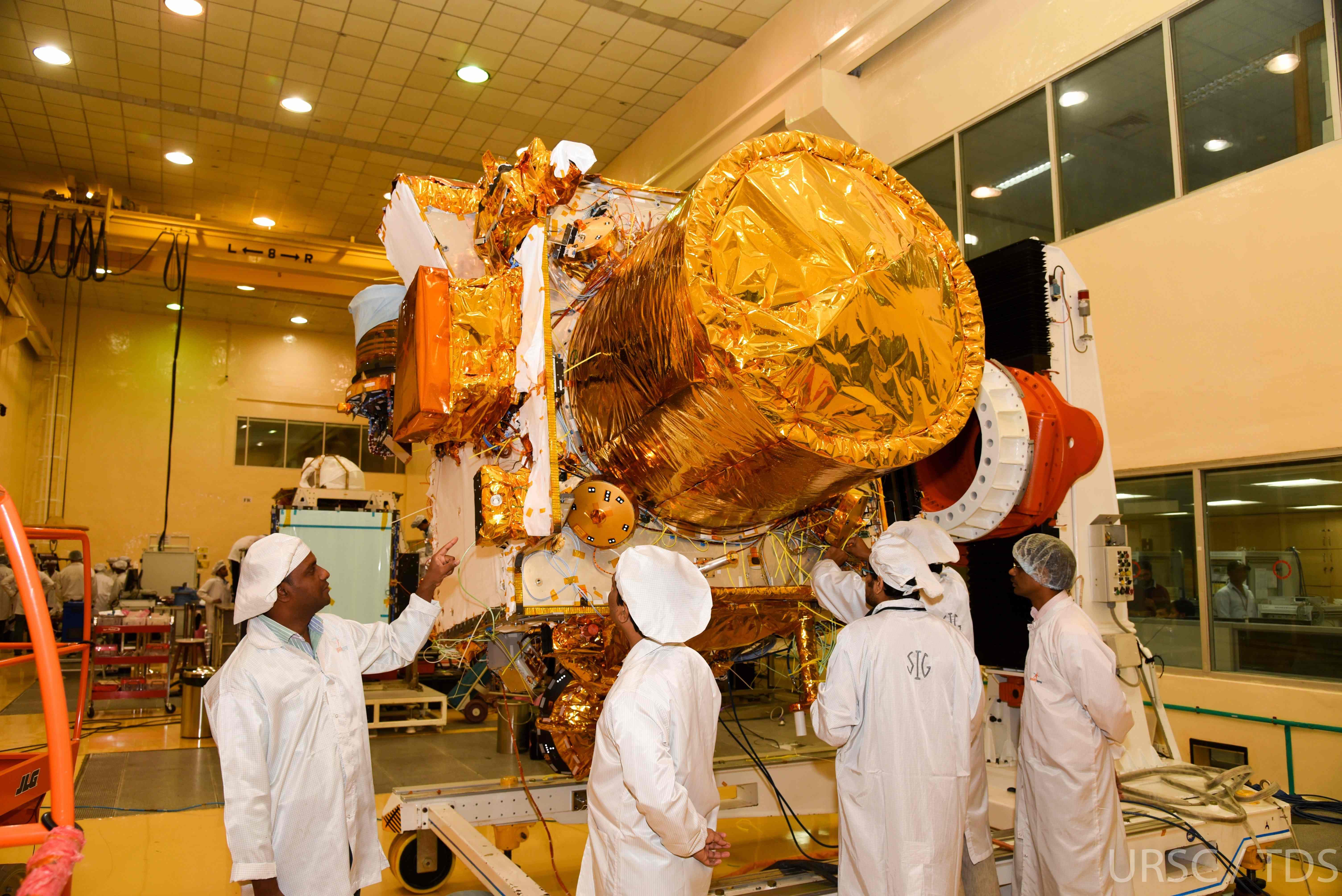

The orbiter has several scientific payloads.
- The Chandrayaan-2 Large Area Soft X-ray Spectrometer (CLASS) from the ISRO Satellite Centre (ISAC), which makes use of X-ray fluorescence spectra to determine the elemental composition of the lunar surface.
- The Solar X-ray monitor (XSM) from Physical Research Laboratory (PRL), Ahmedabad, primarily supports CLASS instrument by providing solar X-ray spectra and intensity measurements as input to it. Additionally these measurements will help in studying various high-energy processes occurring in the solar corona.
- The Dual Frequency L-band and S-band Synthetic Aperture Radar (DFSAR) from the Space Applications Centre (SAC) for probing the first few metres of the lunar surface for the presence of different constituents. DFSAR is expected to provide further evidence confirming the presence of water ice, and its distribution below the shadowed regions of the Moon. It has lunar surface penetration depth of 5 m (L-band).
- The Imaging IR Spectrometer (IIRS) from the SAC for mapping of lunar surface over a wide wavelength range for the study of minerals, water molecules and hydroxyl present. It features an extended spectral range (0.8 μm to 5 μm), an improvement over previous lunar missions whose payloads worked up to 3 μm.
- The Chandrayaan-2 Atmospheric Compositional Explorer 2 (ChACE-2) Quadrupole Mass Analyzer from Space Physics Laboratory (SPL), designed for carry out a detailed study of the lunar exosphere.
- The Terrain Mapping Camera-2 (TMC-2) from SAC for preparing a three-dimensional map essential for studying the lunar mineralogy and geology
- The Radio Anatomy of Moon Bound Hypersensitive Ionosphere and Atmosphere – Dual Frequency Radio Science experiment (RAMBHA-DFRS) by SPL for the studying electron density in the lunar ionosphere
- The Orbiter High Resolution Camera (OHRC) by SAC for scouting a hazard-free spot prior to landing. Used to help prepare high-resolution topographic maps and digital elevation models of the lunar surface. OHRC has a spatial resolution of 0.32 m from 100 km polar orbit, which is the best resolution among any lunar orbiter mission to date.
''Vikram'' lander
The payloads on the Vikram lander were:
- Instrument for Lunar Seismic Activity (ILSA) MEMS based seismometer by LEOS for studying Moon-quakes near the landing site
- Chandra's Surface Thermo-physical Experiment (ChaSTE) thermal probe jointly developed by SPL, Vikram Sarabhai Space Centre (VSSC) and Physical Research Laboratory (PRL), Ahmedabad for estimating the thermal properties of the lunar surface
- RAMBHA-LP Langmuir probe by SPL, VSSC for measuring the density and variation of lunar surface plasma
- A laser retroreflector array (LRA) by the Goddard Space Flight Center for taking precise measurements of distance between the reflector on the lunar surface and satellites in lunar orbit. The microreflector weighed about 22 g and cannot be used for taking observations from Earth-based lunar laser stations.
''Pragyan'' rover
Pragyan rover carried two instruments to determine the abundance of elements near the landing site:
- Laser induced Breakdown Spectroscope (LIBS) from the laboratory for Electro Optic Systems (LEOS), Bangalore
- Alpha Particle Induced X-ray Spectroscope (APXS) from PRL, Ahmedabad
Chandrayaan-2 payloads CHACE2.png|CHACE2 Chandrayaan-2 payloads XSM.png|XSM Chandrayaan-2 payloads CLASS.png|CLASS Chandrayaan-2 payloads ILSA 6.png|ILSA MEMS sensor package Laser_Retroreflector_for_InSight_Image-33-full.jpg|Laser retroreflector array (LRA) Chandrayaan-2 payloads LIBS.png|LIBS Chandrayaan-2 payloads APXS.png|APXS Chandrayaan-2 payloads ChaSTE.png|ChaSTE
Discoveries and results
The orbiter, which is still active, regularly conducts experiments on Lunar Atmospheric composition, trace elements, and more.
- Detection of sodium: In October 2023, the orbiter discovered an abundance of sodium on the Moon. The moon is shown to have a tail of Sodium atoms thousands of Kilometers long. Due to phenomena like photon stimulated desorption, solar wind sputtering, and meteorite impacts, sodium atoms gets knocked off the surface. Solar radiation pressure accelerates the sodium atoms away from the Sun, forming an elongated tail toward the antisolar direction. Using the large area X-raySpectrometer, CLASS, the probe has spotted and mapped sodium on the Moon.
- Hydroxyl and Water molecules: The Chandrayaan-1 probe detected water on the Moon for the first time. Chandrayaan-2 detected Water, as well as Hydroxyl ions on the Moon, August 2022. It distinguished between these two with the aid of IIRS (Imaging Infrared Spectrometer). Between 29 and 62 degrees north latitude, the probe detected the presence of these two molecules. Along with this, it also observed that the sunlit regions contain higher concentrations of these two.
- Distribution of Gas in Lunar Atmosphere: Chandra Atmospheric Composition Explorer-2, detected Argon-40 in Lunar exosphere. The distribution of Ar-40 has significant spatial heterogeneity. The NASA probe, LADEE, detected Argon near the Equatorial region, but Argon far from that, was detected for the first time. There are localised enhancements (termed as Argon bulge) over several regions including the KREEP (potassium (K), rare-earth elements, and phosphorus (P)) and South Pole Aitken terrain.
- Presence of Rare elements: Chandra's Large Area Soft X-ray Spectrometer (CLASS), detected magnesium, aluminium, silicon, calcium, titanium, iron etc. It also examined and detected minor elements – chromium and manganese, for the first time. The findings have paved the path for adding knowledge about the magmatic evolution of the Moon, its nebular conditions and much more.
- Solar X-ray Monitor (XSM), has witnessed a huge amount of microflares outside the active regions of the Sun for the first time.
- The DFSAR instrument studied the subsurface features of the Moon, detected signatures of the sub-surface water-ice, mapped lunar morphological features in the polar regions in high resolution.
- The TMC 2, which is conducting imaging of the Moon at a global scale, found interesting geologic signatures of lunar crustal shortening, and identification of volcanic domes. The OHRC, mapped Moon With a resolution of 25 cm at 100 km altitude.
- DFRS experiment, studied the ionosphere of the Moon, which is generated by the solar photo-ionisation of the neutral species of the lunar tenuous exosphere. The experiment showed that Moon's ionosphere has a plasma density of the order of 10^4 cm^3, in the wake region which is at least one order of magnitude more than that is present in the day side.
- An analysis of the S-band TTC radio signals from India's Chandrayaan-2 orbiter revealed that the Moon's ionosphere exhibits unexpectedly high electron densities (close to 100 times greater) when it enters the Earth's geomagnetic tail. Conducting the expirent by passing radio signals through the plasma layer of the moon,Scientists have proposed that the presence of remnant lunar crustal magnetic fields could be trapping plasma, preventing its diffusion, and leading to localized enhancements in electron density.
- The DFSAR intstument has created multiple detailed data-sets on L-band radar mapping of the lunar poles.
Mission profile
Launch

The launch of Chandrayaan-2 was initially scheduled for 14 July 2019, 21:21 UTC (15 July 2019 at 02:51 IST local time). However, the launch was aborted 56 minutes and 24 seconds before launch due to a technical glitch, so it was rescheduled to 22 July 2019. Unconfirmed reports later cited a leak in the nipple joint of a helium gas bottle as the cause of cancellation.
Finally Chandrayaan-2 was launched on board the LVM3 M1 launch vehicle on 22 July 2019 at 09:13:12 UTC (14:43:12 IST) with a better-than-expected apogee as a result of the cryogenic upper stage being burned to depletion, which later eliminated the need for one of the apogee-raising burns during the geocentric phase of mission. This also resulted in the saving of around 40 kg fuel on board the spacecraft.
Immediately after launch, multiple observations of a slow-moving bright object over Australia were made, which could be related to upper stage venting of residual LOX / LH2 propellant after the main burn.
Geocentric phase
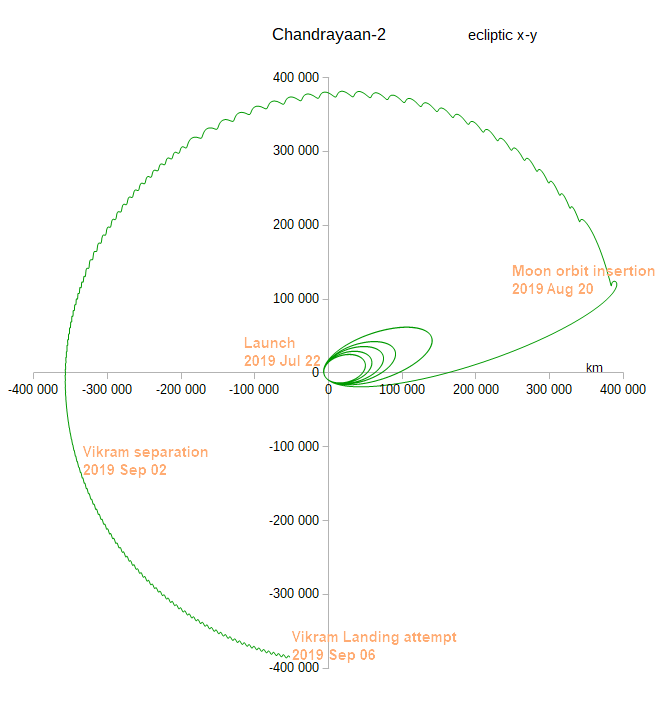
After being placed into a 45,475 × 169 km parking orbit by the launch vehicle, the Chandrayaan-2 spacecraft stack gradually raised its orbit using on-board propulsion over 22 days. In this phase, one perigee-raising and five apogee-raising burns were performed to reach a highly eccentric orbit of 142,975 × 276 km followed by trans-lunar injection on 13 August 2019. Such a long Earth-bound phase with multiple orbit-raising manoeuvres exploiting the Oberth effect was required because of the limited lifting capacity of the launch vehicle and thrust of the spacecraft's on-board propulsion system. A similar strategy was used for Chandrayaan-1 and the Mars Orbiter Mission during their Earth-bound phase trajectory. On 3 August 2019, the first set of Earth images were captured by the LI4 camera on the Vikram lander, showing the North American landmass.
Selenocentric phase
After 29 days from its launch, the Chandrayaan-2 spacecraft stack entered lunar orbit on 20 August 2019 after performing a lunar orbit insertion burn for 28 minutes 57 seconds. The three-spacecraft stack was placed into an elliptical orbit that passed over the polar regions of the Moon, with 18072 km aposelene and 114 km periselene. By 1 September 2019, this elliptical orbit was made nearly circular with 127 km aposelene and 119 km periselene after four orbit-lowering manoeuvres followed by separation of Vikram lander from the orbiter on 07:45 UTC, 2 September 2019.
Planned landing site
Main article: Pragyan (Chandrayaan-2)
| Landing site | Coordinates |
|---|---|
| Prime landing site | |
| Alternate landing site |

Two landing sites were selected, each with an ellipse of 32 ×. The prime landing site (PLS54) was at 70.90267°S 22.78110°E (600 km from the south pole,) and the alternate landing site (ALS01) was at 67.87406° South 18.46947° West. The prime site was on a high plain between the craters Manzinus C and Simpelius N, on the near side of the Moon.
Failed landing attempt
Vikram began its descent at 20:08:03 UTC, 6 September 2019 and was scheduled to land on the Moon at around 20:23 UTC. The descent and soft-landing were to be performed by the on-board computers on Vikram, with mission control unable to make corrections. The initial descent was considered within mission parameters, passing critical braking procedures as expected, but the lander's trajectory began to deviate at about 2.1 km above the surface. Telemetry readings during ISRO's live-stream show that *Vikram'''s final vertical velocity was 58 m/s at 330 m above the surface, which a number of experts noted, would have been too fast for the lunar lander to make a successful landing. Initial reports suggesting a crash were confirmed by ISRO chairman K. Sivan, stating that "it must have been a hard landing". However, it contradicted initial claims from anonymous ISRO officials that the lander was intact and lying in a *tilted position''.
Radio transmissions from the lander were tracked during descent by analysts using a 25 m radio telescope owned by the Netherlands Institute for Radio Astronomy. Analysis of the doppler data suggests that the loss of signal coincided with the lander impacting the lunar surface at a velocity of nearly 50 m/s (as opposed to an ideal 2 m/s touchdown velocity). The powered descent was also observed by NASA's Lunar Reconnaissance Orbiter (LRO) using its Lyman-Alpha Mapping Project instrument to study changes in the lunar exosphere due to exhaust gases from the lander's engines. K. Sivan, tasked senior scientist Prem Shanker Goel to head the Failure Analysis Committee to look into the causes of the failure.
Both ISRO and NASA attempted to communicate with the lander for about two weeks before the lunar night set in, while NASA's LRO flew over on 17 September 2019 and acquired some images of the intended landing zone. NASA's LRO images, showing no sight of the lander, were released on 26 September 2019. The LRO flew over again on 14 October 2019 under more favourable lighting conditions, but was unable to locate it. The LRO performed a third flyover on 10 November 2019.
On 16 November 2019, the Failure Analysis Committee released its report to the Space Commission, concluding that the crash was caused by a software glitch. Phase One of descent the Rough Braking Phase from an altitude of 30 km to 7.4 km above the Moon's surface went as intended with velocity being reduced from 1683 m/s to 146 m/s (6058 to 525 km/h). Anomalous deviation in performance began 693.8 seconds into powered descent after the end of first phase and with the beginning of Absolute Navigation Phase (also known as Camera Coasting Phase) where lander's orientation is deliberately kept fixed. It was found that lander's main engines had slightly higher thrust of 422 N than nominal at 360 N, so during this phase lander slowed down more than it should have. The thrust control algorithm was configured to apply corrections towards the end of the phase and not instantaneously allowing large navigation errors to be accumulated. After end of camera coasting phase, rate of applying corrections was limited due to builtin safety constraints such as maximum rate at which attitude can change. Other contributing issues were, coarse throttling of main engines, polarity related software error, wrong computation of remaining time of flight by onboard algorithm and very rigid requirement to land inside the planned 500×500 meter landing site regardless of non-nominal flight status. Subsequently, Vikram lander ended up increasing its horizontal velocity (48 m/s) to reach landing site while descending at high rate (50 m/s) causing Vikram to land hard, though it managed to impact relatively near the intended landing site. The complete official report has not been made public.
''Vikram'''s impact site was located at by the LROC team after receiving helpful input from Shanmuga Subramanian, a volunteer from Chennai, Tamil Nadu, who located debris from the spacecraft in pictures released by NASA. While initially estimated to be within 500 m of the intended landing site, best-guess estimates from satellite imagery indicate initial impact about 600 m away. The spacecraft shattered upon impact, with debris scattered over almost two dozen locations in an area spanning kilometres.
| Phase | Date | Event | Detail | Result | References | Apogee / | ||||||||
|---|---|---|---|---|---|---|---|---|---|---|---|---|---|---|
| Aposelene | Perigee / | |||||||||||||
| Periselene | ||||||||||||||
| Geocentric phase | 22 July 2019, 09:13:12 UTC | Launch | Burn time: 16 min 14 sec | 45475 km | 169.7 km | |||||||||
| 24 July 2019, 09:22 UTC | 1st orbit-raising manoeuvre | Burn time: 48 seconds | 45163 km | 230 km | url=https://www.isro.gov.in/update/24-jul-2019/chandrayaan2-update-first-earth-bound-maneuver | title=Chandrayaan-2: First Earth bound maneuver | publisher=Indian Space Research Organisation | access-date=24 July 2019 | archive-date=24 July 2019 | archive-url=https://web.archive.org/web/20190724111626/https://www.isro.gov.in/update/24-jul-2019/chandrayaan2-update-first-earth-bound-maneuver | url-status=live}} | |||
| 25 July 2019, 19:38 UTC | 2nd orbit-raising manoeuvre | Burn time: 883 seconds | 54829 km | 251 km | url=https://www.isro.gov.in/update/26-jul-2019/chandrayaan2-update-second-earth-bound-maneuver | title=Chandrayaan-2: Second Earth bound maneuver | date=26 July 2019 | publisher=Indian Space Research Organisation | archive-url=https://web.archive.org/web/20190725201701/https://www.isro.gov.in/update/26-jul-2019/chandrayaan2-update-second-earth-bound-maneuver | archive-date=25 July 2019 | url-status=live | access-date=26 July 2019}} | ||
| 29 July 2019, 09:42 UTC | 3rd orbit-raising manoeuvre | Burn time: 989 seconds | 71,792 km (44,609 mi) | 276 km (171.5 mi) | url=https://www.isro.gov.in/update/29-jul-2019/chandrayaan2-update-third-earth-bound-maneuver | title=Chandrayaan-2: Third Earth bound maneuver | publisher=Indian Space Research Organisation | access-date=29 July 2019 | archive-date=29 July 2019 | archive-url=https://web.archive.org/web/20190729102956/https://www.isro.gov.in/update/29-jul-2019/chandrayaan2-update-third-earth-bound-maneuver | url-status=live}} | |||
| 2 August 2019, 09:57 UTC | 4th orbit-raising manoeuvre | Burn time: 646 seconds | 89472 km | 277 km | url=https://www.isro.gov.in/update/02-aug-2019/chandrayaan2-update-fourth-earth-bound-maneuver | title=Chandrayaan-2: Fourth Earth bound maneuver | publisher=Indian Space Research Organisation | access-date=2 August 2019 | archive-date=2 August 2019 | archive-url=https://web.archive.org/web/20190802102719/https://www.isro.gov.in/update/02-aug-2019/chandrayaan2-update-fourth-earth-bound-maneuver | url-status=live}} | |||
| 6 August 2019, 09:34 UTC | 5th orbit-raising manoeuvre | Burn time: 1041 seconds | 142975 km | 276 km | url=https://www.isro.gov.in/update/06-aug-2019/chandrayaan2-update-fifth-earth-bound-maneuver | title=Chandrayaan-2: Fifth Earth bound maneuver | publisher=Indian Space Research Organisation | access-date=6 August 2019 | archive-date=6 August 2019 | archive-url=https://web.archive.org/web/20190806104005/https://www.isro.gov.in/update/06-aug-2019/chandrayaan2-update-fifth-earth-bound-maneuver | url-status=live}} | |||
| 13 August 2019, 20:51 UTC | Trans-lunar injection | Burn time: 1203 seconds | url=https://www.isro.gov.in/update/14-aug-2019/chandrayaan-2-successfully-enters-lunar-transfer-trajectory | title=Chandrayaan-2 Successfully enters Lunar Transfer Trajectory | publisher=Indian Space Research Organisation | access-date=14 August 2019 | archive-date=13 August 2019 | archive-url=https://web.archive.org/web/20190813230556/https://www.isro.gov.in/update/14-aug-2019/chandrayaan-2-successfully-enters-lunar-transfer-trajectory | url-status=live}} | |||||
| Selenocentric phase | 20 August 2019, 03:32 UTC | Lunar orbit insertion | ||||||||||||
| 1st lunar bound manoeuvre | Burn time: 1738 seconds | 18072 km | 114 km | url=https://www.isro.gov.in/update/20-aug-2019/chandrayaan-2-update-lunar-orbit-insertion | title=Chandrayaan-2: Lunar Orbit Insertion | publisher=Indian Space Research Organisation | access-date=20 August 2019 | archive-date=20 August 2019 | archive-url=https://web.archive.org/web/20190820044245/https://www.isro.gov.in/update/20-aug-2019/chandrayaan-2-update-lunar-orbit-insertion | url-status=live}} | ||||
| 21 August 2019, 07:20 UTC | 2nd lunar bound manoeuvre | Burn time: 1228 seconds | 4412 km | 118 km | url=https://www.isro.gov.in/update/21-aug-2019/chandrayaan-2-update-second-lunar-orbit-maneuver | title=Chandrayaan-2: Second Lunar Orbit Maneuver | publisher=Indian Space Research Organisation | access-date=21 August 2019 | archive-date=21 August 2019 | archive-url=https://web.archive.org/web/20190821080625/https://www.isro.gov.in/update/21-aug-2019/chandrayaan-2-update-second-lunar-orbit-maneuver | url-status=live}} | |||
| 28 August 2019, 03:34 UTC | 3rd lunar bound manoeuvre | Burn time: 1190 seconds | 1412 km | 179 km | url=https://www.isro.gov.in/update/28-aug-2019/chandrayaan-2-update-third-lunar-bound-orbit-maneuver | title=Chandrayaan-2: Third Lunar Orbit Maneuver | publisher=Indian Space Research Organisation | access-date=28 August 2019 | archive-date=28 August 2019 | archive-url=https://web.archive.org/web/20190828072012/https://www.isro.gov.in/update/28-aug-2019/chandrayaan-2-update-third-lunar-bound-orbit-maneuver | url-status=live}} | |||
| 30 August 2019, 12:48 UTC | 4th lunar bound manoeuvre | Burn time: 1155 seconds | 164 km | 124 km | url=https://isro.gov.in/update/30-aug-2019/chandrayaan-2-update-fourth-lunar-orbit-maneuver | title=Chandrayaan-2: Fourth Lunar Orbit Maneuver | publisher=Indian Space Research Organisation | archive-url=https://web.archive.org/web/20190830135323/http://isro.gov.in/update/30-aug-2019/chandrayaan-2-update-fourth-lunar-orbit-maneuver | archive-date=30 August 2019 | url-status=dead | access-date=30 August 2019}} | |||
| 1 September 2019, 12:51 UTC | 5th lunar bound manoeuvre | Burn time: 52 seconds | 127 km | 119 km | url=https://www.isro.gov.in/update/01-sep-2019/chandrayaan-2-update-fifth-lunar-orbit-maneuver | title=Chandrayaan-2: Fifth Lunar Orbit Maneuver | publisher=Indian Space Research Organisation | access-date=1 September 2019 | archive-date=3 September 2019 | archive-url=https://web.archive.org/web/20190903075526/https://www.isro.gov.in/update/01-sep-2019/chandrayaan-2-update-fifth-lunar-orbit-maneuver | url-status=live}} | |||
| Vikram lunar landing | 2 September 2019, 07:45 UTC | Vikram separation | 127 km | 119 km | title=Chandrayaan-2: Vikram Lander successfully separates from Orbiter | url=https://www.isro.gov.in/update/02-sep-2019/chandrayaan-2-update-vikram-lander-successfully-separates-orbiter | publisher=Indian Space Research Organisation | access-date=2 September 2019 | archive-date=3 September 2019 | archive-url=https://web.archive.org/web/20190903080138/https://www.isro.gov.in/update/02-sep-2019/chandrayaan-2-update-vikram-lander-successfully-separates-orbiter | url-status=live}} | |||
| 3 September 2019 3:20 UTC | 1st deorbit burn | Burn time: 4 seconds | 128 km | 104 km | title=Chandrayaan-2: First de-orbiting maneuver | url=https://www.isro.gov.in/update/03-sep-2019/chandrayaan-2-update-first-de-orbiting-maneuver | publisher=Indian Space Research Organisation | access-date=3 September 2019 | archive-date=3 September 2019 | archive-url=https://web.archive.org/web/20190903080922/https://www.isro.gov.in/update/03-sep-2019/chandrayaan-2-update-first-de-orbiting-maneuver | url-status=live}} | |||
| 3 September 2019, 22:12 UTC | 2nd deorbit burn | Burn time: 9 seconds | 101 km | 35 km | url=https://www.isro.gov.in/update/04-sep-2019/chandrayaan-2-update-second-de-orbiting-maneuver | title=Chandrayaan-2: Second de-orbiting maneuver | publisher=Indian Space Research Organisation | access-date=3 September 2019 | archive-date=4 September 2019 | archive-url=https://web.archive.org/web/20190904005541/https://www.isro.gov.in/update/04-sep-2019/chandrayaan-2-update-second-de-orbiting-maneuver | url-status=live}} | |||
| 6 September 2019, 20:08 UTC | Powered descent | Burn time: 15 minutes | Landing (planned) | Landing (planned) | ||||||||||
| 6 September 2019, 20:23 UTC | Vikram landing | Trajectory deviation started at 2.1 km altitude, telemetry was lost seconds before touchdown. | Lost upon crash landing. | |||||||||||
| 7 September 2019, 00:00 UTC−01:00 UTC (planned) | Pragyan rover deployment | Lander failure, rover was not deployed. |
Continuing mission
Despite the failed landing, the orbiter part of the mission, with eight scientific instruments, remains operational, and will continue its seven-year mission to study the Moon. Chandrayaan-2 orbiter performed a collision avoidance manoeuvre at 14:52 UTC on 18 October 2021 to avert possible conjunction with Lunar Reconnaissance Orbiter. Both spacecraft were expected to come dangerously close to each other on 20 October 2021 at 05:45 UTC over the Lunar north pole.
The Chandrayaan-2 Orbiter would later serve as a relay for Chandrayaan-3 which landed close to the crash site and accomplished the mission's goals. The orbiter also observed the Sun during a massive solar flare in May 2024 with the XSM and the CLASS instrument, in conjunction with XpoSAT and Aditya-L1. The CHACE-2 instrument also observed changes in the lunar exosphere during this time. It also performed another collision avoidance manoeuvre on 11 November 2024 to preclude another conjunction with LRO.
Aftermath
There was an outpouring of support for ISRO from various quarters in the aftermath of the crash landing of its lunar lander. However, prominent Indian news media also criticized ISRO's lack of transparency regarding the crash of the lander and its analysis of the crash. Indian media also noted that unlike ISRO's previous record, the report of the Failure Analysis Committee was not made public and RTI queries seeking it were denied by ISRO citing section 8(1) of the RTI Act. ISRO's lack of consistency regarding the explanation around the rover's crashing was criticized, with the organization providing no proof of its own positions until the efforts of NASA and a Chennai based volunteer located the crash site on the lunar surface. In the wake of the events surrounding Chandrayaan-2, former ISRO employees criticized unverified statements from chairman K Sivan and what they claimed is the top-down leadership and working culture of the organisation. S Somanath who succeeded K Sivan as ISRO Chairman also expressed his dissatisfaction at the lack of transparency around landing failure, and misleading representation of it.
Scientists involved in the mission
_at_ISTRAC,_Peenya_before_commencement_of_fourth_orbit_raising_burn_for_Chandrayaan-2.jpg)
Key scientists and engineers involved in the development of Chandrayaan-2 include:
- Ritu Karidhal – Mission Director
- Muthayya Vanitha – Project Director
- Kalpana Kalahasti – Associate Project Director
- G. Narayanan – Associate Project Director
- G. Nagesh – Project Director (former)
- Chandrakanta Kumar – Deputy Project Director (Radio-frequency systems)
- Amitabh Singh – Deputy Project Director (Optical Payload Data Processing, Space Applications Centre (SAC))
Reattempt
Main article: Chandrayaan-3
Mission repeat In November 2019, ISRO officials stated that a new lunar lander mission was being studied and prepared. It was launched on 14 July 2023; with the designation Chandrayaan-3, which was a second attempt to demonstrate the landing capabilities needed for the Lunar Polar Exploration Mission proposed in partnership with Japan for 2025. The new mission was designed with a detachable propulsion module, also behaving like a communications relay satellite, a lander and a rover, but with no orbiter. S. Somanath, the VSSC director, announced that there would be more follow-up missions in the Chandrayaan programme.
In December 2019, it was reported that ISRO requested the initial funding of the project, amounting to , of which is intended for machinery, equipment and other capital expenditure, while the remaining was sought under a revenue expenditure allowance. K. Sivan stated that its cost would be around . It performed a soft landing on the Moon on 23 August 2023.
References
References
- Nair, Avinash. (31 May 2015). "ISRO to deliver "eyes and ears" of Chandrayaan-2 by 2015-end". The Indian Express.
- (29 August 2018). "Chandrayaan-2 to Be Launched in January 2019, Says ISRO Chief". NDTV.
- (28 August 2018). "ISRO to send first Indian into Space by 2022 as announced by PM, says Dr Jitendra Singh". Department of Space.
- (21 July 2019). "Chandrayaan-2: All you need to know about India's 2nd Moon mission". The Times of India.
- "Chandrayaan-2". Indian Space Research Organisation.
- (18 July 2019). "Chandrayan-2 Launch Rescheduled on 22 July 2019, AT 14:43 HRS". Indian Space Research Organisation.
- Singh, Surendra. (5 August 2018). "Chandrayaan-2 launch put off: India, Israel in lunar race for 4th position". The Times of India.
- Shenoy, Jaideep. (28 February 2016). "ISRO chief signals India's readiness for Chandrayaan II mission". The Times of India.
- Ratcliffe, Rebecca. (22 July 2019). "India's Chandrayaan-2 moon mission lifts off a week after aborted launch". The Guardian.
- "GSLV-Mk III – M1 / Chandrayaan-2 Mission". Indian Space Research Organisation.
- Kiran Kumar, Aluru Seelin. (August 2015). "Chandrayaan-2 – India's Second Moon Mission". Inter-University Centre for Astronomy and Astrophysics.
- "ISRO aims for Chandrayaan-2 landing at 1.55 AM on September 7, says Dr K. Sivan".
- Madhumathi, D. S.. (9 June 2019). "ISRO gears up for Chandrayaan-2 mission". The Hindu.
- Chand, Manish. (12 November 2007). "India, Russia to expand n-cooperation, defer Kudankulam deal". Nerve.
- (14 August 2013). "Unstarred Question No:1402 in Lok Sabha about Chandrayaan-2".
- Sunderarajan, P.. (19 September 2008). "Cabinet clears Chandrayaan-2". The Hindu.
- (17 August 2009). "ISRO completes Chandrayaan-2 design". Domain-b.com.
- Ramachandran, R.. (22 January 2013). "Chandrayaan-2: India to go it alone". The Hindu.
- Laxman, Srinivas. (6 February 2012). "India's Chandrayaan-2 Moon Mission Likely Delayed After Russian Probe Failure". Asian Scientist.
- (9 September 2012). "India's next moon mission depends on Russia: ISRO chief". NDTV.
- Jayaraman, K. S.. (15 August 2013). "India Drops Russia from Chandrayaan-2 Lunar Mission".
- (14 August 2013). "Chandrayaan-2". Department of Space.
- (25 October 2020). "How ISRO modified a lunar orbiter into Mars orbiter Mangalyaan, India's "Moon Man" recalls". Zee News.
- Clark, Stephen. (15 August 2018). "Launch Schedule". Spaceflight Now.
- (23 March 2018). "Chandrayaan-2 launch postponed to October: ISRO chief". India Times.
- (5 August 2018). "Soft-landing challenges keep Chandrayaan-2 grounded". The Times of India.
- (25 September 2018). "Chandrayaan-2: Several challenges to meet Jan 2019 deadline". The Times of India.
- (28 March 2018). "With eye on lunar mission, ISRO to test high-thrust Vikas engine".
- (30 January 2018). "ISRO chief on a mission to cut expenses on launches". The Hindu.
- (August 2018). "ISRO faces costly proposition over recall of GSAT-11".
- "What caused delay in ISRO's Chandrayaan-2 launch".
- (1 April 2019). "ISRO to launch PSLVC-46 followed by PSLVC-47, Chandrayaan-2 in May: K. Sivan". Asian News International.
- (4 April 2019). "India's Moon Lander Damaged During Test, Chandrayaan 2 Launch Put on Hold". The Wire.
- (4 April 2019). "Vikram hurt during practice, puts Chandrayaan-2 on bench". The Times of India.
- "Press release on Chandrayaan-2, ISRO". Indian Space Research Organisation.
- "Chandrayaan 2 Moon Mission Launch Aborted After Technical Snag: 10 Points". NDTV.
- (17 July 2019). "ISRO pinpoints GSLV-MkIII leak to 'nipple joint' of cryo engine". The Times of India.
- "GSLV MkIII-M1 Successfully Launches Chandrayaan-2 spacecraft". Indian Space Research Organisation.
- (8 September 2019). "Extra brake thrust may have sent Vikram out of control in home stretch". The Times of India.
- "India's Vikram Spacecraft Apparently Crash – Lands on Moon".
- (19 December 2019). "Chandrayaan-2: Three months on, ISRO yet to make public Vikram lander failure report details". The Indian Express.
- (2023-07-12). "Why did Chandrayaan-2 lander fail? Isro chief gives 3 key reasons for crashlanding". The Times of India.
- "Chandrayaan-2 CHANDRYN2". NASA.
- (24 November 2016). "Question No. 1084: Deployment of Rover on Lunar Surface". Rajya Sabha.
- Banerji, Abigail. (13 July 2019). "Chandrayaan 2: Everything you need to know about the orbiter's mission and design". First Post.
- "Chandrayaan-2 FAQ".
- Kumar, Chethan. (12 August 2018). "ISRO wants Chandrayaan-2 lander to orbit Moon first". The Times of India.
- Ramesh, Sandhya. (12 June 2019). "Why Chandrayaan-2 is ISRO's "most complex mission" so far". The Print.
- Singh, Surendra. (20 February 2018). "Chandrayaan-2 mission cheaper than Hollywood film Interstellar". The Times of India.
- (18 January 2019). "Department of Space presentation on 18 Jan 2019". Department of Space.
- (December 2014). "Annual Report 2014–2015". Indian Space Research Organisation.
- (30 August 2010). "Payloads for Chandrayaan-2 Mission Finalised". Indian Space Research Organisation.
- (2 September 2010). "Chandrayaan-2 to get closer to moon". The Economic Times.
- (December 2015). "Annual Report 2015-2016". Indian Space Research Organisation.
- (22 June 2015). "HAL Delivers the Orbiter Craft Module Structure of Chandrayaan-2 to ISRO". Hindustan Aeronautics Limited.
- "Launch kit at a glance". Indian Space Research Organisation.
- Wilson, Horace Hayman. (1832). "A dictionary in Sanscrit and English". Education Press.
- Kumar, Chethan. (12 August 2018). "Chandrayaan-2 Lander to be named "Vikram" after Sarabhai". The Times of India.
- (7 September 2019). "Chandrayaan-2 Latest Update". Indian Space Research Organisation.
- [https://www.space.com/india-moon-mission-not-over-chandrayaan-2.html India's Moon Mission Continues Despite Apparent Lander Crash.] {{Webarchive. link. (9 September 2019 Mike Wall, ''space.com'', 7 September 2019, Quote: "India's Moon Mission Continues Despite Apparent Lander Crash".)
- "Paper information (56421) — IAF".
- "ISRO developing vehicle to launch small satellites". Frontline.
- (2015). "Development of a Proportional Flow Control Valve for the 800 N Engine Test".
- (1 February 2020). "Chandrayaan-2: The second Indian mission to the Moon".
- (5 November 2020). "Dr P V Venkitakrishnan, Ad Ingenium, Lecture 4".
- (8 July 2019). "Chandrayaan-2: First step towards Indians setting foot on moon in near future". The New Indian Express.
- Subramanian, T. S.. (9 July 2019). "Chandrayaan 2: Giant leap for ISRO". Frontline.
- "How ISRO Plans To Pull Off An Unprecedented Landing on Moon's South Pole".
- "Space Applications Centre, Annual Report 2016–17".
- "Key payload for Chandrayaan-2 leaves for Bengaluru". The Times of India.
- (21 July 2017). "SAC Seminar 2016".
- "Department of Space Annual Report 2016–17". Indian Space Research Organisation.
- Madhumathi, D. S.. (25 October 2016). "ISRO starts landing tests for Chandrayaan-2 mission". The Hindu.
- (25 October 2017). "ISRO begins flight integration activity for Chandrayaan-2, as scientists tests lander and rover". The Indian Express.
- "Chandrayaan-2 Spacecraft". Indian Space Research Organisation.
- Wilson, Horace Hayman. (1832). "A dictionary in Sanscrit and English". Education Press.
- (7 February 2019). "Chandrayaan–II".
- (12 June 2019). "ISRO to Launch Chandrayaan 2 on July 15, Moon Landing by September 7". The Wire.
- (10 May 2019). "Chandrayaan-2 will carry 14 payloads to moon, no foreign module this time". The Times of India.
- (22 December 2010). "2010 International Symposium on Electronic System Design".
- (2019). "With robot hands, IIT-K profs bring joy to paralytics". The Times of India.
- (28 June 2017). ""Chandrayaan-2: Lunar Orbiter and Lander Mission", 10th IAA Symposium on The Future of Space Exploration: Towards the Moon Village and Beyond, Torin, Italy". International Academy of Astronautics.
- (29 June 2019). "Dr M. Annadurai, project director, Chandrayaan-1: "Chandrayaan-2 logical extension of what we did in first mission"". The Indian Express.
- (17 January 2018). "2017 4th International Conference on Power, Control & Embedded Systems (ICPCES)".
- "Ashoka Chakra, ISRO Logo, Flag: Chandrayaan-2 Set to Engrave India's Name on Moon for Centuries". News18.
- "Curtain Raiser video (Hindi)". Indian Space Research Organisation.
- "INPE realiza manobras orbitais para missão lunar Chandrayaan-2".
- Singh, Surendra. (13 June 2019). "ISRO: Chandrayaan-2 will take NASA-ISRO ties to a new height". The Times of India.
- (19 July 2019). "Launch Kit of GSLV Mk III M1 Chandrayaan-2". Indian Space Research Organisation.
- Bagla, Pallava. (31 January 2018). "India plans tricky and unprecedented landing near moon's south pole". Science Mag.
- (12 June 2019). "Chandrayaan-2 Payloads". Indian Space Research Organisation.
- Laxman, Srinivas. (5 September 2010). ""We're launching Chandrayaan-2 for a total coverage of the moon"". The Times of India.
- (11 February 2019). "Implementing arrangement between India and United States of America for cooperation on the Chandrayaan mission-2". Ministry of External Affairs.
- (24 January 2020). "Chandrayaan-2 Large Area Soft X-ray Spectrometer". Current Science.
- (10 January 2020). "Solar X-ray Monitor onboard Chandrayaan-2 Orbiter". Current Science.
- (24 January 2020). "L- and S-band Polarimetric Synthetic Aperture Radar on Chandrayaan-2 mission". Current Science.
- Singh, Surendra. (7 September 2019). "Orbiter will have a lifespan of 7.5 years, it's possible to find Vikram Lander from orbiter: ISRO chief". The Times of India.
- (10 February 2020). "Imaging Infrared Spectrometer onboard Chandrayaan-2 Orbiter". Current Science.
- "Lynred IR detector onboard Chandrayaan-2 expedition to Moon's South Pole".
- (15 November 2018). "CHANDRAYAAN-2 spectrometer for IIRS". AMOS.
- (24 January 2020). "CHandra's Atmospheric Composition Explorer-2 onboard Chandrayaan-2 to study the lunar neutral exosphere". Current Science.
- (25 February 2020). "Terrain Mapping Camera-2 onboard Chandrayaan-2 Orbiter". Current Science.
- (24 January 2020). "Dual Frequency Radio Science experiment onboard Chandrayaan-2: a radio occultation technique to study temporal and spatial variations in the surface-bound ionosphere of the Moon". Current Science.
- (2020). "Orbiter High Resolution Camera onboard Chandrayaan-2 Orbiter". Current Science.
- Clark, Stephen. (12 September 2019). "NASA lunar orbiter to image Chandrayaan-2 landing site". Spaceflight Now.
- "Chandrayaan-2 latest update". Indian Space Research Organisation.
- (10 February 2020). "Instrument for Lunar Seismic Activity Studies on Chandrayaan-2 Lander". Current Science.
- Mallikarjun, Y.. (29 May 2013). "India plans to send seismometer to study moonquakes". The Hindu.
- Mishra, Sanjeev. (September 2019). "PRL News- The Spectrum".
- Bartels, Meghan. (24 March 2019). "How NASA Scrambled to Add Science Experiments to Israeli, Indian Moon Probes". space.com.
- Gohd, Chelsea. (26 July 2019). "50 Years After Apollo, India Is Carrying a NASA Laser Reflector to the Moon (And It's Only the Start)".
- (10 February 2020). "Lunar near surface plasma environment from Chandrayaan-2 Lander platform: RAMBHA-LP payload". Current Science.
- [https://www.skyandtelescope.com/astronomy-news/india-moon-chandrayaan-2/ India Heads to the Moon With Chandrayaan-2] {{Webarchive. link. (23 July 2019 David Dickinson, ''Sky & Telescope'', 22 July 2019, Quote: "Vikram carries a seismometer, thermal probe, and an instrument to measure variation and density of lunar surface plasma, along with a laser retro-reflector supplied by NASA's Goddard Spaceflight Center".)
- (25 February 2020). "Laser Induced Breakdown Spectroscope on Chandrayaan-2 Rover: a miniaturized mid-UV to visible active spectrometer for lunar surface chemistry studies". Current Science.
- (10 January 2020). "Alpha Particle X-ray Spectrometer onboard Chandrayaan-2 Rover". Current Science.
- "India chooses Russian Cm-244 sources for flights to the Moon".
- "PRL News – The Spectrum, September 2019".
- "Chandrayaan-2 Orbiter Maps An 'Abundance of Sodium' On the Moon's Surface for the First Time Ever; Here's What It Means".
- (December 2009). "The sodium tail of the Moon". Icarus.
- "Chandrayaan-2 unveils the effect of the Earth's geomagnetic tail on the Lunar ionosphere plasma".
- "ISRO Says Chandrayaan-2 Orbitor Radio Signs Show High Electron Density In Lunar Environment".
- "ISRO Offers Advanced Data Products for Deeper Understanding of the Lunar Polar Region".
- "MSN".
- Subramanian, T. S.. (17 July 2019). "What went wrong with the Chandrayaan-2 launch". Frontline.
- Chandran, Cynthia. (23 July 2019). "For VSSC chief, setbacks are part of victory cruise". Deccan Chronicle.
- Kumar, Chethan. (23 July 2019). "Chandrayaan-2 will only have 4 operations around Earth". The Times of India.
- "Live coverage: India's Chandrayaan-2 moon mission blasts off". Spaceflight Now.
- Kumar, Chethan. (29 July 2019). "Chandrayaan-2 healthy after another manoeuvre". The Times of India.
- Hartley, Anna. (23 July 2019). "Strange object in the night sky was probably a rocket heading to the Moon: astronomer". ABC News.
- Acharya, Mosiqi. (24 July 2019). "Was the mysterious bright spot in Australian skies Chandrayaan-2, India's mission to Moon?". SBS Hindi.
- (9 August 2019). "Here's Why Chandrayaan-2 Will Take 48 Days to Reach the Moon". The Quint.
- "First set of beautiful images of the Earth captured by Chandrayaan-2 Vikram Lander".
- (20 August 2019). "India's Chandrayaan-2 moon mission enters lunar orbit". CNN.
- (2018). "Potential Landing Sites for Chandrayaan-2 Lander in Southern Hemisphere of Moon".
- Srishti Choudhary. (14 July 2019). "Chandrayaan-2: How "Lander Vikram" will touchdown on the moon?". Live Mint.
- [https://www.hou.usra.edu/meetings/lpsc2019/pdf/1493.pdf Geological Insights into Chandrayaan-2 Landing Site in the Southern High Latitudes of the Moon] {{Webarchive. link. (19 June 2020 Rishitosh K. Sinha, Vijayan Sivaprahasam, Megha Bhatt, Harish Nandal, Nandita Kumari, Neeraj Srivastava, Indhu Varatharajan, Dwijesh Ray, Christian Wöhler, and Anil Bhardwaj. 50th Lunar and Planetary Science Conference 2019 (LPI Contribution No. 2132).)
- [https://www.financialexpress.com/lifestyle/science/chandrayaan-2-heres-everything-about-isro-moon-landing-its-vikram-lander/1697029/ Chandrayaan-2: Here's everything about ISRO Moon-landing its Vikram lander] {{Webarchive. link. (11 September 2019 ''Financial Express'' Ribu Mishra, 7 September 2019)
- [https://www.space.com/india-moon-lander-found-by-chandrayaan-2-orbiter.html India Just Found Its Lost Vikram Lander on the Moon, Still No Signal] {{Webarchive. link. (9 September 2019 Tariq Malik ,''space.com'' 8 September 2019)
- [https://www.universetoday.com/143369/india-has-located-the-vikram-lander-but-its-still-not-communicating-with-home/ India has Located the Vikram Lander, But it's Still not Communicating With Home] {{Webarchive. link. (13 September 2019 Matt Williams, ''Universe Today'' 11 September 2019)
- Neel V. Patel. (6 September 2019). "India's Chandrayaan-2 lander likely crashed into the Moon's surface.". MIT Technology Review.
- [https://indianexpress.com/article/india/chandrayaan-2-isro-vikram-fell-silent-335-m-from-the-moon-5984442/ Frozen screens tell story: Chandrayaan-2's Vikram Lander fell silent 335 m from Moon] {{Webarchive. link. (16 September 2019 Johnson T. A., ''Indian Express'' 11 September 2019)
- [https://economictimes.indiatimes.com/news/science/the-speed-at-which-it-was-travelling-didnt-give-moon-lander-a-chance-expert/articleshow/71234359.cms The speed at which it was travelling didn't give Moon lander a chance: Expert] {{Webarchive. link. (21 September 2019 ''India Economic Times'' 21 September 2019)
- (8 September 2019). "Vikram lander located on lunar surface, wasn't a soft landing: ISRO". The Times of India.
- "Lander Vikram located: K Sivan".
- Schultz, Kai. (8 September 2019). "India Says It Has Located Chandrayaan-2 Lander on Moon's Surface". The New York Times.
- (9 September 2019). "Vikram Lander in a Tilted Position – ISRO". The Hindu Business Line.
- Chang, Kenneth. (10 September 2019). "Did India's Chandrayaan-2 Moon Lander Survive? The Chances Are Slim". The New York Times.
- Bartels, Meghan. (13 September 2019). "U.S. Moon Landing Hopefuls Watch Silent India Lander – and Learn". space.com.
- Raghu Krishnan. (9 September 2019). "Hard landing derailed lunar mission, says K Sivan". The Economic Times.
- [https://www.moneycontrol.com/news/business/chandrayaan-2-the-sun-has-finally-set-on-vikram-lander-4461861.html Chandrayaan-2: The Sun has finally set on Vikram lander] {{Webarchive. link. (22 September 2019 Swathi Moorthy, ''Money Control'' 22 September 2019)
- However, the region was near [[dusk]], causing poor lighting for optical imaging.[https://gadgets.ndtv.com/science/news/search-for-vikram-lander-nasa-analysing-images-taken-by-lunar-reconnaissance-orbiter-2103764 Search for Vikram Lander: NASA Analysing Images Taken by Lunar Reconnaissance Orbiter] {{Webarchive. link. (20 September 2019 Indo-Asian News Service 19 September 2019)
- [https://www.space.com/lro-fails-see-india-moon-lander-vikram.html NASA Moon Orbiter Fails to Spot India's Lunar Lander: Report] {{Webarchive. link. (20 September 2019 Leonard David, ''space.com'' 18 September 2019)
- [https://www.nasa.gov/image-feature/goddard/2019/obscured-in-the-lunar-highlands Obscured in the Lunar Highlands?] {{Webarchive. link. (27 September 2019 Karl Hille, NASA LRO Mission. 26 September 2019 {{PD-notice)
- Bartels, Meghan. (24 October 2019). "A NASA Spacecraft Still Hasn't Spotted India's Ill-Fated Moon Lander". space.com.
- [https://www.cnet.com/news/galaxy-fold-my-first-day-with-samsungs-new-and-improved-foldable-phone-hands-on/ NASA still searching for India's Chandrayaan-2 Vikram moon lander] {{Webarchive. link. (23 September 2019 Amanda Kooser, ''CNET'' 18 September 2019)
- [https://gadgets.ndtv.com/science/news/chandrayaan-2-nasa-to-perform-a-rigorous-search-for-vikram-lander-2118180 Chandrayaan-2: NASA to Perform a "Rigorous" Search for Vikram Lander] {{Webarchive. link. (20 October 2019 Indo-Asian News Service 18 October 2019)
- [https://economictimes.indiatimes.com/news/science/nasa-finds-no-trace-of-indias-chandrayaan-2-vikram-lander-in-latest-pics-by-moon-orbiter/articleshow/71719225.cms NASA finds no trace of India's Chandrayaan-2 Vikram lander in latest pics by Moon orbiter] {{Webarchive. link. (24 October 2019 ''The Economic Times'' 24 October 2019)
- [https://www.theweek.in/news/sci-tech/2019/11/16/how-did-chandrayaan-2-fail-isro-answer.html How did Chandrayaan-2 fail? ISRO finally has the answer] {{Webarchive. link. (19 February 2021 Mahesh Guptan, ''The Week'' 16 November 2019)
- (14 September 2023). "IIST Foundation Day & Chandrayaan Utsav".
- (10 July 2023). "ISRO Chief explains what went wrong with Chandrayaan-2 and how Chandrayaan-3 will be different!".
- (5 August 2023). "First Prof. (Dr.) Pradeep Memorial Lecture, IISc Alumni Association. "Chandrayaan-3: ISRO's Moon Exploration" by S Somanath, Chairman, ISRO".
- "Moon Monday #136: Chandrayaan 3 on its way to Luna as Russia and Japan prep their Moonshot, plus NASA mission updates".
- "Unstarred Question number: 588".
- (20 November 2019). "Chandrayaan-2: Extra braking caused Vikram to deviate: Govt in LS". The Times of India.
- (21 November 2019). "New details emerge about failed lunar landings". SpaceNews.
- [https://www.space.com/india-admits-moon-lander-crash.html India Admits Its Moon Lander Crashed, Cites Problem with Braking Thrusters] {{Webarchive. link. (27 November 2019 Chelsea Gohd, ''space.com'' 25 November 2019)
- Chang, Kenneth. (2 December 2019). "NASA Finds India's Vikram Moon Lander Crash Site, With Amateur's Help". The New York Times.
- (3 December 2019). "India's crashed Vikram moon lander spotted on lunar surface". The Guardian.
- "Vikram Lander Found".
- Chang, Kenneth. (6 December 2019). "A Billion Pixels and the Search for India's Crashed Moon Lander". The New York Times.
- Livemint. (26 August 2023). "PM Modi names Chandrayaan-3 landing site and crash-landed Chandrayaan-2".
- "Chandrayaan-2 update:Mission Plan of Chandrayaan-2 spacecraft". Indian Space Research Organisation.
- "Live media coverage of the landing of Chandrayaan-2 on lunar surface". Indian Space Research Organisation.
- "Chandrayaan-2: First Earth bound maneuver". Indian Space Research Organisation.
- (26 July 2019). "Chandrayaan-2: Second Earth bound maneuver". Indian Space Research Organisation.
- "Chandrayaan-2: Third Earth bound maneuver". Indian Space Research Organisation.
- "Chandrayaan-2: Fourth Earth bound maneuver". Indian Space Research Organisation.
- "Chandrayaan-2: Fifth Earth bound maneuver". Indian Space Research Organisation.
- "Chandrayaan-2 Successfully enters Lunar Transfer Trajectory". Indian Space Research Organisation.
- "Chandrayaan-2: Lunar Orbit Insertion". Indian Space Research Organisation.
- "Chandrayaan-2: Second Lunar Orbit Maneuver". Indian Space Research Organisation.
- "Chandrayaan-2: Third Lunar Orbit Maneuver". Indian Space Research Organisation.
- "Chandrayaan-2: Fourth Lunar Orbit Maneuver". Indian Space Research Organisation.
- "Chandrayaan-2: Fifth Lunar Orbit Maneuver". Indian Space Research Organisation.
- "Chandrayaan-2: Vikram Lander successfully separates from Orbiter". Indian Space Research Organisation.
- "Chandrayaan-2: First de-orbiting maneuver". Indian Space Research Organisation.
- "Chandrayaan-2: Second de-orbiting maneuver". Indian Space Research Organisation.
- (6 September 2019). "#Chandrayaan2 ; Vikram and Pragyan Timeline: #Chandrayaan2Live #Chandrayaan2Landingpic.twitter.com/nZ2u18OXjb".
- (6 September 2019). "Chandrayaan 2 Landing highlights: PM Narendra Modi says India stands in solidarity with ISRO scientists". First Post.
- Sharma, Anand Kumar. (November 2019). "Chandrayaan-2 – What Went Wrong with the Lander?". Science Reporter.
- "Chandrayaan-2 Orbiter (CH2O) performs an evasive manoeuvre to mitigate a critically close approach with LRO – ISRO".
- "ISRO Captures the Signatures of the Recent Solar Eruptive Events from Earth, Sun-Earth L1 Point, and the Moon".
- (2025-10-19). "Chandrayaan-2 makes first ever observation of Sun's impact on Moon, says ISRO". The Hindu.
- "Indian Space Situational Assessment Report (ISSAR) for 2024 Released".
- (3 December 2019). "ISRO silent on NASA pictures of Vikram". The Hindu.
- (1 January 2020). "ISRO finally admits to Chandrayaan-2's lander Vikram lying on Moon "in pieces"". The New Indian Express.
- (3 November 2020). ""ISRO should be transparent": Ex-Chief as ISRO denies info on Vikram Lander failure". The News Minute.
- (18 December 2019). "ISRO: Time for Change of leadership". Newsroom 24x7.
- (30 September 2019). "Chandrayaan-2: Was India's Moon mission actually a success?". BBC News.
- (22 September 2019). "Senior ISRO Scientist Criticises Sivan's Approach After Moon Mission Setback". The Wire.
- (10 September 2019). "No ISRO update on Chandrayaan-2 lander but social media goes wild with speculation". The Print.
- "K Sivan tried to prevent my elevation to ISRO chairman's post: Somanath".
- "Haven't Targeted Anyone In Autobiography, Says ISRO Chief S Somanath".
- Koshy, Jacob. (4 November 2023). "ISRO Chairman Somanath withdraws memoir after controversy". The Hindu.
- (16 December 2013). "At Bangalore mission control, all eyes on Mars". The Indian Express.
- [https://www.thehindu.com/sci-tech/science/the-women-and-men-behind-chandrayaan-2/article28431373.ece The women, and men, behind Chandrayaan-2] {{Webarchive. link. (27 July 2020 Madhumathi D.S., ''The Hindu'' 15 July 2019)
- [https://www.bbc.com/news/world-asia-india-49032603 Chandrayaan-2: India launches second Moon mission] {{Webarchive. link. (22 August 2019 ''BBC News'' 22 July 2019)
- (30 July 2019). "Chandrayaan-2 deputy project director taught village students to fund his education". The Times of India.
- (19 June 2019). "BENGALURU, KARNATAKA, INDIA. Ms K. Kalpana, an electrical engineer at...". Getty Images.
- Rajwi, Tiki. (14 July 2019). "The Malayali hand in Chandrayaan-2". The Hindu.
- Subramanian, T. S.. (28 September 2016). "Cryogenic gains for GSLV". Frontline.
- "Amitabh Singh {{!}} MTech {{!}} Indian Space Research Organization, Bengaluru {{!}} ISRO {{!}} signal & Image Processing {{!}} ResearchGate". Research Gate.
- "A mix of young and middle-aged people will train for Gaganyaan". The Week.
- "Unstarred Question no. 1384 in Lok Sabha".
- (14 November 2019). "ISRO Will Embark on Chandrayaan-3 by November 2020 for Another Landing Attempt". The Wire.
- "NASA – NSSDCA – Spacecraft – Details".
- Kumar, Chethan. (14 November 2019). "Chandrayaan-3: Second bid to land on Moon by November 2020". The Times of India.
- (14 November 2019). "ISRO Will Embark on Chandrayaan-3 by November 2020 for Another Landing Attempt". The Wire.
- (2 November 2019). "ISRO Will Attempt Another Soft-Landing on the Moon 'in the Near Future'". The Wire.
- "Episode 90 – An update on ISRO's activities with S. Somanath and R. Umamaheshwaran".
- (27 November 2019). "CHANDRAYAAN-III".
- Kumar, Chethan. (8 December 2019). "ISRO seeks 75 crore more from Centre for Chandrayaan-3". The Times of India.
- (2 January 2020). "Chandrayaan-3 to cost Rs 615 crore, launch could stretch to 2021". The Times of India.
- (23 August 2023). "Chandrayaan-3 live: India's Vikram lander makes historic Moon landing".
This article was imported from Wikipedia and is available under the Creative Commons Attribution-ShareAlike 4.0 License. Content has been adapted to SurfDoc format. Original contributors can be found on the article history page.
Ask Mako anything about Chandrayaan-2 — get instant answers, deeper analysis, and related topics.
Research with MakoFree with your Surf account
Create a free account to save articles, ask Mako questions, and organize your research.
Sign up freeThis content may have been generated or modified by AI. CloudSurf Software LLC is not responsible for the accuracy, completeness, or reliability of AI-generated content. Always verify important information from primary sources.
Report