From Surf Wiki (app.surf) — the open knowledge base
Chandni Chowk

| Field | Value |
|---|---|
| name | Chandni Chowk |
| settlement_type | Neighborhood of Delhi |
| pushpin_map | India New Delhi#India |
| pushpin_map_caption | Location in Delhi, India |
| coordinates | |
| subdivision_type | Country |
| subdivision_name | India |
| subdivision_type1 | Union Territory |
| subdivision_name1 | Delhi |
| subdivision_type2 | District |
| subdivision_name2 | Central Delhi |
| subdivision_type3 | Metro |
| subdivision_name3 | Chandni Chowk |
| established_title | |
| established_date | 1650 |
| unit_pref | Metric |
| demographics_type1 | Languages |
| demographics1_title1 | Official |
| demographics1_info1 | Hindi, Urdu |
| timezone1 | IST |
| utc_offset1 | +5:30 |
| postal_code_type | PIN |
| postal_code | 110 006 |
| website | https://delhitourism.travel/chandni-chowk-delhi |
| blank3_name_sec1 | Planning agency |
| blank3_info_sec1 | MCD |
The Chandni Chowk (meaning Moonlight Square) is a street market square it is one of the oldest and busiest markets in Old Delhi,{{Cite book |last=Naseer |first=Javed |url=https://books.google.com/books?id=fRoDKCXlscEC&pg=PR7 |title= The Morning Echo An Observation of Nature and Science |date=26 October 2012 |publisher=iUniverse |isbn=9781475957082 |pages=71 |language=en}} India. Located close to the Old Delhi railway station, the Mughal-era Red Fort is located at the eastern fringes of Chandni Chowk. It was built in 1650 by the Mughal Emperor, Shah Jahan, and designed by his daughter, Jahanara. The street spanning the market was historically divided by canals, engineered to reflect moonlight. These canals have since been closed, leaving behind a transformed urban landscape. It remains one of India's largest wholesale markets.
History
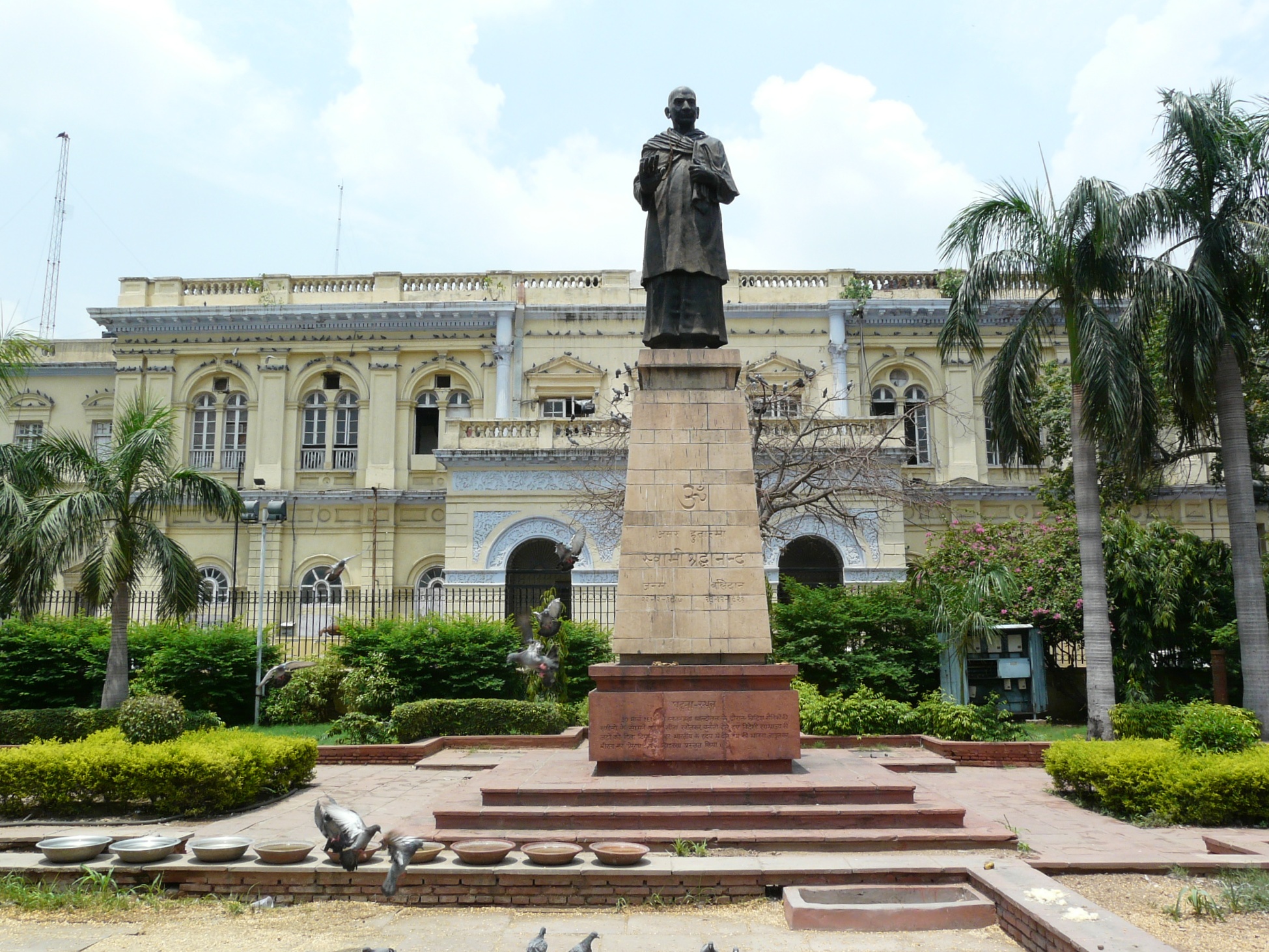
The market's history dates to the founding of the capital city of Shahjahanabad when Emperor Shah Jahan established the Red Fort on the banks of the Yamuna River, hemming his new capital.
Original Chandni Chowk


The original Chandni Chowk, half-moon-shaped square, was situated before the Townhall; its reflection used to shimmer in the moonlit water pool located at the front. A shallow water channel, whose source was the Yamuna, ran through the middle of the straight street now referred to as the Chandni Chowk bazaar, with roads and shops on either side of the channel. This road had three bazaars. Chandni Chowk ("moonlight square") and its three bazaars were designed and established by Princess Jahanara Begum, Shah Jahan's favourite daughter, in 1650. Originally consisting of 1,560 shops, the bazaar was 40 yards wide and 1,520 yards long. The bazaar, fashion to resemble a square, was accorded ample elegance by the presence of a pool at the complex's center. The pool glimmered under the moonlight, a characteristic that inspired its name.
The shops were originally arranged in a distinctive half-moon pattern, a design that has since been lost or altered over time. The bazaar gained renown for its thriving silver trade, leading to its association with silver merchants. This prominence earned it the moniker Silver Street—a name rooted in its Hindi counterpart, wherein silver is called Chandi.
The term Chandni, which is closely derived from Chandi, further emphasizes the cultural and linguistic connection to the bazaar's identity. The pool at the square was replaced by a clock tower (Ghantaghar) in the 1870s. The centre of the market is still referred to as Ghantaghar. Chandni Chowk was once the grandest Indian market. Chandni Chowk was a significant route for Mughal imperial processions, hosting the grand displays of emperors and their entourages, highlighting its importance in the empire's cultural and architectural heritage. The tradition of grand processions through Chandni Chowk continued during the Delhi Durbar of 1903. Meanwhile, the British contributed to the area's architectural heritage by constructing the Delhi Town Hall in 1863.
Original three bazaars

The term Chandni Chowk previously referred only to the square that hosted the reflecting pool. Today, the entirety of the stretch that runs spans the middle of the walled city, from Lahori Gate of the Red Fort to the Fatehpuri Masjid, is known as Chandni Chowk. The road was subsequently trifurcated into the following bazaars:
- Urdu Bazar: the stretch spanning from Lahori Gate of Red Fort to Chowk Kotwali near Gurudwara Sis Ganj Sahib was called Urdu Bazaar, i.e., the encampment market. The Urdu language received its name from this encampment. Ghalib noted the destruction of this market during the disturbances of the Indian Rebellion of 1857 and its aftermath.
- Johri Bazar: the Chowk Kotwali to Chandni Chowk section of the straight road was originally called Johri Bazar.
- Fatehpuri Bazar: Chandni Chowk to Fatehpuri Masjid section of the straight road was originally called the Fatehpuri Bazar.
While the contemporary market is blighted with congestion, the market still retains its historical character.

Kucha, katra and havelis
The road now called Chandni Chowk had several streets branching off of it, which were referred to as kuchas (streets/wings). Each kucha usually had several katras (cul de sac or guild houses), which in turn had several havelis. The following terms are generally used to describe the buildings and the streets:
- Mohalla (neighborhood): a residential neighbourhood with kuchas and katras within kuchas.
- Kucha or Gali (street): Kucha in the Persian language is synonymous with "Gali" or street in the Hindi language. It is a street or a zone with houses whose owners shared some common attributes, usually their occupation. Hence the names Kucha Maliwara (the gardeners' street) and Kucha Ballimaran (the oarsmen's street). Kuchas either had rows of large Havelis or gated cul de sac (dead end) "Katra" marketplaces along with them.
- Kucha mahajani: is one of the biggest gold-trading hubs and wholesale jewellery markets in Asia.
- Katra (gated cul-de-sac courtyard market-cum-residential complex in a street): are one-room quarters around a court with a single narrow entrance and inhabited by people of the same caste or occupation i.e. a zone with houses whose owners shared some common attribute, usually their occupation, hence the name. Katra refers to a separate wing of tradesmen and craftsmen belonging to the same trade. They usually lived and worked together in a gated cul de sac, the doors of which could be closed at night for the protection of the merchandise, equipment, workers and their families. It is a system similar to the guild housing in Amsterdam such as Handboogdoelen and Voetboogdoelen.
- Haveli (mansion): A normal haveli has a big courtyard (atrium) surrounded on four sides by spacious rooms and often another walled courtyard around the exterior. Historic havelis include:
- Begum Samru's palace built in 1806, now called Bhagirath Palace, see.
- Dharampura Haveli, Gali Guliyan, designed in late Mughal style although parts show the influence of 20 Century architecture. During Mughal and late Mughal Period, a large numbers of Havelis were built by courtiers.
- Chunnamal haveli in Katra Neel
- Ghalib ki Haveli of Mirza Ghalib, Gali Qasim Jan (Gali Ballimaran)
- Haksar Haveli in Sita Ram Bazar, where Jawaharlal Nehru was married on 8 February 1916 to Kamla Nehru. She was born here, and her family sold it in the 1960s. Haveli used to host mushairas
- Haveli Banarsi Bhawan with a water well is situated near to Shree Digambar Meru Jain Temple in the Masjid Khajoor area.
- Haveli Naharwali, Kucha Sadullah Khan, where Pervez Musharraf, former president of Pakistan was born and his grandfather sold it to Prem Chand Gola after whom this area is now called Gola Market. This was originally owned by the Raja Nahar Khan a Hindu convert of Mewat who converted to Islam during the era of Firuz Shah Tughlaq in 1355, hence the name.
- Khazanchi haveli, the Khajanchi were the accountants of Shah Jahan. A street is named after them called "Gali Khajanchi", a long tunnel connects the haveli and the Red Fort, so that money could be transferred safely. It is close to the entrance of Chandni Chowk, from the Red Fort walk towards Fatehpuri, turn left on road to Dariba and the haveli is at the end of the road that connects Dariba and Esplanade Road.
- Haveli Raja Jugal Kishore, a grand mansion with an imposing gate, which was adorned with a large ghanta-bell. Located adjacent to the gate, a room in the haveli opening towards the street, was given to Lala Sukhlal by the owners of the haveli as a philanthropic gesture to open a sweet shop, which came to be identified as ghante ke neechewala halwaii. (see Ghantewala). A street is named after the haveli; Kucha-i-Haveli Raja Jugal Kishore between Kucha Maliwara and Kotwali Chabutra.
- Naughara Mansions in Naughara Gali off Kinari Bazaar has 18th century Jain mansions. It is a street with nine (nau) continuous havelies with brightly painted floral designs on the facade. Each of the havelies used to have a gharha (water pot) placed at door for the thirsty passersby. There is a white marble Jain Svetambara Temple at the end of the street with stone elephant heads at the door, intricate carvings on walls and pillars, a museum on the ground floor with rare manuscripts embroidered in pure gold and silver threads and a black image of Lord Parasanath in the rare kasauti stone on the first floor. Office of Atma Prakash Aggrawal at the beginning of the street houses numerous antiques and should not be mistaken as an antique shop.
- Zeenat Mahal Haveli, Lal Kuan Bazar
Some other commonly used terms are Chatta (the upper floor which arches over the street below), phatak (door, usually to a katra or street which could be locked at night), mahal (a palace, as in Taj Mahal), kamra (a room), kuan is waterwell, etc.
Historic religious buildings

Delhi's most famous mosque, Jama Masjid, built-in 1650 in the vicinity, is near other religious shrines, belonging to multiple religions. Starting from the Red Fort, the buildings include:
- The Sri Digambar Jain Lal Mandir, established in 1656 with a bird hospital established in 1929. A Naya Mandir was built in 1807 in Dharampura, as the first temple with a Shikhar.
- The Gauri Shankar Temple was built by a Maratha general Appa Gangadhar according to one of the legends.
- The Central Baptist Church, it was built-in 1814.
- The Gurdwara Sis Ganj Sahib. The ninth Sikh Guru, Guru Tegh Bahadur and his followers Bhai Mati Das, Bhai Dyal Das and Bhai Sati Das were executed nearby by the Mughals in 1675. The Gurudwaras in the form of memorials were built in 1783 after Delhi, the then Mughal capital was captured by the Khalsa (the corporate body of Sikhs) under the command of Baghel Singh. Present Building was however built later in 1930.
- The Sunehri Masjid was built in 1721 by Roshan-Ud-Daula Zafar Khan in the reign of Mohammad Shah. Persian invader Nader Shah spent several hours on the top of the mosque on 11 March 1739 to observe the Katl-e-Aam (the killing of everyone in sight) that he had ordered, which resulted in 30,000 deaths.
- The Fatehpuri Masjid was built by Fatehpuri Begum in 1650, one of the queens of Shah Jahan.
Present
On both sides of the wide Chandni Chowk are historical residential areas served by narrow lanes (gali), several of which are teeming with the peddlers, street vendors, street food and bazaars.
Shops

.JPG)
Chandni Chowk's speciality is its variety and authenticity: food, delicacies and sweets of more than 1,000 kinds, sarees with chikan and zari. Narrow lanes host shops that sell books, clothing, electronics, consumer goods, shoes and leather goods. It is the location of the original Haldiram's and brands such as Giani's. A particular local delicacy is the jalebis, which are fried in pure ghee (clarified butter).
Starting from the Red Fort end one finds the State Bank of India building. A short distance away is Bhagirath Palace Begum Samru which has an intriguing history. Bhagirath Palace and the adjoining area have perhaps the biggest market in India for electrical goods, lamps and light fixtures. Dariba Kalan is the market for silver and gold jewellery. This market also offers trophies, shields, mementos and related items. At its Southern end (and close to the Jama Masjid, Delhi) is Bazaar Guliyan where about a hundred shops selling metallic and wooden statues, sculptures, bells, handicrafts are located. Nai Sarak is the wholesale market for stationery, books, paper and decorative materials. Chawri Bazar is a big market for greeting and wedding cards as well as plumbing items, sanitary ware, and accessories. Located at the western end of Chandni Chowk, Khari Baoli is a street entirely dedicated to all kinds of spices, dried fruits, nuts, herbs, grains, lentils, pickles and preserves.
Restaurants and eateries
Chandni Chowk is home to several notable restaurants and hi (confectioners), most well known among them is Gali Paranthe Wali.
- Paranthewali Gali with paratha shops from 1875 to 1886.
- Annapurna Bhandar established in 1929 by Late Mr.Purna Chander Modak is popular for Bengali sweets.
- Bikaner Sweet Shop, known for rasmalai.
- Chaatwallah, established in 1923, known for fruit chaat.
- Chaina Ram Sindhi Halwai, established in 1948 serves besan ke laddoo, ghee patisa and ghevar like none in the city.
- Giani's, serving icecreams and Rabri Falooda, established around 1947.
- Gol Hatti, established in 1954, serves kullhad wale chhole chawal.
- Hazari Lal Khurchan Wale, Kinaari Bazaar. This shop, established 90 years ago, arguably makes the best khurchan in Delhi. Khurchan means ”scraped leftovers" in Hindi. The preparation sounds simple: boil the milk, scrape off the cream as it appears on the top, and eventually mix it with hi, or powdered sugar.
- Kanwarji's Bhagirathmal Dalbijiwallah established in the mid-19th century.
- Meghraj and Sons, since the 1950s
- Natraj's Dahi Bhalle, established in 1940.
- Shiv Mishtan Bhandar, established 1910, is well known for their bedmi pooree with aloo sabzi with crisp jalebi or imarti. A limited menu but every item is freshly prepared and full of flavour.
- Tewari Brothers Confectioners, (known for Motichoor Laddoo, Samosa) established in 1987
- The Old Famous Jalebi Wala, which is situated in Dariba Kalan, serves city's crispiest jalebis.
Redevelopment


.jpg)
Chandni Chowk was redeveloped as heritage trail to stimulate tourism, seeking inspiration from the inception of the Heritage Street in Amritsar. The Shahjahanabad Redevelopment Corporation, under the auspices of the Government of Delhi, is the agency entrusted with this ambitious task. The redevelopment plan includes the incorporation of walkways to render the area more pedestrian-friendly. No motorized traffic will be allowed to ply on Chandni Chowk from Red Fort to Fatehpuri Masjid during daylight hours. Certain streets will be barricaded. The redevelopment plan was supposed to have been completed before the inauguration of the 2010 Commonwealth Games, but got delayed. The plan also envisions parking space for 1500 cars.
As a part of the redevelopment, the construction of a multilevel parking-cum-commercial complex is underway at Gandhi Maidan in Chandni Chowk.
This multilevel parking-cum-commercial complex, an eight-story building with three basements spanning 18,524 square meters, is being developed at a cost of ₹1,000 crore under a PPP model in collaboration with a real estate developer. The project will have the capacity to accommodate over 2,300 cars.
Popular culture
Chandni Chowk has served as a prominent backdrop in several Bollywood films over the years:
- In 2001, Kabhi Khushi Kabhie Gham featured Chandni Chowk as the residence of leading characters Anjali (Kajol) and her sister Pooja (Kareena Kapoor).
- In 2008, Black & White, starring Anil Kapoor, Anurag Sinha, Shefali Chhaya, and Aditi Sharma, was set in Chandni Chowk.
- In 2009, Chandni Chowk to China, featuring Akshay Kumar, Deepika Padukone, Mithun Chakraborty, and Ranvir Shorey, included scenes depicting the area.
- In 2009, Delhi-6, starring Abhishek Bachchan, Sonam Kapoor, Waheeda Rehman, Om Puri, Atul Kulkarni, and Divya Dutta, was filmed in the Walled City of Old Delhi, with Chandni Chowk as its focus.
- In 2016, Saat Uchakkey, starring Manoj Bajpayee, Kay Kay Menon, Annu Kapoor, Vijay Raaz, Anupam Kher, Aparshakti Khurana, and Aditi Sharma, was entirely shot in and around Chandni Chowk.
- In 2018, Rajma Chawal, starring Amyra Dastur, Rishi Kapoor, and Aparshakti Khurana, had extensive sections filmed at Lachu Ram Ki Haveli in Chandni Chowk.
- In 2019, The Sky Is Pink, starring Priyanka Chopra, Farhan Akhtar, Zaira Wasim, and Rohit Suresh Saraf, was partially shot in Chandni Chowk, as the lead characters, played by Priyanka and Farhan, lived there.
References
References
- (1 February 2011). "Delhi - 100 years as the Capital". [[The Hindu]].
- "Pin Code of Chandni Chowk Delhi". citypincode.in.
- [https://everythingcandid.com/2016/02/08/a-heritage-photowalk-in-old-delhi-with-liddle-sisters/ A heritage walk of Old Delhi].
- Blake, Stephen P.. (1998). "Women in the medieval Islamic world : Power, patronage, and piety". St. Martin’s Press.
- "Chandani CHowk history".
- I. Mohan: ''Delhi, Development and Change'', APH Publishing, 2000, [https://books.google.com/books?id=vLiWb5o3414C Chapter 8, pp. 33-35]
- "chandnichauk".
- Encyclopaedic Survey of Islamic Culture: Growth & Development, Mohamed Taher, Anmol Publications, 1998.
- (2007-11-18). "Chandni Chowk: Landmarks & Monuments".
- [https://www.livemint.com/Leisure/jCDl9CGtowdefkZgFdYD8L/Heritage--The-Old-Delhi-dictionary.html Heritage. The Old Delhi dictionary], Livemint, 2 March 2013.
- Singh, Paras. (28 June 2019). "Delhi: Chandni Chowk gold trading hub next in line for sealing".
- ''Havelis of Old Delhi''/Text by Pavan K. Varma and Sondeep Shankar. Reprint, First published in 1992. New Delhi, Bookwise, 1999.
- "4 Star Hotels in Karol Bagh {{!}} Hotel in Karol Bagh{{!}} Hotel Amrapali Grand".
- (30 November 2003). "Collect Britain has moved". Collectbritain.co.uk.
- (21 December 2015). "Haveli to speak of a history lost in time". The Times of India.
- [https://www.thequint.com/voices/blogs/haksar-haveli-jawaharlal-nehru-married-kamala-death-anniversary Crumbling Haksar Haveli, Delhi-6: Where Nehru Went to Marry Kamla Nehru], The Quint, 27 May 2017.
- [http://www.the-south-asian.com/June2001/General_Musharraf's_Haveli.htm Haveli Naharvali], the-south-asian.com, June 2001.
- "Khazanchi Haveli".
- Horton, Patrick. (2016-11-21). "Naughara Gali".
- (2020-04-21). "Naughara".
- "Gauri Shankar Temple".
- "Home".
- (2019-03-08). "Bhagirath Palace: Begum Samru's forgotten haveli in Old Delhi".
- [https://web.archive.org/web/20110617113008/http://www.mid-day.com/lifestyle/2008/sep/280908-Features-Sweets-roza-Chandni-Chowk.htm Chowk and cheese]
- Swamy, K. R. N.. (2002-11-10). "Frozen paranthas posing a challenge to Paranthewali Gali fare".
- "Annapurna Bhandar Mithai in Chandni Chowk, Delhi/NCR.Annapurna Bhandar Restaurant in Chandni Chowk,Delhi/NCR". Timescity.
- (30 August 2014). "Delhi restaurants guide in India's premier youth magazine".
- (2019-07-01). "City Food – Hazari Lal Jain Khurchan Wale, Kinari Bazaar".
- (2018-03-21). "Shiv Misthan Bhandar".
- "Old Famous Jalebi Wala: Chandni Chowk's Must-Visit Shop for Every Jalebi Lover".
- (2019-03-24). "Walk at your own risk in Delhi's Chandni Chowk".
- (2019-03-06). "Gandhi Maidan parking in Delhi's Chandni Chowk finally takes off".
- "Breather for Chandni chowk urban art body clears Gandhi maidan parking".
This article was imported from Wikipedia and is available under the Creative Commons Attribution-ShareAlike 4.0 License. Content has been adapted to SurfDoc format. Original contributors can be found on the article history page.
Ask Mako anything about Chandni Chowk — get instant answers, deeper analysis, and related topics.
Research with MakoFree with your Surf account
Create a free account to save articles, ask Mako questions, and organize your research.
Sign up freeThis content may have been generated or modified by AI. CloudSurf Software LLC is not responsible for the accuracy, completeness, or reliability of AI-generated content. Always verify important information from primary sources.
Report