From Surf Wiki (app.surf) — the open knowledge base
Chalybes
Race of iron-workers in Greek mythology
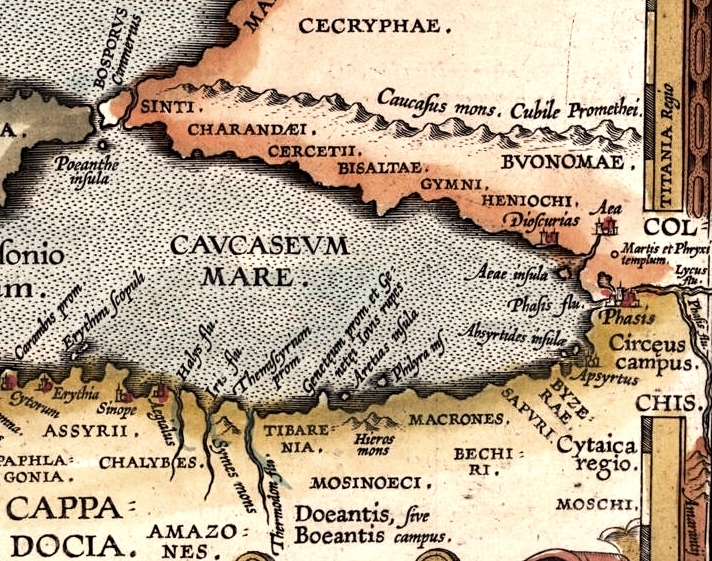
Race of iron-workers in Greek mythology
The Chalybes (; ; ხალიბები) and Chaldoi (; ) were peoples mentioned by classical authors as living in Pontus and Cappadocia in northern Anatolia during Classical Antiquity. Their territory was known as Chaldia, extending from the Halys River to Pharnakeia and Trabzon in the east and as far south as eastern Anatolia. According to Apollonius of Rhodes, the Chalybes were Scythians.
Background and history
The Chaldoi, Chalybes, Mossynoikoi, and Tibareni, are counted among the first ironsmith nations by classical authors. Χάλυψ, the tribe's name in Ancient Greek, means "tempered iron, steel", a term that passed into Latin as chalybs, "steel". Sayce derived the Greek name grc from Hittite hit, "land of Halys River". More than an identifiable people or tribe, "Chalybes" was a generic Greek term for "peoples of the Black Sea coast who trade in iron" or "a group of specialised metalworkers".
The main sources for the history of the Chaldoi are accounts from classical authors, including Homer, Strabo, and Xenophon. Xenophon encountered them during the march of the Ten Thousand to the Black Sea and describes them in his Anabasis as "the most valiant of all the peoples [the Ten Thousand] passed through, and would come to hand-to-hand encounter." He reports that they dwelt in strongholds. In Xenophon's Cyropaedia, Cyrus the Great helps the Armenians and Chaldians resolve a dispute over agricultural land.
In Roman times, the Chaldaei (homonymous but unrelated to the Semitic Chaldeans) and Chalybes are mentioned by Plutarch (Lucull. c. 14) as settled in Pontus and Cappadocia, or the Pontus Cappadocicus section of the Roman province of Pontus.
Pliny the Elder mentioned the Armenochalybes, a tribe residing between Trebizond and Armenia.
Despite the ancient Greeks connecting the Chalybes to Scythians, some modern historians argue the Chalybes were a Georgian tribe. Historian Kalistrat Salia claims the Georgian ethnicity of the Chalybes is "indisputable". According to Sallia, the Zans, a Kartvelian ethnic group from present-day Turkey, are their descendants. According to the 7th-century Geography of Armenia, the Chaldians called the Black Sea Kakamar, which may have an Indo-European etymology (the Greek root kak- 'ill' + mar, the Indo-European root for 'sea').
References
Bibliography
References
- Apollonius Rhodius. "The Argonautica".
- [[Strabo]], xi., 14.5
- Vassaleva, Maya. (31 December 1998). "The Greek Colonisation of the Black Sea Area". Franz Steiner Verlag.
- Diakonoff, I. M.. (1984). "The Pre-History of the Armenian People". Caravan Books.
- (2020). "The metal behind the myths: iron metallurgy in the south-eastern Black Sea region". Antiquity.
- Xenophon. ''Anabasis''. Book 4, Chapter 7, [https://www.perseus.tufts.edu/hopper/text?doc=Perseus%3Atext%3A1999.01.0202%3Abook%3D4%3Achapter%3D7%3Asection%3D15 Sections 15–17]
- Xenophon. ''Cyropaedia''. Book 3, [http://www.perseus.tufts.edu/hopper/text?doc=Perseus%3Atext%3A1999.01.0204%3Abook%3D3%3Achapter%3D2 Chapter 2]
- (2013). "A Chronology Model for Xenophon's Anabasis". Greek, Roman, and Byzantine Studies.
- Pliny. ''The Natural History''. Book 6. [http://www.perseus.tufts.edu/hopper/text?doc=Plin.%20Nat.%206.4&lang=original Chapter 10]
- Salia, Kalistrat. (1983). "History of the Georgian Nation". University of Wisconsin.
- Hewsen, Robert H.. (2001). "Armenia: A Historical Atlas". University of Chicago Press.
This article was imported from Wikipedia and is available under the Creative Commons Attribution-ShareAlike 4.0 License. Content has been adapted to SurfDoc format. Original contributors can be found on the article history page.
Ask Mako anything about Chalybes — get instant answers, deeper analysis, and related topics.
Research with MakoFree with your Surf account
Create a free account to save articles, ask Mako questions, and organize your research.
Sign up freeThis content may have been generated or modified by AI. CloudSurf Software LLC is not responsible for the accuracy, completeness, or reliability of AI-generated content. Always verify important information from primary sources.
Report