From Surf Wiki (app.surf) — the open knowledge base
Ceres (dwarf planet)
Dwarf planet in the asteroid belt

Dwarf planet in the asteroid belt
| Field | Value | |||
|---|---|---|---|---|
| minorplanet | yes | |||
| background | Lavender | |||
| name | Ceres | |||
| symbol | [[File:Ceres symbol (bold).svg | 24px | ⚳ | class=skin-invert]] |
| image | Ceres - RC3 - Haulani Crater (22381131691) (cropped).jpg | |||
| caption | Ceres as imaged by Dawn, May 2015. The two bright spots are the crater Haulani (right), and the floor of the crater Oxo (left). | |||
| discovery_ref | ||||
| discoverer | Giuseppe Piazzi | |||
| discovered | 1 January 1801 | |||
| mpc_name | 1 Ceres | |||
| pronounced | , | |||
| named_after | Cerēs | |||
| alt_names | ||||
| adjectives | Cererian, -ean () | |||
| mp_category | {{Ubl | |||
| orbit_ref | ||||
| epoch | 21 January 2022 (JD 2459600.5) | |||
| aphelion | {{sigfig | 2.98318 | 3}} AU | |
| perihelion | {{sigfig | 2.54891 | 3}} AU | |
| time_periastron | 7 December 2022 | |||
| semimajor | {{sigfig | 2.76604 | 3}} AU | |
| eccentricity | ||||
| period | ||||
| synodic_period | ||||
| inclination | ||||
| arg_peri | ||||
| asc_node | ||||
| mean_anomaly | ||||
| avg_speed | ||||
| p_orbit_ref | ||||
| p_semimajor | ||||
| p_eccentricity | ||||
| p_inclination | ||||
| p_mean_motion | ||||
| perihelion_rate | ||||
| node_rate | ||||
| satellites | Dawn (derelict space probe) | |||
| allsatellites | yes | |||
| dimensions | (966.2 × 962.0 × 891.8) | |||
| ± 0.2 km | ||||
| mean_radius | (291.9 mi) | |||
| surface_area | {{refn | group=lower-alpha | name="known parameters" | Calculated based on known parameters: |
| volume | ||||
| mass | ||||
| density | ||||
| surface_grav | 0.284 m/s2 | |||
| moment_of_inertia_factor | (estimate) | |||
| escape_velocity | km/s | |||
| u | mph}} | |||
| sidereal_day | ||||
| rot_velocity | ||||
| right_asc_north_pole | 291.42744° | |||
| declination | 66.76033° | |||
| axial_tilt | ≈4° | |||
| albedo | (V-band) | |||
| temp_name1 | Kelvin | |||
| min_temp_1 | ≈110 | |||
| mean_temp_1 | ||||
| max_temp_1 | ||||
| spectral_type | C | |||
| magnitude | {{ubl | |||
| 7.6<ref name | "skyand" | |||
| 9.27 (July 2021)<ref name | "AstDys-object" / | |||
| abs_magnitude | ||||
| angular_size | 0.854″ to 0.339″ |
| A801 AA | A899 OF | 1943 XB |dwarf planet |asteroid ± 0.2 km
- Surface area: 4πr
- Surface gravity:
- Escape velocity:
- Rotation velocity: }} |7.6 | 9.27 (July 2021)
Ceres (minor-planet designation: 1 Ceres) is a dwarf planet in the main asteroid belt between the orbits of Mars and Jupiter. It was the first known asteroid, discovered on 1 January 1801 by Giuseppe Piazzi at Palermo Astronomical Observatory in Sicily, and announced as a new planet. Ceres was later classified as an asteroid and more recently as a dwarf planet, the only one not beyond the orbit of Neptune and the largest that does not have a moon.
Ceres's diameter is about a quarter that of the Moon. Its small size means that even at its brightest it is too dim to be seen by the naked eye, except under extremely dark skies. Its apparent magnitude ranges from 6.7 to 9.3, peaking at opposition (when it is closest to Earth) once every 15- to 16-month synodic period. As a result, its surface features are barely visible even with the most powerful telescopes, and little was known about it until the robotic NASA spacecraft Dawn approached Ceres for its orbital mission in 2015.
Dawn found Ceres's surface to be a mixture of water, ice, and hydrated minerals such as carbonates and clay. Gravity data suggest Ceres to be partially differentiated into a muddy (ice–rock) mantle/core and a less dense, but stronger crust that is at most thirty percent ice by volume. Although Ceres likely lacks an internal ocean of liquid water, brines still flow through the outer mantle and reach the surface, allowing cryovolcanoes such as Ahuna Mons to form roughly every fifty million years. This makes Ceres the closest known cryovolcanically active body to the Sun. Ceres has an extremely tenuous and transient atmosphere of water vapour, vented from localised sources on its surface.
History
Discovery
In the years between the acceptance of heliocentrism in the 18th century and the discovery of Neptune in 1846, several astronomers argued that mathematical laws predicted the existence of a hidden or missing planet between the orbits of Mars and Jupiter. In 1596, theoretical astronomer Johannes Kepler believed that the ratios between planetary orbits would conform to "God's design" only with the addition of two planets: one between Jupiter and Mars and one between Venus and Mercury. Other theorists, such as Immanuel Kant, pondered whether the gap had been created by the gravity of Jupiter; in 1761, astronomer and mathematician Johann Heinrich Lambert asked: "And who knows whether already planets are missing which have departed from the vast space between Mars and Jupiter? Does it then hold of celestial bodies as well as of the Earth, that the stronger chafe the weaker, and are Jupiter and Saturn destined to plunder forever?"
In 1772, German astronomer Johann Elert Bode, citing Johann Daniel Titius, published a formula later known as the Titius–Bode law that appeared to predict the orbits of the known planets but for an unexplained gap between Mars and Jupiter. This formula predicted that there ought to be another planet with an orbital radius near 2.8 astronomical units (AU), or 420 million km, from the Sun. The Titius–Bode law gained more credence with William Herschel's 1781 discovery of Uranus near the predicted distance for a planet beyond Saturn. In 1800, a group headed by Franz Xaver von Zach, editor of the German astronomical journal Monthly Correspondence, sent requests to twenty-four experienced astronomers, whom he dubbed the "celestial police", asking that they combine their efforts and begin a methodical search for the expected planet. Although they did not discover Ceres, they later found the asteroids Pallas, Juno, and Vesta.
One of the astronomers selected for the search was Giuseppe Piazzi, a Catholic priest at the academy of Palermo, Sicily. Before receiving his invitation to join the group, Piazzi discovered Ceres on 1 January 1801. He was searching for "the 87th [star] of the Catalogue of the Zodiacal stars of Mr la Caille", but found that "it was preceded by another". Instead of a star, Piazzi had found a moving starlike object, which he first thought was a comet. Piazzi observed Ceres twenty-four times, the final sighting occurring on 11 February 1801, when illness interrupted his work. He announced his discovery on 24 January 1801 in letters to two fellow astronomers, his compatriot Barnaba Oriani of Milan and Bode in Berlin. He reported it as a comet, but "since its movement is so slow and rather uniform, it has occurred to me several times that it might be something better than a comet". In April, Piazzi sent his complete observations to Oriani, Bode, and French astronomer Jérôme Lalande. The information was published in the September 1801 issue of the Monatliche Correspondenz.
By this time, the apparent position of Ceres had changed (primarily due to Earth's motion around the Sun) and was too close to the Sun's glare for other astronomers to confirm Piazzi's observations. Towards the end of the year, Ceres should have been visible again, but after such a long time, it was difficult to predict its position. To recover Ceres, the mathematician Carl Friedrich Gauss, then twenty-four years old, developed an efficient method of orbit determination. He predicted the path of Ceres within a few weeks and sent his results to von Zach. On 31 December 1801, von Zach and fellow celestial policeman Heinrich W. M. Olbers found Ceres near the predicted position and continued to record its position. At 2.8 AU from the Sun, Ceres appeared to fit the Titius–Bode law almost perfectly; when Neptune was discovered in 1846, eight AU closer than predicted, most astronomers concluded that the law was a coincidence.
The early observers were able to calculate the size of Ceres only to within an order of magnitude. Herschel underestimated its diameter at 260 km in 1802; in 1811, German astronomer Johann Hieronymus Schröter overestimated it at 2,613 km. In the 1970s, infrared photometry enabled more accurate measurements of its albedo, and Ceres's diameter was determined to within ten percent of its true value of 939 km.
Name and symbol
Piazzi's proposed name for his discovery was Ceres Ferdinandea: Ceres after the Roman goddess of agriculture, whose earthly home, and oldest temple, lay in Sicily; and Ferdinandea in honour of Piazzi's monarch and patron, King Ferdinand III of Sicily. The latter was not acceptable to other nations and was dropped. Before von Zach's recovery of Ceres in December 1801, von Zach referred to the planet as Hera, and Bode referred to it as Juno. Despite Piazzi's objections, those names gained currency in Germany before the object's existence was confirmed. Once it was, astronomers settled on Piazzi's name.
The adjectival forms of Ceres are Cererian and Cererean, both pronounced . Cerium, a rare-earth element discovered in 1803, was named after Ceres.
The old astronomical symbol of Ceres, still used in astrology, is a sickle, ⟨⚳⟩. The sickle was one of the classical symbols of the goddess Ceres and was suggested, apparently independently, by von Zach and Bode in 1802. It is similar in form to the symbol ⟨♀⟩ (a circle with a small cross beneath) of the planet Venus, but with a break in the circle. It had various minor graphic variants, including a reversed form [[File:Ceres 'C' symbol.svg|12px]] typeset as a 'C' (the initial letter of the name Ceres) with a plus sign. The generic asteroid symbol of a numbered disk, ①, was introduced in 1867 and quickly became the norm.
Classification
The categorisation of Ceres has changed more than once and has been the subject of some disagreement. Bode believed Ceres to be the "missing planet" he had proposed to exist between Mars and Jupiter. Ceres was assigned a planetary symbol and remained listed as a planet in astronomy books and tables (along with Pallas, Juno, and Vesta) for over half a century.
As other objects were discovered in the neighbourhood of Ceres, astronomers began to suspect that it represented the first of a new class of objects. When Pallas was discovered in 1802, Herschel introduced the term asteroid ("star-like") for these bodies, writing that "they resemble small stars so much as hardly to be distinguished from them, even by very good telescopes". In 1852 Johann Franz Encke, in the Berliner Astronomisches Jahrbuch, declared the traditional system of granting planetary symbols too cumbersome for these new objects and introduced a new method of placing numbers before their names in order of discovery. The numbering system initially began with the fifth asteroid, 5 Astraea, as number 1, but in 1867, Ceres was adopted into the new system under the name 1 Ceres.
By the 1860s, astronomers widely accepted that a fundamental difference existed between the major planets and asteroids such as Ceres, though the word "planet" had yet to be precisely defined. In the 1950s, scientists generally stopped considering most asteroids as planets, but Ceres sometimes retained its status after that because of its planet-like geophysical complexity. Then, in 2006, the debate surrounding Pluto led to calls for a definition of "planet", and the possible reclassification of Ceres, perhaps even its general reinstatement as a planet. A proposal before the International Astronomical Union (IAU), the global body responsible for astronomical nomenclature and classification, defined a planet as "a celestial body that (a) has sufficient mass for its self-gravity to overcome rigid-body forces so that it assumes a hydrostatic equilibrium (nearly round) shape, and (b) is in orbit around a star, and is neither a star nor a satellite of a planet". Had this resolution been adopted, it would have made Ceres the fifth planet in order from the Sun, but on 24 August 2006 the assembly adopted the additional requirement that a planet must have "cleared the neighbourhood around its orbit". Ceres is not a planet because it does not dominate its orbit, sharing it as it does with the thousands of other asteroids in the asteroid belt and constituting only about forty per cent of the belt's total mass. Bodies that met the first proposed definition but not the second, such as Ceres, were instead classified as dwarf planets. Planetary geologists still often ignore this definition and consider Ceres to be a planet anyway.
Ceres is designated as a dwarf planet and an asteroid. A NASA webpage states that Vesta, the belt's second-largest object, is the largest asteroid. The IAU has been equivocal on the subject, though its Minor Planet Center, the organisation charged with cataloguing such objects, notes that dwarf planets may have dual designations, and the joint IAU / USGS / NASA Gazetteer categorises Ceres as both asteroid and a dwarf planet.
Orbit
Ceres follows an orbit between Mars and Jupiter, near the middle of the asteroid belt, with an orbital period of 4.6 Earth years. Compared to other planets and dwarf planets, Ceres's orbit is moderately tilted relative to that of Earth; its inclination (i) is 10.6°, compared to 7° for Mercury and 17° for Pluto. It is also slightly elongated, with an eccentricity (e) = 0.08, compared to 0.09 for Mars.
Ceres is not part of an asteroid family, probably due to its large proportion of ice, as smaller bodies with the same composition would have sublimated to nothing over the age of the Solar System. It was once thought to be a member of the Gefion family, the members of which share similar proper orbital elements, suggesting a common origin through an asteroid collision in the past. Ceres was later found to have a different composition from the Gefion family and appears to be an interloper, having similar orbital elements but not a common origin.
Resonances
Due to their small masses and large separations, objects within the asteroid belt rarely fall into gravitational resonances with each other. Nevertheless, Ceres is able to capture other asteroids into temporary 1:1 resonances (making them temporary trojans), for periods from a few hundred thousand to more than two million years. Fifty such objects have been identified. Ceres is close to a 1:1 mean-motion orbital resonance with Pallas (their proper orbital periods differ by 0.2%), but not close enough to be significant over astronomical timescales.
Rotation and axial tilt
The rotation period of Ceres (the Cererian day) is 9 hours and 4 minutes; the small equatorial crater of Kait is selected as its prime meridian. Ceres has an axial tilt of 4°, small enough for its polar regions to contain permanently shadowed craters that are expected to act as cold traps and accumulate water ice over time, similar to what occurs on the Moon and Mercury. About 0.14% of water molecules released from the surface are expected to end up in the traps, hopping an average of three times before escaping or being trapped.
Dawn, the first spacecraft to orbit Ceres, determined that the north polar axis points at right ascension 19 h 25 m 40.3 s (291.418°), declination +66° 45' 50" (about 1.5 degrees from Delta Draconis), which means an axial tilt of 4°. This means that Ceres currently sees little to no seasonal variation in sunlight by latitude. Gravitational influence from Jupiter and Saturn over the course of the last three million years has triggered cyclical shifts in Ceres's axial tilt, ranging from two to twenty degrees, meaning that seasonal variation in sun exposure has occurred in the past, with the last period of seasonal activity estimated at 14,000 years ago. Those craters that remain in shadow during periods of maximum axial tilt are the most likely to retain water ice from eruptions or cometary impacts over the age of the Solar System.
Geology
Main article: Geology of Ceres, List of geological features on Ceres

Earth, the Moon, Mars and Ceres)]]
Ceres is the largest asteroid in the main asteroid belt. It has been classified as a C‑type or carbonaceous asteroid and, due to the presence of clay minerals, as a G-type asteroid. It has a similar, but not identical, composition to that of carbonaceous chondrite meteorites. It is an oblate spheroid, with an equatorial diameter 8% larger than its polar diameter. Measurements from the Dawn spacecraft found a mean diameter of 939.4 km and a mass of . This gives Ceres a density of , suggesting that a quarter of its mass is water ice.
Ceres makes up 40% of the estimated mass of the asteroid belt, and it has times the mass of the next asteroid, Vesta, but it has only the mass of the Moon, and its surface gravity is that of Earth ( of the Moon's). It is close to being in hydrostatic equilibrium, but some deviations from an equilibrium shape have yet to be explained. Ceres is the only widely accepted dwarf planet with an orbital period less than that of Neptune. Modelling has suggested Ceres's rocky material is partially differentiated, and that it may possess a small core, but the data is also consistent with a mantle of hydrated silicates and no core. Because Dawn lacked a magnetometer, it is not known if Ceres has a magnetic field; it is believed not to. Ceres's internal differentiation may be related to its lack of a natural satellite, as satellites of main belt asteroids are mostly believed to form from collisional disruption, creating an undifferentiated, rubble pile structure.
Surface
Composition
The surface composition of Ceres is homogeneous on a global scale, and it is rich in carbonates and ammoniated phyllosilicates that have been altered by water, though water ice in the regolith varies from approximately 10% in polar latitudes to much drier, even ice-free, in the equatorial regions.
Studies using the Hubble Space Telescope show graphite, sulfur, and sulfur dioxide on Ceres's surface. The graphite is evidently the result of space weathering on Ceres's older surfaces; the latter two are volatile under Cererian conditions and would be expected to either escape quickly or settle in cold traps, and so are evidently associated with relatively recent geological activity.
Organic compounds were detected in the Ernutet crater, and at least another eleven regions are candidates for their presence. Most of the planet's near surface is rich in carbon, at approximately 20% by mass. The carbon content is more than five times higher than in carbonaceous chondrite meteorites analysed on Earth. The surface carbon shows evidence of being mixed with products of rock-water interactions, such as clays. This chemistry suggests Ceres formed in a cold environment, perhaps outside the orbit of Jupiter, and that it accreted from ultra-carbon-rich materials in the presence of water, which could provide conditions favourable to organic chemistry. File:PIA21755-CeresMap-CraterNames-20170901.jpg|Black-and-white photographic map of Ceres, centred on 180° longitude, with official nomenclature (September 2017) File:PIA20126-Ceres-PolarRegions-Dawn-20151023.jpg|Ceres, polar regions (November 2015): North (left); south (right). The south pole is in shadow. "Ysolo Mons" has since been renamed "Yamor Mons."
Craters

Ceres's north polar region shows far more cratering than the equatorial region, with the eastern equatorial region in particular comparatively lightly cratered. The overall size frequency of craters of between twenty and a hundred kilometres (10–60 mi) is consistent with their having originated in the Late Heavy Bombardment, with craters outside the ancient polar regions likely erased by early cryovolcanism. Three large shallow basins (planitiae) with degraded rims are likely to be eroded craters. The largest, Vendimia Planitia, at 800 km across, is also the largest single geographical feature on Ceres. Two of the three have higher than average ammonium concentrations.
Dawn observed 4,423 boulders larger than 105 m in diameter on the surface of Ceres. These boulders likely formed through impacts, and are found within or near craters, though not all craters contain boulders. Large boulders are more numerous at higher latitudes. Boulders on Ceres are brittle and degrade rapidly due to thermal stress (at dawn and dusk, the surface temperature changes rapidly) and meteoritic impacts. Their maximum age is estimated to be 150 million years, much shorter than the lifetime of boulders on Vesta.
Tectonic features
Although Ceres lacks plate tectonics, with the vast majority of its surface features linked either to impacts or to cryovolcanic activity, several potentially tectonic features have been tentatively identified on its surface, particularly in its eastern hemisphere. The Samhain Catenae, kilometre-scale linear fractures on Ceres's surface, lack any apparent link to impacts and bear a stronger resemblance to pit crater chains, which are indicative of buried normal faults. Also, several craters on Ceres have shallow, fractured floors consistent with cryomagmatic intrusion.
Cryovolcanism
Main article: Bright spots on Ceres
Ceres has one prominent mountain, Ahuna Mons; this appears to be a cryovolcano and has few craters, suggesting a maximum age of 240 million years. Its relatively high gravitational field suggests it is dense, and thus composed more of rock than ice, and that its placement is likely due to diapirism of a slurry of brine and silicate particles from the top of the mantle. It is roughly antipodal to Kerwan Basin. Seismic energy from the Kerwan-forming impact may have focused on the opposite side of Ceres, fracturing the outer layers of the crust and triggering the movement of high-viscosity cryomagma (muddy water ice softened by its content of salts) onto the surface. Kerwan too shows evidence of the effects of liquid water due to impact-melting of subsurface ice.
A 2018 computer simulation suggests that cryovolcanoes on Ceres, once formed, recede due to viscous relaxation over several hundred million years. The team identified 22 features as strong candidates for relaxed cryovolcanoes on Ceres's surface. Yamor Mons, an ancient, impact-cratered peak, resembles Ahuna Mons despite being much older, due to it lying in Ceres's northern polar region, where lower temperatures prevent viscous relaxation of the crust. Models suggest that, over the past billion years, one cryovolcano has formed on Ceres on average every fifty million years. The eruptions may be linked to ancient impact basins but are not uniformly distributed over Ceres. The model suggests that, contrary to findings at Ahuna Mons, Cererian cryovolcanoes must be composed of far less dense material than average for Ceres's crust, or the observed viscous relaxation could not occur.
An unexpectedly large number of Cererian craters have central pits, perhaps due to cryovolcanic processes; others have central peaks. Hundreds of bright spots (faculae) have been observed by Dawn, the brightest in the middle of 80 km Occator Crater. The bright spot in the centre of Occator is named Cerealia Facula, and the group of bright spots to its east, Vinalia Faculae. Occator possesses a pit 9–10 km wide, partially filled by a central dome. The dome post-dates the faculae and is likely due to freezing of a subterranean reservoir, comparable to pingos in Earth's Arctic region. A haze periodically appears above Cerealia, supporting the hypothesis that some sort of outgassing or sublimating ice formed the bright spots. In March 2016 Dawn found definitive evidence of water ice on the surface of Ceres at Oxo crater.
On 9 December 2015, NASA scientists reported that the bright spots on Ceres may be due to a type of salt from evaporated brine containing magnesium sulfate hexahydrate (MgSO4·6H2O); the spots were also found to be associated with ammonia-rich clays. Near-infrared spectra of these bright areas were reported in 2017 to be consistent with a large amount of sodium carbonate () and smaller amounts of ammonium chloride () or ammonium bicarbonate (). These materials have been suggested to originate from the crystallisation of brines that reached the surface. In August 2020 NASA confirmed that Ceres was a water-rich body with a deep reservoir of brine that percolated to the surface in hundreds of locations causing "bright spots", including those in Occator Crater.
Internal structure

]]The active geology of Ceres is driven by ice and brines. Water leached from rock is estimated to possess a salinity of around 5%. Altogether, Ceres is approximately 50% water by volume (compared to 0.1% for Earth) and 73% rock by mass.
Ceres's largest craters are several kilometres deep, inconsistent with an ice-rich shallow subsurface. The fact that the surface has preserved craters almost 300 km in diameter indicates that the outermost layer of Ceres is roughly 1000 times stronger than water ice. This is consistent with a mixture of silicates, hydrated salts and methane clathrates, with no more than 30% water ice by volume.
Gravity measurements from Dawn have generated three competing models for Ceres's interior. In the three-layer model, Ceres is thought to consist of an outer, 40 km thick crust of ice, salts and hydrated minerals and an inner muddy "mantle" of hydrated rock, such as clays, separated by a 60 km layer of a muddy mixture of brine and rock. It is not possible to tell if Ceres's deep interior contains liquid or a core of dense material rich in metal, but the low central density suggests it may retain about 10% porosity. One study estimated the densities of the core and mantle/crust to be 2.46–2.90 and 1.68–1.95 g/cm3 respectively, with the mantle and crust together being 70 - thick. Only partial dehydration (expulsion of ice) from the core is expected, though the high density of the mantle relative to water ice reflects its enrichment in silicates and salts. That is, the core (if it exists), the mantle and crust all consist of rock and ice, though in different ratios.
Ceres's mineral composition can be determined (indirectly) only for its outer 100 km. The solid outer crust, 40 km thick, is a mixture of ice, salts, and hydrated minerals. Under that is a layer that may contain a small amount of brine. This extends to a depth of at least the 100 km limit of detection. Under that is thought to be a mantle dominated by hydrated rocks such as clays.
In one two-layer model, Ceres consists of a core of chondrules and a mantle of mixed ice and micron-sized solid particulates ("mud"). Sublimation of ice at the surface would leave a deposit of hydrated particulates perhaps twenty metres thick. The range of the extent of differentiation is consistent with the data, from a large, 360 km core of 75% chondrules and 25% particulates and a mantle of 75% ice and 25% particulates, to a small, 85 km core consisting nearly entirely of particulates and a mantle of 30% ice and 70% particulates. With a large core, the core–mantle boundary should be warm enough for pockets of brine. With a small core, the mantle should remain liquid below 110 km. In the latter case a 2% freezing of the liquid reservoir would compress the liquid enough to force some to the surface, producing cryovolcanism.
A second two-layer model suggests a partial differentiation of Ceres into a volatile-rich crust and a denser mantle of hydrated silicates. A range of densities for the crust and mantle can be calculated from the types of meteorite thought to have impacted Ceres. With CI-class meteorites (density 2.46 g/cm3), the crust would be approximately 70 km thick and have a density of 1.68 g/cm3; with CM-class meteorites (density 2.9 g/cm3), the crust would be approximately 190 km thick and have a density of 1.9 g/cm3. Best-fit modelling yields a crust approximately 40 km thick with a density of approximately 1.25 g/cm3, and a mantle/core density of approximately 2.4 g/cm3.
Exosphere
In 2017, Dawn confirmed that Ceres has a transient atmosphere of water vapour. Hints of an atmosphere had appeared in early 2014, when the Herschel Space Observatory detected localised mid-latitude sources of water vapour on Ceres, no more than 60 km in diameter, which each give off approximately molecules (3 kg) of water per second. Two potential source regions, designated Piazzi (123°E, 21°N) and Region A (231°E, 23°N), were visualised in the near infrared as dark areas (Region A also has a bright centre) by the W. M. Keck Observatory. Possible mechanisms for the vapour release are sublimation from approximately 0.6 km2 of exposed surface ice, cryovolcanic eruptions resulting from radiogenic internal heat, or pressurisation of a subsurface ocean due to thickening of an overlying layer of ice. In 2015, David C. Jewitt included Ceres in his list of active asteroids. Surface water ice is unstable at distances less than 5 AU from the Sun, so it is expected to sublime if exposed directly to solar radiation. Proton emission from solar flares and CMEs can sputter exposed ice patches on the surface, leading to a positive correlation between detections of water vapour and solar activity. Water ice can migrate from the deep layers of Ceres to the surface, but it escapes in a short time. Surface sublimation would be expected to be lower when Ceres is farther from the Sun in its orbit, and internally powered emissions should not be affected by its orbital position. The limited data previously available suggested cometary-style sublimation, but evidence from Dawn suggests geologic activity could be at least partially responsible.
Studies using Dawn's gamma ray and neutron detector (GRaND) reveal that Ceres accelerates electrons from the solar wind; the most accepted hypothesis is that these electrons are being accelerated by collisions between the solar wind and a tenuous water vapour exosphere. Bow shocks like these could also be explained by a transient magnetic field, but this is considered less likely, as the interior of Ceres is not thought to be sufficiently electrically conductive. Ceres's thin exosphere is continuously replenished through exposure of water ice patches by impacts, water ice diffusion through the porous ice crust and proton sputtering during solar activity. The rate of this vapour diffusion scales with grain size and is heavily affected by a global dust mantle consisting of an aggregate of approximately 1 micron particles. Exospheric replenishment through sublimation alone is very small, with the current outgassing rate being only 0.003 kg/s. Various models of an extant exosphere have been attempted including ballistic trajectory, DSMC, and polar cap numerical models. Results showed a water exosphere half-life of 7 hours from the ballistic trajectory model, an outgassing rate of 6 kg/s with an optically thin atmosphere sustained for tens of days using a DSMC model, and seasonal polar caps formed from exosphere water delivery using the polar cap model. The mobility of water molecules within the exosphere is dominated by ballistic hops coupled with interaction of the surface, however less is known about direct interactions with planetary regoliths.
Origin and evolution
Ceres is a surviving protoplanet that formed 4.56 billion years ago; alongside Pallas and Vesta, one of only three remaining in the inner Solar System, with the rest either merging to form terrestrial planets, being shattered in collisions or being ejected by Jupiter. Despite Ceres's current location, its composition is not consistent with having formed within the asteroid belt. It seems rather that it formed between the orbits of Jupiter and Saturn, and was deflected into the asteroid belt as Jupiter migrated outward. The discovery of ammonium salts in Occator Crater supports an origin in the outer Solar System, as ammonia is far more abundant in that region.
The early geological evolution of Ceres was dependent on the heat sources available during and after its formation: impact energy from planetesimal accretion and decay of radionuclides (possibly including short-lived extinct radionuclides such as aluminium-26). These may have been sufficient to allow Ceres to differentiate into a rocky planetary core and icy mantle, or even a liquid water ocean, soon after its formation. This ocean should have left an icy layer under the surface as it froze. The fact that Dawn found no evidence of such a layer suggests that Ceres's original crust was at least partially destroyed by later impacts thoroughly mixing the ice with the salts and silicate-rich material of the ancient seafloor and the material beneath.
Ceres possesses surprisingly few large craters, suggesting that viscous relaxation and cryovolcanism have erased older geological features. The presence of clays and carbonates requires chemical reactions at temperatures above 50 °C, consistent with hydrothermal activity.
It has become considerably less geologically active over time, with a surface dominated by impact craters; nevertheless, evidence from Dawn reveals that internal processes have continued to sculpt Ceres's surface to a significant extent contrary to predictions that Ceres's small size would have ceased internal geological activity early in its history.
Habitability
.jpg)
Observation and exploration
Observation
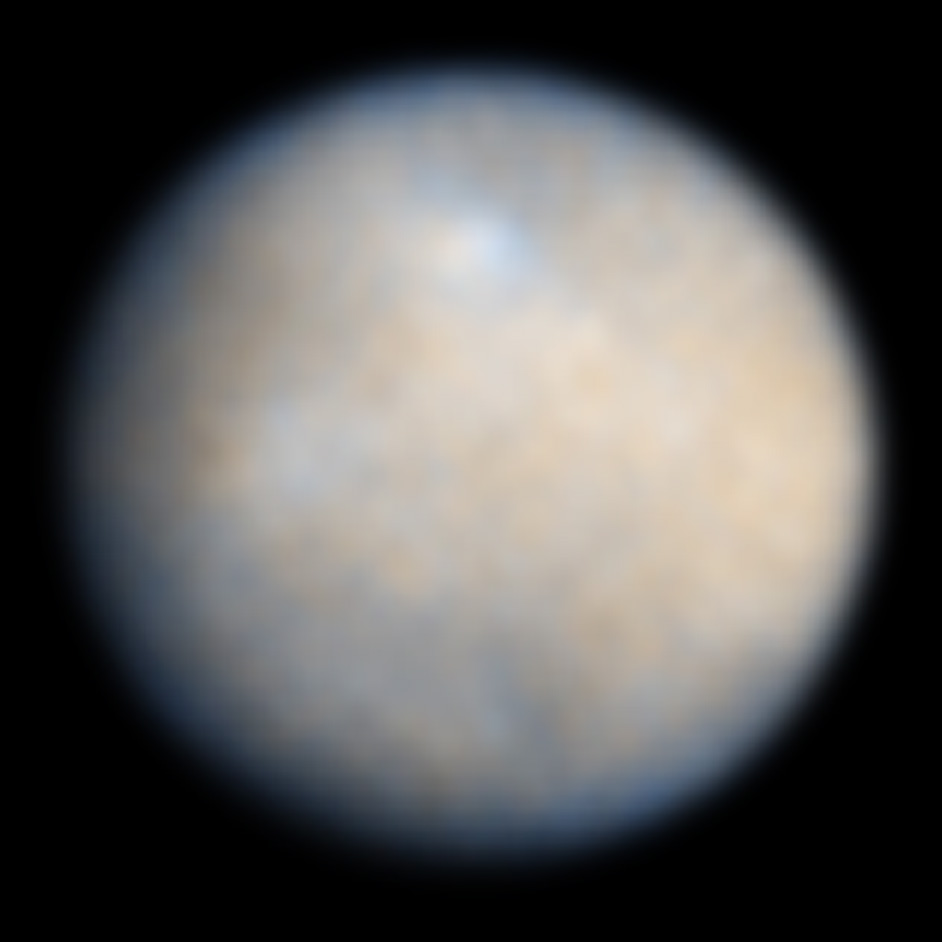
An occultation of the star BD+8°471 by Ceres was observed on 13 November 1984 in Mexico, Florida and across the Caribbean, allowing better measurements of its size, shape and albedo. On 25 June 1995, Hubble obtained ultraviolet images of Ceres with 50 km resolution. In 2002, the W. M. Keck Observatory obtained infrared images with 30 km resolution using adaptive optics.
Before the Dawn mission, only a few surface features had been unambiguously detected on Ceres. High-resolution ultraviolet Hubble images in 1995 showed a dark spot on its surface, which was nicknamed "Piazzi" in honour of the discoverer of Ceres. It was thought to be a crater. Visible-light images of a full rotation taken by Hubble in 2003 and 2004 showed eleven recognisable surface features, the natures of which were undetermined. One of them corresponded to the Piazzi feature. Near-infrared images over a whole rotation, taken with adaptive optics by the Keck Observatory in 2012, showed bright and dark features moving with Ceres's rotation. Two dark features were circular and were presumed to be craters; one was observed to have a bright central region, and the other was identified as the Piazzi feature. Dawn eventually revealed Piazzi to be a dark region in the middle of Vendimia Planitia, close to the crater Dantu, and the other dark feature to be within Hanami Planitia and close to Occator Crater.
''Dawn'' mission
Main article: Dawn (spacecraft)

Dawn, the first space mission to visit either Vesta or Ceres, was launched on 27 September 2007. On 3 May 2011, Dawn acquired its first targeting image 1200000 km from Vesta. After orbiting Vesta for thirteen months, Dawn used its ion thruster to depart for Ceres, with gravitational capture occurring on 6 March 2015 at a separation of 61,000 km, four months before the New Horizons flyby of Pluto.
The spacecraft instrumentation included a framing camera, a visual and infrared spectrometer, and a gamma ray and neutron detector. These instruments examined Ceres's shape and elemental composition. On 13 January 2015, as Dawn approached Ceres, the spacecraft took its first images at near-Hubble resolution, revealing impact craters and a small high-albedo spot on the surface. Additional imaging sessions, at increasingly better resolution, took place from February to April.
Dawns mission profile called for it to study Ceres from a series of circular polar orbits at successively lower altitudes. It entered its first observational orbit ("RC3") around Ceres at an altitude of 13,500 km on 23 April 2015, staying for only one orbit (15 days). The spacecraft then reduced its orbital distance to 4,400 km for its second observational orbit ("survey") for three weeks, then down to 1,470 km ("HAMO;" high altitude mapping orbit) for two months and then down to its final orbit at 375 km ("LAMO;" low altitude mapping orbit) for at least three months. In October 2015, NASA released a true-colour portrait of Ceres made by Dawn. In 2017, Dawns mission was extended to perform a series of closer orbits around Ceres until the hydrazine used to maintain its orbit ran out.
Dawn soon discovered evidence of cryovolcanism. Two distinct bright spots (or high-albedo features) inside a crater (different from the bright spots observed in earlier Hubble images) were seen in a 19 February 2015 image, leading to speculation about a possible cryovolcanic origin or outgassing. On 2 September 2016, scientists from the Dawn team argued in a Science paper that Ahuna Mons was the strongest evidence yet for cryovolcanic features on Ceres. On 11 May 2015, NASA released a higher-resolution image showing that the spots were composed of multiple smaller spots. On 9 December 2015, NASA scientists reported that the bright spots on Ceres may be related to a type of salt, particularly a form of brine containing magnesium sulfate hexahydrate (MgSO4·6H2O); the spots were also found to be associated with ammonia-rich clays. In June 2016, near-infrared spectra of these bright areas were found to be consistent with a large amount of sodium carbonate (), implying that recent geologic activity was probably involved in the creation of the bright spots.
From June to October 2018, Dawn orbited Ceres from as close as 35 km to as far away as 4000 km. The Dawn mission ended on 1 November 2018 after the spacecraft ran out of fuel.
Future missions
In 2020, an ESA team proposed the Calathus Mission concept, a followup mission to Occator Crater, to return a sample of the bright carbonate faculae and dark organics to Earth. The China National Space Administration is designing a sample-return mission from Ceres that would take place during the 2020s.
Notes
References
References
- Schmadel, Lutz. (2003). "Dictionary of minor planet names". Springer.
- (1802). "A Journal of Natural Philosophy, Chemistry, and the Arts".
- (July 2012). "The solar system's invariable plane". Astronomy & Astrophysics.
- "AstDyS-2 Ceres Synthetic Proper Orbital Elements". Department of Mathematics, University of Pisa, Italy.
- (November 2017). "Constraints on Ceres' Internal Structure and Evolution From Its Shape and Gravity Measured by the Dawn Spacecraft". Journal of Geophysical Research: Planets.
- (February 2019). "High-resolution shape model of Ceres from stereophotoclinometry using Dawn Imaging Data". Icarus.
- (2018). "Faster paleospin and deep-seated uncompensated mass as possible explanations for Ceres' present-day shape and gravity". Icarus.
- (2018). "The Ceres gravity field, spin pole, rotation period and orbit from the Dawn radiometric tracking and optical data". Icarus.
- "Asteroid Ceres P_constants (PcK) SPICE kernel file". NASA Navigation and Ancillary Information Facility.
- (2015). "Surface temperature of dwarf planet Ceres: Preliminary results from Dawn". 46th Lunar and Planetary Science Conference.
- (2006). "The surface composition of Ceres: Discovery of carbonates and iron-rich clays". Icarus.
- King, Bob. (5 August 2015). "Let's Get Serious About Ceres". [[Sky & Telescope]].
- Hogg, Helen Sawyer. (1948). "The Titius-Bode Law and the Discovery of Ceres". Journal of the Royal Astronomical Society of Canada.
- Landau, Elizabeth. (26 January 2016). "Ceres: Keeping Well-Guarded Secrets for 215 Years".
- Hoskin, Michael. (26 June 1992). "Bode's Law and the Discovery of Ceres". Observatorio Astronomico di Palermo "Giuseppe S. Vaiana".
- Forbes, Eric G.. (1971). "Gauss and the Discovery of Ceres". Journal for the History of Astronomy.
- Cunningham, Clifford J.. (2001). "The first asteroid: Ceres, 1801–2001". Star Lab Press.
- Nieto, Michael Martin. (1972). "The Titius-Bode Law of Planetary Distances: Its History and Theory". Pergamon Press.
- Hughes, David W. (1994). "The Historical Unravelling of the Diameters of the First Four Asteroids". Quarterly Journal of the Royal Astronomical Society.
- (2002). "Asteroids III". University of Arizona Press.
- Rüpke, Jörg. (2011). "A Companion to Roman Religion". John Wiley and Sons.
- (21 September 2012). "Dawn Spacecraft Finds Traces of Water on Vesta". Sci-Tech Daily.
- (2012). "The Dawn Mission to Minor Planets 4 Vesta and 1 Ceres". Springer.
- Thornton. (2012). "Word For Word From Horace". Nabu Press.
- Booth. (1823). "Flowers of Roman Poesy". Harvard University.
- "Cerium: historical information". Adaptive Optics.
- {{Cite OED. Cerium
- JPL/NASA. (22 April 2015). "What is a Dwarf Planet?".
- Cunningham, Clifford. (2015). "Discovery of the First Asteroid, Ceres". Springer Intl..
- Gould, B. A.. (1852). "On the symbolic notation of the asteroids". Astronomical Journal.
- Hilton, James L.. (17 September 2001). "When Did the Asteroids Become Minor Planets?". US Naval Observatory.
- Herschel, William. (6 May 1802). "Observations on the two lately discovered celestial Bodies". Philosophical Transactions of the Royal Society of London.
- (2019). "The Reclassification of Asteroids from Planets to Non-Planets". Icarus.
- Connor, Steve. (16 August 2006). "Solar system to welcome three new planets". The New Zealand Herald.
- Gingerich, Owen. (16 August 2006). "The IAU draft definition of "Planet" and "Plutons"". IAU.
- (16 August 2006). "The IAU Draft Definition of Planets and Plutons". SpaceDaily.
- Pitjeva, E.V.. (2018). "Masses of the main asteroid belt and the Kuiper belt from the motions of planets and spacecraft". [[Solar System Research]].
- (9 November 2017). "In Depth | Ceres".
- (2022). "Moons are planets: Scientific usefulness versus cultural teleology in the taxonomy of planetary science". Icarus.
- (26 October 2017). "One mission, two remarkable destinations".
- Lang, Kenneth. (2011). "The Cambridge Guide to the Solar System". Cambridge University Press.
- "Question and answers 2". [[International Astronomical Union]].
- Spahr, T.B.. (7 September 2006). "Editorial notice". [[Minor Planet Center]] (MPC).
- "Target: Ceres". [[International Astronomical Union]] / [[USGS Astrogeology Science Center]] / [[National Aeronautics and Space Administration]].
- Cellino, A.. (2002). "Asteroids III". University of Arizona Press.
- (1996). "A Genetic Study of the Ceres (Williams #67) Asteroid Family". Bulletin of the American Astronomical Society.
- Christou, A. A.. (2000). "Co-orbital objects in the main asteroid belt". [[Astronomy & Astrophysics]].
- (January 2012). "A population of Main Belt Asteroids co-orbiting with Ceres and Vesta". Icarus.
- Kovačević, A. B.. (2011). "Determination of the mass of Ceres based on the most gravitationally efficient close encounters". [[Monthly Notices of the Royal Astronomical Society]].
- Rayman. (30 October 2015). "New Maps of Ceres Reveal Topography Surrounding Mysterious 'Bright Spots'". NASA.
- (6 July 2016). "The permanently shadowed regions of dwarf planet Ceres". Geophysical Research Letters.
- (21 July 2015). "05. Dawn Explores Ceres Results from the Survey Orbit". NASA.
- (2017). "Ice in Ceres' Shadowed Craters Linked to Tilt History".
- (15 January 2019). "The surface composition of Ceres from the Dawn mission". Icarus.
- Rayman, Marc D.. (28 May 2015). "Dawn Journal, 28 May 2015". [[Jet Propulsion Laboratory]].
- Nola Taylor Redd. (23 May 2018). "Ceres: The Smallest and Closest Dwarf Planet".
- (September 2018). "European Planetary Science Congress".
- (2 December 2015). "Modelling the internal structure of Ceres: Coupling of accretion with compaction by creep and implications for the water-rock differentiation". Astronomy & Astrophysics.
- (2017). "Thermal evolution of trans-Neptunian objects, icy satellites, and minor icy planets in the early solar system". Meteoritics & Planetary Science.
- (16 May 2018). "The Solar Wind Interaction with Vesta and Ceres: Implications for their Magnetic Moments". ESA Cosmos.
- (1 May 2022). "The Radiation Environment of Ceres and Implications for Surface Sampling". Astrobiology.
- (December 2018). "Dawn mission's search for satellites of Ceres: Intact protoplanets don't have satellites". Icarus.
- (3 September 2016). "Sulfur, Sulfur Dioxide, Graphitized Carbon Observed on Ceres". spaceref.com.
- (21 May 2018). "New Constraints on the Abundance and Composition of Organic Matter on Ceres". Geophysical Research Letters.
- (2024). "New Candidates for Organic-rich Regions on Ceres". The Planetary Science Journal.
- (2018). "An aqueously altered carbon-rich Ceres". [[Nature Astronomy]].
- (7 December 2016). "Name Changed on Ceres". USGS.
- Landau, Elizabeth. (28 July 2015). "New Names and Insights at Ceres".
- (26 July 2016). "The missing large impact craters on Ceres". [[Nature Communications]].
- (2019). "Occator crater in color at highest spatial resolution". Icarus.
- (2018). "Ceres and the Terrestrial Planets Impact Cratering Record". Icarus.
- (23 March 2018). "Hanami Planum on Ceres". NASA.
- (May 2021). "The brittle boulders of dwarf planet Ceres". Planetary Science Journal.
- (January 2018). "Stagnant lid tectonics: Perspectives from silicate planets, dwarf planets, large moons, and large asteroids". Geoscience Frontiers.
- (December 2017). "Exploring Tectonic Activity on Vesta and Ceres". American Geophysical Union, Fall Meeting 2017, Abstract #P53G-02.
- (7 March 2016). "PIA20348: Ahuna Mons Seen from LAMO". [[Jet Propulsion Laboratory]].
- (2 September 2016). "Cryovolcanism on Ceres". Science.
- (December 2018). "The geology of the Kerwan quadrangle of dwarf planet Ceres: Investigating Ceres' oldest, largest impact basin". Icarus.
- (December 2018). "Cryovolcanic rates on Ceres revealed by topography". Nature Astronomy.
- (2017). "The vanishing cryovolcanoes of Ceres". [[Geophysical Research Letters]].
- (17 September 2018). "Ceres takes life an ice volcano at a time". University of Arizona.
- "News – Ceres Spots Continue to Mystify in Latest Dawn Images".
- "USGS: Ceres nomenclature".
- {{GPN. 15530. Cerealia Facula
- {{GPN. 15531. Vinalia Faculae
- (24 July 2018). "What Looks Like Ceres on Earth?".
- (1 March 2019). "The central pit and dome at Cerealia Facula bright deposit and floor deposits in Occator Crater, Ceres: Morphology, comparisons and formation". Icarus.
- Rivkin, Andrew. (21 July 2015). "Dawn at Ceres: A haze in Occator Crater?". The Planetary Society.
- Redd, Nola Taylor. "Water Ice on Ceres Boosts Hopes for Buried Ocean [Video]".
- (July 2017). "Preferential formation of sodium salts from frozen sodium-ammonium-chloride-carbonate brines – Implications for Ceres' bright spots". Planetary and Space Science.
- (2019). "The surface composition of Ceres from the Dawn mission". Icarus.
- (1 March 2019). "A Possible Brine Reservoir Beneath Occator Crater: Thermal and Compositional Evolution and Formation of the Cerealia Dome and Vinalia Faculae". Icarus.
- (1 March 2019). "The formation and evolution of bright spots on Ceres". Icarus.
- McCartney, Gretchen. (11 August 2020). "Mystery solved: Bright areas on Ceres come from salty water below". [[Phys.org]].
- (2017). "''Dawn'' at Ceres: What Have We Learned?".
- (2016). "Composition and structure of the shallow subsurface of Ceres revealed by crater morphology". Nature Geoscience.
- (14 August 2018). "PIA22660: Ceres' Internal Structure (Artist's Concept)". Jet Propulsion Laboratory.
- (3 August 2016). "A partially differentiated interior for (1) Ceres deduced from its gravity field and shape". Nature.
- (2016). "Geochemistry, thermal evolution, and cryovolcanism on Ceres with a muddy ice mantle". Geophysical Research Letters.
- (6 April 2017). "Confirmed: Ceres Has a Transient Atmosphere". Universe Today.
- (23 January 2014). "Localized sources of water vapour on the dwarf planet (1) Ceres". Nature.
- (23 January 2014). "Solar system: Evaporating asteroid". Nature.
- (10 March 2006). "Enceladus' Water Vapor Plume". Science.
- (26 November 2013). "Transient Water Vapor at Europa's South Pole". Science.
- (2015). "Asteroids IV". [[University of Arizona]].
- (2007). "Protostars and Planets V". University of Arizona Press.
- (May 2022). "Ceres, a wet planet: The view after Dawn". Geochemistry.
- (1 September 2016). "Cratering on Ceres: Implications for its crust and evolution". Science.
- NASA/Jet Propulsion Laboratory. (1 September 2016). "Ceres' geological activity, ice revealed in new research".
- (2 September 2016). "Dawn arrives at Ceres: Exploration of a small, volatile-rich world". Science.
- (20 November 2017). "The Putative Cerean Exosphere". The Astrophysical Journal.
- (January 2014). "Localized sources of water vapour on the dwarf planet (1) Ceres". Nature.
- (6 January 2017). "Extensive water ice within Ceres' aqueously altered regolith: Evidence from nuclear spectroscopy". Science.
- (1 December 2011). "The Surface Composition of Ceres". Space Science Reviews.
- (1 September 2021). "Water Group Exospheres and Surface Interactions on the Moon, Mercury, and Ceres". Space Science Reviews.
- (1 December 2014). "A Sublimation-driven Exospheric Model of Ceres". Planetary and Space Science.
- (September 2015). "Thermal stability of ice on Ceres with rough topography". Journal of Geophysical Research: Planets.
- (7 March 2006). "Ceres, Vesta, and Pallas: Protoplanets, Not Asteroids". Eos.
- (2007). "Iron meteorite evidence for early formation and catastrophic disruption of protoplanets". Nature.
- (2001). "The Primordial Excitation and Clearing of the Asteroid Belt". Icarus.
- Greicius, Tony. (29 June 2016). "Recent Hydrothermal Activity May Explain Ceres' Brightest Area".
- Atkinson, Nancy. (26 July 2016). "Large Impact Craters on Ceres Have Gone Missing". Universe Today.
- (31 January 2020). "Ceres: Astrobiological Target and Possible Ocean World". Astrobiology.
- Wall, Mike. (2 September 2016). "NASA's Dawn Mission Spies Ice Volcanoes on Ceres".
- (2007). "Ceres: evolution and present state". Lunar and Planetary Science.
- (17 October 2018). "Characteristics of organic matter on Ceres from VIR/Dawn high spatial resolution spectra". Monthly Notices of the Royal Astronomical Society.
- Specktor, Brandon. (19 January 2021). "Humans could move to this floating asteroid belt colony in the next 15 years, astrophysicist says". Live Science.
- (1983). "A Field Guide to the Stars and Planets". [[Houghton Mifflin]].
- Martinez, Patrick. (1994). "The Observer's Guide to Astronomy". [[Cambridge University Press]].
- (1987). "The size, shape, density, and albedo of Ceres from its occultation of BD+8°471". Icarus.
- (2002). "Analysis of the first disk-resolved images of Ceres from ultraviolet observations with the Hubble Space Telescope". The Astronomical Journal.
- (11 October 2006). "Keck Adaptive Optics Images the Dwarf Planet Ceres". Adaptive Optics.
- (2006). "Photometric analysis of 1 Ceres and surface mapping from HST observations". Icarus.
- (7 September 2005). "Largest Asteroid May Be 'Mini Planet' with Water Ice". HubbleSite.
- Carry, Benoit. (2007). "Near-Infrared Mapping and Physical Properties of the Dwarf-Planet Ceres". Astronomy & Astrophysics.
- (2017). "Ceres: A Frontier in Astrobiology". Astrobiology Science Conference.
- (October 2007). "Dawn Mission to Vesta and Ceres". Earth, Moon, and Planets.
- (11 May 2011). "NASA's Dawn Captures First Image of Nearing Asteroid".
- Schenk, P.. (15 January 2015). "Year of the 'Dwarves': Ceres and Pluto Get Their Due". [[The Planetary Society]].
- Rayman, Marc. (1 December 2014). "Dawn Journal: Looking Ahead at Ceres". [[The Planetary Society]].
- (2006). "Dawn Discovery mission to Vesta and Ceres: Present status". Advances in Space Research.
- Rayman, Marc. (30 January 2015). "Dawn Journal: Closing in on Ceres". [[The Planetary Society]].
- Rayman, Marc. (6 March 2015). "Dawn Journal: Ceres Orbit Insertion!". [[The Planetary Society]].
- Rayman, Marc. (3 March 2014). "Dawn Journal: Maneuvering Around Ceres". [[The Planetary Society]].
- Rayman, Marc. (30 April 2014). "Dawn Journal: Explaining Orbit Insertion". [[The Planetary Society]].
- Rayman, Marc. (30 June 2014). "Dawn Journal: HAMO at Ceres". [[The Planetary Society]].
- Rayman, Marc. (31 August 2014). "Dawn Journal: From HAMO to LAMO and Beyond". [[The Planetary Society]].
- "Dawn data from Ceres publicly released: Finally, color global portraits!". [[The Planetary Society]].
- (19 October 2017). "Dawn Mission Extended at Ceres".
- Plait, Phil. (11 May 2015). "The Bright Spots of Ceres Spin Into View". [[Slate (magazine).
- Lakdawalla, Emily. (2015). "LPSC 2015: First results from Dawn at Ceres: provisional place names and possible plumes". [[The Planetary Society]].
- (11 May 2015). "Ceres RC3 Animation". [[Jet Propulsion Laboratory]].
- Landau, Elizabeth. (9 December 2015). "New Clues to Ceres' Bright Spots and Origins". [[phys.org]].
- De Sanctis, M. C.. (29 June 2016). "Bright carbonate deposits as evidence of aqueous alteration on (1) Ceres". [[Nature (journal).
- Rayman, Marc. (13 June 2018). "Dawn – Mission Status". [[Jet Propulsion Laboratory]].
- Rayman, Marc. (2018). "Dear Dawntasmagorias".
- (2020). "Sample Return From A Relic Ocean World: The Calthus Mission To Occator Crater, Ceres". 51st Lunar and Planetary Science Conference.
- "China's Deep-space Exploration to 2030". Key Laboratory of Lunar and Deep Space Exploration, National Astronomical Observatories, Chinese Academy of Sciences, Beijing.
- "JPL Small-Body Database Browser: 1 Ceres". JPL Solar System Dynamics.
- "Asteroid (1) Ceres – Summary". AstDyS-2.
- "Horizons Batch for 1 Ceres on 2022-Dec-06". [[JPL Horizons On-Line Ephemeris System.
This article was imported from Wikipedia and is available under the Creative Commons Attribution-ShareAlike 4.0 License. Content has been adapted to SurfDoc format. Original contributors can be found on the article history page.
Ask Mako anything about Ceres (dwarf planet) — get instant answers, deeper analysis, and related topics.
Research with MakoFree with your Surf account
Create a free account to save articles, ask Mako questions, and organize your research.
Sign up freeThis content may have been generated or modified by AI. CloudSurf Software LLC is not responsible for the accuracy, completeness, or reliability of AI-generated content. Always verify important information from primary sources.
Report