From Surf Wiki (app.surf) — the open knowledge base
Cephalopod fin
| [[File:Standard measurements for squid.jpg | thumb | 180px | Standard measurements for squid, showing the location of the fins and tail in different configurations]] | [[File:Measurement of fin angle in squid.jpg | thumb | 240px | Measurement of fin angle in a squid with sagittate fins]] |
|---|
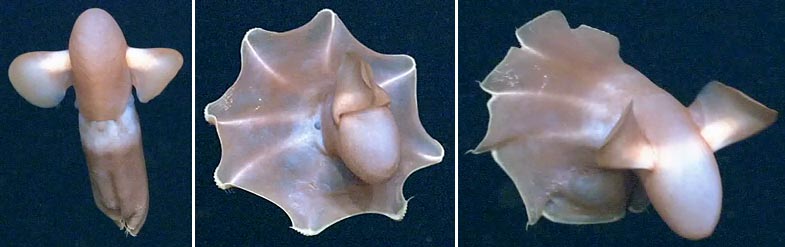
Cephalopod fins, sometimes known as wings, are paired flap-like locomotory appendages. They are found in ten-limbed cephalopods (including squid, bobtail squid, cuttlefish, and Spirula) as well as in the eight-limbed cirrate octopuses and vampire squid. Many extinct cephalopod groups also possessed fins. Nautiluses and the more familiar incirrate octopuses lack swimming fins. An extreme development of the cephalopod fin is seen in the bigfin squid of the family Magnapinnidae.
Fins project from the mantle and are often positioned dorsally. In most cephalopods, the fins are restricted to the posterior end of the mantle, but in cuttlefish and some squid they span the mantle's entire length.
Fin attachment varies greatly among cephalopods, though in all cases it involves specialised fin cartilage (which reaches its greatest development in Octopodiformes). A fin may be attached to the internal shell or shell remnant (such as the gladius), to the opposite fin, to the mantle, or a combination of these.
Tail and secondary fins
Certain squid species possess a tail, which is an extension of the body past the fins. or remain through sexual maturity (as in Grimalditeuthis). Grimalditeuthis and larval Chiroteuthis are unusual in that they possess a pair of flotation devices or "secondary fins" attached to the tail. The vampire squid (Vampyroteuthis infernalis) also has two pairs of fins during a brief period of its ontogeny, and secondary fins have been reported in the extinct Trachyteuthis.
.jpg)
Fin morphology and placement
Cephalopod fin morphology is highly variable. The fins may be large and muscular, extending for the entire length of the mantle, or greatly reduced (sometimes less than 10% ML) and restricted to the mantle's posterior end. Fin placement in cephalopods is often termed normal, terminal, or subterminal, depending on their position with respect to the muscular mantle.
Eight major fin shapes can be distinguished among the Decapodiformes: sagittate (the most common shape in squid), rhomboid, circular/elliptical, lanceolate, ear-shaped, ribbed, lobate, and skirt-like.
| File:Onychoteuthis banksii1.jpg |Ventral (left) and dorsal aspects of Onychoteuthis banksii, showing classic sagittate fins | File:Thysanoteuthis rhombus (Naef).jpg |The diamondback squid, Thysanoteuthis rhombus, has full-length rhomboid fins | File:Mastigoteuthis magna.jpg |Mastigoteuthis magna has very large circular fins, characteristic of its family, Mastigoteuthidae | File:Galiteuthis phyllura.jpg|Galiteuthis phyllura in dorsal (top) and ventral views, showing its lanceolate fins | File:Spirula spirula1.jpg |Spirula spirula has small ear-shaped fins on either side of a terminal photophore | File:Chtenopteryx sicula 1.jpg |The highly distinctive ribbed fins of Chtenopteryx sicula | File:Sepia officinalis1.jpg |Skirt-like fins spanning the length of the mantle are characteristic of sepiids, such as this Sepia officinalis
References
References
- Young, R.E., M. Vecchione & K.M. Mangold (1999). [http://tolweb.org/accessory/Cephalopoda_Glossary?acc_id=587 Cephalopoda Glossary]. [[Tree of Life Web Project]].
- Vecchione, M. & R.E. Young (1998). The Magnapinnidae, a newly discovered family of oceanic squid (Cephalopoda: Oegopsida). ''South African Journal of Marine Science'' '''20'''(1): 429–437. {{doi. 10.2989/025776198784126340
- Young, R.E., M. Vecchione & K.M. Mangold (2000). [http://tolweb.org/accessory/Cephalopoda_Fin_Cartilage?acc_id=1969 Cephalopoda Fin Cartilage]. [[Tree of Life Web Project]].
- Young, R.E., M. Vecchione & K.M. Mangold (2001). [http://tolweb.org/accessory/Cephalopod_Fin_Attachment?acc_id=1974 Cephalopod Fin Attachment]. [[Tree of Life Web Project]].
- "A tale of two species: tail morphology in paralarval ''Chiroteuthis''.".
- "Two pairs of fins in the late Jurassic coleoid ''Trachyteuthis'' from southern Germany.".
- Young, R.E., M. Vecchione & K.M. Mangold (2001). [http://tolweb.org/accessory/Cephalopod_Fin_Length?acc_id=2055 Cephalopod Fin Length]. [[Tree of Life Web Project]].
- Young, R.E., M. Vecchione & K.M. Mangold (2001). [http://tolweb.org/accessory/Cephalopod_Fin_Position?acc_id=2041 Cephalopod Fin Position]. [[Tree of Life Web Project]].
- Young, R.E., M. Vecchione & K.M. Mangold (2001). [http://tolweb.org/accessory/Decapodiform_Fin_Shapes?acc_id=2029 Decapodiform Fin Shapes]. [[Tree of Life Web Project]].
This article was imported from Wikipedia and is available under the Creative Commons Attribution-ShareAlike 4.0 License. Content has been adapted to SurfDoc format. Original contributors can be found on the article history page.
Ask Mako anything about Cephalopod fin — get instant answers, deeper analysis, and related topics.
Research with MakoFree with your Surf account
Create a free account to save articles, ask Mako questions, and organize your research.
Sign up freeThis content may have been generated or modified by AI. CloudSurf Software LLC is not responsible for the accuracy, completeness, or reliability of AI-generated content. Always verify important information from primary sources.
Report