From Surf Wiki (app.surf) — the open knowledge base
Cephalopod beak
Body part of cephalopods

Body part of cephalopods
All extant cephalopods have a two-part beak, or rostrum, situated in the buccal mass (mouthparts) and surrounded by the muscular head appendages. The dorsal (upper) mandible fits into the ventral (lower) mandible and together they function in a scissor-like fashion. The beak may also be referred to as the mandibles or jaws. These beaks are different from bird beaks because they crush bone while most bird beaks do not.
Fossilized remains of beaks are known from a number of cephalopod-groups, both extant and extinct, including squids, octopodes, belemnites, and vampyromorphs. Aptychi - paired plate-like structures found in ammonites - may also have been jaw elements.
Composition
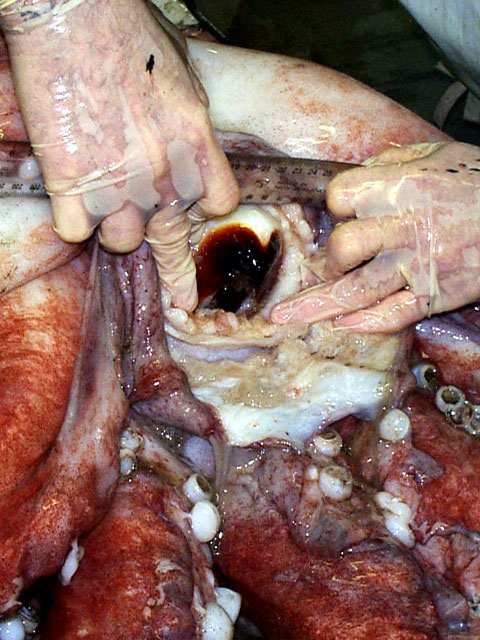
Composed primarily of chitin and cross-linked proteins, beaks are more or less indigestible and are often the only identifiable cephalopod remains found in the stomachs of predatory species such as sperm whales. Cephalopod beaks gradually become less stiff as one moves from the tip to the base, a gradient that results from differing chemical composition. In hydrated beaks of the Humboldt squid (Dosidicus gigas) this stiffness gradient spans two orders of magnitude.
| File:Lower beak Chiroteuthis picteti side view.jpg |Side view of the lower beak of Chiroteuthis picteti (3.6 mm LRL, 160 mm ML (estimate))
| File:Upper beak Chiroteuthis picteti side view.jpg |Side view of the upper beak from the same specimen (2.7 mm URL)
Measurements

The abbreviations LRL and URL are commonly used in teuthology to refer to lower rostral length and upper rostral length, respectively. These are the standard measures of beak-size in Decapodiformes; hood length is preferred for Octopodiformes.
| File:Lower beak Chiroteuthis picteti oblique view.jpg |Lower rostral length | File:Upper beak Chiroteuthis picteti oblique view.jpg |Upper rostral length
References
References
- Young, R.E., M. Vecchione & K.M. Mangold (1999). [http://tolweb.org/accessory/Cephalopoda_Glossary?acc_id=587 Cephalopoda Glossary]. [[Tree of Life Web Project]].
- Young, R.E., M. Vecchione & K.M. Mangold (2000). [http://tolweb.org/accessory/Cephalopod_Beak_Terminology?acc_id=1980 Cephalopod Beak Terminology]. [[Tree of Life Web Project]].
- Tanabe, K., Y. Hikida & Y. Iba (2006). Two coleoid jaws from the Upper Cretaceous of Hokkaido, Japan. ''Journal of Paleontology'' '''80'''(1): 138–145. {{doi. 10.1666/0022-3360(2006)080[0138:TCJFTU]2.0.CO;2
- Zakharov, Y.D. & T.A. Lominadze (1983). New data on the jaw apparatus of fossil cephalopods. ''Lethaia'' '''16'''(1): 67–78. {{doi. 10.1111/j.1502-3931.1983.tb02000.x
- Kanie, Y. (1998). New vampyromorph (Coleoidea: Cephalopoda) jaw apparatuses from the Late Cretaceous of Japan. ''Bulletin of Gumma Museum of Natural History'' '''2''': 23–34.
- Tanabe, K. & N.H. Landman (2002). Morphological diversity of the jaws of Cretaceous Ammonoidea. ''Abhandlungen der Geologischen Bundesanstalt, Wien'' '''57''': 157–165.
- Tanabe, K., P. Trask, R. Ross & Y. Hikida (2008). Late Cretaceous octobrachiate coleoid lower jaws from the north Pacific regions. ''Journal of Paleontology'' '''82'''(2): 398–408. {{doi. 10.1666/07-029.1
- Klug, C., G. Schweigert, D. Fuchs & G. Dietl (2010). First record of a belemnite preserved with beaks, arms and ink sac from the Nusplingen Lithographic Limestone (Kimmeridgian, SW Germany). ''Lethaia'' '''43'''(4): 445–456. {{doi. 10.1111/j.1502-3931.2009.00203.x
- Tanabe, K. (2012). Comparative morphology of modern and fossil coleoid jaw apparatuses. ''Neues Jahrbuch für Geologie und Paläontologie, Abhandlungen'' '''266'''(1): 9–18. {{doi. 10.1127/0077-7749/2012/0243
- Morton, N. (1981). Aptychi: the myth of the ammonite operculum. ''Lethaia'' '''14'''(1): 57–61. {{doi. 10.1111/j.1502-3931.1981.tb01074.x
- Morton, N. & M. Nixon (1987). Size and function of ammonite aptychi in comparison with buccal masses of modem cephalopods. ''Lethaia'' '''20'''(3): 231–238. {{doi. 10.1111/j.1502-3931.1987.tb02043.x
- Lehmann, U. & C. Kulicki (1990). Double function of aptychi (Ammonoidea) as jaw elements and opercula. ''Lethaia'' '''23''': 325–331. {{doi. 10.1111/j.1502-3931.1990.tb01365.x
- Seilacher, A. (1993). Ammonite aptychi; how to transform a jaw into an operculum? ''American Journal of Science'' '''293''': 20–32. {{doi. 10.2475/ajs.293.A.20
- "The jaw apparatus of Recent ''Nautilus'' and its palaeontological implications.".
- Hunt, S. & M. Nixon (1981). A comparative study of protein composition in the chitin-protein complexes of the beak, pen, sucker disc, radula and oesophageal cuticle of cephalopods. ''Comparative Biochemistry and Physiology Part B: Comparative Biochemistry'' '''68'''(4): 535–546. {{doi. 10.1016/0305-0491(81)90071-7
- "Jumbo squid beaks: Inspiration for design of robust organic composites.".
- [http://www.asknature.org/strategy/c8582fcb160cdd74fe4872bfb8052458 Organic composite is exceptionally robust: jumbo squid] {{Webarchive. link. (2012-01-06 . Ask Nature.)
- Clarke, M.R. (1986). ''A Handbook for the Identification of Cephalopod Beaks''. Oxford University Press, Oxford.
- Miserez, A., T. Schneberk, C. Sun, F.W. Zok & J.H. Waite (2008). The transition from stiff to compliant materials in squid beaks. ''Science'' '''319'''(5871): 1816–1819. {{doi. 10.1126/science.1154117
- They can be used to estimate the [[mantle (mollusc). mantle]] length and total body weight of the original animal as well as the total ingested [[biomass]] of the species.Clarke, M.R. (1962). [https://www.biodiversitylibrary.org/page/26204326 The identification of cephalopod "beaks" and the relationship between beak size and total body weight]. ''Bulletin of the British Museum (Natural History), Zoology'' '''8'''(10): 419–480.
- "A beak key for eight eastern tropical Pacific cephalopod species with relationships between their beak dimensions and size.".
- "''Identification and estimation of size from the beaks of 18 species of cephalopods from the Pacific Ocean''.".
- Jackson, G.D. (1995). The use of beaks as tools for biomass estimation in the deepwater squid ''Moroteuthis ingens'' (Cephalopoda: Onychoteuthidae) in New Zealand waters. ''Polar Biology'' '''15'''(1): 9–14. {{doi. 10.1007/BF00236118
- Jackson, G.D. & J.F. McKinnon (1996). Beak length analysis of arrow squid ''Nototodarus sloanii'' (Cephalopoda: Ommastrephidae) in southern New Zealand waters. ''Polar Biology'' '''16'''(3): 227–230. {{doi. 10.1007/BF02329211
- Jackson, G.D., N.G. Buxton & M.J.A. George (1997). Beak length analysis of ''Moroteuthis ingens'' (Cephalopoda: Onychoteuthidae) from the Falkland Islands region of the Patagonian Shelf. ''Journal of the Marine Biological Association of the United Kingdom'' '''77'''(4): 1235–1238. {{doi. 10.1017/S0025315400038765
- "Beak length analysis of the Southern Ocean squid ''Psychroteuthis glacialis'' (Cephalopoda: Psychroteuthidae) and its use for size and biomass estimation. }} ''Polar Biology'' '''23'''(1): 70–74. {{doi".
This article was imported from Wikipedia and is available under the Creative Commons Attribution-ShareAlike 4.0 License. Content has been adapted to SurfDoc format. Original contributors can be found on the article history page.
Ask Mako anything about Cephalopod beak — get instant answers, deeper analysis, and related topics.
Research with MakoFree with your Surf account
Create a free account to save articles, ask Mako questions, and organize your research.
Sign up freeThis content may have been generated or modified by AI. CloudSurf Software LLC is not responsible for the accuracy, completeness, or reliability of AI-generated content. Always verify important information from primary sources.
Report