From Surf Wiki (app.surf) — the open knowledge base
Centrul Civic
District in central Bucharest, Romania
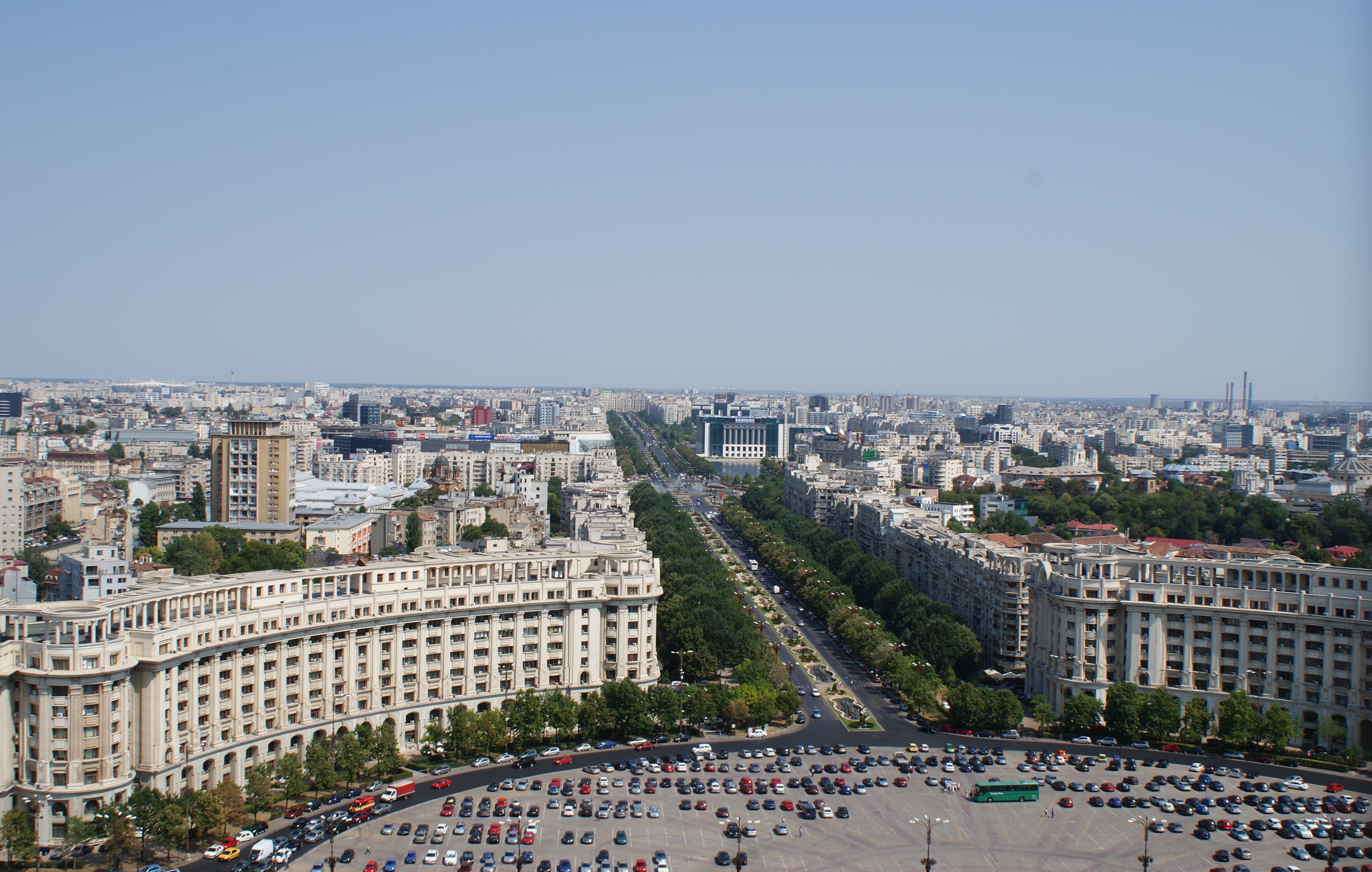
District in central Bucharest, Romania
Centrul Civic (; "the Civic Centre") is a district in central Bucharest, Romania, which was completely rebuilt in the 1980s as part of the scheme of systematization under the dictator Nicolae Ceaușescu, which included the construction of new civic centres in the Romanian cities. Bucharest Civic Centre was planned to become the new political-administrative center of Communist Romania.
History
Bucharest suffered significant damage due to Allied bombing during World War II and the devastating earthquake of March 4, 1977. However, neither of these events changed the face of the city more than the Ceaușescan "redevelopment schemes" of the 1980s, under which an overall area of 5.9 km2 of the historic center of Bucharest was affected, including monasteries, churches, synagogues, a hospital, and a noted Art Deco sports stadium (Stadionul Republicii). This also involved evicting 40,000 people after a single day's notice and relocating them to new homes, in order to make way for the grandiose Centrul Civic and the House of the Republic, now officially renamed as the Palace of the Parliament.
Prior to starting to demolish the old historical town of Bucharest in order to build Centrul Civic, Bucharest (and other cities and towns throughout the country) had already undergone Communist reconstruction, particularly in the 1970s, under the systematization programme which consisted of the demolition and reconstruction of existing villages, towns, and cities, in whole or in part, in order to make place to standardized blocks of flats (blocuri), as a result of increasing urbanization following an accelerated industrialization process. The construction of Centrul Civic and the demolitions necessary for it, however, were quite extreme even compared to other reconstruction communist programmes.
The vast empty fields which emerged in the historic town during the demolitions of the 1980s were sarcastically called "Ceaușima" (a portmanteau of Ceaușescu and Hiroshima). Concrete hulks of half-completed buildings (such as the new National Library of Romania) long stood where historic buildings (including most of the city's historic Jewish quarter) once stood. A remainder of the former "Ceaușima" is the never-completed eastern large area between the Mircea Vodă Boulevard and Nerva Traian Street (10.7 ha), where in 1989 had begun the construction of the National Centre for Creation and Culture, named after Cântarea României, an ensemble that would include seven performance halls, the first six with capacities between 550 and 2,100 seats, and the seventh, dedicated to the National Opera, of 3,100 seats.
Centrul Civic is surrounded all-around by old historical buildings and neighborhoods (Lipscani street in particular is a famous old-fashioned street). Many churches, such as the Mihai Vodă Monastery, were moved rather than demolished, and the nearby Antim Monastery remains largely intact, although lacking its original eastern wing. Immediately next to Piața Unirii (the Union Square) is Dealul Mitropoliei (the Metropolitan Hill), with the Patriarchal Cathedral and Palace, the seat of the Patriarch of the Romanian Orthodox Church.
Description
Centrul Civic is a complex of modern concrete buildings with marble façades, centered on a main boulevard originally meant to be Bulevardul Victoria Socialismului (the Victory of Socialism Boulevard). Being renamed, after the Romanian Revolution of 1989, in Bulevardul Unirii (the Union Boulevard), it has been modeled after Paris's Champs-Élysées, though a little wider; it runs roughly east–west, making a grand approach to the Palace of the Parliament at its western terminus. A large balcony in the Palace surveys the entire length of the boulevard. Other streets included in the perimeter of Centrul Civic are, among others, Libertății (Liberty) Boulevard, Decebal Boulevard, Burebista Boulevard (unfinished), United Nations (Națiunile Unite) Boulevard, Octavian Goga Boulevard, Mircea Vodă Boulevard (partially), Nerva Traian Street (partially), Izvor Street, or Calea 13 Septembrie (partially).
Centrul Civic includes numerous public offices and apartments, the latter roughly equalling the housing units destroyed for its construction. The apartments were originally intended to house Romania's communist elite. In the Union Square, the boulevard bisects the Dâmbovița river, which is channelled at this point underground the Square.
With its architectural uniformity, Centrul Civic stands out as a Socialist Realism style monument. Due to the lack of attractiveness for the commercial spaces located on the ground floor of the respective buildings, as a result of the relatively low pedestrian traffic in the area, most of the small shops and restaurants that form the heart of Bucharest are to be found in the areas immediately to the north of Centrul Civic, in Bucharest Old Town. |File:Boulevard_Unirii.jpg |Bulevardul Unirii seen from the Palace of the Parliament with Piața Constituției in foreground |File:Bucuresti fantana.jpg |Front view of the Palace of the Parliament |File:Piata Unirii - Bucuresti.jpg |Union Square view to Dealul Mitropoliei |File:AcademiaRomana12rhd.jpg |Romanian Academy building |File:Dambovita si biblioteca nationala WP 20170316 17 47 32 Pro highres.jpg |National Library of Romania and Dâmbovița river |File:20171003-103447-ministry-of-defence-romania.jpg |Ministry of National Defense building |File:Foto Ministerul Justiției.jpg |Ministry of Justice building |File:Institutul Național de Statistică.jpg |National Institute of Statistics | |JW Marriott Bucharest Grand Hotel |File:UlicaBukaresztu-8166.jpg |Office (left) and apartment (right) buildings |File:Unirii Square Palace of Parliament Buchareest Bucuresti Romania.JPG |The pedestrian area of Bulevardul Unirii |File:Bulevardul Unirii (11321088543).jpg |View along the boulevard |File:Catedrala Mântuirii Neamului (Noiembrie 2025).jpg |The People's Salvation Cathedral is being built next to the Palace of the Parliament |File:Hyperion-Piata Alba Iulia - panoramio.jpg |Panoramic view of the boulevard from Alba-Iulia Square
References
References
- Alex Răuță. (2016). "Fascinația conceptului de centru civic". Ordinul Arhitecților din România.
- Elena Tănase. (2019). "Cum a fost mutilat Bucureștiul istoric în anii 80 ca să facă loc proiectului faraonic al lui Ceaușescu: Casa Poporului și Centrul Civic".
- Mitrica, Bianca. (2016). "Dezvoltarea urbană și ariile metropolitane".
- Ionel-Claudiu Dumitrescu. "Urbanizarea în România secolului XX: interbelic vs comunism".
- . (2018). ["Cum s-a ales Bucureștiul cu două ruine, în loc de investiții de miliarde de euro"](https://www.digi24.ro/special/campanii-digi24/romania-furata/romania-furata-cum-s-a-ales-bucurestiul-cu-doua-ruine-in-loc-de-investitii-de-miliarde-de-euro-952581).
- Sorin Șerb. (2019). "Buletin de știri 6 iulie 1989". [[Radio Free Europe]].
This article was imported from Wikipedia and is available under the Creative Commons Attribution-ShareAlike 4.0 License. Content has been adapted to SurfDoc format. Original contributors can be found on the article history page.
Ask Mako anything about Centrul Civic — get instant answers, deeper analysis, and related topics.
Research with MakoFree with your Surf account
Create a free account to save articles, ask Mako questions, and organize your research.
Sign up freeThis content may have been generated or modified by AI. CloudSurf Software LLC is not responsible for the accuracy, completeness, or reliability of AI-generated content. Always verify important information from primary sources.
Report