From Surf Wiki (app.surf) — the open knowledge base
Central Kalimantan
Province in Kalimantan, Indonesia

Province in Kalimantan, Indonesia
| Field | Value |
|---|---|
| name | Central Kalimantan |
| native_name | Kalimantan Tengah |
| official_name | Province of Central Kalimantan |
| {{nobold | Provinsi Kalimantan Tengah}} |
| nickname | Bumi Tambun Bungai (Dayak) |
| Land of Courage and advantage | |
| image_shield | Coat of arms of Central Kalimantan.svg |
| shield_link | Armorial of Indonesia#Provincial |
| image_map | Central Kalimantan in Indonesia.svg |
| map_caption | |
| coordinates | |
| established_title | Founded |
| established_date | 2 July 1958 |
| motto | |
| Persistent | |
| subdivision_type | Country |
| subdivision_name | Indonesia |
| subdivision_type1 | Region |
| subdivision_name1 | Kalimantan |
| established_title1 | Established |
| established_date1 | 14 July 1950 |
| seat_type | Capital |
| and largest city | |
| seat | Palangka Raya |
| leader_title | Governor |
| leader_name | Agustiar Sabran (Gerindra) |
| governing_body | Central Kalimantan Provincial Government |
| leader_title2 | Vice Governor |
| leader_name2 | Edy Pratowo |
| leader_title3 | Legislature |
| leader_name3 | (DPRD) |
| unit_pref | Metric |
| area_footnotes | |
| area_total_km2 | 153443.91 |
| area_rank | 1st |
| elevation_max_ft | 7546 |
| elevation_max_point | Bukit Raya |
| population_total | 2844992 |
| population_as_of | mid 2025 Estimate |
| population_footnotes | |
| population_density_km2 | auto |
| demographics_type1 | Demographics |
| demographics1_footnotes | |
| demographics1_title1 | Ethnic groups |
| timezone1 | Western Indonesian Time |
| utc_offset1 | +7 |
| type | Province |
| demographics1_info1 | 46% Dayak22% Javanese21% Banjarese3.9% Malay1.9% Madurese4.8% other |
| demographics1_title2 | Religion (2021) |
| demographics1_info2 | 74.11% Islam |
| 16.67% Protestant | |
| 5.84% Hinduism/Kaharingan | |
| 3.23% Catholic | |
| 0.11% Buddhism | |
| 0.1% other | |
| demographics1_title3 | Languages |
| demographics1_info3 | Indonesian (official) |
| Ngaju | |
| Banjar | |
| Maanyan | |
| mapframe | yes |
| mapframe-zoom | 8 |
| blank_name | GDP (nominal) |
| blank_info | 2022 |
| blank1_name | - Total |
| blank1_info | Rp 199.9 trillion (21st) |
| US$ 13.5 billion | |
| Int$ 42.0 billion (PPP) | |
| blank2_name | - Per capita |
| blank2_info | Rp 72.9 million (9th) |
| US$ 4,913 | |
| Int$ 15,329 (PPP) | |
| blank3_name | - Growth |
| blank3_info | 6.45% |
| blank4_name | HDI (2024) |
| blank4_info | 0.743 (19th) – high |
| website |
Land of Courage and advantage Persistent and largest city 16.67% Protestant 5.84% Hinduism/Kaharingan 3.23% Catholic 0.11% Buddhism 0.1% other Ngaju Banjar Maanyan | mapframe-zoom = 8 US$ 13.5 billion Int$ 42.0 billion (PPP) US$ 4,913 Int$ 15,329 (PPP) Central Kalimantan () is a province of Indonesia. It is one of five provinces in Kalimantan, the Indonesian part of Borneo. It is the largest province in Indonesia by area since 2022, bordered by West Kalimantan to the west, South Kalimantan and East Kalimantan to the east, Java Sea to the south and is separated narrowly from North Kalimantan and Malaysia by East Kalimantan's Mahakam Ulu Regency. Its provincial capital is Palangka Raya and in 2010 its population was over 2.2 million, while the 2020 Census showed a total of almost 2.67 million; the official estimate as at mid 2025 was 2,844,992 (comprising 1,467,139 males and 1,377,853 females).
The population growth rate was almost 3.0% per annum between 1990 and 2000, one of the highest provincial growth rates in Indonesia during that time; in the subsequent decade to 2010 the average annual growth rate slowed markedly to around 1.8%, but it rose again in the decade beginning 2010. More than is the case in other provinces on Kalimantan, Central Kalimantan is populated by the Dayaks, the indigenous inhabitants of Borneo.
History
Since the eighteenth century the central region of Kalimantan and its Dayak inhabitants were ruled by the Muslim Sultanate of Banjar. Following Indonesian independence after World War II, Dayak tribes demanded a province separate from South Kalimantan province.{{cite book
In 1957 South Kalimantan was divided to provide the Dayak population with greater autonomy from the Muslim population in the province. The change was approved by the Indonesian Government on 23 May 1957 under Presidential Law No. 10 Year 1957, which declared Central Kalimantan the seventeenth province of Indonesia. President Sukarno appointed the Dayak-born national hero Tjilik Riwut as the first Governor and designated Palangkaraya as the provincial capital.
Geography
Central Kalimantan is the largest Indonesian province by area (Papua held this position until the 2022 partition) with a size of 153443.91 km2, about 1.5 times the size of the island of Java, and it is slightly larger than Bangladesh or the U.S. state of Illinois or Murmansk Oblast. It is bordered by West Kalimantan and East Kalimantan provinces to the north, by the Java Sea to the south, by South Kalimantan and East Kalimantan provinces to the east, and by West Kalimantan province to west.
The Schwaner Mountains stretch from the north-east of the province to the south-west, 80% of which is covered in dense forest, peatland swamps, mangroves, rivers and traditional agriculture land. Highland areas in the north-east are remote and not easily accessible. Non-volcanic mounts are scattered in this area including Kengkabang, Samiajang, Liang Pahang and Ulu Gedang.
The centre of the province is covered with tropical forest, which produces rattan, resin and valuable timber such as Ulin and Meranti. The southern lowlands are dominated by peatland swamps that intersect with many rivers. Sabangau National Park is a protected peatland area internationally acknowledged as sanctuary for the endangered Orangutan. Recently the peat swamp forests have been damaged by the Mega Rice Project, which unsuccessfully sought to turn large areas into rice paddies.
The province's climate is wet weather equatorial zone with an eight-month rainy season, and 4 months of dry season. Rainfall or precipitation is 2,776—3,393 mm per year with an average of 145 rainy days annually.
Rivers
Central Kalimantan has numerous rivers from the catchment areas to the north in the Schwaner Mountains, flowing to the Java Sea. The major rivers include:
- Barito River (900 km)
- Kapuas River (600 km)
- Kahayan River (600 km)
- Katingan River (600 km)
- Mentaya (Sampit) River (400 km)
- Seruyan River (350 km)
- Lamandau River (300 km)
- Arut River (250 km)
- Sabangau River (200 km)
- Kumai River (179 km)
- Jelai River (100 km)
Rivers are an important mode of transportation and a primary location for settlement. With relatively undeveloped infrastructure, the province's economy relies heavily on the rivers.
Ecology
Based upon the research of the Indonesian Ministry of Environment and Forestry, Central Kalimantan has approximately 10 different ecological regions and is dominated by two main ecological regions. Those two are peat ecological region which covered 26% of the total area of Central Kalimantan and the fluvial plain ecoregion which covered 21% of the whole area of Central Kalimantan. Due to its high concentration of peat ecological region, Central Kalimantan is prone to drought and peat fires during the dry season and inundation during the rainy season within each episodes of the ENSO and the IOD. These situations worsen because of massive deforestation in the region and climate change.
Central Kalimantan is also home for many endemic floras and faunas like orangutans, proboscis monkeys, hornbill birds, rattan, Bornean iron wood, etc. This province currently has three national parks i.e. Sabangau National Park, Tanjung Puting National Park, and Bukit Baka Bukit Raya National Park which are home to the endemic floras and faunas of Kalimantan.
Government and administrative divisions
Central Kalimantan Province, when separated from South Kalimantan in 1958, comprised three regencies (kabupaten) - Barito, Kapuas and Kotawaringin. However on 26 June 1959 two of these were split - Barito Regency was divided into a South Barito Regency and a North Barito Regency, while Kotawaringin Regency was divided into a West Kotawaringin Regency and an East Kotawaringin Regency. On 14 June 1965 the provincial capital of Palangka Raya was split off from Kapuas Regency to form an independent city (kotamadya).
On 10 April 2002 an additional eight regencies were created by splitting existing regencies - Sukamara and Lamandau from parts of West Kotawaringin Regency, Seruyan and Katingan from parts of East Kotawaringin Regency, Pulang Pisau and Gunung Mas from parts of Kapuas Regency, East Barito from part of South Barito Regency, and Murung Raya from part of North Barito Regency. Thus the province now is administratively divided into thirteen regencies (each headed by a regent) and the single city. These are listed below with their areas and their populations at the 2010 and 2020 Censuses, together with the official estimates as at mid 2025.
| Kode | |||||||||||
|---|---|---|---|---|---|---|---|---|---|---|---|
| Wilayah | Name of | ||||||||||
| City or | |||||||||||
| Regency | Area | ||||||||||
| in | |||||||||||
| km2 | Pop'n | ||||||||||
| 2000 | |||||||||||
| Census | Pop'n | ||||||||||
| 2010 | |||||||||||
| Census | Pop'n | ||||||||||
| 2020 | |||||||||||
| Census | Pop'n | ||||||||||
| mid 2025 | |||||||||||
| Estimate | Capital | HDI | |||||||||
| 2022 | Location Map | ||||||||||
| 62.01 | West Kotawaringin | ||||||||||
| Regency | |||||||||||
| (Kotawaringin Barat) | Pangkalan Bun | 0.734 () | [[File:Lokasi Kalimantan Tengah Kabupaten Kotawaringin Barat.svg | alt=Lokasi Kalimantan Tengah Kabupaten Kotawaringin Barat | thumb]] | ||||||
| 62.02 | East Kotawaringin | ||||||||||
| Regency | |||||||||||
| (Kotawaringin Timur) | Sampit | 0.717 () | [[File:Lokasi Kalimantan Tengah Kabupaten Kotawaringin Timur.svg | alt=Lokasi Kalimantan Tengah Kabupaten Kotawaringin Timur | thumb]] | ||||||
| 62.03 | Kapuas Regency | Kuala Kapuas | 0.700 () | [[File:Lokasi Kalimantan Tengah Kabupaten Kapuas.svg | alt=Lokasi Kalimantan Tengah Kabupaten Kapuas | thumb]] | |||||
| 62.04 | South Barito Regency | ||||||||||
| (Barito Selatan) | Buntok | 0.710 () | [[File:Lokasi Kalimantan Tengah Kabupaten Barito Selatan.svg | alt=Lokasi Kalimantan Tengah Kabupaten Barito Selatan | thumb]] | ||||||
| 62.05 | North Barito Regency | ||||||||||
| (Barito Utara) | Muara Teweh | 0.712 () | [[File:Lokasi Kalimantan Tengah Kabupaten Barito Utara.svg | alt=Lokasi Kalimantan Tengah Kabupaten Barito Utara | thumb]] | ||||||
| 62.06 | Katingan Regency | Kasongan | 0.697 () | [[File:Lokasi Kalimantan Tengah Kabupaten Katingan.svg | alt=Lokasi Kalimantan Tengah Kabupaten Katingan | thumb]] | |||||
| 62.07 | Seruyan Regency | Kuala Pembuang | 0.682 () | [[File:Lokasi Kalimantan Tengah Kabupaten Seruyan.svg | alt=Lokasi Kalimantan Tengah Kabupaten Seruyan | thumb]] | |||||
| 62.08 | Sukamara Regency | Sukamara | 0.689 () | [[File:Lokasi Kalimantan Tengah Kabupaten Sukamara.svg | alt=Lokasi Kalimantan Tengah Kabupaten Sukamara | thumb]] | |||||
| 62.09 | Lamandau Regency | Nanga Bulik | 0.711 () | [[File:Lokasi Kalimantan Tengah Kabupaten Lamandau.svg | alt=Lokasi Kalimantan Tengah Kabupaten Lamandau | thumb]] | |||||
| 62.10 | Gunung Mas Regency | Kuala Kurun | 0.714 () | [[File:Lokasi Kalimantan Tengah Kabupaten Gunung Mas.svg | alt=Lokasi Kalimantan Tengah Kabupaten Gunung Mas | thumb]] | |||||
| 62.11 | Pulang Pisau Regency | Pulang Pisau | 0.690 () | [[File:Lokasi Kalimantan Tengah Kabupaten Pulang Pisau.svg | alt=Lokasi Kalimantan Tengah Kabupaten Pulang Pisau | thumb]] | |||||
| 62.12 | Murung Raya Regency | Purukcahu | 0.686 () | [[File:Lokasi Kalimantan Tengah Kabupaten Murung Raya.svg | alt=Lokasi Kalimantan Tengah Kabupaten Murung Raya | thumb]] | |||||
| 62.13 | East Barito Regency | ||||||||||
| (Barito Timur) | Tamiang Layang | 0.721 () | [[File:Lokasi Kalimantan Tengah Kabupaten Barito Timur.svg | alt=Lokasi Kalimantan Tengah Kabupaten Barito Timur.svg | thumb]] | ||||||
| 62.71 | Palangkaraya City | Palangkaraya | 0.812 () | [[File:Lokasi Kalimantan Tengah Kota Palangka Raya.svg | alt=Lokasi Kalimantan Tengah Kota Palangka Raya.svg | thumb]] | |||||
| *Totals* | Palangka Raya | 0.716 () |
The six western regencies (covering the original pre-1958 Kotawaringin Regency, have a combined area of 71,565.2 km2 and had a total population of 1,264,451 persons as at mid 2025. The seven eastern regencies (plus the municipality of Palangka Raya) have a combined area of 81,878.7 km2 and had a total population of 1,580,541 persons as at mid 2025. There has been a campaign in Kotawaringin for the six western regencies to be split away to form a separate province.
In addition to the civil service, Central Kalimantan also recognises a traditional governing system led by traditional leaders known as Damang. The province is divided into 67 traditional law areas known as Kedamangan, headed by Damang. The system is intended to culturally recognise and preserve the customs and heritage of the Dayak tribes.
The province now forms one of Indonesia's 84 national electoral districts to elect members to the People's Representative Council. The Central Kalimantan Electoral District consists of all of the 13 regencies in the province, together with the city of Palangkaraya, and elects 6 members to the People's Representative Council.
Railroads
A Russian company had been contracted to build railroads from Central Kalimantan to East Kalimantan for coal transportation, with an estimated cost of US$2.4 billion, that was expected to start in 2013 and be completed by 2017.
Demographics
Population
|1971|701936 |1980|954353 |1990|1396486 |1995|1627453 |2000|1857000 |2005|1914900 |2010|2207367 |2015|2490178 |2020|2669969 |2024|2809700 The total population of Central Kalimantan was 2,669,969 people based upon the national census in 2020; the official estimate as at mid 2024 was 2,809,700. The sex ratio of this province is 107 which means there are 107 males to every 100 females. The population density of Central Kalimantan is only 18.3 people/km2.
Religion
According to the Statistics on 2021, the largest religious group in Central Kalimantan province is Islam with more than 74% of its total population. Then, the second largest group is Christianity with more than 19% of its total population. The rest of the population adhere to the local belief of Kaharingan, Hinduism, and Buddhism with more than 5%. File:Darussalam_Grand_Mosque_Palangka_Raya.jpg|Darussalam Grand Mosque in Palangka Raya File:Balai_Basarah_Induk_Intan_Kaharingan_Muara_Teweh.JPG|Balai Basarah Induk Intan in Muara Teweh (Kaharingan temple) File:GKE Palanungkai.jpg|Kalimantan Evangelical Church in East Barito File:Vihara Avalokitesvara Palangka Raya.JPG|Buddhist temple with Chinese architecture in Palangka Raya
Ethnic groups
Central Kalimantan is predominantly inhabited by the Dayak people that would further be divided into three major Dayak sub-ethnics. The three major Dayak tribes in Central Kalimantan are the Ngaju, Ot Danum and Dusun Ma'anyan Ot Siang. The three major tribes extended into several branches of prominent Dayak tribes in Central Kalimantan such as Lawangan, Taboyan, Dusun Siang, Boyan, Bantian, Dohoi and Kadori.
In addition to the indigenous Dayak tribes, there are also ethnic groups from other areas of Indonesia, including Malays, Javanese, Madurese, Batak, Toraja, Ambonese, Bugis, Palembang, Minang, Banjarese, Makassar, Papuan, Balinese, Acehnese and also Chinese.
| Ethnic group | Islam | Christian | Hindu | Other | % of population |
|---|---|---|---|---|---|
| Banjarese | 100% | 0% | 0% | 0% | 24.6% |
| Javanese | 96% | 4% | 0% | 0% | 18.8% |
| Ngaju Dayak | 43% | 44% | 13% | 0% | 18.0% |
| Sampit Dayak | 82% | 9% | 9% | 0% | 9.6% |
| Bakumpai | 99% | 0% | 0% | 0% | 7.5% |
| Madurese | 100% | 0% | 0% | 0% | 3.5% |
| Katingan Dayak | 37% | 22% | 32% | 9% | 3.3% |
| Maanyan | 4% | 86% | 9% | 1% | 2.8% |
| Tomun Dayak | 18% | 56% | 17% | 2% | 2.2% |
| Sundanese | 99% | 1% | 0% | 0% | 1.4% |
| Dusun Dayak | 9% | 29% | 63% | 0% | 1.1% |
| Siang Dayak | 6% | 40% | 48% | 4% | 0.9% |
| Manyan Dayak | 20% | 70% | 10% | 0% | 0.7% |
| Ot Danum | 10% | 51% | 38% | 0% | 0.6% |
| Other non-Dayak | NA | NA | NA | NA | 1.3% |
| Other Dayak | NA | NA | NA | NA | 5.0% |
Culture
Traditional music
The most well-known traditional musical instrument from Central Kalimantan is Japen, Garantung, and Gandang Manca which are traditional Dayak musical instruments. These musical instruments are usually played during traditional procession or ritual.
Japen or Kecapi is a lute-like instrument that is honored by Dayak people. This traditional musical instrument is usually played as an accompaniment for Central Kalimantan traditional music such as Karungut recitation, a Dayak oral literature in the form of musicalized rhyme scheme. Japen is mainly made of wood and nylon rope for its strings.
Garantung is a percussion instrument that is fairly similar with kempul in gamelan. It is a type of hanging gong that is normally played ensemble with Gandang Manca or Gandang Kembar. Gandang Manca itself is a two-headed drum of Dayak traditional musical instrument that is mainly made of wood for the body of the drum and leather membranes to cover the cavity at both ends that are tied by rattan rope. Both Garantung and Gandang Manca are commonly played ensembly as an accompaniment for Dayak traditional processions and rituals.
Traditional architecture
The most notable fine arts of Dayak people is the traditional house. The traditional house of Dayak people in Central Kalimantan is commonly called Huma Betang. Huma Betang or simply called Betang like many other traditional houses in Indonesia is built on stilts. This traditional house structure is mainly made of iron wood which is commonly anti-termite and resistant to high humidity, thus the house can stand up to hundreds of years. Huma Betang is very well-known for its huge and long size. The length of this house structure is usually between 30 and 150 metres, the width is somewhere between 5 and 30 metres, and the height is approximately 3 to 6 metres. Due to its huge and long size, this house can be occupied by up to 150 people and usually inhabited by one big family. File:Rumah Betang Sei Pasah 180505001.JPG|A Huma Betang in Sei Pasah Village, Kapuas Regency, Central Kalimantan File:Rumah Betang in Lewu Hante Museum, Tamiang Layang, Kalimantan Tengah.jpg|A Huma Betang in Lewu Hante Museum, East Barito, Central Kalimantan File:Rumah Betang 5.jpg|A Huma Betang with Sapundu sculpture at the front of the house in West Kotawaringin, Central Kalimantan
Traditional carving
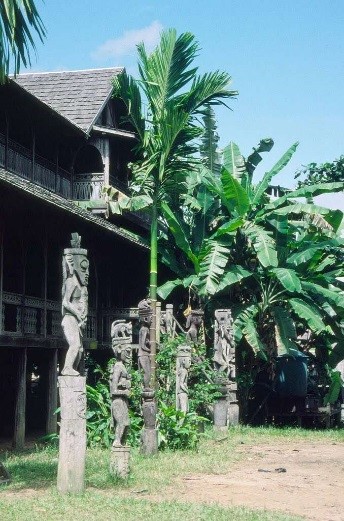


Central Kalimantan is well-known for its unique traditional carving. The three most famous carving from this province are the three dimensional wood carving sculpture of Sapundu and the traditional weapons i.e. Mandau and Talawang.
Sapundu sculpture is a three dimensional wood carving in the form of humanoid statue. This sculpture is commonly adorned with decorative motifs or even colors. Sapundu sculpture is mainly made of Bornean iron wood and usually presents during Tiwah procession. In ancient times, Sapundu sculpture symbolized the social status of its owner and was believed to possess magical powers.
The Mandau and Talawang are the main traditional weapon of Dayak people in Central Kalimantan. The Mandau is a type of sword with a single edge blade i.e. one side is convex and the other side is concave. The Mandau consists of three different parts, which are (i) the Bilah or the blade that made of Mantikei iron plate with a sharp edge and is 70 cm long, (ii) the Pulang Gagang or the hilt that is usually made of wood, deer's horns, or even human bones, and (iii) the Sarung or the sheath which covers the blade and is typically made of wood and usually covered with bracelet-shaped bone on the upper part and wrapped by rattan rope.
The Talawang is a shield that mainly made of Bornean iron wood that is carved with certain motifs and adorned with some bright colors. In ancient times, this weapon was used as a protection against wild animals and enemy's arrows and sword slashes. However, the function currently shifts to become a decorative ornament of Kaharingan temples, public buildings, or even people's houses mostly in Central Kalimantan.
Traditional dance
Central Kalimantan is home for various sub-ethnics of Dayak tribe. Each of those Dayak sub-ethnics live spread out across all regencies in Central Kalimantan. This makes every regency have their own unique traditional dances. These are some of the traditional dances from Central Kalimantan:
- Kinyah Mandau Hatue Dance, originating from Kapuas Regency and depicting theatrical war and martial arts of Dayak tribes in ancient time.
- Giring-Giring Dance, coming from East Barito Regency and usually performed in group of 6 to 10 people.
- Walian Dadas Dance, originating from South Barito Regency and used to be performed as a way to heal a region from negativity.
- Babukung Dance, originally from Lamandau Regency and performed during funeral especially among Dayak Tomun people.
- Tambun Bungai Dance, originating from Palangka Raya city and depicting heroic action of Tambung and Bungai protecting the territory from enemy who tried to loot people's crops.
Notable people
Main article: People from Central Kalimantan
References
References
- Statistik Kependudukan, Jakarta, July 2025, ''Provinsi Kalimantan Tengah Dalam Angka 2025'' (Katalog-BPS 2101023.62)
- (2003). "Indonesia's Population: Ethnicity and Religion in a Changing Political Landscape". Institute of Southeast Asian Studies.
- (2015). "Demography of Indonesia's Ethnicity". Institute of Southeast Asian Studies.
- BPS Provinsi Kalimantan Tengah/BPS-Statistics of Kalimantan Tengah Province. "Provinsi Kalimantan Tengah Dalam Angka 2018/Kalimantan Tengah Province in Figures 2018". BPS Provinsi Kalimantan Tengah/BPS-Statistics of Kalimantan Tengah Province.
- "Visualisasi Data Kependuduakan - Kementerian Dalam Negeri 2020".
- Badan Pusat Statistik. (2023). "Produk Domestik Regional Bruto (Milyar Rupiah), 2022". Badan Pusat Statistik.
- Badan Pusat Statistik. (2023). "Produk Domestik Regional Bruto Per Kapita (Ribu Rupiah), 2022". Badan Pusat Statistik.
- Badan Pembangunan Nasional. (2023). "Capaian Indikator Utama Pembangunan". Badan Pembangunan Nasional.
- (2024). "Indeks Pembangunan Manusia 2024". [[Statistics Indonesia]].
- Biro Pusat Statistik, Jakarta, 2011.
- Badan Pusat Statistik, Jakarta, 2021.
- Riwut, Nila. (2003). "Maneser Panatau Tatu Huang". Pusaka Lima.
- (2020). "Informasi Kinerja Lingkungan Hidup Tahun 2019". Environmental Services of Central Kalimantan.
- "Berita Resmi Statistik Kalimantan Tengah".
- (30 December 2019). "Politik Etnisitas Dalam Upaya Pemekaran Provinsi Kotawaringin". Jurnal Sosial Humaniora.
- (December 2008). "PERDA Prov. Kalimantan Tengah No. 16 Tahun 2008 (Regional Regulation of Central Kalimantan Province No. 16 Of 2008)". Provincial Government of Central Kalimantan.
- Law No. 7/2017 (''UU No. 7 Tahun 2017'') as amended by Government Regulation in Lieu of Law No. 1/2022 and Regulation of General Elections Commission No. 6/2023.
- (February 8, 2012). "Russian Firm Signs MoU to Build $2.4 Billion Railway". The Jakarta Post.
- (July 2023). "Population Statistics of Central Kalimantan".
- (April 2021). "Potret Sensus Penduduk 2020 Menuju Satu Data Kependudukan Indonesia Provinsi Kalimantan Tengah".
- (31 August 2022). "Jumlah Penduduk Menurut Agama". [[Ministry of Religious Affairs (Indonesia).
- (February 2021). "Provinsi Kalimantan Tengah dalam Angka 2021". [[Badan Pusat Statistik]] of Central Kalimantan.
- (2015). "Demography of Indonesia's Ethnicity". Institute of Southeast Asian Studies dan BPS – Statistics Indonesia.
- Chalmers, Ian. (2006). "Proceedings of the 16th Biennial Conference of the Asian Studies Association of Australia (ASAA): Asia Reconstructed, Jun 26–29 2006". Australian National University.
- "Japen & Garantung Alat Musik daerah Kalteng".
- "Alat Musik Gandang Manca". Pemkab Gunung Mas.
- "Materi Musik Nusantara". UNY.
- "Kecapi, Alat Musik Tradisional Kalteng". Palangka Raya University.
- (2020). "Ensambel Sakepeng". ISI Yogyakarta.
- "Huma Betang Masyarakat Dayak Kalimantan tengah". Centre of Language and Culture Studies in Surakarta.
- (January 2015). "Warisan Budaya Tak Benda Patung Sapundu". Ministry of Education, Culture, Research, and Technology (Indonesia).
- (January 2010). "Warisan Budaya Tak Benda Mandau". Ministry of Education, Culture, Research, and Technology (Indonesia).
- (May 2021). "Pergeseran Nilai Guna Talawang, Perisai Suku Dayak".
- "Tarian Tradisional Asal Kalteng".
- "Makna Tarian Kinyah Mandau Hatue". Airlangga University.
- "Deskripsi Tarian Giring-giring". Ministry of Education, Culture, Research, and Technology (Indonesia).
- "Tarian Dadas dalam Membentuk Kedisiplinan". Palangka Raya University.
- "Tarian babukung Upacara Adat Pemakaman Suku Dayak Tomun". Kumparan.
- "Tari Tambun Bungai".
This article was imported from Wikipedia and is available under the Creative Commons Attribution-ShareAlike 4.0 License. Content has been adapted to SurfDoc format. Original contributors can be found on the article history page.
Ask Mako anything about Central Kalimantan — get instant answers, deeper analysis, and related topics.
Research with MakoFree with your Surf account
Create a free account to save articles, ask Mako questions, and organize your research.
Sign up freeThis content may have been generated or modified by AI. CloudSurf Software LLC is not responsible for the accuracy, completeness, or reliability of AI-generated content. Always verify important information from primary sources.
Report