From Surf Wiki (app.surf) — the open knowledge base
Central Belt
Demographic area of highest population density in Scotland
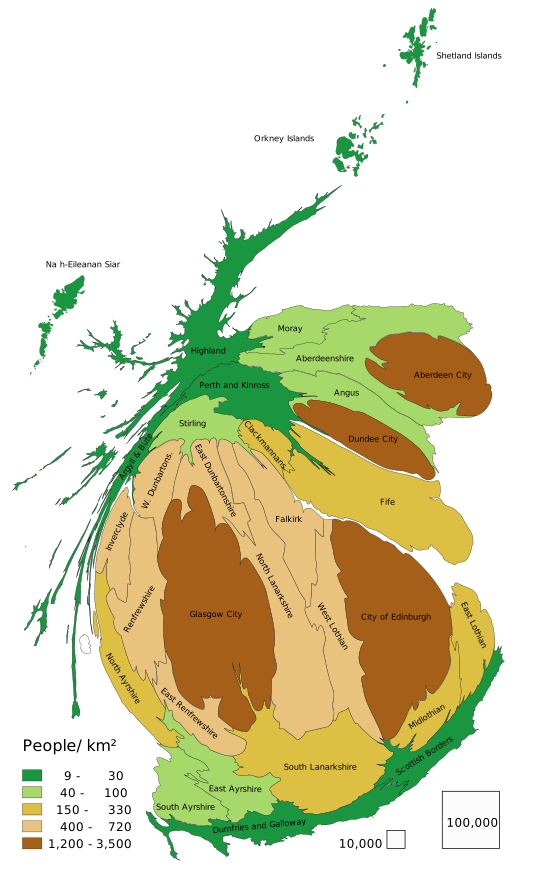
Demographic area of highest population density in Scotland
| Field | Value | |||
|---|---|---|---|---|
| official_name | Central Belt | |||
| type | Area | |||
| country | Scotland | |||
| crown_dependency | ||||
| region | ||||
| region1 | ||||
| parts_type | ||||
| parts_style | ||||
| parts | ||||
| p2 | ||||
| static_image_name | Scotland at night, as seen from space, Oct 2012.png | |||
| static_image_width | ||||
| static_image_alt | ||||
| static_image_caption | 2012 night image of Scotland from space, with band of near-continuous light from habitation across the Central Belt | |||
| static_image_2_name | ||||
| static_image_2_width | ||||
| static_image_2_alt | ||||
| static_image_2_caption | ||||
| area_total_sq_mi | ||||
| area_total_km2 | ||||
| area_footnotes | ||||
| population | ||||
| population_ref | ||||
| population_density | ||||
| <!-- to convert /sq-km to /sq-mi, use {{pop density km2 to mi2 | (/sq-km value here) | precision | 1 | abbr=yes}}. -- |
| os_grid_reference | NS 83764 74675 | |||
| map_type | Scotland | |||
| map_alt | ||||
| coordinates | ||||
| label_position | ||||
| other_language_name | ||||
| other_language | ||||
| language | ||||
| language1 | ||||
| website | ||||
| hide_services | yes |
The Central Belt of Scotland is the area of highest population density within Scotland. Depending on the definition used, it has a population of between 2.4 and 4.2 million (the country's total was around 5.4 million in 2019), including multiple major Scottish settlements such as Paisley, Glasgow, East Kilbride, Livingston, and Edinburgh.
Despite the name, it is not geographically central but is nevertheless at the "waist" of Scotland on a conventional map and the term "central" is used in many local government, police, and NGO designations.
It was formerly known as the Midlands or Scottish Midlands, but this term has fallen out of fashion.
The Central Belt lies between the Highlands to the north and the Southern Uplands to the south.
In the early 21st century, predictions were made that due to economic migration indicators, the urban areas of Glasgow and Edinburgh, whose centres are approximately 41 miles apart, could merge to create a megalopolis over the coming decades.
Smaller Central Belt
.png)
The area is often considered as the triangle defined by the M8, M80 and M9 motorways stretching from Greenock and Glasgow in the west to Edinburgh in the east, and has been referred to as the Lowland Triangle. encompassing towns such as Paisley, Cambuslang, Hamilton, Stirling, Falkirk, Cumbernauld, Livingston and Bathgate. The population of the local authority areas which are wholly within this territory and have no extensive unpopulated areas was approximately 2.39 million in 2018.
Larger Central Belt
.png)
The larger Central Belt is a trapezoid, not precisely defined, but essentially encompassing the generally low-lying areas from Helensburgh to Montrose (the Highland Boundary Fault) and from Girvan to Dunbar (the Southern Uplands Fault). This also takes in fairly densely populated regions such as Ayrshire and East Lothian, and encompasses all the major cities of Scotland, except for Aberdeen and Inverness which are located in the north of the country, as well as the bulk of Scotland's industrial works. Including rural parts of the council areas involved, the total population was around 4.28 million in 2018.
Similar terms
There are several terms in common usage in a Scottish context with a similar meaning to "Central Belt".
- The Central Lowlands is geologically defined and covers an area that stretches further to the north east than the Central Belt.
- The "Midland Valley" is a less commonly used expression synonymous with "Central Lowlands".
- The Scottish Lowlands are topographically and culturally defined and include all of Scotland outside of the Highlands and Islands, including the Southern Uplands.
- Central Scotland is a less well-defined term used to mean various things, including "Central Lowlands" and "Central Belt".
Notes
Citations
References
- ...
- Census, 2001
- [http://mapzone.ordnancesurvey.co.uk/mapzone/didyouknow/whereis/q_16_39.html "Where is the centre of mainland Scotland?"] [[Ordnance Survey]] Retrieved 11 December 2010.
- See [http://www.highlandhostel.co.uk/wherearewe.htm "The 'Where Are We' page"] {{webarchive. link. (2005-12-01 highlandhostel.co.uk. Retrieved 22 September 2007.)
- [https://www.thetimes.com/travel/destinations/uk-travel/scotland-travel/glasgow/central-belt-to-meld-as-megacity-fksq32xp0tl Central belt 'to meld as megacity'], ''The Sunday Times'', 9 November 2014
- [https://www.scotsman.com/news/opinion/leader-comment-central-belt-megacity-1-4648472 Leader comment: Central belt megacity?], ''The Scotsman'', 28 December 2017
- (7 October 2020). "Central Belt: Where is it, how did it get its name and everything else you need to know about Scotland’s coronavirus hotspot". Scotsman.
- [https://statistics.gov.scot/atlas/resource?uri=http%3A%2F%2Fstatistics.gov.scot%2Fid%2Fstatistical-geography%2FS92000003 Scotland], Scottish Government Statistics
This article was imported from Wikipedia and is available under the Creative Commons Attribution-ShareAlike 4.0 License. Content has been adapted to SurfDoc format. Original contributors can be found on the article history page.
Ask Mako anything about Central Belt — get instant answers, deeper analysis, and related topics.
Research with MakoFree with your Surf account
Create a free account to save articles, ask Mako questions, and organize your research.
Sign up freeThis content may have been generated or modified by AI. CloudSurf Software LLC is not responsible for the accuracy, completeness, or reliability of AI-generated content. Always verify important information from primary sources.
Report