From Surf Wiki (app.surf) — the open knowledge base
Central Bank of Russia
Central Bank of the Russian Federation

Central Bank of the Russian Federation
| Field | Value |
|---|---|
| name | Central Bank of the Russian Federation |
| native_name | Центральный банк Российской Федерации |
| logo | CBRF logo.svg |
| logo_size | 250px |
| image | Moscow RussiaCentralBank M00.jpg |
| caption | Head office erected in 1894 as the Moscow branch of the State Bank of the Russian Empire |
| headquarters | 12 Neglinnaya Street, Moscow, Russia |
| coordinates | |
| established | (original institution) |
| (Bank of the RSFSR) | |
| (current name) | |
| executive_title | Governor |
| executive | Elvira Nabiullina |
| bank_of | |
| currency | Russian ruble |
| currency_iso | RUB |
| reserves | () |
| reserve_requirements | International Reserves |
| borrowing_rate | 16.50% |
| website | |
| predecessor | State Bank of the USSR |
(Bank of the RSFSR) (current name)
The Central Bank of the Russian Federation (), commonly known as the Bank of Russia (), also called the Central Bank of Russia (CBR), is the central bank of the Russian Federation. The bank was established on 13 July 1990. It traces its beginnings to the State Bank of the Russian Empire established in 1860.
The bank is headquartered on Neglinnaya Street in Moscow. Its functions are described in the Constitution of Russia (Article 75), as well as in federal law.
History
Shortly after declaring sovereignty in June 1990, the Russian SFSR decreed the creation of a central bank under the leadership of Georgy Matyukhin. Matyukhin commandeered Russian branches of the State Bank of the USSR and brought them under the control of the Bank of the RSFSR. A comprehensive central bank statute was passed in December 1990 and the bank adopted a charter in June 1991. A remnant of the State Bank continued to operate alongside it until it was dissolved along with the Soviet Union in December 1991, and the Bank of Russia assumed its remaining business.
Since 1992, the Bank of Russia began to buy and sell foreign currency on the foreign exchange market created by it, establish and publish the official exchange rates of foreign currencies against the ruble.
In 2006 capital controls mandate by the RCB began to ease, as confidence in the ruble mounted from the depths of the 1990s. Legislation continued to ease through the 2010s. The 2022 Russian invasion of Ukraine reversed this trend.
In August 2023 the RCB raised the primary interest rate from 8.5% to 12%. At the same time president Vladimir Putin was said to be considering capital controls on exporters from Russia, who would have to convert 80% of foreign funds to the ruble. This would be done in order artificially to increase demand for the domestic currency. In April 2024 this measure was prolonged for another year, from the original term of six months. It was reported that "43 major Russian commodities groups" were affected. At the time the ruble was trading at 93 to the US dollar.
In October 2023 western firms that wanted to exit the Russian economy were doubly fleeced when they were told about extraordinary capital controls. On 15 July 2024 the CBRF closed the statistics of the over-the-counter currency market; at the time it was under pressure from international sanctions over the Russian invasion of Ukraine.
On 26 July 2024 the CBRF hiked its primary interest rate by 200 basis points to 18%. In 2024 Q2, core inflation increased to 9.2% in annualised terms and labour shortages continued to grow.
In September 2024 it was reported that the RCB had allowed the Rosoboronexport to buy US banknotes from the Rwandan Ministry of Defence while entities in Russia were interdicted from having US currency.
On 13 September 2024 the RCB raised its primary interest rate to 19%.
Role and duties
According to the constitution, it is an independent entity, with the primary responsibility of protecting the stability of the national currency, the ruble.
Before 1 September 2013, it was the main regulator of the Russian banking industry, responsible for banking licenses, rules of banking operations and accounting standards, serving as a lender of last resort for credit organizations. After pointed date functions and powers of CBR were significantly expanded and the central bank received the status of a mega-regulator of all financial markets of Russia.
It holds the exclusive right to issue ruble banknotes and coins through the Moscow and St. Petersburg mints, and the Goznak mint. The central bank issues commemorative coins made of precious and non-precious metals as well as investment ones made of precious metals, which are distributed inside and outside the country. In 2010, in honor of its 150th anniversary it issued a 5-kilo commemorative gold coin Alexander II.
Under Russian law, half of the bank's profit must be channeled into the government's federal budget. The Central Bank of Russia is a member of the BIS.
The Bank of Russia owns a 57.58% stake in Sberbank, the country's leading commercial bank. The Bank of Russia also owns a 100% stake in Russian National Reinsurance Company (RNRC), the biggest national reinsurance company. The RNRC was established in July 2016 to prevent possible problems with reinsurance of large risks under international sanctions during the Russo-Ukrainian War, like constructing the Crimean Bridge.
The Bank of Russia is actively working on financial literacy of the population. In particular, the Fincult project is developing a website with materials aimed at improving financial literacy of the population, combating fraud through a description of all fraudulent schemes.
The Bank of Russia is also involved in working with citizens' pension savings. Pensions in Russia remain very low. For 2024, the minimum social pension is set at 13,269 rubles (147 US dollars). Since there is not enough money in the budget, citizens are offered to save for retirement on their own. To this end, since 2024, the Bank of Russia and all its regional divisions have been actively promoting the Long-term Savings Program developed by the Bank of Russia.
The main feature of the long–term savings program is co-financing by the state. That is, citizens who have joined the program will receive an increase in their savings from the state for a certain time. Thus, people can form additional capital for their priority goals in the future, for example, to buy a home or educate children, create a financial "safety cushion" or use this money as an increase to a pension, she said in an interview Bankiros.ru representative of the Central Bank of the Russian Federation Larisa Pavlova.
Anti-fraud activities
A key prospective witness in improper financial affairs was Lyubov Tarasova () who was a senior auditor for the Central Bank of Russia and worked for the "Unicom" () auditing firm which had been established on 20 August 1991 and was responsible for "checking the correctness of the documentation and the essence of business transactions that are in doubt" (), but was stabbed to death in her apartment in Moscow on 15-16 October 1997.
In 2017, within the framework of a joint anti-phishing project of the Bank of Russia and search engine Yandex, a special check mark (a green circle with a tick and 'Реестр ЦБ РФ' (Bank of Russia Register) text box) appeared in the search results, informing the consumer that the website is really owned by a legally registered company licensed by the Bank of Russia.
Governors
The President of the Board of Directors of the Central Bank is the head of the central banking system of the Russian Federation. The Governor is chosen by the President of Russia; and serves for four-year-terms after appointment. A Governor may be appointed for several consecutive terms (Sergey Ignatyev was the Governor of the Central Bank for 11 years, and he was appointed three times, in the longest serving term in post-soviet Russia).
| № | Name (governor) | Photo | Term of office | Appointed by | Start of term | End of term | Length of service | Boris Yeltsin | Vladimir Putin | |
|---|---|---|---|---|---|---|---|---|---|---|
| 1 | Georgy Matyukhin | [[File:CBRF.png | 70px]] | 25 December 1990 | 16 May 1992 | ( days) | ||||
| 2 | Viktor Gerashchenko | [[File:Gerashchenko.jpg | 70px]] | 17 July 1992 | 18 October 1994 | ( days) | ||||
| 3 | Tatyana Paramonova | [[File:CBRF.png | 70px]] | 19 October 1994 | 8 November 1995 | ( days) | ||||
| 4 | Alexander Khandruyev | [[File:CBRF.png | 70px]] | 8 November 1995 | 22 November 1995 | ( days) | ||||
| 5 | Sergey Dubinin | [[File:Sergey Dubinin, July 2011.jpeg | 70px]] | 22 November 1995 | 11 September 1998 | ( days) | ||||
| 6 | Viktor Gerashchenko | [[File:Viktor Gerashchenko2.jpg | 70px]] | 11 September 1998 | 20 March 2002 | ( days) | ||||
| 7 | Sergey Ignatyev | [[File:Ignatyev S M 2011 12 21.jpeg | 70px]] | 21 March 2002 | 23 June 2013 | ( days) | ||||
| 8 | Elvira Nabiullina | [[File:Elvira Nabiullina - kremlin.ru portrait.jpg | 70px]] | 24 June 2013 | present | ( days) |
Subsidiaries
.jpg)
The Central Bank of Russia holds directly significant participatory interests in a number of Russian companies:
- Sberbank of Russia (50%+1 voting share of the stock);
- Moscow Exchange (11.779% of the stock);
- Russian National Reinsurance Company (100% of the stock);
- Trust company of the Banking Sector Consolidation Fund (100% of the stock);
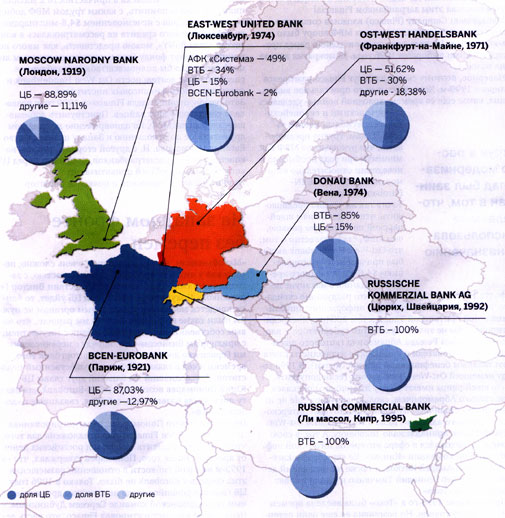
- Rosincas (Russian Association of Cash-in-transit). Additionally, the Bank of Russia held earlier interests in some other Russian organizations. In particular, after the liquidation of Gosbank (State Bank of the USSR), the CBR beneficially acquired complete or controlling interests in five so-called "Russian Foreign Banks" (until 1991 – "Soviet Foreign Banks"):
- VTB Bank (99.99% of the stock – until 2002, now - 60.9% owned by The Federal Agency for State Property Management (Rosimushchestvo) );
- Donau Bank AG, Vienna;
- East-West United Bank, Luxemburg;
- Eurobank, Paris;
- Moscow Narodny Bank, London;
- Ost-West Handelsbank, Frankfurt am Main. All of them were members of the USSR Vnesheconombank system and were transferred to the CBR in 1992 by the Resolution of the Presidium of the Supreme Soviet of Russia. For over five years – 2000 to 2005 – all stocks of the Russian Foreign Banks were being purchased from the Bank of Russia by VTB Bank. As part of the financial support to credit institutions, the Bank of Russia invests in them through the Banking Sector Consolidation Fund and acquires (on a temporary and indirect basis) shares in the equity of such banks. The first project of this kind was Otkritie FC Bank, in summer 2017.
Policies

]]

]] In December 2014, amidst falling global oil prices, international sanctions during the Russo-Ukrainian War, capital flight, and fears of recession, the bank had increased the one-week minimum auction repo rate up by 6.5 points to 17 percent. This caused a run on the ruble, and on 29 January, the bank decreased the rate by two points to 15 percent.
In January 2015, the head of monetary policy, Ksenia Yudayeva, a proponent of strict anti-inflation policy, was replaced by Dmitry Tulin, who is "seen as more acceptable to bankers, who have called for lower interest rates".
In response to the 2021–2022 Russo-Ukrainian crisis, multiple countries imposed economic sanctions against Russian banks. On 22 February 2022, US president Joe Biden announced restrictions of activities by US citizens involved with the Bank of Russia and others. In March, the Bank of International Settlements suspended the Bank of Russia. In March 2022, the Depository Trust & Clearing Corporation blocked Russian securities from the Bank of Russia and Russia's finance ministry. At the end of May 2022, three months into the invasion of Ukraine, the central bank cut interest rates in an effort to prop up the increasingly isolated Russian economy, suffering shortages and supply chain issues. The inflation rate rose to 17.8 percent in April. Also the ruble reached its strongest level against the U.S. dollar in four years, hurting exports. The central bank announced a possible rate cut in 2025 due to stabilising inflation on the 1000th day of the Ukraine war. In September 2025 the Central Bank lowered the interest rate from 18 percent to 17 percent, as part of its post war recovery monetary policy.
Sanctions also included asset freezes on the Russian Central Bank, which holds $630 billion in foreign-exchange reserves, to prevent it from offsetting the impact of sanctions. On 5 May 2022, President of the European Council Charles Michel said: "I am absolutely convinced that this is extremely important not only to freeze assets but also to make possible to confiscate it, to make it available for the rebuilding" of Ukraine.
In December 2025, international media reported that France refused to allow approximately $19.4 billion in frozen RCB assets held at commercial banks to be used in a proposed EU loan for Ukraine.
Notes
References
References
- Weidner, Jan. (2017-04-20). "The Organisation and Structure ofCentral Banks". Technische Universität Darmstadt.
- CEIC Data. "Russia Foreign Exchange Reserves, 2002 – 2025".
- (24 October 2025). "Bank of Russia cuts the key rate by 50 bp to 16.50% p.a.". Bank of Russia.
- "About Bank of Russia".
- "О Банке России {{!}} Банк России".
- "Constitution of the Russian Federation".
- "Конституция Российской Федерации / Constitution of the Russian Federation (in Russian)".
- (2022-03-03). "Federal Register / Vol. 87, No. 42 / Thursday, March 3, 2022 / Notices".
- History of the Bank of Russia. 1860–2010. In 2 vols. Ed.: Y. A. Petrov, S. Tatarinov. 2010.
- "Constitution of the Russian Federation".
- Johnson, Juliet. (2000). "A Fistful of Rubles".
- Prokopenko, Alexandra. (19 October 2023). "Russia's Capital Controls Are Designed to Aid Putin's 2024 Re-Election". Carnegie.
- (16 August 2023). "Putin to discuss capital controls to help prop up rouble, report says". The Guardian.
- "Russia Extends Mandatory FX Conversion for Major Exporters". Barron's.
- (19 October 2023). "Russia tightens capital controls on western companies". Financial Times.
- (15 July 2024). "The Central Bank of the Russian Federation closed the statistics of the over-the-counter currency market". Interfax.
- "Bank of Russia increases the key rate by 200 bp to 18.00% p.a. | Bank of Russia".
- (26 July 2024). "Russian Central Bank hikes rates". Reuters.
- (2 September 2024). "Россия начала закупать долларовые банкноты в Африке".
- (13 September 2024). "Russia's Central Bank Raises Rates to 19% as Inflation Ticks up".
- "As war in Ukraine worsens inflation, Russian central bank hikes rates - National | Globalnews.ca".
- (13 September 2024). "Russia's central bank hikes interest rates in a bid to fight inflation".
- "Banking Legislation".
- [http://www.bis.org/review/r170314h.htm "Elvira Nabiullina: Establishing a mega regulator for the Russian financial sector"] {{Webarchive. link. (17 October 2017 , Bank for International Settlements : Central bankers' speeches : Speech by Ms Elvira Nabiullina, Governor of the Bank of Russia, at the Federation Council, Moscow, 15 February 2017.)
- "Commemorative Coins – Banknotes and Coins – Bank of Russia". cbr.ru.
- [http://www.financialexpress.com/news/russia-to-issue-5-kg-gold-coin/620822/ "Russia to issue 5 kg gold coin"] {{webarchive. link. (23 May 2010 , The Financial Express. 19 May 2010. Accessed 19 May 2010.)
- (2012-12-12). "Inside the Risky Bets of Central Banks". The Wall Street Journal.
- [http://sevendaynews.com/2016/07/04/putin-signed-a-law-establishing-a-national-reinsurance-company "Putin signed a law establishing a National reinsurance company"] {{Webarchive. link. (27 May 2020 , World News, Breaking News, 4 July 2016.)
- (30 April 1999). "Arthur Christy. Inkombank lawyer former US Attorney: US lawyers hired as spin doctors for Russian mob". US-Russia Press Club.
- (18 October 1997). "Убили аудитора: Убит хранитель тайн Центробанка". [[Kommersant]].
- (18 October 1997). "били аудитора: Кого проверяла Любовь Тарасова". [[Kommersant]].
- "Bank of Russia to mark microfinance organisations on the Internet {{!}} Банк России".
- "Insurers' websites receive first marks {{!}} Банк России".
- Ovchinnikov, O.. (8 November 2000). "ЦБ - центральный Банд ...". Compromat.ru.
- (February 2005). ""Дочерние" российские зарубежные банки и сеть ВТБ: доли ЦБ, ВТБ и др.". compromat.ru.
- Birman, Alexander. (21 February 2005). "В советских сетях: Нефтедоллары пойдут по проверенным каналам загранбанков". [[:ru:Компания (журнал).
- (28 November 2018). "Телега из Кремля. Рассказ о том, как власти превратили Telegram в телевизор". [[Proekt.
- (30 January 2015). "Russian central bank makes surprise interest rate cut". Reuters.
- (22 February 2022). "Fact Sheet: United States Imposes First Tranche of Swift and Severe Costs on Russia".
- (10 March 2022). "IMF approves $1.4 billion Ukraine aid and BIS suspends Russia".
- Lomax, Jenna. (March 2, 2022). "DTCC blocks Russian securities from Bank of Russia".
- (2022-05-26). "As Russia Diverges From the Global Economy, Soviet-Style Scarcity Looms". The New York Times.
- "Central Bank of Russia could begin cutting key rate in 2025 if inflation slows, absent any shocks - Nabiullina". interfax.com.
- "Russia’s central bank cuts rates further as economic pressure mounts".
- (16 May 2022). "Now is not the time to confiscate Russia's central bank reserves". [[Bruegel (think tank).
- (28 February 2022). "The West declares economic war on Russia". [[Politico]].
- Pop, Valentina. (25 February 2022). "EU leaders agree more Russia sanctions, but save some for later". [[Financial Times]].
- (17 May 2022). "Germany open to Russian Central Bank asset seizure to finance Ukraine's recovery". [[Euractiv]].
- (2025-12-08). "France Blocks Use of About $19 Billion Frozen Russian Assets in EU Loan Plan for Ukraine".
This article was imported from Wikipedia and is available under the Creative Commons Attribution-ShareAlike 4.0 License. Content has been adapted to SurfDoc format. Original contributors can be found on the article history page.
Ask Mako anything about Central Bank of Russia — get instant answers, deeper analysis, and related topics.
Research with MakoFree with your Surf account
Create a free account to save articles, ask Mako questions, and organize your research.
Sign up freeThis content may have been generated or modified by AI. CloudSurf Software LLC is not responsible for the accuracy, completeness, or reliability of AI-generated content. Always verify important information from primary sources.
Report