From Surf Wiki (app.surf) — the open knowledge base
Central and Western District
District of Hong Kong

District of Hong Kong
| Field | Value | |
|---|---|---|
| name | Central and Western | |
| official_name | Central and Western District | |
| native_name | 中西區 | |
| native_name_lang | zh-hant | |
| type | District | |
| image_skyline | Hong Kong Island Skyline 2009.jpg | |
| image_caption | Day view of the Central and Western District skyline | |
| blank_emblem_type | Official emblem | |
| blank_emblem_size | 60px | |
| mapframe | yes | |
| mapframe-zoom | 11 | |
| mapframe-point | none | |
| subdivision_type1 | Region | |
| subdivision_type | Country | |
| subdivision_name1 | Hong Kong (special administrative region) | |
| subdivision_name | China | |
| parts_type | District Council constituencies | |
| parts_style | para | |
| p1 | 2 | |
| area_total_km2 | 12.55 | |
| area_land_km2 | 12.55 | |
| area_note | Lands Department | |
| leader_title | District Officer | |
| leader_name | David Leung Chi-Ki | |
| leader_title1 | District Council Chairman | |
| leader_name1 | David Leung Chi-ki (ex-officio) | |
| leader_title2 | District Council Vice-Chairman | |
| leader_name2 | Victor Yeung Sui-Yin | |
| population_as_of | 2021 | |
| population_total | 235,953 | |
| {{unbulleted list | bullet | no |
| 5.8% White<ref name | "2021census"}} | |
| population_note | Census and Statistics Department | |
| population_density_km2 | auto | |
| timezone | Hong Kong Time | |
| utc_offset | +8 | |
| coordinates | ||
| website | Central and Western District | |
| blank1_name_sec1 | Largest neighbourhood by population | |
| blank1_info_sec1 |
| mapframe-zoom = 11 | mapframe-point = none |77% Chinese |7.6% Filipino |5.8% White}}
The Central and Western District (, ), located on northwestern part of Hong Kong Island, is one of the 18 administrative districts of Hong Kong. It had a population of 243,266 in 2016. The district has the most educated residents with the second highest income, and the third lowest population due to its relatively small size.
Central is the central business district and the core urban area of Hong Kong. Western District covers Shek Tong Tsui, Kennedy Town, Sai Ying Pun, parts of Lung Fu Shan. Most of the districts lie within the statutory limits of the City of Victoria, the earliest urban settlement in colonial Hong Kong, except the far western end of the district, i.e. Victoria Road, Mount Davis and areas above the 700-feet contour, aka. the Peak.
History
Central District, as Victoria City, was the first area of planned urban development in Hong Kong during the colonial era. The British held a land sale in June 1841, six months after the flag was raised at Possession Point. A total of 51 lots of land were sold to 23 merchant houses to build offices and warehouses. The property buyers included Dent's, Jardine's, Russell's and Olyphant's. At the time, the two roads Albany Nullah (now Garden Road) and Glenealy Nullah (now Glenealy) were mainly used by the British. The streets later became known as Government Hill.
In 1857, the British government expanded Victoria City and divided it into seven districts. Those located in present-day Central and Western are: Sai Ying Pun, Sheung Wan, Tai Ping Shan, Central. The area was essentially a European area until 1860 when Chinese merchants begin buying up European properties around Cochrane, Wellington and Pottinger Streets. The Central district was the principal European business district, hence the arrival of the first major bank HSBC. The Western district was the commercial centre for Chinese businesses. When property values in the district rose, a meeting was held in February 1866 to establish a "District Watch Force" to police and protect this specific area.
In 1880, Shek Tong Tsui was established, followed by Kennedy Town in the early 20th century. By the 1890s the majority of Hong Kong's population was concentrated in the district with about 200,000 residents, mostly in Victoria City.
Politics
District councils in Hong Kong are primarily consultative bodies of the HKSAR government with very limited powers, primarily restricted to building and maintaining parks, open areas, recreational and cultural activities and tourist promotion. The corresponding body for the district is Central and Western District Council.
District council elections are held every four years; the last one was held on 10 December 2023, for terms beginning 1 January 2024. The district was divided into two constituencies, each returning two members. Before 2023 the district comprised 15 single-member constituencies. The constituency areas were smaller than the commonly used geographic areas, which are in turn based on the old 1857 and 1880 divisions.
Demographics
In Hong Kong's 2011 Census the district population was 251,519, down four percent from 261,884 in the 2001 census, and with an average of 2.7 people for each of the 89,529 households. Among the 18 districts, Central and Western has the second highest median household income in the territory (behind only Wan Chai District). In terms of average size of households, it is third smallest at 2.8 persons, behind only Wan Chai and Yau Tsim Mong District, at 2.7 each.
In 2021 census, the district population was slightly reduced to 235,953 .It has a relatively ethnically diverse population. As of 2021, 77% of the district's residents are Chinese, and the largest ethnic groups are Filipinos (7.6%) and white people (5.8%). 72% of the district's residents speak Cantonese as their primary language, while 14% use English and 3% use Mandarin.
Geography and political subdivisions
The district is located at , based on the location of the General Post Office in Central. With an area of 12.4 km2, the district occupies the northwestern portion of Hong Kong Island. It is surrounded by Wan Chai District on the east, Southern District on the south, and Victoria Harbour in the north. The district also encompasses Green Island and Little Green Island, two uninhabited islands to the west of Hong Kong Island.
Areas from west to east along Victoria Harbour are: Kennedy Town, Sai Ying Pun, Sheung Wan, Central, Admiralty and other localities.
Central
Main article: Central, Hong Kong
Central is the business centre of Hong Kong, and many multinational financial services corporations have their headquarters there. Government Hill, the site of the government headquarters, is also in Central.
Central mid-levels escalator
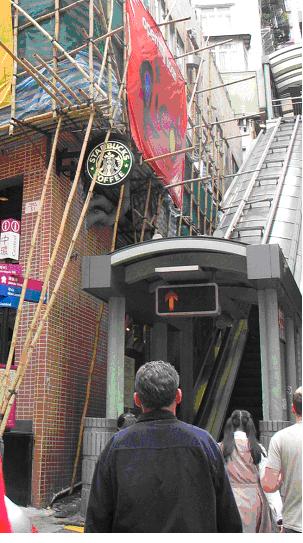
The Central-Mid-Levels escalator in Hong Kong is the longest outdoor covered escalator system in the world. The system is 800 m long, connecting Des Voeux Road Central, in Central with Conduit Road in the Mid-Levels, passing through narrow streets in SoHo.
The escalator runs downhill from 6 am to 10 am and uphill from 10:20 am to 12:00 am (midnight) every day. Apart from its significance in transport linkage, it is also a tourist attraction, with many restaurants, bars, and shops lining its route.
Bank of China Tower
The Bank of China Tower in Central houses the headquarters of BOCHK. Designed by I. M. Pei, the 70-storey building's height is 315 m with two masts reaching 369 m. Construction began in 1985 and the building was completed in 1989. It was the first building outside the United States to exceed 1000 ft and to exceed 300 m. It was the tallest building in Hong Kong and Asia from 1989 to 1992, when the nearby, taller Central Plaza was completed.
City Hall
Main article: Hong Kong City Hall
Built in 1962, the City Hall complex housed the old central library of Hong Kong, as well as concert halls, restaurants and a marriage registry. The conference room of the former Urban Council was also at the lower building of the City Hall.
The garden at the north-western side of the complex includes a memorial to those killed in Hong Kong during World War II.
Chinese People's Liberation Army Forces Hong Kong Building
The funnel-shaped Chinese People's Liberation Army Forces Hong Kong Building (formerly, and still commonly known as the Prince of Wales Building) housed the headquarters of the British garrison in Hong Kong until the territory's handover to the People's Republic of China on 30 June 1997. It now houses the local garrison of the People's Liberation Army and is formally known as Central Barracks, in line with PLA convention for naming barracks after the name of the locality.
Other landmarks

- Cenotaph, Hong Kong
- Central Harbourfront
- Central Market
- Chater Garden
- Chinese People's Liberation Army Forces Hong Kong Building (formerly the Prince of Wales Building)
- Edinburgh Place, Hong Kong – including Queen's Pier and the Star Ferry pier
- Exchange Square
- Former Supreme Court Building
- Fringe Club
- Harcourt Garden
- Hong Kong Zoological and Botanical Gardens
- Hong Kong Club
- Hong Kong Maritime Museum
- Hong Kong Park
- HSBC Hong Kong headquarters building
- International Finance Centre
- Jardine House
- Lan Kwai Fong
- Legislative Council building
- Lippo Centre
- Old Bank of China Building
- Peak Tram terminus
- St John's Cathedral (Hong Kong)
- St Joseph's College, Hong Kong
- St. Paul's Co-educational College
- SoHo, Hong Kong
- Statue Square
- PMQ
- Tai Kwun
Admiralty
- Queensway
Mid-Levels
- Government House
Sai Ying Pun
- Sai Ying Pun Community Complex
Sheung Wan
- The Center
Education
Secondary schools
Arranged by alphabetical order of their full names in each category.
Government-administered schools:
- King's College
Aided schools:
- Lok Sin Tong Leung Kau Kui College
- Raimondi College
- St. Clare's Girls' School
- St. Joseph's College
- St. Louis School
- St. Stephen's Church College
- St. Stephen's Girls' College
- Ying Wa Girls' School
Schools under Direct Subsidy Scheme (DSS) and grant schools:
- St. Paul's Co-educational College
- St. Paul's College
International schools:
- German Swiss International School
- Island School http://www.island.edu.hk/ (under funding of English Schools Foundation, subsidised by government)
Tertiary institutions
- The University of Hong Kong
- Caritas Institute of Higher Education
Public libraries
Hong Kong Public Libraries operates three libraries in the district: City Hall Public Library, Shek Tong Tsui Public Library, and Smithfield Public Library.
Transport
Link
- Route 3 (Hong Kong)
- Route 4 (Hong Kong)
Major roads that serves the area include:
- Harcourt Road
- Connaught Road Central, Connaught Road West
- Queensway, Queen's Road Central, Queen's Road West
- Des Voeux Road Central, Des Voeux Road West
- Hill Road Flyover
- Caine Road
- Robinson Road
- Park Road
- Bonham Road
- Western Harbour Crossing
Public transport
Public transport includes Hong Kong Tramways, the Peak Tram and the MTR.
MTR lines include:
- Island line: Sheung Wan station, Central station, Admiralty station, Sai Ying Pun, HKU, Kennedy Town
- Tsuen Wan line: Central station, Admiralty station
- Tung Chung line: Hong Kong station
- Airport Express: Hong Kong station
- South Island line: Admiralty station
- East Rail line: Admiralty station
References
References
- (January 2022). "Hong Kong Geographic Data (As at October 2021)". [[Lands Department]], [[Hong Kong SAR]].
- [https://www.had.gov.hk/en/18_districts/my_map_01.htm Home Affairs Dept, Welcome page for Central and Western District, Retrieved 2018-05-25]
- (February 2022). "2021 Population Census: Summary Results". [[Census and Statistics Department]], [[Hong Kong Government]].
- (8 December 2017). "District Profiles". Hong Kong Government.
- Wordie, Jason. (2002). "Streets: Exploring Hong Kong Island". [[Hong Kong University Press]].
- Tsai Jung-fang. [1995] (1995). Hong Kong in Chinese History: community and social unrest in the British Colony, 1842-1913. Columbia University Press. {{ISBN. 0-231-07933-8
- Sanderson, Edgar. (1897–1898). "The British Empire in the nineteenth century: its progress and expansion at home and abroad". [[Blackie and Son]].
- [http://www.census2011.gov.hk/en/district-profiles/central-and-western.html 2011 Population Census - Fact Sheet for Central and Western District Council District] {{Webarchive. link. (26 December 2013 , [[Hong Kong Census]])
- "Central and Western District Libraries". [[Hong Kong Public Libraries]].
This article was imported from Wikipedia and is available under the Creative Commons Attribution-ShareAlike 4.0 License. Content has been adapted to SurfDoc format. Original contributors can be found on the article history page.
Ask Mako anything about Central and Western District — get instant answers, deeper analysis, and related topics.
Research with MakoFree with your Surf account
Create a free account to save articles, ask Mako questions, and organize your research.
Sign up freeThis content may have been generated or modified by AI. CloudSurf Software LLC is not responsible for the accuracy, completeness, or reliability of AI-generated content. Always verify important information from primary sources.
Report