From Surf Wiki (app.surf) — the open knowledge base
Centered nonagonal number
Centered figurate number that represents a nonagon with a dot in the center
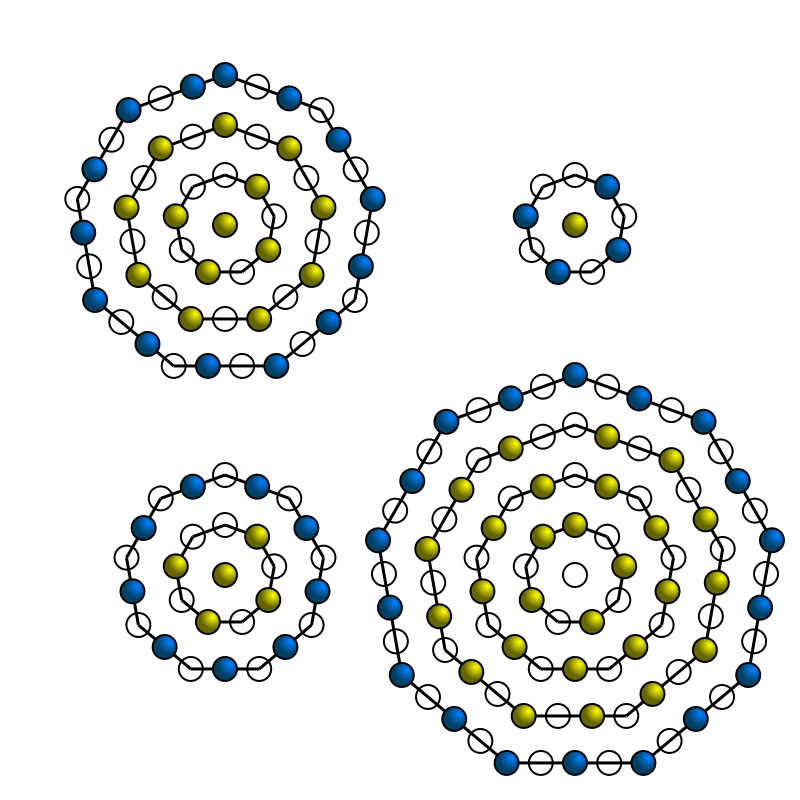
Centered figurate number that represents a nonagon with a dot in the center
A centered nonagonal number, (or centered enneagonal number), is a centered figurate number that represents a nonagon with a dot in the center and all other dots surrounding the center dot in successive nonagonal layers. The centered nonagonal number for n layers is given by the formula
:Nc(n) = \frac{(3n-2)(3n-1)}{2}.
Multiplying the (n − 1)th triangular number by 9 and then adding 1 yields the nth centered nonagonal number, but centered nonagonal numbers have an even simpler relation to triangular numbers: every third triangular number (the 1st, 4th, 7th, etc.) is also a centered nonagonal number.
Thus, the first few centered nonagonal numbers are :1, 10, 28, 55, 91, 136, 190, 253, 325, 406, 496, 595, 703, 820, 946.
The list above includes the perfect numbers 28 and 496. All even perfect numbers are triangular numbers whose index is an odd Mersenne prime. Since every Mersenne prime greater than 3 is congruent to 1 modulo 3, it follows that every even perfect number greater than 6 is a centered nonagonal number.
In 1850, Sir Frederick Pollock conjectured that every natural number is the sum of at most eleven centered nonagonal numbers. Pollock's conjecture was confirmed as true in 2023.
Congruence Relations
- All centered nonagonal numbers are congruent to 1 mod 3.
- Therefore the sum of any 3 centered nonagonal numbers and the difference of any two centered nonagonal numbers are divisible by 3.
References
References
- {{Cite OEIS. A060544. Centered 9-gonal (also known as nonagonal or enneagonal) numbers
- Koshy, Thomas. (2014). "Pell and Pell–Lucas Numbers with Applications". Springer.
- Dickson, L. E.. (2005). "Diophantine Analysis". Dover.
- Kureš, Miroslav. (2023-10-27). "A Proof of Pollock's Conjecture on Centered Nonagonal Numbers". The Mathematical Intelligencer.
This article was imported from Wikipedia and is available under the Creative Commons Attribution-ShareAlike 4.0 License. Content has been adapted to SurfDoc format. Original contributors can be found on the article history page.
Ask Mako anything about Centered nonagonal number — get instant answers, deeper analysis, and related topics.
Research with MakoFree with your Surf account
Create a free account to save articles, ask Mako questions, and organize your research.
Sign up freeThis content may have been generated or modified by AI. CloudSurf Software LLC is not responsible for the accuracy, completeness, or reliability of AI-generated content. Always verify important information from primary sources.
Report