From Surf Wiki (app.surf) — the open knowledge base
Centaur (rocket stage)
Family of rocket stages which can be used as a space tug
Family of rocket stages which can be used as a space tug
| Field | Value | ||||||||
|---|---|---|---|---|---|---|---|---|---|
| image | Landsat-9_Centaur_1_(cropped).jpg | ||||||||
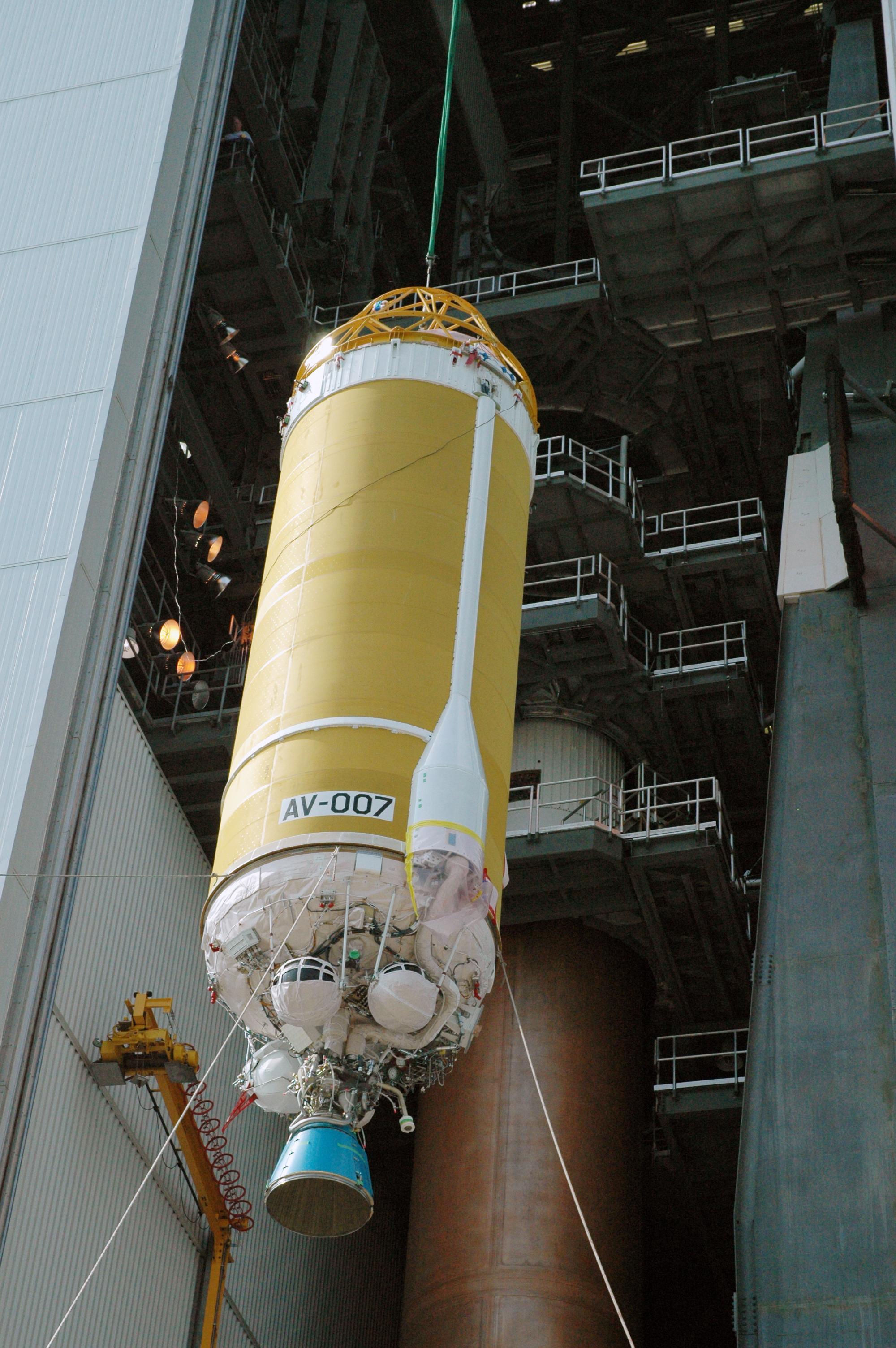
| caption | A single-engine Centaur III being raised for mating to an Atlas V rocket | ||||||||
| name | Centaur | ||||||||
| manufacturer | United Launch Alliance | ||||||||
| derivatives | Advanced Cryogenic Evolved Stage (cancelled, not flown) | ||||||||
| status | Active | ||||||||
| launches | 273 | ||||||||
| success | 254 | ||||||||
| fail | 15 | ||||||||
| noburn | 4 | ||||||||
| first | |||||||||
| name | Centaur III | ||||||||
| length | 12.68 m | ||||||||
| diameter | 3.05 m | ||||||||
| propmass | 20830 kg | ||||||||
| empty | 2247 kg, single engine | ||||||||
| 2462 kg, dual engine | |||||||||
| engines | 1 × RL10A, 2 × RL10A or 1 × RL10C | ||||||||
| thrust | 99.2 kN, per engine | ||||||||
| SI | 450.5 isp | ||||||||
| burntime | 904 seconds | ||||||||
| fuel | LOX / | ||||||||
| name | Centaur V | ||||||||
| length | {{Unbulleted indent list | ||||||||
| : <ref name | "Kanayama 2022" | ||||||||
| diameter | 5.4 m | ||||||||
| empty | CV-HE: 7100 kg | ||||||||
| gross | CV-HE: 53600 kg | ||||||||
| propmass | |||||||||
| engines | {{Unbulleted indent list | ||||||||
| 2 × RL10C<ref>{{Cite web | date | May 11, 2018 | title=United Launch Alliance Selects Aerojet Rocketdyne's RL10 Engine | url=https://www.ulalaunch.com/about/news/2018/05/11/united-launch-alliance-selects-aerojet-rocketdyne-s-rl10-engine-for-next-generation-vulcan-centaur-upper-stage | url-status=live | archive-url=https://web.archive.org/web/20180512130637/https://www.ulalaunch.com/about/news/2018/05/11/united-launch-alliance-selects-aerojet-rocketdyne-s-rl10-engine-for-next-generation-vulcan-centaur-upper-stage | archive-date=May 12, 2018 | access-date=May 13, 2018 | publisher=ULA}} |
| 2 × RL10E (planned upgrade)<ref name | "Foust 2023" | ||||||||
| thrust | {{Unbulleted indent list | ||||||||
| RL10C: | lb-f | kN | order | flip}} | |||||
| RL10E: | lb-f | kN | order | flip}} | |||||
| SI | {{Unbulleted indent list | ||||||||
| RL10E: <ref name | "RL10 Datasheet" / | ||||||||
| burntime | CV-HE: 1,077 seconds | ||||||||
| fuel | LOX / |
:Current
:Historical
2462 kg, dual engine | CV-L: 10.66 m | CV-HE: 12.6 m | 2 × RL10C | 2 × RL10E (planned upgrade) | RL10C: {{#expr:228902}} lb-f | RL10E: {{#expr:241202}} lb-f | RL10C: 453.8 isp | RL10E: 460.9 isp
The Centaur is a family of rocket-propelled upper stages that has been in use since 1962. It is currently produced by United Launch Alliance (ULA) in two main versions. The 3.05 m diameter Centaur III (also known as the Common Centaur) serves as the second stage of the retiring Atlas V rocket, and the 5.4 m diameter Centaur V is used as the second stage of the Vulcan Centaur rocket. Centaur was the first rocket stage to use hydrolox propellant—liquid hydrogen (LH2) and liquid oxygen (LOX)—a high-energy combination well suited for upper stages but difficult to handle because both propellants must be stored at extremely low cryogenic temperatures.
Characteristics
Centaur stages are built around stainless steel pressure-stabilized balloon propellant tanks with 0.020 in thick walls. It can lift payloads of up to 19000 kg. The thin tank walls minimize mass, maximizing overall stage performance.
A common bulkhead separates the LOX and LH2 tanks, further reducing weight. The bulkhead consists of two stainless steel skins separated by a fiberglass honeycomb, which limits heat transfer between the extremely cold LH2 and the comparatively warmer LOX.
The main propulsion system consists of one or two RL10 engines made by Aerojet Rocketdyne. The stage is capable of multiple restarts, constrained by propellant supply, orbital lifetime, and mission requirements. In combination with insulation on the propellant tanks, this enables Centaur to perform multi-hour coast phases and multiple engine burns for complex orbital insertions.
The stage is equipped with a reaction control system (RCS), which also provides ullage.
On the Centaur III the RCS system consists of twenty hydrazine monopropellant thrusters, arranged in two two-thruster pods and four four-thruster pods. Approximately 340 lb of hydrazine is stored in two bladder tanks and fed to the thrusters by pressurized helium, which also supports some main engine functions.
On some Centaur V stages, the hydrazine system is replaced with hydrolox thrusters supplied by gaseous propellants from the main tanks.
Current versions
, two Centaur variants are in use: Centaur III on Atlas V, and Centaur V on Vulcan Centaur. All of the many other Centaur variants have been retired.
Centaur III/Common Centaur
Common Centaur is the upper stage of the Atlas V rocket. Earlier Common Centaurs were propelled by the RL10-A-4-2 version of the RL-10. Since 2014, Common Centaur has flown with the RL10-C-1 engine, which is shared with the Delta Cryogenic Second Stage, to reduce costs. The Dual Engine Centaur (DEC) configuration will continue to use the smaller RL10-A-4-2 to accommodate two engines in the available space.
The Atlas V can fly in multiple configurations, but only one affects the way Centaur integrates with the booster and fairing: the 5.4 m diameter Atlas V payload fairing attaches to the booster and encapsulates the upper stage and payload, routing fairing-induced aerodynamic loads into the booster. If the 4 m diameter payload fairing is used, the attachment point is at the top (forward end) of Centaur, routing loads through the Centaur tank structure.
The latest Common Centaurs can accommodate secondary payloads using an Aft Bulkhead Carrier attached to the engine end of the stage.
Single Engine Centaur (SEC)
Most payloads launch on Single Engine Centaur (SEC) with one RL10. This is the variant for all normal flights of the Atlas V (indicated by the last digit of the naming system, for example Atlas V 421).
Dual Engine Centaur (DEC)
A dual engine variant with two RL-10 engines is available, but only for launching the CST-100 Starliner crewed spacecraft. The higher thrust of two engines allows a gentler ascent with more horizontal velocity and less vertical velocity, which reduces deceleration to survivable levels in the event of a launch abort and ballistic reentry occurring at any point in the flight.
Centaur V
_(cropped).jpg)
Centaur V is the upper stage of the Vulcan launch vehicle developed by United Launch Alliance (ULA) beginning in 2014 to meet the requirements of the National Security Space Launch (NSSL) program.
Development
ULA initially intended the Centaur V, an upgraded version of the Common Centaur, to only be used on an interim basis until a transition to the Advanced Cryogenic Evolved Stage (ACES) planned after the first few years of flights.
In late 2017, the company began development of Centaur V by accelerating elements of the ACES design, including a 5.4 m diameter and advanced insulation. The Integrated Vehicle Fluids (IVF) system, which had been intended to extend on-orbit lifetime from hours to weeks, was omitted.
Centaur V was designed to provide higher performance than the Common Centaur, fulfilling NSSL requirements and supporting the planned retirement of the Atlas V and Delta IV Heavy families. The stage was officially named Vulcan Centaur in March 2018, and in May 2018 ULA selected Aerojet Rocketdyne’s RL10 engine over Blue Origin's BE-3. Each Centaur V uses two RL10 engines.
In September 2020, ULA confirmed that ACES would no longer be developed and that Centaur V would remain Vulcan’s upper stage. The company said that the initial versions of the Centaur V offers 40% more endurance and 250% more energy than the Common Centaur.
Vulcan launched successfully on January 8, 2024, with Centaur V performing as planned on its maiden flight.
Starting in late 2025, ULA plans to upgrade the stage with the RL10E engine, featuring a fixed nozzle extension and modest improvements in thrust and specific impulse, offering minor improvements to payload capacities.
CV-L
During the Vulcan Cert-2 mission broadcast on October 4, 2024, ULA announced a "LEO Optimized Centaur" variant, later designated CV-L, scheduled to debut in 2025. CV-L is 1.94 m shorter than the baseline Centaur V, which was redesignated CV-HE (Centaur V High Energy). Unlike CV-HE, which uses a hydrolox RCS, CV-L returns to using a simpler hydrazine monopropellant RCS.
ACES revival
On August 28, 2025, in an infographic by ULA posted by Tory Bruno, a variant of Centaur V was referred as "ACES", this time standing for "Advanced Centaur Endurance Stage". Few details were provided about this updated ACES concept, other than a mention of "Smart Propulsion", which was not further explained. Previously, Bruno has suggested that future upper stages could offer up to 600% more endurance than the Common Centaur.
Current engines
Centaur engines have evolved over time, and three versions (RL10A-4-2, RL10C-1 and RL10C-1-1) are in use as of 2024 (see table below). All versions utilize liquid hydrogen and liquid oxygen.
| Engine | Upper Stage | Dry mass | Thrust | Specific impulse, vac. | Length | Diameter | Ref | RL10A-4-2 | RL10C-1 | RL10C-1-1 | RL10E-1 | ||||||||||
|---|---|---|---|---|---|---|---|---|---|---|---|---|---|---|---|---|---|---|---|---|---|
| Centaur III | 168 kg | 99.1 kN | 451 isp | 7 ft | 1.17 m | title=RL-10A-4-2 | encyclopedia=Encyclopedia Astronautica | url=http://www.astronautix.com/engines/rl10a42.htm | access-date=February 27, 2012 | last=Wade | first=Mark | date=November 17, 2011 | archive-url=https://web.archive.org/web/20120130143126/http://www.astronautix.com/engines/rl10a42.htm | archive-date=January 30, 2012 | url-status=dead | df=mdy-all}} | |||||
| Centaur III (SEC) | 190 kg | 101.8 kN | 449.7 isp | 2.12 m | 1.45 m | date=August 5, 2011 | title=Cryogenic Propulsion Stage | url=https://ntrs.nasa.gov/archive/nasa/casi.ntrs.nasa.gov/20110015783.pdf | access-date=October 11, 2014 | publisher=NASA}} | |||||||||||
| Centaur V | 188 kg | 106 kN | 453.8 isp | 2.46 m | 1.57 m | date=March 2019 | title=Aerojet Rocketdyne RL10 Propulsion System | url=http://rocket.com/sites/default/files/documents/Capabilities/PDFs/RL10_data_sheet.pdf | url-status=dead | archive-url=https://web.archive.org/web/20190629113826/http://rocket.com/sites/default/files/documents/Capabilities/PDFs/RL10_data_sheet.pdf | archive-date=June 29, 2019 | access-date=July 1, 2019 | website=Aerojet Rocketdyne}} | ||||||||
| Centaur V | 510 lb | 24120 lbf | 460.9 isp | 10 ft | 6 ft |
History


The Centaur concept originated in 1956 when the Convair division of General Dynamics began studying a liquid hydrogen fueled upper stage. The ensuing project began in 1958 as a joint venture among Convair, the Advanced Research Projects Agency (ARPA), and the U.S. Air Force. In 1959, NASA assumed ARPA's role. Centaur initially flew as the upper stage of the Atlas-Centaur launch vehicle, encountering a number of early developmental issues due to the pioneering nature of the effort and the use of liquid hydrogen. In 1994 General Dynamics sold their Space Systems division to Lockheed-Martin.
Centaur A-D (Atlas)
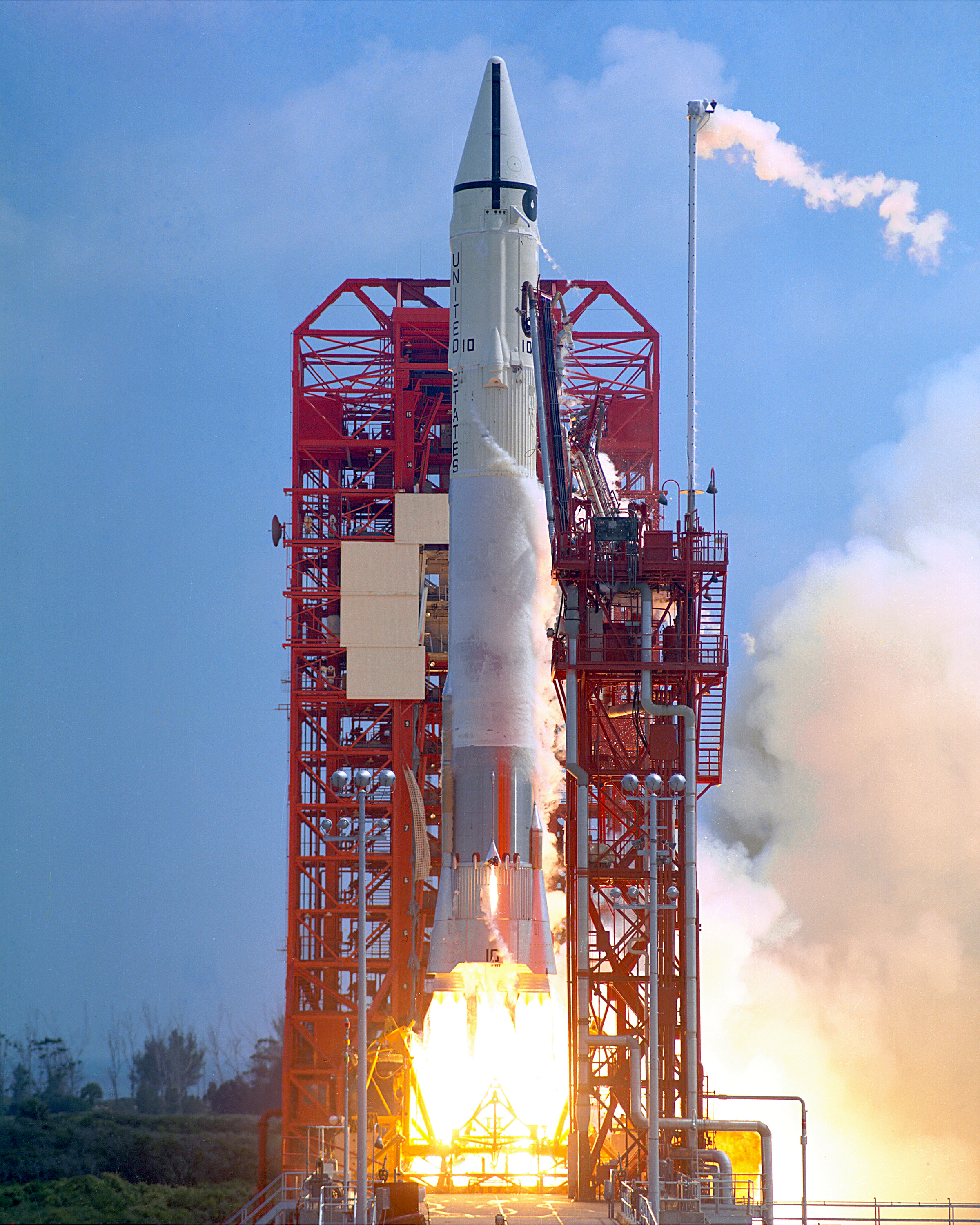
The Centaur was originally developed for use with the Atlas launch vehicle family. Known in early planning as the 'high-energy upper stage', the choice of the mythological Centaur as a namesake was intended to represent the combination of the brute force of the Atlas booster and finesse of the upper stage.
Initial Atlas-Centaur launches used developmental versions, labeled Centaur-A through -C.
The only Centaur-A launch on 8 May 1962 ended in an explosion 54 seconds after liftoff when insulation panels on the Centaur separated early, causing the LH2 tank to overheat and rupture. This version was powered by two RL10A-1 engines.
After extensive redesigns, the only Centaur-B flight on 26 November 1963 was successful. This version was powered by two RL10A-3 engines.
Centaur-C flew three times between 1964 and 1965, with two failures and one launch declared successful although the Centaur failed to restart. This version was also powered by two RL10A-3 engines.
Centaur-D was the first version to enter operational service in 1965 , with fifty-six launches. It was powered by two RL10A-3-1 or RL10A-3-3 engines.
On 30 May 1966, an Atlas-Centaur boosted the first Surveyor lander towards the Moon. This was followed by six more Surveyor launches over the next two years, with the Atlas-Centaur performing as expected. The Surveyor program demonstrated the feasibility of reigniting a hydrogen engine in space and provided information on the behavior of LH2 in space.
By the 1970s, Centaur was fully mature and had become the standard rocket stage for launching larger civilian payloads into high Earth orbit, also replacing the Atlas-Agena vehicle for NASA planetary probes.
An updated version, called Centaur-D1A (powered by RL10A-3-3 engines), was used on the Atlas-SLV3D came into use during the 1970s.
The Centaur-D1AR was used for the Atlas-SLV3D and Atlas G came into use during the 1970s and 1980s.
By the end of 1989, Centaur-D had been used as the upper stage for 63 Atlas rocket launches, 55 of which were successful.
Saturn I S-V
Main article: S-V
The Saturn I was designed to fly with a S-V third stage to enable payloads to go beyond low Earth orbit (LEO). The S-V stage was intended to be powered by two RL-10A-1 engines burning liquid hydrogen as fuel and liquid oxygen as oxidizer. The S-V stage was flown four times on missions SA-1 through SA-4, all four of these missions had the S-V's tanks filled with water to be used a ballast during launch. The stage was not flown in an active configuration.
Centaur D-1T (Titan III)

The Centaur D-1T (powered by RL10A-3-3 engines) was an improved version for use on the far more powerful Titan III booster in the 1970s, with the first launch of the resulting Titan IIIE in 1974. The Titan IIIE more than tripled the payload capacity of Atlas-Centaur, and incorporated improved thermal insulation, allowing an orbital lifespan of up to five hours, an increase over the 30 minutes of the Atlas-Centaur.
The first launch of Titan IIIE in February 1974 was unsuccessful, with the loss of the Space Plasma High Voltage Experiment (SPHINX) and a mockup of the Viking probe. It was eventually determined that Centaur's engines had ingested an incorrectly installed clip from the oxygen tank.
The next Titan-Centaurs launched Helios 1, Viking 1, Viking 2, Helios 2, Voyager 1, and Voyager 2. The Titan booster used to launch Voyager 1 had a hardware problem that caused a premature shutdown, which the Centaur stage detected and successfully compensated for. Centaur ended its burn with less than 4 seconds of fuel remaining.
Centaur D-1T specifications
The Centaur D-1T had the following general specifications:
- Diameter: 126 in
- Length: 31.5 ft
- Inert mass: 4028 lb
- Fuel: Liquid hydrogen
- Oxidizer: Liquid oxygen
- Fuel and oxidizer mass: 29750 lb
- Guidance:
- Thrust:
- Burn Capability: 3 to 4 burns
- Engine: 2 x RL10A-3-3
- Engine start: Restartable
- Attitude control: 4 x 6 lbf thrusters
Shuttle-Centaur
Main article: Shuttle-Centaur
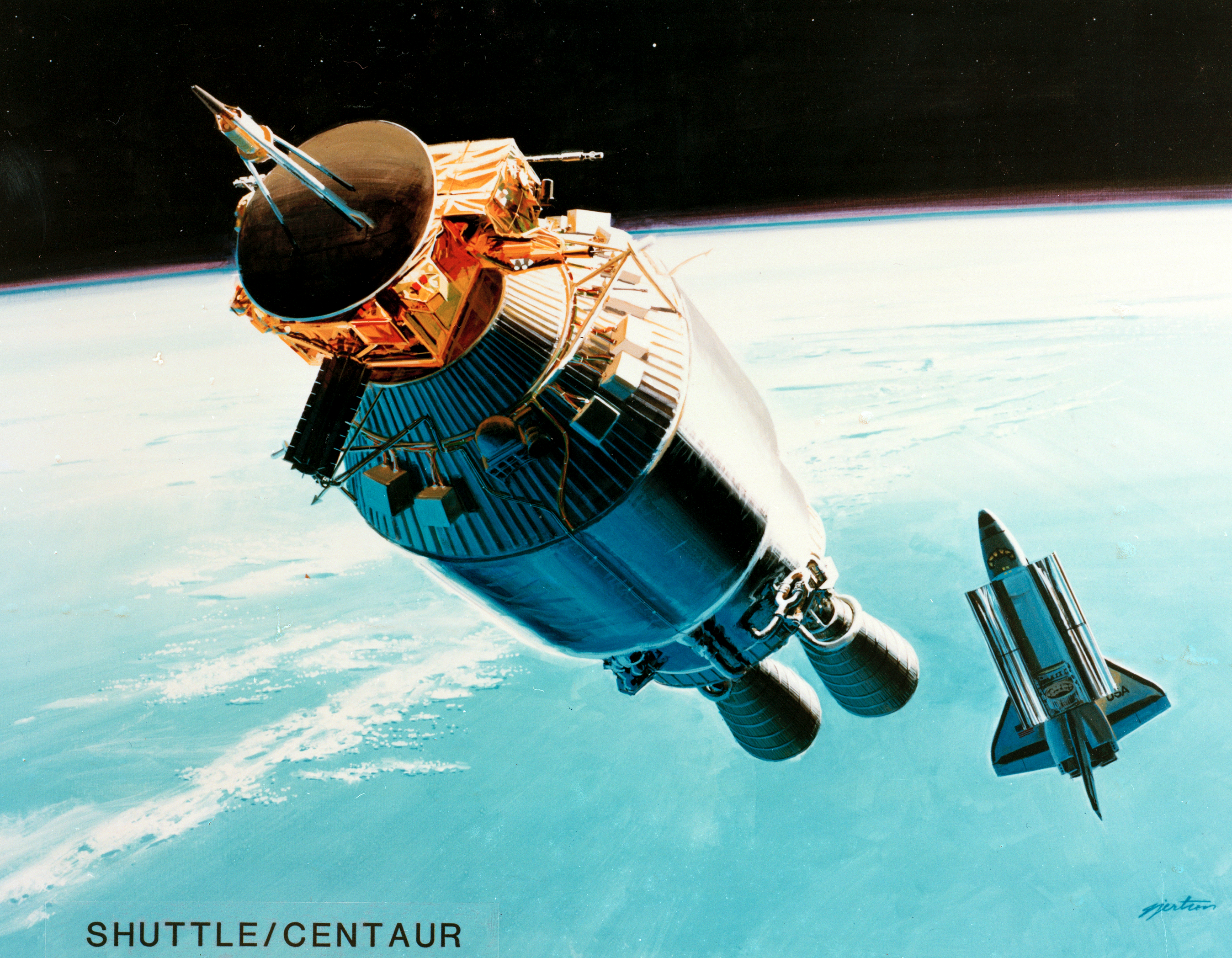
Shuttle-Centaur was a proposed Space Shuttle upper stage. To enable its installation in shuttle payload bays, the diameter of the Centaur's hydrogen tank was increased to 14 ft, with the LOX tank diameter remaining at 10 ft. Two variants were proposed: Centaur GPrime, which was planned to launch the Galileo and Ulysses robotic probes, and Centaur G, a shortened version, reduced in length from approximately 30 to, planned for U.S. DoD payloads and the Magellan Venus probe.
After the Space Shuttle Challenger disaster, just months before the Shuttle-Centaur had been scheduled to fly, NASA concluded that it was too risky to fly the Centaur on the Shuttle. The probes were launched with the much less powerful solid-fueled Inertial Upper Stage, with Galileo needing multiple gravitational assists from Venus and Earth to reach Jupiter.
Centaur T (Titan IV)
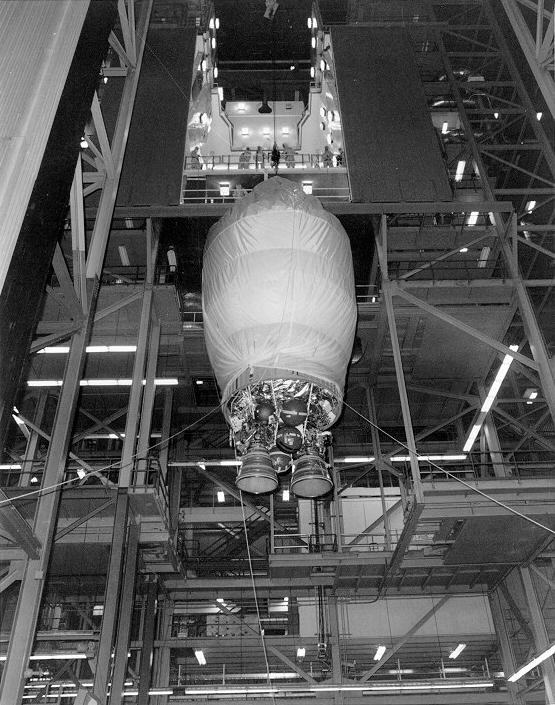
The capability gap left by the termination of the Shuttle-Centaur program was filled by a new launch vehicle, the Titan IV. The 401A/B versions used a Centaur upper stage with a 14 ft diameter hydrogen tank. In the Titan 401A version, a Centaur-T was launched nine times between 1994 and 1998. The 1997 Cassini-Huygens Saturn probe was the first flight of the Titan 401B, with an additional six launches wrapping up in 2003 including one SRB failure.
Centaur I (Atlas I)
Main article: Atlas I
The upper stage of the Atlas I was the Centaur I stage, derived from earlier models of Centaur that also flew atop Atlas boosters. Centaur I featured two RL-10-A-3A engines burning liquid hydrogen and liquid oxygen, making the stage extremely efficient. To help slow the boiloff of liquid hydrogen in the tanks, Centaur featured fiberglass insulation panels that were jettisoned 25 seconds after the first stage booster engines were jettisoned. Centaur I was the last version of the stage to feature separating insulation panels.
Centaur II (Atlas II/III)
Main article: Atlas II

Centaur II was initially developed for use on the Atlas II series of rockets.
Centaur III/Common Centaur (Atlas III/V)
Main article: Atlas III

Atlas IIIB introduced the Common Centaur, a longer and initially dual engine Centaur II.
Centaur III specifications
Source: Atlas V551 specifications, as of 2015.
- Diameter: 3.05 m (10 ft)
- Length: 12.68 m (42 ft)
- Inert mass: 2,247 kg (4,954 lb)
- Fuel: Liquid hydrogen
- Oxidizer: Liquid oxygen
- Fuel and oxidizer mass: 20,830 kg (45,922 lb)
- Guidance: Inertial
- Thrust: 99.2 kN (22,300 lbf)
- Burn time: Variable; e.g., 842 seconds on Atlas V
- Engine: RL10-C-1
- Engine length: 2.32 m (7.6 ft)
- Engine diameter: 1.53 m (5 ft)
- Engine dry weight: 168 kg (370 lb)
- Engine start: Restartable
- Attitude control: 4 x 27 N thrusters, 8 x 40 N thrusters
- Propellant: Hydrazine
Atlas V cryogenic fluid management experiments
Most Common Centaurs launched on Atlas V have hundreds to thousands of kilograms of propellants remaining on payload separation. In 2006 these propellants were identified as a possible experimental resource for testing in-space cryogenic fluid management techniques.
In October 2009, the Air Force and United Launch Alliance (ULA) performed an experimental demonstration on the modified Centaur upper stage of DMSP-18 launch to improve "understanding of propellant settling and slosh, pressure control, RL10 chilldown and RL10 two-phase shutdown operations. DMSP-18 was a low mass payload, with approximately 28% (5400 kg) of LH2/LOX propellant remaining after separation. Several on-orbit demonstrations were conducted over 2.4 hours, concluding with a deorbit burn. The initial demonstration was intended to prepare for more-advanced cryogenic fluid management experiments planned under the Centaur-based CRYOTE technology development program in 2012–2014, and will increase the TRL of the Advanced Cryogenic Evolved Stage Centaur successor.
Mishaps
Although Centaur has a long and successful flight history, it has experienced a number of mishaps:
- April 7, 1966: Centaur did not restart after coast — ullage motors ran out of fuel.
- August 10, 1968: AC-17. Centaur did not restart after coast — icing of the hydrogen peroxide supply lines.
- May 9, 1971: Centaur guidance failed, destroying itself and the Mariner 8 spacecraft bound for Mars orbit.
- April 18, 1991: AC-70. Centaur failed to restart (icing problem). Incomplete failure investigation initially stated that Centaur failed due to particles from the scouring pads used to clean the propellant ducts getting stuck in the turbopump, preventing start-up.
- August 22, 1992: AC-71. Centaur failed to restart (same icing problem as the prior incident).
- April 30, 1999: Launch of the USA-143 (Milstar DFS-3m) communications satellite failed when a Centaur database error resulted in uncontrolled roll rate and loss of attitude control, placing the satellite in a useless orbit.
- June 15, 2007: the engine in the Centaur upper stage of an Atlas V shut down early, leaving its payload — a pair of National Reconnaissance Office ocean surveillance satellites — in a lower than intended orbit. The failure was called "A major disappointment," though later statements claim the spacecraft will still be able to complete their mission. The cause was traced to a stuck-open valve that depleted some of the hydrogen fuel, resulting in the second burn terminating four seconds early. The problem was fixed, and the next flight was nominal.
- March 23–25, 2018: Atlas V Centaur passivated second stage launched on September 8, 2009, broke up.
- August 30, 2018: Atlas V Centaur passivated second stage launched on September 17, 2014, broke up, creating space debris.
- April 6, 2019: Atlas V Centaur passivated second stage launched on October 17, 2018, broke up.
- September 6, 2024: Atlas V Centaur passivated second stage launched on March 1, 2018, broke up.
References
References
- (March 2010). "Atlas V Launch Services User's Guide". United Launch Alliance.
- Kanayama, Lee. (May 9, 2022). "As Centaur turns 60 years old, ULA prepares to evolve Centaur V". [[NASASpaceFlight.com]].
- Reich, Eugen. (2020). "Raketen: Die Internationale Enzyklopädie". Motorbuch Verlag.
- (May 11, 2018). "United Launch Alliance Selects Aerojet Rocketdyne's RL10 Engine". ULA.
- Foust, Jeff. (November 28, 2023). "New RL10 engine to be introduced on Vulcan in 2025". SpaceNews.
- "RL10 Propulsion System Datasheet". L3Harris.
- (October 16, 2023). "Vulcan Launch Systems User's Guide".
- Berger, Eric. (December 11, 2018). "Getting Vulcan up to speed: Part one of our interview with Tory Bruno".
- . (2018). ["Vulcan Centaur"](https://www.ulalaunch.com/rockets/vulcan-centaur). *United Launch Alliance*.
- "Origin of NASA Names". NASA Science and Technical Information Office.
- [https://www.nasa.gov/centers/glenn/about/history/centaur.html NASA.gov]
- (23 May 2019). "Yes. The Amazing Centaur in its dual RL10 configuration.".
- (July 15, 2005). "The Rocket Company". [[American Institute of Aeronautics and Astronautics]].
- (2004). "Taming Liquid Hydrogen: The Centaur Upper Stage Rocket 1958–2002". NASA.
- Bruno, Tory. (August 28, 2025). "ICYMI: Great discussion with Amanda Bacchetti, one of our Directors for Vulcan Development – we talked reuse, Centaur V development and our focus on long duration, including ACES".
- Bruno, Tory. (March 31, 2020). "Good catch. It should say H2/O2. A thruster that uses propellant from the main tank instead of a stand alone system".
- "Atlas V USSF-12 Launch Delivers Two National Security Space Payloads to GEO | the Aerospace Corporation".
- (June 5, 2024). "Boeing's Starliner launches astronauts for 1st time in historic liftoff (Photos, video)".
- (January 7, 2024). "Vulcan successfully launches Peregrine lunar lander on inaugural flight".
- Zegler, Frank. (2010-09-02). "Evolving to a Depot-Based Space Transportation Architecture". AIAA.
- (2015-04-13). "ULA's Vulcan Rocket To be Rolled out in Stages". SpaceNews.
- (December 13, 2014). "Atlas V NROL-35 Launch Updates". Spaceflight 101.
- Rae Botsford End. (December 13, 2014). "new RL10C engine debuts on classified NROL-35 launch". Spaceflight Insider.
- (2019). "Atlas V Cutaway".
- "Aft Bulkhead Carrier Auxiliary Payload User's Guide". United Launch Alliance.
- "DUAL RL10 ENGINE CENTAUR DEBUTS ON ATLAS V TO ENSURE SAFE LAUNCH OF ASTRONAUTS TO LOW EARTH ORBIT". Aerojet Rocket.
- (2015-04-13). "America, meet Vulcan, your next United Launch Alliance rocket". Denver Post.
- Bruno, Tory. (October 10, 2017). "Building on a successful record in space to meet the challenges ahead". Space News.
- (April 14, 2015). "ULA chief explains reusability and innovation of new rocket". Spaceflight Now.
- Erwin, Sandra. (March 25, 2018). "Air Force stakes future on privately funded launch vehicles. Will the gamble pay off?". [[SpaceNews]].
- Bruno, Tory. (March 9, 2018). "Internally, the current version of Centaur flying atop Atlas is technically a 'Centaur III.' Since we are only flying one Centaur at present, we've just call it 'Centaur.' Vulcan will have an upgraded Centaur. Internally, we refer to that as the 'Centaur V'".
- (May 11, 2018). "United Launch Alliance Selects Aerojet Rocketdyne's RL10 Engine". ULA.
- (September 11, 2020). "ULA studying long-term upgrades to Vulcan". SpaceNews.
- Erwin, Sandra. (April 7, 2021). "Bruno: The next big thing for ULA is a long-endurance upper stage".
- Belam, Martin. (2024-01-08). "Nasa Peregrine 1 launch: Vulcan Centaur rocket carrying Nasa moon lander lifts off in Florida – live updates". the Guardian.
- (September 25, 2019). "Vulcan Centaur Cutaway Poster".
- "Oct. 4 LIVE Broadcast: Vulcan Cert-2". [[United Launch Alliance]].
- "RL10 Engine | L3Harris® Fast. Forward.".
- Wade, Mark. (November 17, 2011). "RL-10A-4-2".
- "RL10 Engine". Aerojet Rocketdyne.
- (August 5, 2011). "Cryogenic Propulsion Stage". NASA.
- "Atlas-V with RL10C powered Centaur".
- "Evolution of Pratt & Whitney's cryogenic rocket engine RL-10".
- (March 2019). "Aerojet Rocketdyne RL10 Propulsion System".
- [[NASA]]. (n.d.). "SPC Centaur Testing".
- "Atlas Centaur LV-3C Development History".
- https://www.gd.com/about-gd/our-history 1990–1994
- "Origin of NASA Names". NASA Science and Technical Information Office.
- "Centaur".
- "Centaur Upper Stage Family".
- "Atlas-SLV3D Centaur-D1A".
- "Atlas-SLV3C Centaur-D Star-37E".
- "Atlas-SLV3D Centaur-D1AR".
- "Atlas-G Centaur-D1AR".
- Krebs, Gunter. "Centaur". Gunter's Space Page.
- (March 26, 2011). "What are the fastest spacecraft we've ever built?".
- (2016-09-27). "Centaur Upper Stage Family".
- (1980). "Graphite/Epoxy Composite Adapters for the Space Shuttle/Centaur Vehicle". Scientific and Technical Information Division of the NASA Office of Management.
- "Titan 4 Launch".
- Mark Wade. "Atlas I".
- (December 3, 2002). "The Centaur Upper Stage Vehicle". Lockheed Martin.
- "Atlas V 551".
- Sakla, Steven. (2006). "Centaur Test Bed (CTB) for Cryogenic Fluid Management". NASA.
- [http://www.ulalaunch.com/site/docs/publications/SuccessfulFlightDemonstrationConductedbytheAirForceandUnitedLaunchAllianceWillEnhanceSpaceTransportation_.pdf Successful Flight Demonstration Conducted by the Air Force and United Launch Alliance Will Enhance Space Transportation: DMSP-18] {{webarchive. link. (2011-07-17 , ''[[United Launch Alliance]]'', October 2009, accessed 2011-01-23.)
- [http://spirit.as.utexas.edu/~fiso/telecon/Kutter_11-10-10/Kutter_11-10-10.pdf Propellant Depots Made Simple] {{Webarchive. link. (February 6, 2011 , Bernard Kutter, ''[[United Launch Alliance]]'', FISO Colloquium, 2010-11-10, accessed 2011-01-10.)
- Wade, Mark. "Titan". Encyclopedia Astronautica.
- Lewis Research Center (1972) [https://ntrs.nasa.gov/citations/19720017275 ''Atlas-Centaur AC-17 performance for applications technology satellite ATS-D mission''] NASA TM X-2525
- Pyle, Rod. (2012). "Destination Mars". [[Prometheus Books]].
- "The Space Review: Launch failures: an Atlas Groundhog Day".
- Rummerman, Judy A.. (1988). "NASA Historical Data Book". National Aeronautics and Space Administration.
- [https://nssdc.gsfc.nasa.gov/nmc/spacecraft/display.action?id=1999-023A ''MILSTAR 3'' — Description.]
- "NRO Shortfall May Delay Upcoming ULA Missions".
- Covault, Craig. (July 3, 2007). "AF Holds To EELV Schedule". Aerospace Daily & Defense Report.
- Ray, Justin. (October 9, 2007). "Atlas Rocket Team Ready for Wednesday Satellite Launch". Spaceflight Now.
- Ray, Justin. "AV-011: Mission Status Center". Spaceflight Now.
- . (April 12, 2019). ["Rocket break up provides rare chance to test debris formation"](http://www.esa.int/Our_Activities/Space_Safety/Rocket_break-up_provides_rare_chance_to_test_debris_formation). *[[European Space Agency]]*.
- David, Leonard. (April 23, 2019). "Cluttering Up Space: U.S. Rocket Stage Explodes".
- Agapov, Vladimir. (September 29, 2018). "Major fragmentation of Atlas 5 Centaur upper stage 2014-055B (SSN #40209)". [[International Academy of Astronautics]] Space Debris Committee.
- (April 24, 2019). "#18SPCS confirmed breakup of ATLAS 5 CENTAUR R/B (2018-079B, #43652) on April 6, 2019. Tracking 14 associated pieces – no indication caused by collision.".
- . ["ATLAS 5 CENTAUR R/B"](https://www.n2yo.com/satellite/?s=43652).
- (September 9, 2024). "FAA to complete orbital debris upper stage regulations in 2025".
- Mangels, John. (December 11, 2011). "Long-forgotten Shuttle/Centaur boosted Cleveland's NASA center into manned space program and controversy". [[The Plain Dealer]].
This article was imported from Wikipedia and is available under the Creative Commons Attribution-ShareAlike 4.0 License. Content has been adapted to SurfDoc format. Original contributors can be found on the article history page.
Ask Mako anything about Centaur (rocket stage) — get instant answers, deeper analysis, and related topics.
Research with MakoFree with your Surf account
Create a free account to save articles, ask Mako questions, and organize your research.
Sign up freeThis content may have been generated or modified by AI. CloudSurf Software LLC is not responsible for the accuracy, completeness, or reliability of AI-generated content. Always verify important information from primary sources.
Report