From Surf Wiki (app.surf) — the open knowledge base
Census of Quirinius
Census of Judea taken by Publius Sulpicius Quirinius in 6
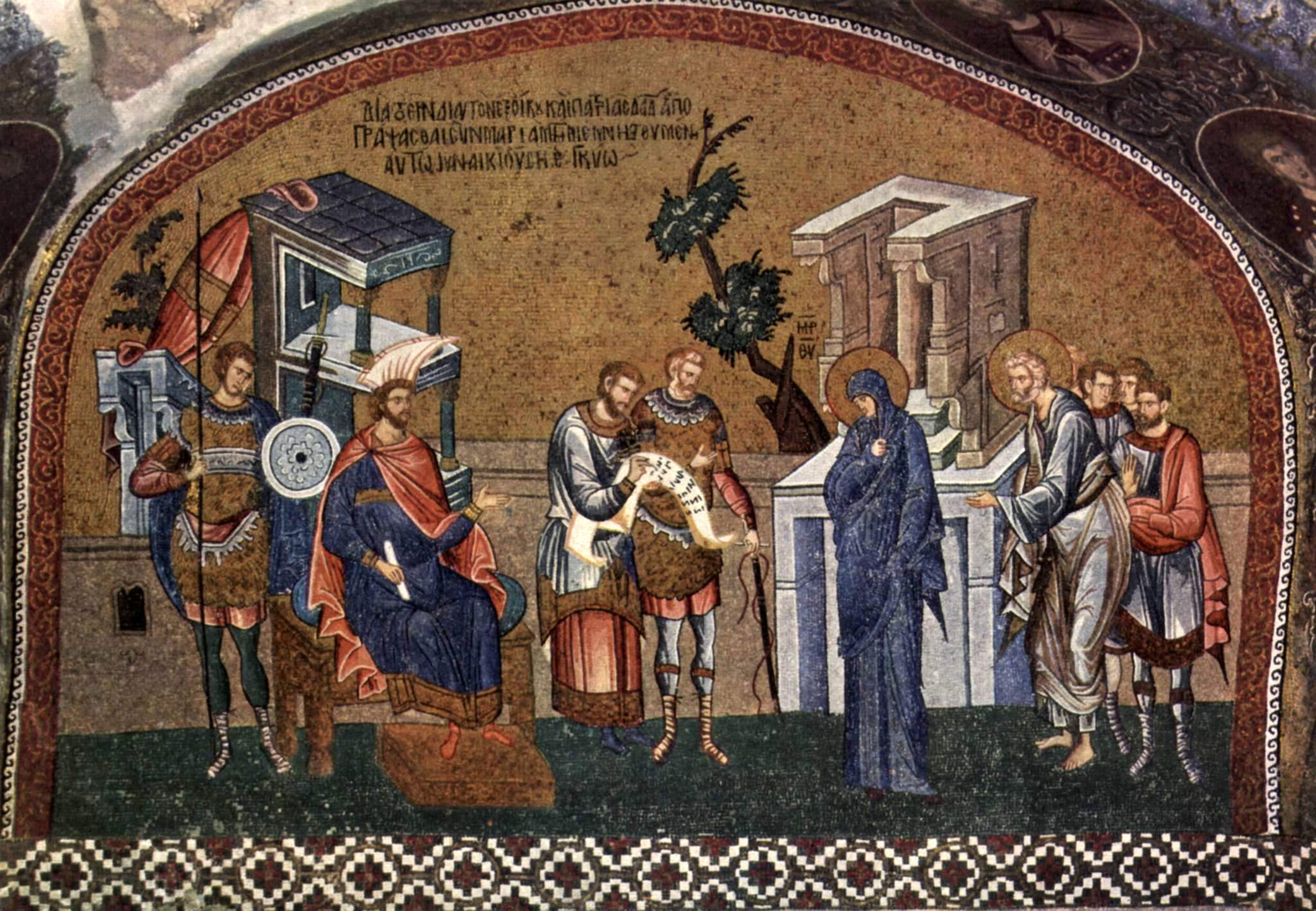
Census of Judea taken by Publius Sulpicius Quirinius in 6
The Census of Quirinius was a census of the Roman province of Judaea taken in 6 CE, upon its formation, by the governor of Roman Syria, Publius Sulpicius Quirinius. The census triggered a revolt of Jewish extremists (called Zealots) led by Judas of Galilee.
The Gospel of Luke uses the Census of Quirinius to date the birth of Jesus but also cites the time of Herod the Great (who died between 5 BCE and 1 CE), while the Gospel of Matthew only references Herod the Great. Most critical scholars agree that Luke is in error, while some religious scholars have attempted to defend the gospel, sometimes invoking unproven claims.
Overview
Herod I (Herod the Great, ), was a Roman client king whose territory included Judea. Upon his death, his kingdom was divided into four, each section ruled by a family member. In 6 CE, Emperor Augustus deposed Herod Archelaus, who had ruled the largest section (for a decade according to first-century Roman-Jewish historian Josephus), and converted his territory into the Roman province of Judaea.
In order to install an ad valorem property tax in the new province, Publius Sulpicius Quirinius, the legate (governor) of the province of Roman Syria starting in 6 CE, was assigned to carry out a census in Judaea. This would record the names of the owners of taxable property, along with its value, for which they would be taxed. Josephus states that Quirinius was sent to conduct the census and collect Archelaus's property 37 years after the Battle of Actium (31 BCE). The later historian Cassius Dio also recorded 6 CE as the start of Archelaus's exile.
The census triggered a revolt of Jewish extremists (called Zealots) led by Judas of Galilee. (Galilee itself was a separate territory under the rule of Herod Antipas.) Judas seems to have found the census objectionable because it ran counter to a biblical injunction (the traditional Jewish reading of ) and because it would lead to taxes paid in heathen coins bearing an image of the emperor.
Gospel of Luke
The Gospel of Matthew places Jesus' birth in the time of Herod I. This is affirmed by the Gospel of Luke (), but it subsequently correlates the birth with the census ():
In those days a decree went out from Caesar Augustus that all the world should be registered. This was the first registration and was taken while Quirinius was governor of Syria. All went to their own towns to be registered. [Saint Joseph
Joseph]] also went from the town of [[Nazareth]] in Galilee to Judea, to the city of [[David]] called [[Bethlehem]], because he was descended from [David]. He went to be registered with [[Mary, mother of Jesus
Most critical [biblical scholars agree that the Gospel of Luke is erroneous. Its author seems to have invoked the census as Joseph and Mary's motivation for departing "their own city" of Nazareth, Galilee, for Bethlehem. Additionally, the author may have wished to contrast Joseph and Mary's obedience to the Roman edict with the rebelliousness of the Zealots, and also to find a prophetic fulfilment of Psalm 87:6: "In the census of the peoples, [princes] will be born there." (Luke and Matthew also give different accounts of the family's departure from Bethlehem.) Catholic priest and biblical scholar Joseph Fitzmyer states:
Scholars point out that there was no single census of the entire Roman Empire under Augustus and the Romans did not directly tax client kingdoms; further, no Roman census required that people travel from their own homes to those of their ancestors. A census of Judaea would not have affected Joseph and his family, who lived in Galilee under a different ruler; the revolt of Judas of Galilee suggests that Rome's direct taxation of Judaea was new at the time. Catholic priest and biblical scholar Raymond E. Brown postulates that Judas's place of origin may have led the author of Luke to think that Galilee was subject to the census. Brown also points out that in the Acts of the Apostles, Luke the Evangelist (the traditional author of both books) dates Judas's census-incited revolt as following the rebellion of Theudas, which took place four decades later.
Attempted defences
The 2nd-century Christian apologist Justin Martyr claimed, without evidence, that the record of the census was still available and that it showed that Jesus was born in Bethlehem. Another Christian apologist, Tertullian (), suggested that Jesus' family was recorded in a census of Judaea conducted by Sentius Saturninus, the governor of Syria from 9–7 BCE.
In his 4th-century Ecclesiastical History, the Greek Christian bishop Eusebius dated the census to 3/2 BCE, after Herod's death but conveniently agreeing with and that Jesus was "about thirty" in the 15th year of Emperor Tiberius's reign.
The 5th-century theologian and historian Orosius refers to an Augustan census in which allegiance to the emperor was sworn, allegedly including the newborn Christ. Josephus refers to a similar census of the Jews (possibly occurring a year before Herod's death), which 6,000 Pharisees abstained from.
A number of modern scholars have attempted to defend Luke, which according to biblical scholar Géza Vermes contradicts historical fact, assuming that the gospel refers to the Census of Quirinius. Some conservative scholars have generally posited that an earlier census took place, invoking unproven claims. Historian Ralph Martin Novak explains that both Quirinius's career and the names and dates of the governors are well documented and there is no time before 6 CE when Quirinius could have served an earlier term as governor of Syria. Novak points out that such views spring from biblical inerrancy, the belief that the Bible is without error. Vermes describes attempts to defend the historicity of the biblical birth narratives as "exegetical acrobatics". The United States Conference of Catholic Bishops holds that the various attempts to resolve the difficulties have proved unsuccessful, suggesting that the author of Luke may have simply combined Jesus' birth in Bethlehem with the census for theological reasons, perhaps vaguely remembering that one was conducted by Quirinius.
Several unsubstantiated versions of the two-census hypothesis have been advanced by some conservative scholars. Paul Barnett, bishop and historian, theorizes that a census unrelated to taxation took place before Quirinius's tenure. In a 1984 article for the Journal of the Evangelical Theological Society (JETS), Wayne Brindle argues that the gospel's translation is ambiguous and thus refers to an earlier census held during Herod the Great's reign, as a result of the turbulent circumstances towards the end of his life; Brindle further argues that Quirinus held administrative power in the Syria region around that time, as part of a dual governorship with Gaius Sentius Saturninus, the former holding military and the latter political power. In a 2012 Perspectives on Science and Christian Faith article, James A. Nollet asserts that Quirinius served two terms as governor of Syria and took two censuses in Judea, the earlier one being a universal census by Augustus allegedly taken in 2 BCE. In 2021, Dominican scholar Anthony Giambrone called for "a more generous interpretation" of Luke to counter Augustan propaganda which purportedly could have been used to obscure a universal census of Roman regions conducted separately over a number of years.
In 1978, biblical scholar I. Howard Marshall argued in his commentary on the Greek text of Luke that instead of reading "This census was first made when Quirinius was governor" (emphasis added), the gospel should be read as saying, "This census took place before the one when Quirinius was governor"; theological scholar Brook W. R. Pearson made similar arguments in 1999. Additionally, in 1995, hobbyist Bible scholar Colin Humphreys argued that such an interpretation could refer to a non-taxing census (mentioned by Orosius and possibly dated to Herod's last years by Josephus)—ostensibly aligning with a candidate for the Nativity story's Star of Bethlehem, a comet of 5 BCE noted in the Chinese Book of Han. In 2024, the Southeastern Baptist Theological Seminary argued that the gospel only mentions the well-known Census of Quirinius as a reference point and also that the word for 'governor' could be translated to an earlier post held by Quirinius.
In a 2011 JETS article, John H. Rhoads argues that Josephus's accounts of religious revolts by Judas of Galilee, one shortly after Herod's death and another in 6 CE, were both accidental duplications of an earlier revolt by "Judas son of the Sepphorean", whose execution Herod ordered. In the earliest account, the high priest is deposed and replaced by a Joazar, who is deposed once or twice in each of the other two stories.
Additionally, some writers state that in ancient literature, strict chronology is secondary to narrative coherence, and thus events could be excusably reordered. David J. Armitage claims Luke 3 as an example because it gives an overview of John the Baptist's ministry up to his imprisonment before discussing his baptism of Jesus. Armitage argues that Luke refers to the Census of Quirinius as a similar anachronistic digression, briefly flashing years forward from the Nativity before returning to it,{{efn|Armitage proposes that the gospel could logically be rendered:
Now, it transpired that the days were completed for her to give birth when they were in that place, and she gave birth to her firstborn son ...}}}} with the confusion ostensibly stemming from the author's "overly generous estimation of the historical literacy of his readers".
Gallery
|Brueghel7.jpg|Pieter Bruegel the Elder, The Census at Bethlehem (1566), oil on wood panel, Royal Museums of Fine Arts of Belgium |File:Volkstelling te Bethlehem, RP-P-OB-44.916.jpg|Jan Luyken, Joseph and Mary taking the census (1700), etching and book print, Haarlem, Netherlands|File:Maria en Jozef bij de volkstelling in Bethlehem, RP-P-1896-A-19368-2100.jpg|Jan Luyken, Joseph and Mary taking the census (1703), etching and book print, Haarlem, Netherlands|
References
Footnotes
Citations
Bibliography
References
- Rhoads, John H.. (March 2011). "Josephus Misdated the Census of Quirinius". [[Journal of the Evangelical Theological Society]].
- {{Bibleverse. Matthew. 2:16–18
- [[Robert W. Funk. Funk, Robert W.]] and the [[Jesus Seminar]] (1998). ''The Acts of Jesus: The Search for the Authentic Deeds of Jesus.'' HarperSanFrancisco. "Birth & Infancy Stories" pp. 497–526.
- {{Bibleverse. Luke. 2:39
- {{Bibleverse. Luke. 2:22–40
- {{Bibleverse. Matthew. 2:23
- J.A. Fitzmyer, ''The Gospel According to Luke I-IX'' (AB, 28; Garden City, NY: Doubleday, 1981), p. 393
- Barnett, Paul. (29 March 2005). "The Birth of Christianity: The First Twenty Years". Wm. B. Eerdmans Publishing.
- Kellum, L. Scott. (2020). "Acts". B&H Publishing Group.
- {{cite wikisource. Justin Martyr. The First Apology, Chapter XXXIV
- Osborn, Eric Francis. (1973). "Justin Martyr". [[Mohr Siebeck]].
- {{cite wikisource. Tertullian. Against Marcion, Book IV, Chapter XIX
- Di Segni, Leah (2005). [https://museum.imj.org.il/journal/archive/2005/images/A%20Roman%20Standard%20in%20Herod's%20Kingdom%20Leah%20D%20i%20Segni.pdf "A Roman Standard in Herod's Kingdom"], Israel Museum Studies in Archaeology 4: 23–48.
- Graham, Daryn. "Luke's Census and Dating the Birth of Christ" in ''Archaeological Diggings'' Volume 20, #6-2013, Issue 119, December 2013–January 2014, pp. 20–25.
- Humphreys, Colin. (October 1995). "The Star of Bethlehem". [[Science and Christian Belief]].
- Pearson, Brook W. R.. (1999). "The Lucan Censuses, Revisited". [[Catholic Biblical Quarterly]].
- Porter, Stanley E.. (2003). "Paul, Luke and the Graeco-Roman World: Essays in Honour of Alexander J.M. Wedderburn". Bloomsbury Publishing.
- Huebner, Sabine R.. (2019). "Papyri and the Social World of the New Testament". Cambridge University Press.
- "Luke, CHAPTER 2".
- (1984). "The Census and Quirinus: Luke 2:2". [[Journal of the Evangelical Theological Society]].
- Nollet. (December 2012). "Astronomical and Historical Evidence for Dating the Nativity in 2 BC". [[Perspectives on Science and Christian Faith]].
- Giambrone, Anthony. (2021). "Augustus as Censor and Luke's Worldwide Enrollment: Roman Propaganda and Lukan Theology from the Margins". Revista Bíblica.
- Marshall, I. Howard, The Gospel of Luke: A Commentary on the Greek Text, Exeter (Paternoster Press), 1978, 104.
- Darville, Jono. (2024-05-20). "The Census: Did Luke Make a Mistake?".
- (2012). "Misreading Scripture with Western Eyes: Removing Cultural Blinders to Better Understand the Bible". [[InterVarsity Press]].
- Licona, Michael R.. (2016). "Why Are There Differences in the Gospels: What We Can Learn from Ancient Biography". [[Oxford University Press]].
- Armitage, David J.. (2018). "Detaching the Census: An Alternative Reading of Luke 2:1-7". [[Tyndale Bulletin]].
This article was imported from Wikipedia and is available under the Creative Commons Attribution-ShareAlike 4.0 License. Content has been adapted to SurfDoc format. Original contributors can be found on the article history page.
Ask Mako anything about Census of Quirinius — get instant answers, deeper analysis, and related topics.
Research with MakoFree with your Surf account
Create a free account to save articles, ask Mako questions, and organize your research.
Sign up freeThis content may have been generated or modified by AI. CloudSurf Software LLC is not responsible for the accuracy, completeness, or reliability of AI-generated content. Always verify important information from primary sources.
Report