From Surf Wiki (app.surf) — the open knowledge base
Celje

| Field | Value | |
|---|---|---|
| name | Celje | |
| native_name_lang | sl | |
| settlement_type | Town | |
| image_skyline | {{multiple image | |
| border | infobox | |
| perrow | 1/2/2 | |
| total_width | 280 | |
| align | center | |
| caption_align | center | |
| image1 | View of Celje (28189851435).jpg | |
| caption1 | View from the castle | |
| image2 | Celjski dom in Celje.jpg | |
| caption2 | Celje Hall | |
| image3 | Celje - Stara grofija.jpg | |
| caption3 | Old Count Manor | |
| image4 | Assumption of Mary Church (Celje) 01.jpg | |
| caption4 | St. Mary's Church | |
| image5 | Celje National Hall (2).jpg | |
| caption5 | National Hall | |
| image6 | Celjski grad s Pečovnika.jpg | |
| caption6 | Celje Castle | |
| image_flag | Flag of Celje.svg | |
| image_shield | Coat_of_arms_of_Celje.svg | |
| nickname | The Princely Town | |
| () | ||
| pushpin_map | Slovenia | |
| pushpin_label_position | left | |
| pushpin_map_caption | Location of the city of Celje in Slovenia | |
| coordinates | ||
| subdivision_type | Country | |
| subdivision_name | ||
| subdivision_type1 | Traditional region | |
| subdivision_name1 | Styria | |
| subdivision_type2 | Statistical region | |
| subdivision_name2 | Savinja | |
| subdivision_type3 | Municipality | |
| subdivision_name3 | Celje | |
| established_title | Town rights | |
| established_date | 11 April 1451 | |
| parts_type | Districts & local communities | |
| parts_style | list | |
| p1 | ||
| p2 | ||
| government_type | ||
| leader_party | Levica | |
| leader_title | Mayor | |
| leader_name | Matija Kovač | |
| unit_pref | Metric | |
| area_footnotes | ||
| area_total_km2 | 22.7 | |
| <!-- Elevation --------------------------> | elevation_footnotes | |
| elevation_m | 238 | |
| elevation_min_m | ||
| population_footnotes | ||
| population_total | 38059 | |
| population_as_of | 2025 | |
| population_density_km2 | auto | |
| population_blank1_title | Municipality | |
| population_blank1 | 49628 | |
| population_note | ||
| timezone | CET | |
| utc_offset | +1 | |
| timezone_DST | CEST | |
| utc_offset_DST | +2 | |
| <!-- Area/postal codes & others --------> | postal_code_type | Postal code |
| postal_code | 3000 | |
| area_code | 03 | |
| blank_name | Climate | |
| blank_info | Dfb | |
| registration_plate | CE | |
| website | ||
| footnotes | Source: Statistical Office of the Republic of Slovenia, census of 2002. |
the city in Slovenia
()
Celje ( ; ; ) is the third-largest city in Slovenia. It is a regional center of the traditional Slovenian region of Styria and the administrative seat of the City Municipality of Celje. The town is located below Upper Celje Castle at the confluence of the Savinja, Hudinja, Ložnica, and Voglajna rivers in the lower Savinja Valley, and at the crossing of the roads connecting Ljubljana, Maribor, Velenje, and the Central Sava Valley.
Name
Celje was known as Celeia during the Roman period. Early attestations of the name during or following Slavic settlement include Cylia in 452, ecclesiae Celejanae in 579, Zellia in 824, in Cilia in 1310, Cilli in 1311, and Celee in 1575. The proto-Slovene name *Ceľe or *Celьje, from which modern Slovene Celje developed, was borrowed from Vulgar Latin Celeae. The name is of pre-Roman origin and its further etymology is unclear. In the local Slovene dialect, Celje is called Cjele or Cele. In German it is called Cilli, and it is known in Italian as Cilli or Celie.
History
Bronze Age to 18th century
The first settlement in the area of Celje appeared during the Hallstatt era. The settlement was known in the Celtic times and to Ancient Greek historians as Kelea; findings suggest that Celts coined Noric money in the region.
Once the area was incorporated in the Roman Empire in 15 BC, it was known as Civitas Celeia. It received municipal rights in AD 45 under the name municipium Claudia Celeia during the reign of the Roman Emperor Claudius (41–54). Records suggest that the town was rich and densely populated, secured with the walls and towers, containing multi-storied marble palaces, wide squares, and streets. It was called Troia secunda, the second; or small Troy. A Roman road through Celeia led from Aquileia (Sln. Oglej) to Pannonia. Celeia soon became a flourishing Roman colony, and many great buildings were constructed, such as the temple of Mars, which was known across the Empire. Celeia was incorporated into Aquileia c. 320 under the Roman Emperor Constantine I (272–337).
The city was razed by Slavic tribes during the Migration period of the 5th and 6th centuries, but was rebuilt in the Early Middle Ages. The first mention of Celje in the Middle Ages was under the name of Cylie in Wolfhold von Admont's Chronicle, which was written between 1122 and 1137. The town was the seat of the Counts of Celje from 1341 to 1456, with princely status from 1436. It acquired market-town status in the first half of the 14th century and town privileges from Count Frederick II on 11 April 1451.
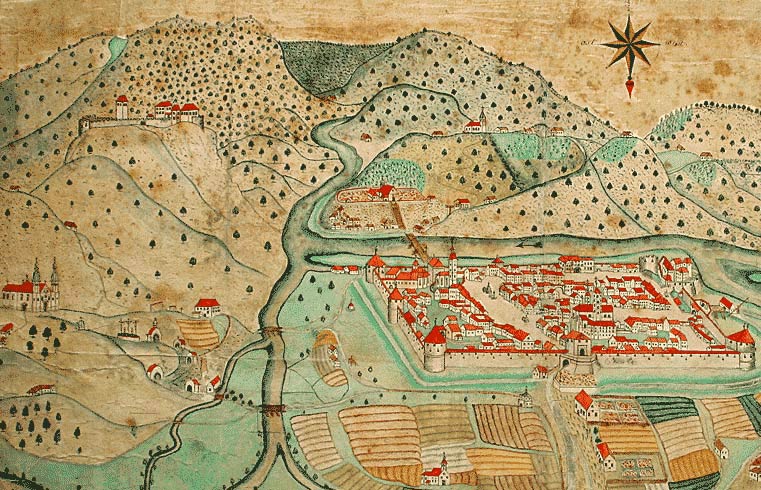

After the Counts of Celje died out in 1456, the region was inherited by the Habsburgs of Austria and administered by the Duchy of Styria. The city walls and defensive moat were built in 1473. The town defended itself against Turks and in 1515 during great Slovene peasant revolt against peasants, who had taken Old Castle.
Many local nobles converted to Protestantism during the Protestant Reformation, but the region was converted back to Roman Catholicism during the Counter-Reformation.
19th century to Second World War
Celje became part of the Habsburgs' Austrian Empire during the Napoleonic Wars. In 1867, after the defeat of Austria in the Austro-Prussian War and the ensuing Austro-Hungarian Compromise, the town became part of the Austrian-ruled section of Austria-Hungary.
The first service on the Vienna-Trieste railway line came through Celje on 27 April 1846. In 1895, Celje secondary school, established in 1808, began to teach in Slovene.
At the end of the 19th century and in the early 20th century, Celje was a center of German nationalism which had repercussions for Slovenes. The 1910 census showed that 66.8% of the population was German. A symbol of this was the German Cultural Center (), built in 1906 and opened on 15 May 1907, today the Celje Hall (). The centuries-old German name of the town, Cilli, sounded no longer German enough to some German residents, the form Celle being preferred by many.
Population growth was steady during this period. In 1900, Celje had 6,743 inhabitants and by 1924 this had grown to 7,750. The National Hall (Narodni dom), which hosts the mayor's office and town council today, was built in 1896. The first telephone line was installed in 1902 and the city received electric power in 1913.
Slovene and German ethnic nationalism increased during the 19th and early 20th centuries. With the collapse of Austria-Hungary in 1918 as a result of World War I, Celje became part of the Kingdom of Serbs, Croats and Slovenes (later known as Yugoslavia). During this period, the town experienced a rapid industrialization and a substantial growth in population.
Second World War
Celje was occupied by Nazi Germany in April 1941. The Gestapo arrived in Celje on 16 April 1941 and were followed three days later by SS leader Heinrich Himmler, who inspected Stari pisker prison. During the war, the city suffered from allied bombing, aimed at important communication lines and military installations. The National Hall was severely damaged.
The toll of the war on the city was heavy. The city (including nearby towns) had a pre-war population of 20,000 and lost 575 people during the war, mostly between the ages of 20 and 30. More than 1,500 people were deported to Serbia or into the German interior of the Third Reich. Around 300 people were interned and around 1,000 people imprisoned in Celje's prisons. An unknown number of citizens were forcibly conscripted into the German army. Around 600 "stolen children" were taken to Nazi Germany for Germanization. A monument in Celje called Vojna in mir (War and Peace) by the sculptor Jakob Savinšek, commemorates the World War II era.
After the end of the war, the remaining German-speaking portion of the populace was expelled or executed. Anti-tank trenches and other sites were used to create 25 mass graves in Celje and its immediate surroundings and were filled with Croatian, Serbian, and Slovenian militia members that had collaborated with the Germans, as well as ethnic German civilians from Celje and surrounding areas.
Independent Slovenia
Celje became part of independent Slovenia following the Ten-Day War in 1991. On 7 April 2006, Celje became the seat of a new Diocese of Celje, created by Pope Benedict XVI within the Archdiocese of Maribor.
Sights
The town's tourist sights include a Grayfriars' monastery founded in 1241 and a palace from the 16th century.
The parish church, dating from the 14th century, with its Gothic chapel, is a specimen of medieval architecture. The so-called German church, in Romanesque style, belonged to the monastery, which was closed in 1808. The throne of the counts of Cilli is preserved here, and also the tombs of several members of the family.
Geography
Climate
Celje has a continental climate (Köppen climate classification Dfb). | Jan record high C = 17.1 | Feb record high C = 21.4 | Mar record high C = 25.5 | Apr record high C = 28.9 | May record high C = 32.6 | Jun record high C = 36.9 | Jul record high C = 37.0 | Aug record high C = 39.7 | Sep record high C = 33.3 | Oct record high C = 26.9 | Nov record high C = 22.8 | Dec record high C = 20.0 | year record high C = 39.7 | Jan record low C = −29.2 | Feb record low C = −28.4 | Mar record low C = −24.2 | Apr record low C = −9.1 | May record low C = −4.2 | Jun record low C = −0.7 | Jul record low C = 3.7 | Aug record low C = 2.5 | Sep record low C = −2.2 | Oct record low C = −8.6 | Nov record low C = −19.5 | Dec record low C = −23.2 | year record low C = −29.2 | Jan snow depth cm = 5 | Feb snow depth cm = 6 | Mar snow depth cm = 2 | Apr snow depth cm = 0 | May snow depth cm = 0 | Jun snow depth cm = 0 | Jul snow depth cm = 0 | Aug snow depth cm = 0 | Sep snow depth cm = 0 | Oct snow depth cm = 0 | Nov snow depth cm = 1 | Dec snow depth cm = 3 | year snow depth cm = 1.5 | archive-url = https://web.archive.org/web/20230821172907/https://meteo.arso.gov.si/met/sl/climate/tables/statistike_1950_2020/celje_medlog/ | archive-date = 21 August 2023 | access-date = 21 August 2023}}{{Cite web | archive-url = https://web.archive.org/web/20230821174102/https://meteo.arso.gov.si/uploads/probase/www/climate/table/en/by_location/celje/climate-normals_81-10_Celje_eng.pdf | archive-date = 21 August 2023 | access-date = 21 August 2023}} | archive-url = https://web.archive.org/web/20230821174443/https://www.nodc.noaa.gov/archive/arc0216/0253808/1.1/data/0-data/Region-6-WMO-Normals-9120/Slovenia/CSV/Celje_14023.csv | archive-date = 21 August 2023 | access-date = 21 August 2023}} Ogimet
Symbols

The coat of arms of Celje are based on the coat of arms of the Counts of Celje.
The coat-of-arms of Celje was selected for the national arms immediately after World War I in 1918, when Slovenia together with Croatia and Serbia formed the original Kingdom of Serbs, Croats and Slovenes (later Yugoslavia). A similar coat of arms was integrated into the Slovenian national arms in 1991.
Districts and local communities
The city of Celje is divided into 10 districts (mestne četrti) and the municipality has 9 local communities (krajevne skupnosti):
Districts
- Center
- Dečkovo Naselje
- Dolgo Polje
- Gaberje
- Hudinja
- Karel Destovnik Kajuh
- Lava
- Nova Vas
- Savinja
- Slavko Šlander Local communities
- Aljažev Hrib
- Ljubečna
- Medlog
- Ostrožno
- Pod Gradom
- Škofja Vas
- Šmartno v Rožni Dolini
- Teharje
- Trnovlje
Demographics
|1439|1000 |1798|1,400 |1820|1,635 |1834|1,511 |1840|1,793 |1900|6,743 |1924|7,750 |1940|20,000 |1981|33,033|1991|41,279|2002|37,834|2011|37,520|2021|37,392| source =
In 1991 the population consisted of:
- Slovenes: 33,434 (82.1%)
- Serbs: 1,864 (4.6%)
- Croats: 1,687 (4.1%)
- ethnic Muslims: 466 (1.1%)
- Yugoslavs: 405 (1%)
- Albanians: 189
- Macedonians: 140
- Montenegrins: 93
- Hungarians: 41
- Others: 82
- Unknown: 1,972 (4.8%)
- Undeclared: 249
- Regionally declared: 88
Education
Celje does not have its own university, although some college-level education has been established in the city.
- The Faculty of Logistics, formally part of the University of Maribor, was established in Celje in 2005.
- International School for Social and Business Studies
- Faculty of Commercial and Business Sciences
- UP Faculty of Management
Law and government
Mayor
The current mayor of Celje is Matija Kovač.
Vice mayors
The current vice mayors of Celje are Saša Kundih, Samo Seničar and Uroš Lesjak.
Courts
In Celje there are three courts of general jurisdiction:
- Celje Higher Court;
- Celje District Court;
- Celje Local Court.
In addition to that there are also Celje Labour Court for resolving labour law disputes and an external department of Administrative Court for resolving disputes arising from administrative procedures.
Communications
.jpg)
Postal number: SI-3000 (from 1991). (Old one: 63000 (between 1945–1991)).
Sports
Sports clubs based in Celje include football club NK Celje, basketball club KK Celje, handball club RK Celje, ice hockey club HK Celje.
International relations
Twin towns and sister cities
Celje is twinned with
- MNE Budva, Montenegro (1984)
- SRB Ćuprija, Serbia (1966)
- BIH Doboj, Bosnia and Hercegovina (1965)
- TUR Gaziantep, Turkey (2014)
- GER Grevenbroich, Germany (1986)
- SRB Šabac, Serbia (2012)
- RUS Shchyolkovo, Russia (2017)
- GER Singen, Germany (1990)
- CRO Sisak, Croatia (1965)
- CRO Slavonski Brod, Croatia (2010)
- SRB Sombor, Serbia (1986)
- MKD Veles, North Macedonia (1979)
Celje also cooperates with Cherepovets in Russia and has informal friendly relations with Graz and Spittal an der Drau in Austria.
Notable people
- Anna of Celje (1381–1416), Queen consort of Poland
- Lenore Aubert (1918–1993), Hollywood actress and model
- Barbara of Celje (1390/1395–1451), second wife of Sigismund, Holy Roman Emperor
- (1915–2001), film actress
- Gregor Cankar (born 1975), athlete
- Jolanda Čeplak (born 1976), athlete
- Anica Černej (1900–1944), poet, author, and schoolmistress
- Janez Drnovšek (1950–2008), politician, statesman, and third president of Slovenia
- Janez Drozg (1933–2005), television director
- Dejan Glavnik (born 1975), Slovenian extreme cyclist
- (born 1964), singer
- Bojan Gorišek (born 1962), pianist
- Hermann II of Celje (1365–1435), Count of Celje, Ortenburg and Seger
- Andrej Hieng (1925–2000), writer, playwright, screenwriter and dramaturgist
- (1943–2015), critic, essayist, theatrologist and dramaturgist
- Lea Jagodič (born 1991), basketball player
- Romana Jordan Cizelj (born 1966), physicist and politician
- Boban Jović (born 1991), footballer
- Jelko Kacin (born 1955), politician
- Alma Karlin (1889–1950), traveller, author, poet, and collector
- Margareta of Celje (1411–1480), noblewoman member of the House of Celje, duchess of Głogów and Ścinawa.
- Margit Korondi (born 1932), gymnast, Olympic champion
- (1937–2012), geophysicist and seismologist
- Janez Lapajne (born 1967), film director
- Marianne Elisabeth Lloyd-Dolbey (1919–1994), personal secretary to the Brunei sultan Omar Ali Saifuddien III
- Janko Orožen (1891–1989), historian, honorary citizen
- Oto Pestner (born 1956), musician and singer
- Milan Pogačnik (born 1946), politician
- Lucija Polavder (born 1984), judoka
- (1914–1947), worker, victim of the communist regime
- Fran Roš (1898–1976), writer, poet, playwright, honorary citizen
- Johann Gabriel Seidl (1804–1875), archeologist, poet, storyteller and dramatist
- Bina Štampe Žmavc (born 1952), poet and author
- Tina Trstenjak (born 1990), judoka, Olympic champion
- Beno Udrih (born 1982), basketball player
- Bogumil Vošnjak (1882–1955), scholar, politician, diplomat
- Urška Žolnir (born 1981), judoka, Olympic champion
Gallery
File: File: File:Celje - panoramio.jpg|Town Hall File:Slovenia IMG 7590 (19609559536).jpg|Post Building File:Železniška postaja Celje.jpg|Railway Station File:Celje Cathedral 18.jpg|Celje Cathedral File:Ducal Court in Celje (1).jpg|Ducal Court File:Celje Water Tower, July 2007.JPG|Water Tower File:Saint Cecilia's Parish Church, Celje 01.JPG|St. Cecilia's Church File:Glavni trg in Celje (2).jpg|Main Square Houses File:Hohenwarter house in Celje (2).jpg|Hohenwarter house File:SLO-Celje08-2.JPG|Stane Street File:The Celje Ceiling (stropna freska, Stara grofija).jpg|The Celje Ceiling from the Old's Counts Mansion File:View over Celje from the Old town.JPG|View from the Castle File:2023-05-23 Celje detail 01.jpg|View over the river
References
References
- (2002). "Nadmorska višina naselij, kjer so sedeži občin". Statistical Office of the Republic of Slovenia.
- "Population - selected indicators, municipalities and settlements, Slovenia, annually". Statistical Office of the Republic of Slovenia.
- "Celje". Slovenski pravopis 2001.
- (2009). "Etimološki slovar slovenskih zemljepisnih imen". Modrijan.
- "The history of Celje: From the Celts and Romans to the Counts and Yugoslavia to the EU".
- For more information on the 1910 Austro-Hungarian census, see ''Geographischer Atlas zur Vaterlandskunde an der österreichischen Mittelschulen''. K. u. k. Hof-Kartographische Anstalt G. Freytag & Berndt, [[Vienna]] 1911.
- {{EB1911
- . (27 June 2025). ["14023: Celje (Slovenia)"](https://www.ogimet.com/cgi-bin/gsynres?lang=en&ind=14023&ndays=30&ano=2025&mes=06&day=27&hora=07&ord=REV&Send=Send). *OGIMET*.
- Orožen, pp. 362-365
- "Slovenia: Major Cities".
- "Partnerska mesta". Mestna občina Celje.
- [http://www.iaspei.org/newsletters/iaspei_newsletter_june_2012.pdf Motnikar, Barbara Šket, & Andrej Gosar. 2012. Obituaries: Janez Lapajne, 1937–2012. ''IASPEI Newsletter'' (June/July): 4.] {{webarchive. link. (2015-09-04)
This article was imported from Wikipedia and is available under the Creative Commons Attribution-ShareAlike 4.0 License. Content has been adapted to SurfDoc format. Original contributors can be found on the article history page.
Ask Mako anything about Celje — get instant answers, deeper analysis, and related topics.
Research with MakoFree with your Surf account
Create a free account to save articles, ask Mako questions, and organize your research.
Sign up freeThis content may have been generated or modified by AI. CloudSurf Software LLC is not responsible for the accuracy, completeness, or reliability of AI-generated content. Always verify important information from primary sources.
Report