From Surf Wiki (app.surf) — the open knowledge base
Cedrus atlantica
Species of conifer

Species of conifer
the tree species
Cedrus atlantica, the Atlas cedar, is a species of tree in the pine family Pinaceae, native to the Rif and Atlas Mountains of Morocco (Middle Atlas, High Atlas), and to the Tell Atlas in Algeria. A majority of the modern sources treat it as a distinct species Cedrus atlantica, but some sources consider it a subspecies of Lebanon cedar (C. libani subsp. atlantica).
Description

Fully grown, Atlas cedar is a large coniferous evergreen tree, 30 to (rarely 40 m) tall, with a trunk diameter of 1.5 to. It is very similar in all characters to the other varieties of Lebanon cedar; differences are hard to discern. The mean cone size tends to be somewhat smaller (although recorded to 12 cm,
Ecology
Atlas cedar form forests on mountainsides at 1,170 to, often in pure forests, or mixed with Algerian fir - Abies numidica, Juniperus oxycedrus, holm oak - Quercus ilex, and Acer opalus. These forests can provide habitat for the endangered Barbary macaque (Macaca sylvanus), a primate that had a prehistorically much wider distribution in northern Morocco and Algeria.
Currently, Morocco has the highest total surface of Atlas cedar in the world, and it forms vast forests in the humid zones of the country, around the Middle-Atlas range, the oriental and Northern High-Atlas range, and in the Western and Central Rif mountain range. The current total area is around 163,000 hectares, of which around 115,000 hectares (80%) are situated in the Middle-Atlas mountains. The species is in danger from human use, wood harvesting and fires. Data that go back to 1927 show higher number of Atlas cedars (more than 150,000 hectares) in the Middle-Atlas mountains only. The Rif mountains had one of the largest cedar forests in the past, but forests nowadays are much smaller, 15% of the total cedar forests in Morocco. Recently massive reforestation campaigns have taken place in the region of Ifrane Province.
In Algeria, the Atlas cedar has been in significant decline. According to data from 1966 the species inhabited 23,000 hectares, forming forests around the Djurdjura Mountains in Kabylie and Aures Mountains. However, it is expected that it currently inhabits fewer than 15,000 hectares owing to extensive fires and human use.
Cultivation and uses
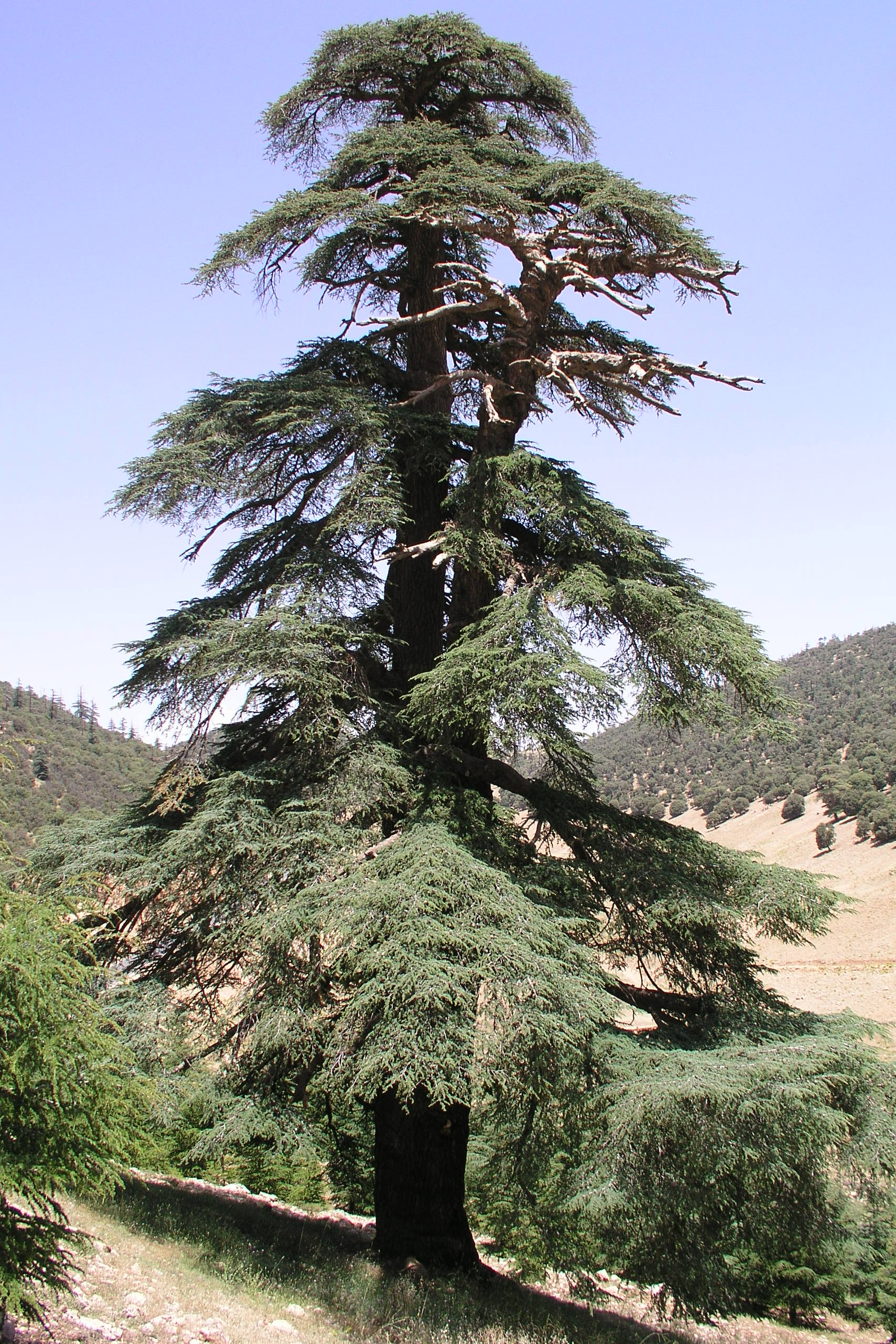
Landscape
C. atlantica is common in cultivation as an ornamental tree in temperate climates. In garden settings, often the glaucous forms are planted as ornamental trees, distinguished as the Glauca group, a cultivar group. Also, fastigiate, pendulous, and golden-leaf forms are in cultivation. The Atlas cedar is useful in cultivation because it is more tolerant of dry and hot conditions than most conifers.
Many of the cultivated trees have glaucous (bluish) foliage, more downy shoots, and can have more leaves in each whorl; young trees in cultivation often have more ascending branches than many cultivated C. atlantica specimens.
In the UK the following cultivars have gained the Royal Horticultural Society's Award of Garden Merit (confirmed 2017):
- 'Aurea' (golden Atlas cedar){{cite web
- 'Glauca' (Glauca Group){{cite web
- 'Glauca Pendula' (Glauca Group){{cite web
An Atlas cedar is planted at the White House South Lawn in Washington, DC. President Carter ordered a tree house built within the cedar for his daughter Amy. The wooden structure was designed by the President himself, and is self-supporting so as not to cause damage to the tree.
Forestry

Cedar plantations, mainly with C. atlantica, have been established in southern France for timber production.
References
References
- Thomas, P.. (2013). "''Cedrus atlantica''".
- Gaussen, H. (1964). Genre ''Cedrus''. Les Formes Actuelles. ''Trav. Lab. For. Toulouse'' T2 V1 11: 295-320
- Gymnosperm database [http://www.conifers.org/pi/ce/index.htm ''Cedrus''].
- GRIN Taxonomy for Plants [http://www.ars-grin.gov/cgi-bin/npgs/html/splist.pl?2217 ''Cedrus''] {{webarchive. link. (2009-01-20 .)
- NCBI Taxonomy Browser [https://www.ncbi.nlm.nih.gov/Taxonomy/Browser/wwwtax.cgi?mode=Tree&id=3321&lvl=3&p=mapview&p=has_linkout&p=blast_url&p=genome_blast&lin=f&keep=1&srchmode=1&unlock ''Cedrus''].
- Flora of China [http://www.efloras.org/florataxon.aspx?flora_id=2&taxon_id=105979 vol. 4]
- Qiao, C.-Y., Jin-Hua Ran, Yan Li and Xiao-Quan Wang (2007): Phylogeny and Biogeography of ''Cedrus'' (Pinaceae) Inferred from Sequences of Seven Paternal Chloroplast and Maternal Mitochondrial DNA Regions. ''Annals of Botany'' '''100(3)''':573-580. Available [https://archive.today/20120529113829/http://aob.oxfordjournals.org/cgi/content/full/100/3/573 online]
- Farjon, A. (1990). ''Pinaceae. Drawings and Descriptions of the Genera''. Koeltz Scientific Books {{ISBN. 3-87429-298-3.
- Farjon, A. (2008). ''A Natural History of Conifers''. Timber Press {{ISBN. 0-88192-869-0.
- Christou, K. A. (1991). The genetic and taxonomic status of Cyprus cedar, ''Cedrus brevifolia'' (Hook.) Henry. Mediterranean Agronomic Institute of Chania, Greece.
- Güner, A., Özhatay, N., Ekim, T., & Başer, K. H. C. (ed.). 2000. ''Flora of Turkey and the East Aegean Islands'' 11 (Supplement 2): 5–6. Edinburgh University Press. {{ISBN. 0-7486-1409-5
- Eckenwalder, J. E. (2009). ''Conifers of the World: The Complete Reference''. Timber Press {{ISBN. 0-88192-974-3.
- only rarely over 9 cm long, compared to up to 10 cm in ''C. brevifolia'', and 12 cm in ''C. libani''), though with considerable overlap (all can be as short as 6 cm). The ''Cedrus atlantica'' leaf length (10–25 mm) is similar that of ''C. libani'' subsp. ''stenocoma'', on average longer than ''C. brevifolia'' and shorter than ''C. libani'' subsp. ''libani'', but again with considerable overlap.Schwarz, O. (1944). Anatolica. ''Feddes Repertorium'' 54: 26-34.
- link. (August 31, 2009)
- Walters, W. M. (1986). ''European Garden Flora'' Vol 1. {{ISBN. 0-521-24859-0.
- (July 2017). "AGM Plants - Ornamental". Royal Horticultural Society.
- "The White House Historical Association > Picturing the President's House".
This article was imported from Wikipedia and is available under the Creative Commons Attribution-ShareAlike 4.0 License. Content has been adapted to SurfDoc format. Original contributors can be found on the article history page.
Ask Mako anything about Cedrus atlantica — get instant answers, deeper analysis, and related topics.
Research with MakoFree with your Surf account
Create a free account to save articles, ask Mako questions, and organize your research.
Sign up freeThis content may have been generated or modified by AI. CloudSurf Software LLC is not responsible for the accuracy, completeness, or reliability of AI-generated content. Always verify important information from primary sources.
Report