From Surf Wiki (app.surf) — the open knowledge base
CD74
Mammalian protein found in humans
Mammalian protein found in humans
HLA class II histocompatibility antigen gamma chain also known as HLA-DR antigens-associated invariant chain or CD74 (Cluster of Differentiation 74), is a protein that in humans is encoded by the CD74 gene. The invariant chain (Abbreviated Ii) is a polypeptide which plays a critical role in antigen presentation. It is involved in the formation and transport of MHC class II peptide complexes for the generation of CD4+ T cell responses.{{cite web
Function
The nascent MHC class II protein in the rough endoplasmic reticulum (RER) binds a segment of the invariant chain (Ii; a trimer) in order to shape the peptide-binding groove and prevent the formation of a closed conformation.
The invariant chain also facilitates the export of MHC class II from the RER in a vesicle. The signal for endosomal targeting resides in the cytoplasmic tail of the invariant chain. This fuses with a late endosome containing the endocytosed antigen proteins (from the exogenous pathway). Binding to Ii ensures that no antigen peptides from the endogenous pathway meant for MHC class I molecules accidentally bind to the groove of MHC class II molecules. The Ii is then cleaved by cathepsin S (cathepsin L in cortical thymic epithelial cells), leaving only a small fragment called CLIP remaining bound to the groove of MHC class II molecules. The rest of the Ii is degraded. CLIP blocks peptide-binding until HLA-DM interacts with MHC II, releasing CLIP and allowing other peptides to bind. In some cases, CLIP dissociates without any further molecular interactions, but in other cases the binding to the MHC is more stable.
The stable MHC class II + antigen complex is then presented on the cell surface. Without CLIP, MHC class II aggregates disassemble and/or denature in the endosomes, and proper antigen presentation is impaired.
Clinical significance
Vaccine adjuvant
The Ii molecule—fused with a viral vector to a conserved region of the Hepatitis C virus (HCV) genome—has been tested as an adjuvant for a HCV vaccine in a cohort of 17 healthy human volunteers. This experimental vaccine was well-tolerated, and those who received the adjuvanted vaccine had stronger anti-HCV immune responses (enhanced magnitude, breadth and proliferative capacity of anti-HCV-specific T-cells) compared with volunteers who received the vaccine that lacked the Ii adjuvant.
The Ii molecule might also prove to be useful as an adjuvant for a future vaccine for the SARS-CoV-2 virus, if this enhancing effect can be demonstrated to apply to the appropriate antigen(s).
Cancer
Found on a number of cancer cell types. Possible cancer therapy target. See milatuzumab.
Axial spondyloarthritis
Autoantibodies against CD74 have been identified as promising biomarkers in the early diagnosis of the autoimmune disease called axial spondyloarthritis (non-radiographic axial spondyloarthritis and radiographic axial spondyloarthritis / Ankylosing spondylitis).
Interactions
CD74 receptor interacts with the cytokine Macrophage migration inhibitory factor (MIF) to mediate some of its functions.
Recovery functions
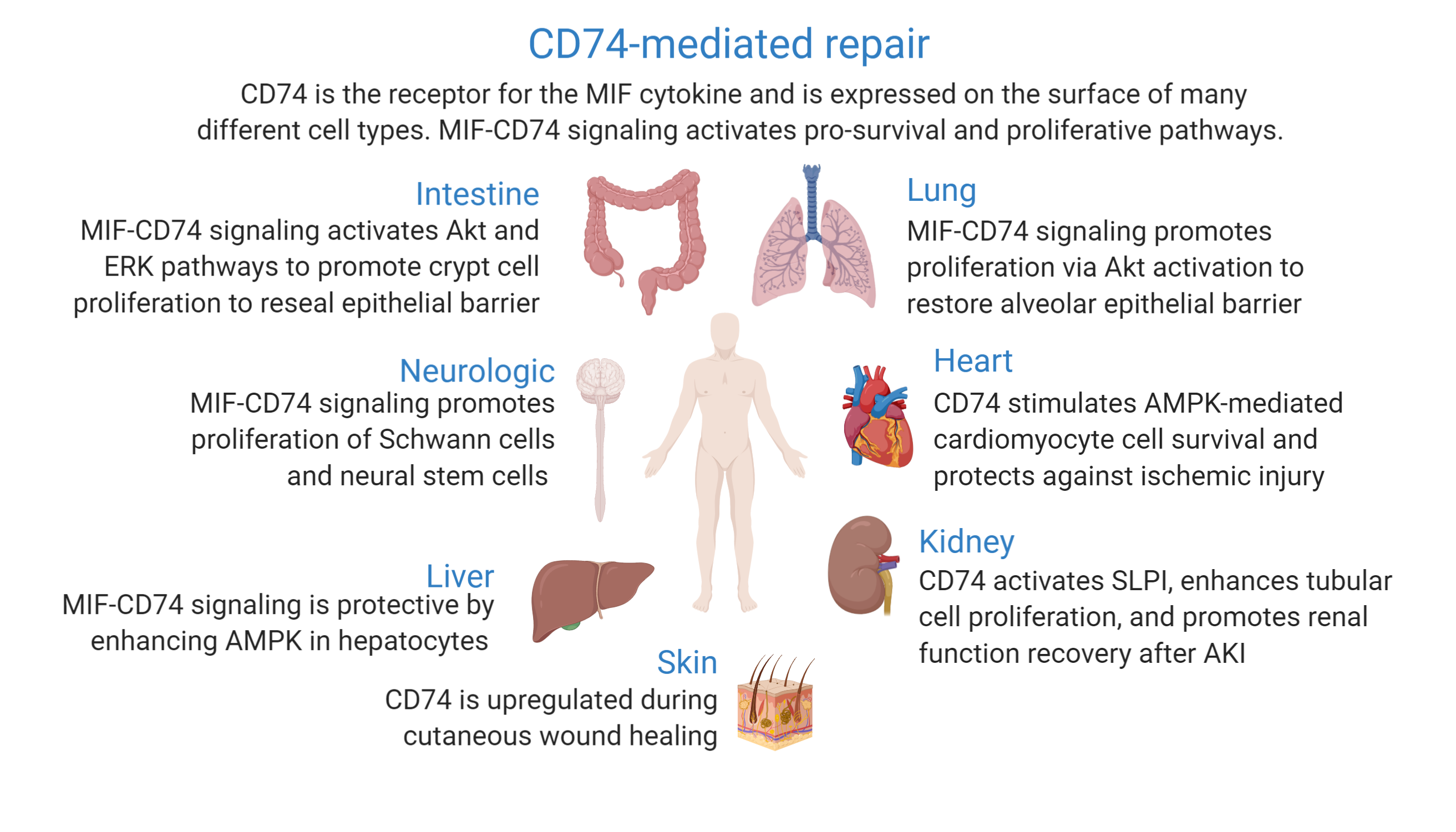
CD74 receptor is expressed on the surface of different cell types. Interaction between MIF cytokine and its cell membrane receptor CD74 activates pro-survival and proliferative pathways that protect against injury and promote healing in different parts of the body.
History
The invariant chain was first described by Patricia P. Jones, Donal B. Murphy, Derek Hewgill, and Hugh McDevitt at Stanford. The nomenclature "Ii" comes from an Ix-based naming system (I for Immune) that predates the naming of the Major Histocompatibility Complex.
References
References
- (December 1983). "cDNA clone for the human invariant gamma chain of class II histocompatibility antigens and its implications for the protein structure". Proceedings of the National Academy of Sciences of the United States of America.
- (December 1985). "Structure of the human gene encoding the invariant gamma-chain of class II histocompatibility antigens". Nucleic Acids Research.
- (1994). "Assembly, transport, and function of MHC class II molecules". Annual Review of Immunology.
- (2020). "Role of MIF Cytokine/CD74 Receptor Pathway in Protecting Against Injury and Promoting Repair". Frontiers in Immunology.
- (2013). "Kuby immunology". W.H. Freeman.
- (February 2012). "The mechanism of HLA-DM induced peptide exchange in the MHC class II antigen presentation pathway". Current Opinion in Immunology.
- (April 1999). "HLA-DM - an endosomal and lysosomal chaperone for the immune system". Trends in Biochemical Sciences.
- (June 2020). "MHC class II invariant chain-adjuvanted viral vectored vaccines enhances T cell responses in humans". Science Translational Medicine.
- (June 24, 2020). "Adjuvanted viral-vectored vaccine promising against hepatitis C in early trial". GI Health Foundation.
- (June 2014). "Autoantibodies against CD74 in spondyloarthritis". Annals of the Rheumatic Diseases.
- (March 2020). "Targeting Parasite-Produced Macrophage Migration Inhibitory Factor as an Antivirulence Strategy With Antibiotic-Antibody Combination to Reduce Tissue Damage". The Journal of Infectious Diseases.
- (February 2010). "Spinal macrophage migration inhibitory factor contributes to the pathogenesis of inflammatory hyperalgesia in rats". Pain.
- (December 2009). "The crystal structures of macrophage migration inhibitory factor from Plasmodium falciparum and Plasmodium berghei". Protein Science.
- (November 2009). "The dexamethasone-induced inhibition of proliferation, migration, and invasion in glioma cell lines is antagonized by macrophage migration inhibitory factor (MIF) and can be enhanced by specific MIF inhibitors". The Journal of Biological Chemistry.
- (July 2009). "Dual role of macrophage migration inhibitory factor (MIF) in human breast cancer". BMC Cancer.
- (2020). "Role of MIF Cytokine/CD74 Receptor Pathway in Protecting Against Injury and Promoting Repair". Frontiers in Immunology.
- (January 1979). "Detection of a common polypeptide chain in I--A and I--E sub-region immunoprecipitates". Molecular Immunology.
This article was imported from Wikipedia and is available under the Creative Commons Attribution-ShareAlike 4.0 License. Content has been adapted to SurfDoc format. Original contributors can be found on the article history page.
Ask Mako anything about CD74 — get instant answers, deeper analysis, and related topics.
Research with MakoFree with your Surf account
Create a free account to save articles, ask Mako questions, and organize your research.
Sign up freeThis content may have been generated or modified by AI. CloudSurf Software LLC is not responsible for the accuracy, completeness, or reliability of AI-generated content. Always verify important information from primary sources.
Report