From Surf Wiki (app.surf) — the open knowledge base
Catherine Courtney, Baroness Courtney of Penwith
British social worker and internationalist

British social worker and internationalist
| Field | Value |
|---|---|
| honorific_prefix | The Right Honourable |
| name | The Lady Courtney of Penwith |
| image | Catherine Potter.jpg |
| caption | Catherine Courtney in 1883 |
| birth_name | Catherine Potter |
| birth_date | |
| birth_place | Herefordshire, England |
| death_date | |
| death_place | Chelsea, London, England |
| nationality | English |
| other_names | Kate Courtney |
| occupation | Social worker |
| known_for | Activism |
| spouse | |
| parents | Richard Potter |
| Laurencina Heyworth |
Laurencina Heyworth
Catherine Courtney, Baroness Courtney of Penwith ( Potter; 4 April 1847 – 26 February 1929), known as Kate Courtney, was a British social worker and internationalist. Active in charitable organisations in her early life, she later campaigned with her husband Leonard Courtney to end the Second Boer War and the First World War. She sought to bring attention to the plight of citizens of the enemy nations and was denounced as being overly sympathetic to the enemy during both wars.
Early life
Catherine Potter was born at Gayton Hall, Herefordshire. She was the second daughter of the businessman Richard Potter and his wife Lawrencina (née Heyworth), daughter of a Liverpool merchant. Her seven younger sisters included the social reformer Beatrice Webb, Baroness Passfield, while Charles Cripps, 1st Baron Parmoor, and Henry Hobhouse were among her brothers-in-law. Mostly educated at home by tutors, she briefly attended a London boarding school for girls in the 1860s. She was not regarded as particularly clever or beautiful, and strongly disliked seasons and socialising with the upper class. After her coming out party in 1865, she strived for independence and resisted her parents' attempts to marry her off.
Work in the slums
In 1875, after a particularly difficult year, the 28-year-old Kate Potter left her family home and went to London to enlist in the activities of Octavia Hill and started training for the Charity Organization Society in Whitechapel, as well as working as an organiser of an East End boys' clubs, before joining Samuel Augustus and Henrietta Barnett in their philanthropic work.
For the next eight years, she worked at St Jude's Church, Whitechapel. As Hill's full-time aide from 1876 until 1883, Kate Potter's duties included running youth clubs and collecting rents. Her friendliness made her popular even as a rent collector, and she eventually managed to persuade her sisters Theresa and Beatrice to join her.
Marriage
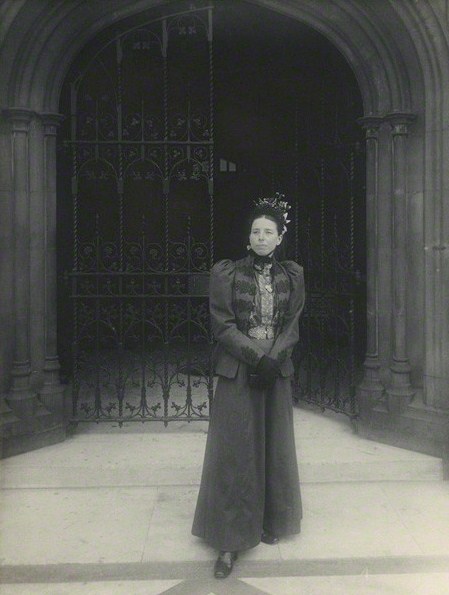
Catherine Potter met the 48-year-old Leonard Courtney, then Liberal cabinet minister, in 1880, and they were happily married for 35 years. Despite their hopes to have children and Catherine's fertility operation in 1888, the couple remained childless. In the 1890s, she became leader of the Women's Liberal Unionist Association but was disappointed by its conservatism and imperialism and resigned from the association's committee on 24 October 1900.
Wartime activities
The Courtneys actively campaigned for world peace. They were accused of being "pro-Boers" during the Second Boer War, receiving anonymous threatening letters, and Catherine was called "pro-Hun" after the First World War by the Daily Sketch. She actively supported negotiating the end of both wars, joining the 1899 armistice campaign of Emily Hobhouse, and later aligning herself with Jane Addams' attempts to negotiate peace during the First World War, with the help of neutral nations.
Throughout 1901, she visited South Africa to report on conditions inside the concentration camps built for Boer civilians. In 1906, her husband was elevated to peerage and she became Baroness Courtney of Penwith. Lady Courtney championed the "innocent enemies" of the First World War and participated in the founding of an emergency committee aimed at helping German civilians living in Britain. She visited German prisoners of war and publicised the work of her German counterparts in Berlin. She unsuccessfully pleaded with the Home Office to prevent German aliens from being deported back to Germany.
Widowhood and death
Lady Courtney was widowed in May 1918. In January the next year, she hosted the first meeting of the Fight the Famine Committee at her home in Cheyne Walk; the Save the Children Fund developed from that committee. She wrote to The Daily News in 1920, saying that "somebody must begin to be good if the better world we were promised is ever to come". She died in Cheyne Walk in 1929 and was buried at Chelsea Old Church.
Family tree
References
References
- Oldfield, Sybil. (2004). "Courtney, Catherine".
- Oldfield, Sybil. (2000). "Alternatives to militarism 1900–1989: women against the iron fist". [[Edwin Mellen Press]].
- Ross, Ellen. (2007). "Slum Travelers: Ladies and London Poverty, 1860–1920". [[University of California Press]].
- Roodenburg, Herman. (2004). "Social Control in Europe: 1800–2000". [[Ohio State University Press]].
- Caine, Barbara. (1996). "Destined to be wives: the sisters of Beatrice Webb". [[Clarendon Press]].
- "Members of the Survey Committee Pages 4-7 Survey of London Monograph 12". Guild & School of Handicraft, London, 1926..
- Storr, Katherine. (2009). "Excluded from the Record: Women, Refugees and Relief, 1914–1929". [[Peter Lang (publishing company).
This article was imported from Wikipedia and is available under the Creative Commons Attribution-ShareAlike 4.0 License. Content has been adapted to SurfDoc format. Original contributors can be found on the article history page.
Ask Mako anything about Catherine Courtney, Baroness Courtney of Penwith — get instant answers, deeper analysis, and related topics.
Research with MakoFree with your Surf account
Create a free account to save articles, ask Mako questions, and organize your research.
Sign up freeThis content may have been generated or modified by AI. CloudSurf Software LLC is not responsible for the accuracy, completeness, or reliability of AI-generated content. Always verify important information from primary sources.
Report