From Surf Wiki (app.surf) — the open knowledge base
Cathedral of St. John the Divine
Cathedral of the Episcopal Diocese of New York
Cathedral of the Episcopal Diocese of New York
| Field | Value |
|---|---|
| name | Cathedral of St. John the Divine |
| fullname | Cathedral Church of Saint John the Divine |
| image | St. John the Divine Cathedral.jpg |
| location | 112th Street and 1047 Amsterdam Ave, Manhattan, New York City |
| coordinates | |
| country | United States |
| denomination | Episcopal Church |
| website | |
| founded date | |
| founder | Henry Codman Potter |
| dedication | St. John |
| consecrated date | November 30, 1941 |
| architect | Christopher Grant LaFarge and George Lewis Heins; Ralph Adams Cram |
| architectural type | Cathedral |
| style | Romanesque Revival, Gothic Revival |
| groundbreaking | December 27, 1892 |
| length | 601 ft |
| width | 232 ft |
| height | 124 ft |
| materials | Stone, granite, limestone |
| deanery | Manhattan North |
| province | Atlantic |
| diocese | New York |
| bishop | Matthew Heyd |
| dean | Winnie Varghese |
| vicar | Steven Y. Lee |
| canon | Eva Suarez |
| organistdom | Kent Tritle |
| organist | Daniel Ficarri |
| organscholar | Jacob Gruss |
| sacristan | Peter Ennis |
| embedded | {{Infobox historic site |
| embed | yes |
| designation1 | NYCL |
| designation1_offname | Cathedral Church of Saint John the Divine and the Cathedral Close |
| designation1_type | New York City Landmark |
| designation1_date | February 21, 2017 |
| designation1_number | 2585 |
The Cathedral of St. John the Divine (sometimes referred to as St. John's and also nicknamed St. John the Unfinished) is the cathedral of the Episcopal Diocese of New York. It is at 1047 Amsterdam Avenue in the Morningside Heights neighborhood of Manhattan in New York City, between West 110th Street (also known as Cathedral Parkway) and West 113th Street.
The cathedral is an unfinished building, with only two-thirds of the proposed building completed, due to several major stylistic changes, work interruptions, and unstable ground on the site. The original design, in the Byzantine Revival and Romanesque Revival styles, began construction in 1892. After the opening of the crossing in 1909, the overall plan was changed to a Gothic Revival design. The completion of the nave was delayed until 1941 due to various funding shortfalls, and little progress has occurred since then, except for an addition to the tower at the nave's southwest corner. After a large fire damaged part of the cathedral in 2001, it was renovated and rededicated in 2008. The towers above the western elevation of the facade, as well as the southern transept and a proposed steeple above the crossing, have not been completed.
Despite being incomplete, the Cathedral of St. John the Divine is the largest church in North America, and world's largest Protestant cathedral and fourth-largest church by area of any Christian denomination. The floor area of St. John's is 121000 sqft, spanning a length of 601 ft, while the roof height of the nave is 177 ft. Since the cathedral's interior is so large, it has been used for hundreds of events and art exhibitions. In addition, the Cathedral of St. John the Divine has been involved in various advocacy initiatives throughout its history.
The cathedral close includes numerous buildings: the Leake & Watts Orphan Asylum Building, the cathedral proper, the St. Faith's House, the Choir School, the Deanery, and the Bishop's House. The buildings are designed in several different styles and were built over prolonged periods of construction, with the Leake & Watts Orphan Asylum predating the cathedral itself. The cathedral close was collectively designated an official city landmark by the New York City Landmarks Preservation Commission in 2017.
History
Context
Site
The neighborhood of Morningside Heights was thinly settled in the 17th century by the Dutch, then by the English. It remained rural through the mid-19th century, with two exceptions. The first was the Bloomingdale Insane Asylum, which opened in 1821 moved to Westchester in 1889. Columbia University's main campus which moved from midtown in 1896. The other was Leake and Watts Orphan Asylum, bounded by 110th Street to the south and 113th Street to the north, which later became the current cathedral site. The Leake and Watts asylum was incorporated in 1831 under act of the New York State Legislature, and three years later, 25 acre of land at the corner of Bloomingdale Road (now Broadway) and 110th Street was purchased from the Bloomingdale Asylum. The initial plans for the asylum were drawn up by Ithiel Town, but were revised several times to keep the costs within the asylum's budget. The cornerstone of the asylum was laid in 1838, and it was completed in 1843.
Need for a cathedral
Meanwhile, the Episcopal Diocese of New York started to grow in the early 19th century: there were 26 Episcopal parishes in the city by 1800, and a decade later, that number had nearly doubled to 50. In 1828, the first proposal for a grand cathedral for the diocese was made by Bishop John Henry Hobart, who proposed a site near Washington Square Park. The church would be called the Cathedral of St. John the Divine, or St. John's Cathedral for short, after the Revelation by John of Patmos (also called "John the Divine"). The plans were canceled because of objections over erecting such a large building for the diocese, a derivative of the Church of England, even as many New Yorkers still harbored resentment over the American Revolutionary War.
In 1873, a cathedral board of trustees was established under Bishop Horatio Potter. The board decided on property just south of Central Park, bounded by 59th Street to the north and 57th Street to the south. However, the purchase was canceled after the would-be donors lost their savings in the Panic of 1873. Yet another plot of land, at Eighth Avenue and 74th Street, was offered to the church in 1882, but rejected due to the high cost of acquisition. By 1890, there were 40,000 Episcopalians in Manhattan, and Episcopalians made up the largest bloc of Protestants in the borough. Furthermore, many imposing institutions were being built in New York City, such as the Metropolitan Museum of Art, Carnegie Hall, Metropolitan Opera House, and the American Museum of Natural History.
Planning
Site selection
When Henry C. Potter, Horatio Potter's nephew, became the Diocese of New York's assistant bishop in 1883, he convened the trustees to look for an alternative site. On June 1, 1887, Henry Potter publicly announced his intention to build St. John's, though the exact location was still to be determined. Potter described the planned cathedral as an "American Westminster Abbey" that would rival the Catholic St. Patrick's Cathedral in Midtown Manhattan. In his announcement, Potter called on New Yorkers to give funds toward the new cathedral, which was expected to cost $10 million. The plans for the cathedral were well received by both Protestants and non-Protestants, as well as the media and other denominational leaders. The donors included the wealthy Astor, Vanderbilt, and Belmont families. Additionally, the Barberini family's tapestries were gifted to the cathedral in 1891.
Numerous sites in Manhattan were examined for the new cathedral's location, and by 1889, the Leake and Watts Asylum between 110th and 113th Streets had been chosen as the site for the future site of St. John's. News media such as The New York Times and Uptown Visitor praised the decision, as the site was located on a high point overlooking Central and Morningside parks. The committee had wanted to build slightly further north, on a more elevated plot between 116th Street to the south and 119th Street to the north. However, that plot would be too difficult to acquire, as ownership of that tract was divided among several entities; by contrast, the Leake and Watts Asylum had full control over their entire city block. The 11.5 acre asylum site was deeded to the cathedral in October 1891, and the asylum moved to Westchester County, New York. The asylum site was then acquired for $850,000. At the time, Morningside Heights was quickly being developed as a residential neighborhood surrounded by numerous higher-education institutions. The proposed cathedral's elevated location would have been visible from New Jersey, across the Hudson River to the west, as well as from the New York Bay to the south.
Architecture competition

There was also debate over the new cathedral's style. Because of the larger plot and more remote location from Midtown Manhattan it was anticipated it could be more elaborate than St. Patrick's. The trustees had formed a Committee on Architecture in conjunction with William Robert Ware, a Columbia architecture professor, which held a design competition involving several prominent architectural firms. Though the competition had an open entry, fourteen selected architects were paid $500 each to create designs. The competition closed in January 1889.
In May 1889 the trustees formed a committee to review the more than 60 designs submitted. Many entrants were American, though only four were experienced in cathedral construction. The board members then discussed the designs privately; some architects expressed concerns about the secret consultations, since the trustees generally did not have professional knowledge of architecture. The entries were narrowed down to four finalists, namely, the "Gerona" by William A. Potter and R. H. Robertson; "Three Arabesque Scrolls within a Circle" by George L. Heins and Christopher Grant LaFarge with William Winthrop Kent (1860–1955), brother of Edward Austin Kent; "AMDG" by George M. Huss and J. H. Buck; and "Jerusalem the Golden" by William Halsey Wood. "Gerona" used the Gothic style based on Spanish cathedrals; "AMDG" and "Jerusalem the Golden" were in a regular Gothic style, and "Three Arabesque Scrolls" was mainly Byzantine.
Potter and Robertson were the only finalists with significant experience at the time, and the trustees had agreed not to release any designs without the consent of all competitors, although some contestants broke this agreement and revealed their designs to the media. The finalists were given more than a year to carry out further work their plans: the original deadline was set for February 1890, but was later extended to November after a failed proposal to host the World's Columbian Exposition in Morningside Park. The submissions were placed in public view in April 1891. By then, the public was losing interest in the competition, and the finalist designs mainly received negative criticism.
Plan selected
In July 1891, the plan-selection committee chose Heins & LaFarge's plan as the winner. This design had been the trustees' second choice but although the trustees liked Potter and Robertson's plan more, W. A. Potter was the bishop's half-brother and the trustees did not want to be accused of nepotism. To Kent's consternation, he was initially not recognized as a co-collaborator, and would not be acknowledged as such until the following year. The design proposed an apse of radiating chapels apses; a square crossing defined by four round-headed arches, supporting a dome over which was rise a massive tower; and transepts with round edges. The interior was based upon Boston's Trinity Church, and the crossing was based upon Istanbul's Hagia Sophia, Venice's St. Mark's Basilica, and the Périgueux Cathedral. The "exotic" design was seen as an example of the unusual architecture that was prevalent at that time. It was also Heins & LaFarge's first major commission: the firm later designed structures such as the Astor Court buildings at the Bronx Zoo, as well as the early stations of the Interborough Rapid Transit Company, the first operator of the present-day New York City Subway.
That October, the trustees directed the firm to revise their design further. The following month, it was announced that work would begin in early 1892, provided that Heins & LaFarge submitted their revised plans that April. The original plans were then substantially revised because the board of trustees wanted a Gothic-style appearance. The western towers were modified to remove the spires and enlarge the windows, and various Gothic details were placed on the facade. The nave was realigned from north–south to east–west so that the apse would face east, in the direction of the sunrise, to represent the resurrection of Jesus as per Episcopal tradition. Heins & LaFarge objected to the realignment because it would result in the cathedral being hidden behind other buildings. In the final plan, "Three Arabesque Scrolls" incorporated both Byzantine and Romanesque influences, with Gothic detailing on the exterior. Outwardly, the design resembled the AMDG plan from Huss & Buck. By April 1892, the trustees had raised much of the $850,000 required for land acquisition, though there still remained a deficit of $175,000.
Construction and early years
Construction on the Cathedral of St. John the Divine was begun with the cornerstone-laying ceremony on December 27, 1892, St. John's Day.
- One thousand tickets for seats at the ceremony were distributed, though the actual attendance was 1,100. The cornerstone contained various objects such as a Bible and church papers. Potter hit the stone three times with a mallet and said "Other foundation can no man lay, than that is laid which is Jesus Christ." The following month, the remaining $175,000 for land acquisition had been secured, and the trustees moved to take title to the land, including the cathedral close around the cathedral's main building, in April. Unlike the main building, the cathedral close was not designed under a single master plan, and during the 1890s and 1900s, several proposals would be made for the site.
Initial construction

Construction work began in early 1893. The trustees initially expected that work would proceed quickly because much of the Morningside Heights plateau sat on shallow bedrock. However, in September 1893, builders unexpectedly hit pockets of soft shale and an underground spring about 40 ft below ground. One of these pockets was located directly below the site for one of the four massive piers that were to support the cathedral's 445 ft stone tower. The trustees briefly considered moving the entire cathedral slightly southward. They decided against moving the cathedral, believing it to be inauspicious to move the cornerstone. Instead, builders drilled several shafts until they hit bedrock, then poured concrete pit piles within each shaft to accommodate the weight of the tower piers. The layer of bedrock was, in some cases, 72 ft beneath ground level. The pits were completed in late 1895 at a significantly higher cost than originally estimated.
By 1898, St. John's had cost an estimated $750,000, and as per an 1896 estimate, the cathedral was projected to cost at least $5 million when complete. As a temporary measure, the Tiffany Chapel was purchased in mid-1898 so that services could be held there. The chapel was placed in the crypt, within the basement. The first services were held in January 1899 within the Tiffany Chapel. The crossing arches, located in the cathedral plot's eastern portion, were completed the following year, though three of the arches were temporarily sealed off until the transepts and nave could be completed. By then, some $2 million had already been spent, even though little appeared to have been completed. Despite large donations from prominent figures such as financiers John Jacob Astor IV and William Waldorf Astor, governor Levi P. Morton, banker J. P. Morgan, and businessman Cornelius Vanderbilt, the trustees continued to raise funds.
In March 1903, the trustees announced that the next stage of St. John's construction would require $500,000 for building the choir and $200,000 for completing the loft, and that eight massive granite columns would need to be procured to support the roof over the choir. Furthermore, the trustees would build three arches to support the rest of the roof. Quarried in Vinalhaven, Maine, each column was 54 ft tall with a 6 ft diameter—at the time, the world's second-largest stone columns. Each column comprises two parts—a lower section 38 ft tall and weighing 90 ST, and the upper section of 17 ft and weighing 40 ST—jointed so that the columns appear to be monoliths. Because of their size, three of the columns were cracked while being turned. The columns were then transported using a specially constructed barge towed by the large steam tug Clara Clarita. When the columns arrived at Manhattan in July and August 1903, they were rolled onto flatbed trucks and brought to the cathedral's site. The builders lacked a derrick strong enough to lift the column pieces, so they ordered wood to build one. The columns were finally lifted in July 1904, more than a year after the initial announcement. The walls could not be placed until after the columns had been installed. In 1903 construction of the crossing dome began, constructed of relatively lightweight interlocking "Guastavino tiles" made of terracotta and patented by Spanish architect Rafael Guastavino. These were laid without centering or scaffolding in three layers, sandwiched with quick-drying cement, forming a shell of great strength in spite of the wide span. The 93 ft diameter dome was completed in just 15 weeks.
The board of trustees implemented a new charter in early 1904, which provided for greater representation of laypeople on the board. By 1905, with $800,000 available for construction, the trustees anticipated that the cathedral would be completed within a decade. The church's great organ was ordered from Skinner the following year at a cost of $50,000 (), following a gift by the Morton family. It was almost completed by 1911 with nearly 7,000 pipes; the cost of the organ had risen to $70,000. Work also continued on the exterior walls of the choir and the seven surrounding chapels in the apse, which required 100,000 ST of granite. Builders estimated that 300,000 ST of stone would have been used for the walls once work was completed. Gutzon Borglum was commissioned for some of the initial sculptural elements on St. John's, though his relation with the trustees was strained: he destroyed two angels after criticism of his work and threatened to quit in 1906. Because of the delays in construction, members of the public began to question the necessity of constructing such a large cathedral. With little progress to show for, public sentiment began to turn against the cathedral. Even the trustees started to have doubts about certain aspects of the plan, criticizing Heins & LaFarge's small staff, their simultaneous involvement in many other projects, slow construction, and cost overruns.
Crossing opening and change in design

A month after the consecration of the choir, the trustees abruptly fired LaFarge, commissioning Ralph Adams Cram to take his place as lead architect of St. John's. The trustees exercised a clause in their contract with Heins & LaFarge, enabling them to hire another architect if either partner were to die. LaFarge had no notice of his dismissal, and was notified of it via a cable from his partner Benjamin Wistar Morris. The original Byzantine-Romanesque design was switched to a Gothic design, and Cram was asked to convert many existing features to Gothic style. The move was criticized in the local media, who claimed that the trustees and Cram had been conspiring to eject LaFarge from the lead architect position. However, The New York Sun reported that Cram had only reluctantly accepted the commission because the trustees had threatened to hire an overseas architect.
Cram presented a master plan for the cathedral close's buildings in October 1911, and his revised designs for the main structure were completed in 1913. Regardless, there was still not enough money to complete the cathedral's construction, as the New York Episcopal Diocese Cathedral League had mentioned in 1912 that $5.5 million was still needed. The diocese was able to construct several structures to the south of the main building (see ), as part of a plan that had been approved by the trustees in late 1911. These structures included the St. Faith's House (1909), Synod House (1911–1913), Cathedral School (1912–1913), and Cathedral House (1912–1914).
Nave and north transept
_-_48.JPG)
By January 1916, Bishop David H. Greer announced that the diocese would construct St. John's nave and narthex, along with a pair of towers on the western elevation of the facade above the narthex. The project would cost $1.5 million, even though St, John's only had about $200,000 on hand as of June 1915. A groundbreaking ceremony for the nave was held on May 8, 1916. That November, construction stopped due to material and funding shortages during World War I, and the trustees had decided against raising funds until after the war. Cram edited his plans in the interim. In February 1919, the trustees approved Cram's revised plan to incorporate a memorial for soldiers. The new plans required $5–6 million, but would make St. John's the third- or fourth-largest worldwide. The cathedral did not yet have the money to build the nave, and furthermore, in 1920 the trustees decided not to hold fundraising drives for said purpose. Because of an unstable economy, work did not resume for another four years, though both Greer and Bishop Charles Sumner Burch supported the project.
In 1923, Burch's successor William T. Manning announced a $15 million capital campaign to raise money for this project. The New York campaign committee, headed by Franklin D. Roosevelt, campaigned from 1923 to 1925 to raise $6 million (). By May 1924, Manning announced that $2.5 million had been donated within the previous three months, and that work on the nave would soon begin if that rate of donation were to continue. St. John's was seeking price estimates for the nave's construction by that November, and the baptistery was donated the same year. Some $7.7 million had been raised by February 1925, and the laying of the nave's cornerstone occurred on November 9, 1925. Manning wanted the cathedral to be an interdenominational place of worship, but was still reluctant to add other denominations' members to the board of trustees. Notably, Manning rejected a request from John D. Rockefeller Jr., a Baptist, despite the latter's $500,000 donation toward the cathedral's building fund.
In January 1927, Manning announced that the trustees had approved Cram's proposal for a square tower above the crossing; the tower would replace the dome, which did not conform to the Gothic style. With sides of 60 ft, the tower would be half as wide as the arches below it. Cram's blueprint revisions, published in 1929, entailed building the 300 ft square tower over the crossing, and adding two portals to the western elevation. Additionally, St. John's northern transept began construction in December 1927. Since the funds for that transept were donated solely by women, it was called the Women's Transept. Work on the Women's Transept was halted in October 1930 due to a lack of funds. Construction at St. John's was otherwise unaffected by the Great Depression. During this duration, work was concentrated mainly on the western elevation.
When construction of the Women's Transept resumed in 1934, the nave and the western elevation were nearly complete except for the two towers above the western facade, but work on the crossing tower and south transept had yet to commence. By 1938, the nave was completed, but the temporary construction wall between the nave and crossing was still in place because the Byzantine-Romanesque crossing's design had yet to be harmonized with the Gothic nave. As such, Cram subsequently replaced the portions of the ceiling above the choir and the apse's eastern section. Additionally, the nave started to be used for services, even though it had not yet been dedicated. The 1939 WPA Guide to New York City stated that $20 million had been spent on the cathedral by then.
Full-length opening and expansion
.jpg)
The full 601 ft length of the Cathedral of St. John the Divine was opened for the first time on November 30, 1941. At that time, St. John's was only three-fifths completed, yet it was the second-largest Christian church in the world by area, behind only St. Peter's Basilica in Vatican City. The event was commemorated with a week-long celebration. The last day of the celebrations, Sunday December 7, 1941, coincided with Japan's attack on Pearl Harbor. With the consequent entry of the United States into World War II, work on the cathedral stopped. The southern transept and tower had yet to start, while the northern transept remained one-third complete. The western towers, planned to be 266 ft, reached only to the roof of the nave. Cram revised his plans yet again just before his 1942 death, this time with shorter western towers and a slim spire in place of the square tower over the crossing.
Halt in construction

Following the end of World War II, St. John's did not experience any more new construction for three decades. In 1945, Manning had attempted to start a fundraising drive for $10 million so that the remaining funds could be raised for the cathedral's completion. However, during the late 1940s, his successor Bishop Charles Kendall Gilbert turned efforts toward alleviating social issues in the vicinity of the cathedral. Rather than being focused on expansion, the cathedral became more involved in the surrounding community. By that time, a total of $19 million had been spent on construction (equivalent to $ million in ). By the 1950s, there was debate over whether to complete St. John's in the Gothic fashion of the nave; a more contemporary style; or the original Byzantine/Romanesque style. Several plans were proposed through the early 1960s, but none were examined in depth.
In 1966, it was announced that work at St. John's would resume. The trustees had approved a smaller version of the western towers and the crossing, with a modern multicolored dome to be built atop the crossing. The project did not proceed, as Bishop Horace W. B. Donegan said that such work would not occur during his administration; rather, he wanted the construction money to instead go toward helping the poor. In the 1970s, the cathedral's activities turned toward improving quality of life in Morningside Heights; helping the elderly, young, and the environment; and participating in the civil rights movement and the opposition to United States involvement in the Vietnam War. However, when the Very Reverend James Parks Morton was installed as St. John's dean in 1973, he said that construction at St. John's would start again. Morton said he wanted St. John's to become "a holy place for the whole city". St. John's had become overcrowded because of its increasing focus on community activities, and even though the cathedral was losing $500,000 each year, Morton believed that an expansion would help make space for these extra activities.
Resumption of work

Morton announced in December 1978 that construction would soon begin on constructing the two western towers, extending their height by 150 ft and bringing their total height to 291 ft. The job was expected to cost $20 million and take five years. However, by then, there was a shortage of qualified stone carvers in the area. James R. Bambridge, who was hired as the stonemason, planned to employ unskilled younger workers from the surrounding community. Bambridge hired Nicholas G. Fairplay, an English stonemason, as master carver. The architect was Hoyle, Doran and Berry, the successor to Cram's architecture firm. The expansions would be based primarily on Cram's revised designs, published before his death. The north transept would be completed, but would remain separate from the main building.
Work on the western facade's towers was restarted with the opening of St. John's stone yard, the Cathedral Stoneworks, which received its first several Indiana limestone blocks in June 1979. Construction started first on the south tower, named for Saint Paul, which began to rise in 1982. However, the project continued to be delayed due to a shortage of funds, and due to slow development of the towers' designs. Work also progressed slowly because the stonemasons were carving a myriad of minute details on the south tower. By 1984, St. John's was projected to be complete in 2000. Under the leadership of master stone carvers Nicholas Fairplay, Simon Verity, and Jean Claude Marchionni, work on the statuary of the central portal of the cathedral's western elevation was started in 1988 and completed in 1997. During this era, the cathedral expanded its cultural programming, hosting some 140 shows and performances in the 1987–1988 season, some of which drew up to 3,000 observers.
By 1992, the construction budget had been depleted; work was halted, and the stone yard was closed. By then, another 50 ft of height had been added to the south tower. While some of the scaffolding was removed, other portions remained, rusting away for fifteen years. The Very Reverend Harry H. Pritchett Jr., who succeeded Morton in 1997, decided against further expansion of St. John's, especially since the existing facilities needed $20–40 million in repairs.
21st century

On December 18, 2001, a fire swept through the unfinished north transept, destroying the gift shop and damaging tapestries. Despite the damage sustained, St. John's reopened two weeks later. Though the pipe organ was not damaged, all its pipes and other component parts were removed and restored. Valuable tapestries and other items in the cathedral were damaged by the smoke. In January 2005, the cathedral began a major restoration to not only remove smoke damage resulting from the 2001 fire, but also clean the 80 years of dirt accumulation in the nave. The renovations temporarily depleted St. John's funds: the unaffected portions of the cathedral started to deteriorate, staff salary raises were deferred, and several staff positions were eliminated. The scaffolding around the south tower was removed in 2007, and the cathedral was rededicated on November 30, 2008.
The cathedral's main building was made a city landmark in June 2003, but the designation was overturned that October, since it did not cover the entire cathedral close. At the same time, St. John's officials wanted to lease out the lots at the northern and southern borders of the cathedral close for further development, a move that preservationists unsuccessfully attempted to prevent. Ultimately, two residential buildings were erected on these lots: Avalon Morningside Park on the southern lot and the Enclave on the northern lot. In 2017, the cathedral close was re-designated a city landmark, except for the two new residential buildings. The next year, the first phase of the north transept's renovation was finally completed, and work began on a renovation of the crypt.
On April 14, 2019, a small fire occurred in the crypt; except for smoke damage, the cathedral building was mostly unaffected. Many artworks stored in the crypt were reportedly damaged or destroyed in the fire. An initial cleaning removed smoke damage from the bottom 10 feet of the interior of the cathedral. A cleaning of the rest of the interior was also ongoing. Ennead Architects proposed erecting a copper dome above the crossing so that the crossing's tiles could be rehabilitated. The restoration of the dome was completed in 2022. The New York City government gave the cathedral a $1.5 million grant in August 2024 to convert Synod Hall into a community center. A restoration of the organ, which had been damaged in the 2019 fire, was completed in December 2024.
Main structure
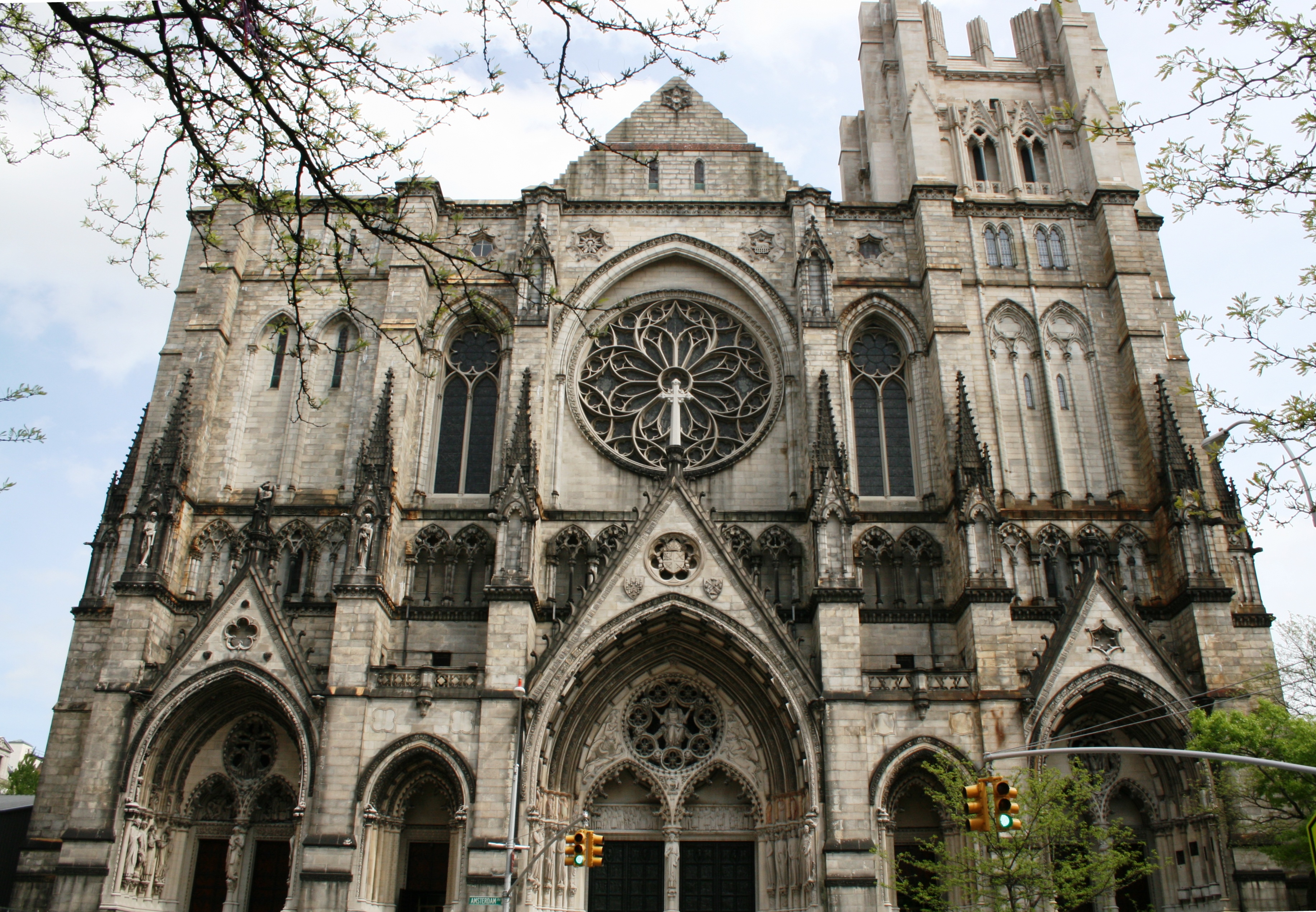
The Cathedral of St. John the Divine is located at 1047 Amsterdam Avenue in Morningside Heights, Manhattan, between West 110th Street (also known as Cathedral Parkway) to the south and 113th Street to the north. The cathedral's main entrance on the west is along the same axis as 112th Street. Adjacent sites include Mount Sinai Morningside (formerly St. Luke's Hospital) to the north, Columbia University's Morningside Heights campus to the north and west, and Morningside Park to the east. One of the key reasons for St. John's location is that the land under it was described as the "highest point in Manhattan". One author wrote that "the view from outside tells much about St. John's inner spirit", saying that the southeastern elevation of the facade gives an impression of incompleteness, while the great western elevation was "vitalized by its incipience".
St. John's is oriented west–east relative to the street grid and was originally supposed to have a cruciform plan, with transepts extending to the north and south of the crossing near the eastern end of the cathedral. The entire structure measures 601 ft long. From west to east, the cathedral contains a narthex measuring 50 ft long by 207 ft wide; a nave of 248 by; a crossing of 100 by; a choir of 145 by; and the Chapel of St. Savior in the apse, measuring 58 ft with an ambulatory 14 ft wide. The cathedral's western elevation is 207 ft wide; if the transepts had been completed, they would have measured 330 ft from end to end. The cathedral has an interior floor area of 121000 ft2 and can host 8,600 people. , these dimensions make St. John's the fourth-largest Christian cathedral in the world and puts it in competition with Liverpool Cathedral as being the world's largest Anglican cathedral.
The original design for the cathedral was created by Heins & LaFarge. Despite being primarily Byzantine and Romanesque in influence, the last version of Heins & LaFarge's design contained a significantly Gothic-style appearance. The original plan at St. John's called for tiled-arch domes and barrel vaults. The crossing was to be held up by four round arches under a dome, with a tower on top. The completed cathedral was supposed to have been 520 ft long and 290 ft wide between transepts, while the tower would have been 450 ft tall.
The modern plan for the building, as it appeared upon its official opening in 1941, conforms primarily to the second design campaign from the prolific Gothic Revival architect Ralph Adams Cram. The plans are based on the French Gothic style, with English Gothic accents. Cram had initially wanted to use English Gothic models, which typically placed less emphasis on vertical elements and height, and which contrasted with the extant parts of the cathedral. Cram's plan originally called for three main entrances; two 500 ft spires set back from the western facade; two smaller spires on the western facade. Inside were ten full-height aisles, with a triforium and clerestory rising to the ceiling, as well as large chapels along each side of the nave. The design provides a transition between the nave and the crossing, because the nave was to be 50 ft wide, about half the width of the crossing. Cram, described as a "brilliant perfectionist", frequently revised his proposal and later spoke of Heins & LaFarge's plans as better than his own. One major change, published in 1926, called for a 300 ft, square tower above the crossing and five portals on the western elevation. Another revision was published just before he died in 1942, and called for a spire above the crossing. Cram's designs were not fully built, either. The Cathedral of St. John the Divine remains only two-thirds complete and is often nicknamed St. John the Unfinished.See:
- , no major construction work was ongoing; according to the cathedral's website, its funds were being used mainly "to prioritize serving the community through our programming and social initiatives, and to maintaining the architectural integrity of the Cathedral".
Narthex and western facade
Narthex

The narthex, in the westernmost portion of the cathedral facing Amsterdam Avenue, was designed by Cram. His original plans did not include a narthex, instead showing the nave continuing as far as the western facade. Inside the narthex is a large vestibule, which serves as an entrance to the nave on the east. The vestibule measures 180 ft along the north–south axis and 85 ft along the west–east axis. The southern part of the narthex contains the cathedral's gift shop.
Above the narthex are two towers: one named for Saint Peter to the north and the other named for Saint Paul to the south. The north tower reaches to the roof of the nave, which is 177 ft above ground level; the south tower is about 50 ft taller, with the additional height having been built between 1982 and 1992. If the towers had been completed, they would have been about 266 ft tall. The towers protrude slightly from the northern and southern elevations of the facade but are flush with the western elevation. On the northern and southern facades of the narthex, at the base of the towers, are stained glass windows, one on each side.
Western facade
The narthex abuts the unfinished western elevation of the facade facing Amsterdam Avenue; this facade is 207 ft wide and consists of five architectural bays. The bays are separated by large arched buttresses with finials at their tops, and they contain niches for the possible future installation of statues. The western elevation is divided into four vertical tiers. From bottom to top, they are the ground-level portals, on the first tier; the gallery level, on the second tier; the large rose window and several smaller grisaille and lancet windows, on the third tier; and the top of the south tower and the gable above the center bay, on the fourth tier.
At ground level, there are five portals under arched openings. The largest of those is the center portal, called the Portal of Paradise, which contains carvings of the transfiguration of Jesus as well as St. John and 32 biblical characters; these were carved in 1988 under Simon Verity's leadership. St. John is depicted on the trumeau, or vertical pier, between the two pairs of doors within the center portal. The center portal also contains depictions of New York City skyscrapers being destroyed in an apocalypse. The center, northernmost, and southernmost portals are set within large, gabled structures with several archivolts, or arched moldings, surrounding each portal under the gables; porches overhang the portals above the gables. The other two portals are located under simple rectangular canopy structures, located underneath grisaille windows looking into the nave. Lights salvaged from the former Pennsylvania Station illuminate the steps in front of the portals.
Above the center portal, between the towers, is a rose window installed by stained glass artist Charles Connick and constructed out of 10,000 pieces of glass. With a diameter of 40 ft, the rose window is the largest rose window in the U.S. Flanking the rose window on either side are two grisaille windows, each with two lancet windows under a smaller rose. The seven archangels are depicted in the north grisaille, while the seven churches of Asia are depicted in the south grisaille. Connick had designed the grisailles as well. On the gable above the large rose window, there are lancets as well as a medallion in the middle.

Great west doorsThe two pairs of great west doors on the western elevation, set beneath the elaborate center portal, were designed between 1927 and 1931 by the designer Henry Wilson. The bronze doors include a sequence of 60 relief panels, which presents scenes from the Old and New Testaments and the Apocalypse. The doors open three times per year: Easter; St. Francis's feast day in October; and the "blessing of the bicycles" in the spring. They comprise one of four bronze-door commissions designed by Wilson before his death. St. John's great west doors were the last of the four commissions, each pair measuring some 18 x. The remaining doors on the western elevation are composed of Burmese teak with wrought iron decoration.
Nave
.jpg)
The nave was designed by Cram, though the final plan is slightly modified from the original. It is oriented from west to east, measuring 248 ft long by 146 ft wide. The ceiling is 124 ft above ground level, but the ridge of the roof is 174 ft high. These dimensions are about the same as in the original plans, which called for floor dimensions of 260 by. a 175 ft roof, and a 125 ft ceiling.
On the northern and southern elevations, there are four vertical "double bays", each with two columns of windows. Large arched buttresses, with two piers each, separate the different double bays; smaller buttresses, containing a single pier, divide each double bay into smaller "sub-bays". This alternation of large and small buttresses gives the appearance of four double bays with two sub-bays each, rather than eight singular rectangular bays. At the arcade level, each of the sub-bays contains an arrangement of stained glass with two lancet windows under a rose window. The sub-bays also contain another stained-glass arrangement at clerestory level, each with two lancet windows and one rose window. The clerestory arrangements each measure 45 ft long by 12 ft wide. Carved parapets, as well as gables with dormers, run along the copper roof.
Inside, there are six north–south rows of piers, three to either side of the nave. These piers divide the nave into five aisles running west to east, with the center aisle located on the same axis as 112th Street. There are four smaller aisles, two to either side of the center aisle. Additionally, the interior contains several flying buttresses, concealed by "bridges" that carry them over the outermost aisles.

There are sixteen sub-bays in the nave, eight on each side; the easternmost sub-bays on either side contain doorways. Each of the bays are named after some aspect of humanity. From west to east, the sub-bays along the northern side of the nave are named the Sports, Arts, Crusaders, Education, Lawyers, Ecclesiastical Origins (Anglican), and Historical and Patriotic Societies' (American), and Fatherhood bays. The sub-bays on the southern side are named the All Souls', Missionary, Labor, Press (Communication), Medical, Religious Life (Earth), Armed Forces (Military), and Motherhood bays. Each of the sub-bays contain carved parapets atop their mono-pitched roofs. The sub-bays are used for various exhibits. The iconography of the stained-glass windows in the arcade and clerestory is related to the theme of each respective sub-bay. gives a detailed analysis of the stained glass at arcade level. describes the stained glass in the clerestory. In each sub-bay, between the lower windows and the clerestory windows, is the triforium level, which contains two west–east corridors with numerous windowless rooms and office spaces.
Apse
The apse, located at St. John's eastern end, is made up of numerous components. The center of the apse contains the choir, located below the great organ. Two ambulatory passages run adjacent to the choir, one to the north and the other to the south. Seven chapels, a baptistery, and a columbarium are also located in the northwestern part of the apse. The apse contains two sets of clerestory windows: the large ambulatory clerestories with multiple panels, as well as a smaller sanctuary clerestory window above each of the ambulatory clerestories. The apse's walls are supported by gabled buttresses, which are taller than the height of the walls, and contain niches with statues.
Choir
_-_18.JPG)
The choir was consecrated in 1911. It consists of two sets of wooden stalls facing each other, with three rows in each stall. The stalls were made by the Philadelphia-based John Barber Company. The westernmost unit in the southern row of choir stalls is called the "Dean's Stall". The roof above the choir is supported by eight columns, each 54 ft tall with a 6 ft diameter and a weight of 130 ST. The columns' foundations descend as much as 130 ft into the bedrock below them.
The parapets behind the two sections of the choir were originally installed in 1922 with twenty niches for statues of the spiritual heroes of the twenty centuries since the birth of Christ. For example, the 17th, 18th, and 19th centuries are respectively represented by statues of William Shakespeare, George Washington, and Abraham Lincoln. The niche for the 20th century was left blank through the end of that century. In 2001 the choir parapet was completed with carvings of Martin Luther King Jr., Albert Einstein, Susan B. Anthony, and Mohandas Gandhi by stonecarver Christopher Pellettieri. In addition, the finials on both rows of stalls were carved by Otto Jahnsen and depict church-music composers and performers.
On the floor are tiles designed by the Grueby Faience Company, with geometric patterns and imagery reminiscent of the iconography in other cathedrals. A compass rose, the official icon of the Anglican Communion (in which the Episcopal Church participates), is located on the floor between the two stalls, in the center of the choir.
Great Organ
The Great Organ was built by Ernest M. Skinner in 1906–1910. It is located above the choir on the north and south sides, and consists of four manual keyboards with several pedals. The opening recital was given in 1911 by Clarence Dickinson. In 1954, it was enlarged by the Aeolian-Skinner Organ Company, Opus 150-A, under the tonal direction of G. Donald Harrison. The organ contains 8,514 pipes, though it previously included 8,035. While most of the pipes are located above the choir stalls, the Great Organ also controls the State Trumpet, located beneath the rose window about 500 ft to the west.
The 2001 fire in the north transept resulted in heavy smoke damage to the organ, and it was subsequently restored by Quimby Pipe Organs, Inc., of Warrensburg, Missouri. After two years of extensive and detailed refurbishment work, including a reorganization of many pipes and a rebuilding of the console, the organ finally returned to service in 2008 as part of an overall $41-million cleaning and repair to the cathedral. The Great Organ was damaged again in the April 2019 crypt fire, and was indefinitely placed out of service pending a thorough cleaning. While the Great Organ was being restored, the Cathedral of St. John the Divine used an electric organ.
The organists have included:
- Walter Henry Hall (1905–1909)
- Miles Farrow (1910–1931)
- Norman Coke-Jephcott (1932–1953)
- John Upham (interim) (1953–1954)
- Alec Wyton (1954–1974)
- David Pizzaro (1974–1977)
- Paul Halley (1977–1990)
- Dorothy Papadakos (1990–2003)
- Timothy Brumfield (2003–2009)
- Bruce Neswick (2009–2011)
- Kent Tritle (2011–present)
Sanctuary

Behind the choir, to its east, is the sanctuary (or chancel), a raised platform. The chancel includes the high altar, which is made of white Vermont marble. The Magna Carta Pedestal—named as such because it is located atop three stones from the Bury St Edmunds Abbey in England—is located to the right, while the sedilia for the bishop and other clergy is to the left. The sanctuary also contains the cathedra (or bishop's seat), donated by Olivia Egleston Phelps Stokes in memory of her sister Caroline Phelps Stokes. The bishop's pulpit is made of Tennessee marble, with five niches, each of which contain reliefs that depict scenes from the life of Christ. A presbytery, which houses the officiating clergy of St. John's, is located between the chancel and the choir. The reredos behind the sanctuary depicts four scenes from the Old Testament on the left (north), and four from the New Testament on the right (south).
Behind the altar is a wrought iron enclosure. The space contains the English Gothic style tomb of the man who originally conceived and founded the cathedral, the Right Reverend Horatio Potter, which was dedicated in 1921.
Ambulatory and chapels
_-_28.JPG)
An ambulatory, measuring 250 ft long and 14 ft wide, surrounds the choir to the north, east, and south, making a rough "U" shape with the two ends of the "U" facing west. The floor is covered with red clay-colored tiles that contain green-serpentine borders. There are 30 ft wrought-steel gates at either end of the ambulatory. Numerous plaques are present in the ambulatory, paying homage to large donors and other notable individuals in St. John's history. A "poetry wall" and several Madonna paintings are also located in the ambulatory, particularly in the southern part of the ambulatory.
Extending outward from the ambulatory are seven chapels. These chapels are known as the "Chapels of the Tongues", and all were donated by prominent individuals and families. The chapels were designed by four different architects and firms: Heins & LaFarge designed two of the chapels, while Cram designed a third. The Chapels of the Tongues were devoted to seven of the city's largest immigrant groups when the apse was completed: the southernmost three chapels represent "Latin races" and the northernmost three chapels represent "Germanic races". All of the chapels, except for St. Ansgar's, were donated by individuals or families.{{efn|The donors for each chapel were:
- St. Ansgar: built in memory of William Reed Huntington
- St. Boniface: gift of George and Julia Bowdoin and their children
- St. Columba: gift of Mary Augusta King
- St. Savior: gift of August Belmont Jr.
- St. Martin: gift of Clementina Furniss
- St. Ambrose: gift of Sara Whiting Rives
- St. James: gift of Elizabeth Scriven Potter, wife of Henry Codman Potter}} Clockwise from north, they are devoted to:
- St. Ansgar, patron of Denmark; designed by Henry Vaughan, dedicated 1918. St. Ansgar Chapel has its own organ.
- St. Boniface, apostle of the Germans; designed by Henry Vaughan, dedicated 1916.
- St. Columba, patron of Ireland and Scotland; designed by Heins & LaFarge, dedicated 1911.
- St. Savior (Holy Savior), devoted to immigrants from Africa and Asia; designed by Heins & LaFarge, dedicated 1911. St. Savior was the first chapel to be complete, hosting its first services in 1904. It contains a bronze three-paneled altar with gold-leaf decoration, designed by Keith Haring just before his death.
- St. Martin of Tours, patron of the French; designed by Cram & Ferguson, dedicated 1918.
- St. Ambrose, patron of Milan; designed by Carrère and Hastings, dedicated 1914.
- St. James, patron of Spain; designed by Henry Vaughan, dedicated 1916. St. James Chapel is the largest apsidal chapel, with a seating capacity of 25 people, and is frequently utilized for small funerals, weddings, or worship services. The chapel has its own choir and 857-pipe organ.
The northwest corner of the apse, adjacent to the St. Ansgar Chapel, includes the octagonal baptistery. The baptistery was donated by three Stuyvesant family siblings in 1924. The space measures 31 ft in diameter with a ceiling 43 ft tall. The baptistery's iconography depicts the Stuyvesant family history; icons of New Amsterdam, New York, and Dutch history; and the 12 apostles.
The columbarium, established in the 1970s, is in a room directly west of the baptistery. It contains marble vaults, which store the remains of people from all religions.
Crossing

Between the nave to the west and the apse to the east is the crossing, designed by Rafael Guastavino. The interior of the crossing includes four massive granite arches, which in the original Heins & LaFarge design were originally intended to support the massive 445 ft tower above it. When completed in 1900, the arches were described as the "crowning glory" of Morningside Heights. During the time that the nave remained incomplete, temporary walls were placed within the arches so that services could be held in the crossing.
Above the crossing is a domed roof, which was meant as a temporary covering until the tower above the crossing was built. It was completed within fifteen weeks between May and August 1909. The dome is shaped like a saucer, and consists of several overlapping layers of Guastavino tile, which support themselves around the dome's center upon their own weight. The pendentives, or triangular areas between the circular dome and the corners of the arches, are 1 in thick; the thickness of the dome itself ranges from 4 in on top to 7.5 in at the bottom. Compared to conventional ceilings, the tiles saved money because they did not require temporary supports when they were installed. For added strength, metal rods were included in the dome's shell.
The dome was originally intended to be temporary. Cram had proposed three plans for the structure above the crossing: a steeple, a square tower rising 500 ft above the crossing floor, and then a slim spire. None of these plans were realized. A three-year renovation project from 2019 to 2022 repaired cracks in tiles, patched concrete, added new protective materials, and built a new copper dome over the crossing.
Basements
Directly below the crossing is the basement, which contains the crypt, now used as a storage area. The items stored in the crypt include artifacts such as pieces of the destroyed Pennsylvania Station and World Trade Center, as well as wooden angels, plaster gargoyles, leadlights, antique furniture, and a single-file line of saints. The crypt also includes objects such as a large fossil and a massive crystal of quartz, both of which were relocated to the crypt after the 2001 fire. Along either side the basement are rooms, each named after the chapels that they are located under. In the 1980s, the crypt was also home to the Cathedral Works Company, which sold textiles.
The crypt also formerly contained the Tiffany Chapel, created by jewelry designer Louis Comfort Tiffany. Originally exhibited at the World's Columbian Exposition in 1893, it was then acquired by Celia Whipple Wallace and moved to the cathedral in 1898. Services at the cathedral were hosted at the Tiffany Chapel from 1899 to 1911, and the chapel was reacquired by Tiffany in 1916. The chapel has been in the Charles Hosmer Morse Museum of American Art in Winter Park, Florida, since 1999.
SubbasementA subbasement below the crypt is often flooded by groundwater, potentially from springs in the area. The Leake and Watts Asylum had a well on the site of the present-day baptistery, and there was a spring near the intersection of 110th Street and Morningside Drive. As early as 1893, workers discovered that the ground under the cathedral was soft and prone to flooding. As a result, the cathedral has a concrete foundation. Sump pumps keep the area dry, and construction of the neighboring Enclave has reduced flooding. However, the spring still exists underneath the cathedral, and water from the spring may have contributed to the partial collapse of a retaining wall in 2006.
Cathedral close
| mark-coord1 = | mark-title1 = Cathedral Church of St. John the Divine | shape-color1=dark blue | shape-outline1=white | mark-size1=16
| mark-coord2 = | mark-title2 = Ithiel Town Building
| mark-coord3 = | mark-title3 = Biblical Garden
| mark-coord4 = | mark-title4 = The Cathedral School of St. John the Divine
| mark-coord5 = | mark-title5 = Pulpit Green
| mark-coord6 = | mark-title6 = Cathedral House/Ogilvie House
| mark-coord7 = | mark-title7 = Synod Hall
| mark-coord8 = | mark-title8 = Diocesan House
| auto-caption=1 The cathedral close, surrounding the main cathedral, consists of several buildings on a 11.5 acre site, including the former Leake & Watts asylum building, which predates the land's acquisition by the Episcopal Diocese of New York. The other structures were built later.
The former asylum is located immediately south of the crossing. The Cathedral School of St. John the Divine is located on the eastern boundary of the site, just south of the apse. A Biblical garden is located between the school and the asylum building. To the southwest is a pulpit green, situated between the nave to the north and the Synod Hall and Diocesan House to the south. The Cathedral House is located south of the Biblical garden and east of the pulpit green. The Synod Hall and Diocesan House are located on the southern boundary. Various paths, gardens, play areas, and furniture are located on the cathedral close, as are numerous artworks and several commemorative or religious objects.
The initial plans for the cathedral close, put forth in the 1890s, varied widely. The included a 1892 plan for buildings on Morningside Drive and Cathedral Parkway; various proposals for an Episcopal residence somewhere along the close; and an 1898–1899 plan for a deaconesses' training school. Two other plans were proposed in 1902 and 1903, but after objections to the 1903 plan from St. Luke's Hospital, a new plan was presented in 1906. The Training School for Deaconesses was completed in 1909, independently of the plan. Cram presented to the trustees an extensive plan for all the structures on the grounds in October 1911, and the trustees approved the choir school the same month. The following month, the trustees certified plans for the Synod Hall, bishop's house, and deanery, as well as the never-built diocesan offices and canons' residences. A heating plant at the southwestern corner of the cathedral close (added to the plan in 1913), and two structures planned for the western boundary and approved in 1920, were not built. A shelter was built in 2015 for the cathedral's three peacocks, Jim, Phil, and Harry, who lived on the cathedral close from the early 2000s to 2023.
Ithiel Town Building
The former Leake and Watts Asylum building, designed by Ithiel Town and completed in 1843, is located south of the crossing, where the south transept would have been located. The building, designed in the Greek Revival style, was originally composed of five parts. There was a central pavilion with Ionic-style porticos to the south and north. The front entrance, located within the south portico, was approached by a wide granite staircase. The only decorative element was at the south portico's pediment, which was supported by six stucco-covered brick columns, topped by capitals made of wood. Brick wings flanked the central pavilion to each side, and originally contained wooden porches along their facades, replaced with iron balconies in 1888.
Originally, there were common areas and staff rooms within the central pavilion, and dormitories for 300 children in the wings. When the Episcopal Diocese of New York acquired the site, the former asylum building served several functions for the cathedral. Between 1892 and 1899, it was used as an employee dormitory and construction offices, while the parlor hosted worship services. Afterward, the former asylum's west wing was used by the day school for the cathedral's choirboys between 1901 and 1913. Cathedral leaders had proposed demolishing parts of the asylum building, since it was in the way of the proposed southern transept, though these demolitions did not happen. Subsequently, the west wing was used by the Diocese offices, and the east wing by Cathedral offices until 1949. The building then became the "Exhibit Hall" and the top stories were removed sometime afterward. The structure was renovated in 2004–2012, becoming the "Ithiel Town Building".
The Ithiel Town Building houses a textile laboratory that conserves the cathedral's textiles, including the Barberini tapestries to cartoons by Raphael. The laboratory also conserves tapestries, needlepoint, upholstery, costumes, and other textiles for its clients. The building has also housed the Museum of Religious Art, as well as offices, shops, choir rehearsal quarters, sacristies, and the Cathedral Community Cares program.
Diocesan House
The Diocesan House, also known as St. Faith's House, is the only building on the cathedral close to be designed by Heins & LaFarge before they were fired. The structure, designed in the Tudor Gothic style, is located on the southern side of the cathedral close, close to Cathedral Parkway (110th Street). It is a -story H-shaped building with a brick facade, a base of Indiana limestone, and gable roofs above the pavilions on the western end. The southern elevation also contains an additional basement story. Its main entrance, on the eastern portion of the northern elevation, is a recessed-arched portal with an oriel window on the third story. , the Diocesan House is used by the diocese's offices and archives; the cathedral's library; and apartments.
The Diocesan House was originally built for the New York Training School for Deaconesses, which was established in 1890 and had been searching for new locations since 1898 or 1899. Funds to build the structure were finally received in 1907 after Archdeacon Charles Comfort Tiffany included $125,000 for the deaconesses' school in his will. The building was originally supposed to be on the northern side of the cathedral close, but was moved due to objections from St. Luke's Hospital. Construction started in May 1910 and the school opened by that October. All work was finished in February 1911, and the building was used as a deaconesses' school until May 1948, and it was converted to office use the following year.
Synod Hall
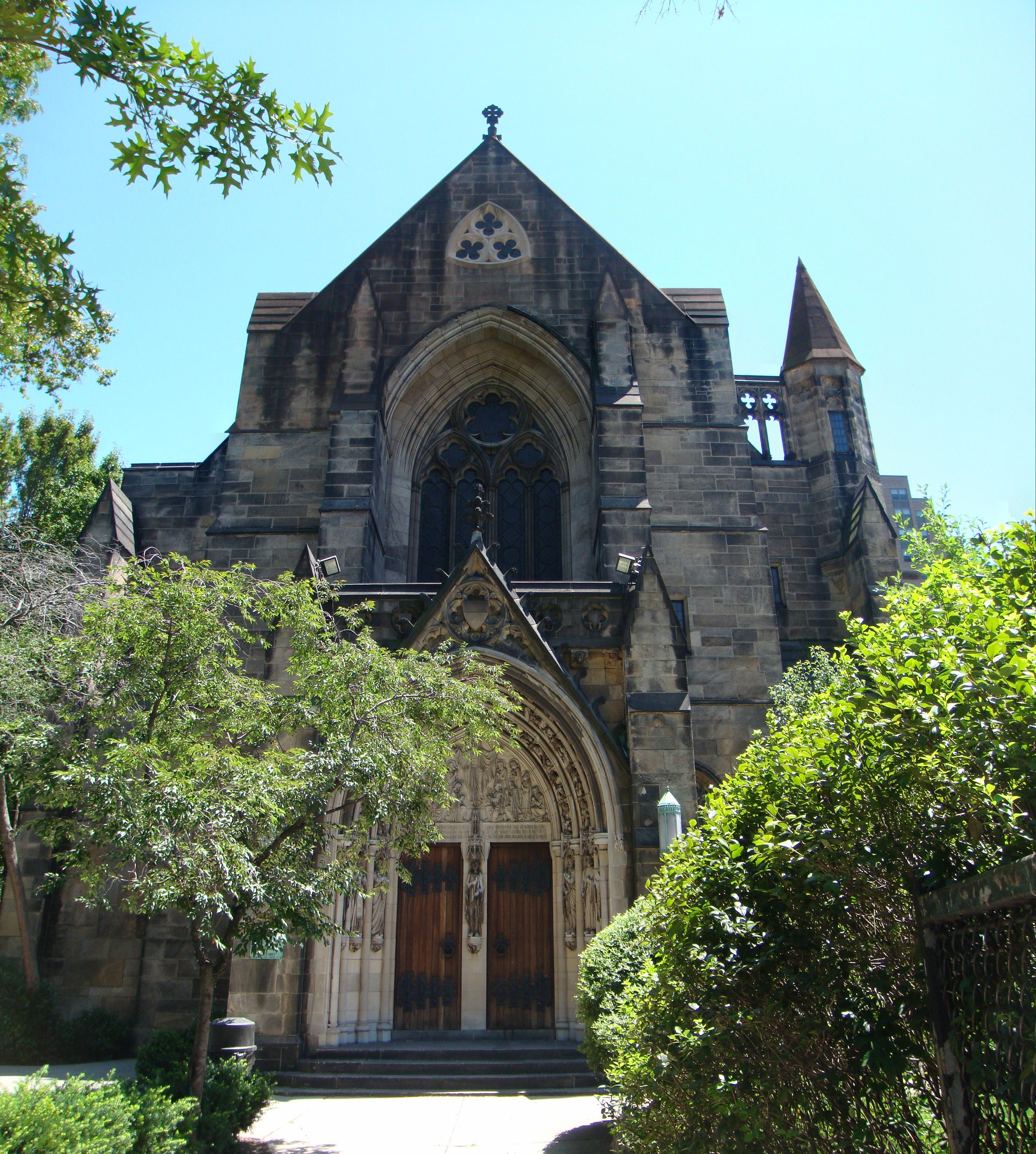
The Synod Hall (also known as the Synod House) houses the cathedral's synod or council, but is also used for various events and other functions. It was completed in 1913 and was the first of four structures on the cathedral close to be designed by Cram, and was designed to be "the most beautiful thing in New York". It is located at the southwestern corner of the cathedral close. The main entrance, an arched portal facing Amsterdam Avenue, contains carvings of Christian figures, which flank oak double-doors. A carving of George Washington is located between the doors, and six smaller figures are located on the tympanum above the doors. The exterior is made of pink Kingwood sandstone. Inside is a hall that can seat over a thousand people, with gallery seating above the main level. There are grisaille windows to the north and south, and wooden trusses on the ceiling, supporting the gable roof. The Synod Hall also contains a three-manual Skinner pipe organ.
Plans for a diocesan building were considered as early as 1903. The current Synod Hall was announced in 1911, in preparation for the 1913 General Convention of the Episcopal Church. Cram's firm submitted plans for Synod Hall in March 1912, and it opened in October 1913 with the start of the convention. However, the hall was not completed until early 1914. After Bayard Cutting and J. P. Morgan made large donations toward the Synod Hall, the cathedral had to return some of the previous donations, as the two men had given more than enough funds to pay for the building.
School

The choir school building, now the Cathedral School of St. John the Divine, is located on the cathedral close's eastern border. The building is in the Collegiate Gothic style and is stories tall. The exterior contains gray schist cladding and limestone trim, with architectural features such as a gabled roof, dormers protruding from the roof, and Tudor-style arched openings. Inside, the building contained classrooms; gathering space for reception, dining; music rooms; a library; a gymnasium; a dormitory; and masters' and service rooms.
The choir school was created in 1901 within the Town Building. A separate structure was first proposed in Walter Cook & Winthrop A. Welch's 1906 plan for the campus. In January 1910, Mary Eliza Blodgett (alternatively Mrs. J. Jarrett Blodgett) donated $25,000 toward the new school building's projected $150,000 cost, as a gift to honor her father John H. Sherwood. Blodgett later covered the rest of the choir school building's cost after no one else donated, while former choirboy Frederick G. Bourne provided a $500,000 endowment in 1914. Cram approved Cook & Welch's plan in January 1912 and filed construction plans that July, with work beginning that October. The school building was finished in September 1913. The choir school consisted of day school for 20 adult men and a boarding school for 40 choirboys who paid no tuition. It was turned into a boys' day school in 1964 and a coeducational day school for grades K-8 in 1972.
Bishop's house and deanery
The Episcopal Residence, consisting of the bishop's house (also Cathedral House) and deanery (also Ogilvie House), were the final buildings that Cram designed within the cathedral close. The structures were intentionally built close together to evoke a feeling of coziness. According to Cram, the Chateauesque-style buildings were inspired by "later domestic" buildings in the French Gothic style. The bishop's house is west of the deanery, on slightly higher ground; the deanery is thus hidden behind the bishop's house. A small garden is located at the northeast corner of the buildings.
As built, the two structures contained a myriad of living space inside. The bishop's house contained eight rooms with seven bathrooms, while the deanery contained 20 rooms with five bathrooms. The deanery is three stories tall; like the choir school, it has gray schist cladding and limestone trim. It contains several pavilions with dormers and gabled roofs, as well as a loggia and an oriel window on the southern elevation. The bishop's house is four stories tall and is largely in the same design, but part of the northern elevation is made of exposed brick, marking the location where it would have connected to the unbuilt southern transept. The ornamentation of the bishop's house contains symbols of the diocesan offices, such as bishops; by contrast, the deanery has simpler decorations, such as depictions of flowers and cats. A private chapel between the two buildings was not built.
An episcopal residence had been announced in 1897 and Heins & LaFarge drew up plans for such a structure in 1902. The Deanery was donated by Helen Slade Ogilvie in 1911 in memory of her late husband Clinton, while the bishop's house was funded partly by the sale of a previous bishop's house at Gramercy Park. Initially, the site of the two structures was contested because the buildings would have blocked views of the main cathedral from the south. Before the structures' construction started in 1912, the sites for the bishop's house and deanery were relocated eastward. The two buildings' sites were given preliminary approval in May 1912 and were officially approved that October. The bishop's house started in November 1912 and was finished in April 1914. while the deanery was started in February 1913 and completed by that November. Both structures were erected by Leonard Jacob and Frederick T. Youngs. After the 1947 Diocesan Convention, the bishop moved into the upper two floors of the deanery, and the old bishop's house was turned into administration offices.
Residential buildings

In 2008, the cathedral leased the southeast corner of its property, which contained the cathedral's playground and Rose Garden, to the AvalonBay Communities, which built a luxury apartment building called the Avalon Morningside Park. The project includes 295 apartments, of which 20% are affordable housing units, as well as replacement rose garden. The cathedral leased the northeastern edge of its property, formerly a parking lot, in 2012. The lessee was the Brodsky Organization, which built a residential building called the Enclave between 2014 and 2015. The Enclave consists of 428 rental apartments in two 15-story buildings, separated by the passageway leading to the northern transept; an underground gallery connects the two buildings.
Both developments leased the land from the cathedral for 99-year terms. The lease on the land under the Enclave pays the Cathedral about $3 million a year; the lease on the Avalon, about $2.5 million.
Art, activities, and exhibitions
Concerts and special events
The cathedral's interior is frequently used for concerts, performances, and other special events.
Recurring events
The cathedral has an annual New Year's Eve Concert for Peace. The Postlude to Act I of Leonard Bernstein's opera Quiet Place received its New York premiere at the 1985 concert. The 1990 concert was a tribute to Bernstein himself, who helped found the event and had died two months earlier on October 14.
Paul Winter has given many concerts at the cathedral, and the Paul Winter Consort are the artists in residence. Among the major musical events that takes place every year is a celebration of the feast day of St. Francis, when the Paul Winter Consort participates in a liturgical performance of Winter's Missa Gaia (Earth Mass). The musical group also performs at the annual Winter Solstice program.
One-time events
The cathedral has also been used for several individual events:
- Duke Ellington's Second Sacred Concert, of his original sacred music compositions, premiered at the cathedral on January 19, 1968.
- When construction on the south tower restarted in 1982, French high-wire artist Philippe Petit walked on a tightrope stretched across Amsterdam Avenue. Petit was also the artist-in-residence at St. John's starting in 1982.
- In 1990, the avant-garde musician Diamanda Galas performed Plague Mass, a culmination of her work dedicated to the victims of the AIDS epidemic. Galas's performance consisted of covering her body in cattle blood and reinterpreting biblical texts and classic literature. She said it was a protest against what she saw as the ignorance and condemnation toward people with AIDS from religious and political groups.
- On December 8, 1994, Mariah Carey hosted a benefit concert for The Fresh Air Fund. The concert helped raise $700,000 to support the Fresh Air Fund and Carey's own Camp Mariah, and an additional $1 million from Carey herself.
- The wedding of Ethan Hawke and Uma Thurman took place at the cathedral on May 1, 1998.
- In November 2017, Aretha Franklin held her last large public concert, a 25th-anniversary event for the Elton John AIDS Foundation being hosted at the cathedral.
The Cathedral of St. John the Divine has also hosted events with spiritual leaders. Among them are Tenzin Gyatso, the 14th Dalai Lama, who first visited the cathedral in 1979. In addition, Bishop Desmond Tutu led a service in the cathedral in 1986.
Temporary art exhibitions
The Cathedral of St. John the Divine is also used as an art exhibition space:
- In 1977, a sculpture dedicated to the 12 firemen who died in the 23rd Street Fire of 1966 was unveiled at St. John's.
- Edwina Sandys's Christa, a sculpture exhibited during Holy Week in 1984, was based upon the feminine divine. Though the sculpture generally received positive acclaim, several pieces of hate mail were addressed to the cathedral, accusing the cathedral of "blasphemy" with its depiction of Christ on the cross. The statue was displayed again at The Christa Project: Manifesting Divine Bodies exhibition in 2016.
- The Value of Water, curated by artist activist Fredericka Foster, was exhibited at the cathedral in 2011. Featuring over forty artists, it was the largest-ever art exhibition to appear at the cathedral.
- In 2014, the cathedral housed Phoenix, a sculptural group by Chinese artist Xu Bing. The two sculptures that comprised Phoenix was one of the largest pieces of sculpture ever displayed in the United States, weighing 12 ST with lengths of 90 and.
Poets' Corner
The Poets' Corner, inspired by a similar corner at Westminster Abbey, is located in the Arts Bay, on the nave's northern side. It was dedicated in 1985, with Emily Dickinson, Washington Irving, and Walt Whitman being the first poets to be inducted as part of the tradition. The Poets' Corner consists of a poet-in-residence, hired for a five-year term, who in turn appoints electors on staggered terms. The poets-in-residence and electors have included 17 United States Poet Laureates. The electors then vote on choices for honorees, whose names are carved into blocks in the Poets' Corner; subsequent honorees have included Edgar Allan Poe, T. S. Eliot, William Faulkner, and William Carlos Williams. The electors' choices can be overturned, as occurred in 1999, when the Very Reverend Harry Pritchett vetoed Ezra Pound's inclusion because of Pound's anti-Semitic statements during World War II.
Permanent works

The pulpit green contains the Peace Fountain, a large bronze work of public art by the cathedral's sculptor-in-residence, Greg Wyatt. It was commissioned in 1985 and depicts the struggle of good and evil; a battle between the Archangel Michael and Satan; and images of the Sun, the Moon, and several animals.
Advocacy
Throughout the years, the Cathedral of St. John the Divine has been involved in various initiatives and projects. These programs included youth initiatives, a soup kitchen, a homeless shelter, and AIDS outreach. During the Vietnam War, the cathedral was also part of the opposition to United States involvement in the war. The Temple of Understanding, an interfaith organization, was housed at the cathedral for several decades in the late 20th century, moving to Midtown Manhattan in the 1990s.
Several programs have been directed toward helping members of the surrounding community. In 1971, the cathedral founded ACT (Athletics, Creativity, and Trips), a program that provided after-school activities and summer camp to children in the neighborhood. The program still runs under the name "Advancing the Community of Tomorrow". In 1974, in response to a need for housing in New York City, St. John's created a program that became the Urban Homesteading Assistance Board (UHAB); by 1987, the program had helped residential tenants in over 500 buildings to renovate and take ownership of their houses. Additionally, a homeless shelter, crisis center, clothes closet, and kitchen are run by in-house volunteers.
Deans
- William Mercer Grosvenor (1911–1916)
- Howard Chandler Robbins (1917–1929)
- Milo Hudson Gates (1930–1939)
- James Pernette DeWolfe (1940–1942)
- vacant (1942–1952)
- James Albert Pike (1952–1958)
- John Vernon Butler (1960–1966)
- vacant (1966–1972)
- James Parks Morton (1972–1997)
- Harry Houghton Pritchett Jr. (1997–2001)
- James August Kowalski (2002–2017)
- Clifton Daniel III (2018–2022)
- Patrick Malloy (2022–2025)
- Winnie Varghese (2025−present)
Notable funerals and memorials
The following people are listed with the year of their funeral or memorial service in parentheses:
- Alvin Ailey (memorial, 1989), choreographer
- Arthur Ashe (memorial, 1993), tennis player
- George Balanchine (funeral, 1983), choreographer
- James Baldwin (funeral, 1987), writer, activist
- Joseph Brodsky (funeral, 1996), poet
- Joan Didion (memorial, 2022), writer and journalist
- John Gregory Dunne (funeral, 2004), writer, journalist and husband of Joan Didion
- Duke Ellington (funeral, 1974), composer
- James Gandolfini (funeral, 2013), actor
- Dizzy Gillespie (funeral, 1993), musician
- Allen Ginsberg (funeral, 1998), poet
- Jim Henson (memorial, 1990), Muppets creator
- Trevor Huddleston (memorial, 1997), anti-apartheid activist
- Richard Hunt (funeral, 1992), Muppet performer
- Audre Lorde (funeral, 1993), poet, activist
- Toni Morrison (funeral, 2019), author
- Paul Moore Jr. (funeral, 2003), bishop
- Eleanor Roosevelt (memorial, 1962), activist, diplomat, U.S. First Lady
- Nikola Tesla (funeral, 1943), inventor
- Terence Tolbert (funeral, 2008), political operative
Visitor access
In addition to worship services, the Cathedral of St. John the Divine offers both self-guided and guided tours of the interior exhibits, the cathedral close, and the gardens. These tours require paid tickets; there are discounts for seniors and students, as well as for those in tour groups. Admission is also included within several New York City tourist passes.
Landmark status
The Cathedral of St. John the Divine complex had been considered for designation as an official landmark by the New York City Landmarks Preservation Commission in 1966. At the time, St. John's trustees had opposed the move because the structure was incomplete, and a landmark designation would have required the commission to review every proposed major expansion thereafter. The church's trustees were able to prevent designation by claiming the church was not completed, using a stipulation in the landmark's law that stated that potential landmarks had to have been completed for at least 30 years. A subsequent landmark designation was precluded in 1979 for a similar reason.
In 2003, the exterior of the cathedral was again considered for landmark status; the interior was ineligible because the commission was legally unable to recognize religious buildings' interiors as landmarks. However, shortly after the commission conferred landmark status on the structure, the designation was unanimously overturned by the New York City Council, some of whose members favored landmark status for the entire cathedral close instead of just the main building. Councilman Bill Perkins proposed that the protective status should also be extended to the cathedral's grounds in order to control development there. The lack of an official city landmark designation meant that the cathedral site could potentially be redeveloped, and as such, two residential buildings were built on the same block as the cathedral. In 2017, the cathedral and six other buildings on the grounds were re-designated a New York City Landmark; the designation excludes the two new structures.
References
Notes
Citations
Sources
References
- {{harvnb. Landmarks Preservation Commission. 2017
- Hall, Edward Hagaman. (1916). "Documents of the Assembly of the State of New York".
- {{harvnb. Landmarks Preservation Commission. 2017
- {{harvnb. Dolkart. 1998
- {{harvnb. Dolkart. 1998
- {{harvnb. Richmond. 1872
- {{harvnb. Dolkart. 1998
- {{harvnb. Richmond. 1872
- Gray, Christopher. (June 24, 1990). "Streetscapes: The Leake & Watts Orphan Asylum; A Castoff in the Path of a Growing, Great Cathedral". [[The New York Times]].
- {{harvnb. Landmarks Preservation Commission. 2017
- {{Cite gotham
- {{harvnb. Dolkart. 1998
- {{harvnb. Jackson. 2010
- (November 22, 1941). "St. John's Cathedral Mapped 113 Years Ago, Diary of Phil Hone, Mayor in 1820s, Shows". The New York Times.
- {{harvnb. Landmarks Preservation Commission. 2017
- "Memories of a Metropolitan Bishop, by George F. Nelson (1927)".
- {{harvnb. Dolkart. 1998
- {{Harvnb. Quirk. 1993
- {{harvnb. Landmarks Preservation Commission. 2017
- {{harvnb. Dolkart. 1998
- Episcopal Church. Diocese of New York. (1883). "The Election and Consecration of the Rev. Henry Codman Potter, D.D., LL D.: As Assistant Bishop of the Diocese of New York". J. Pott.
- {{harvnb. Stern. Gilmartin. Massengale. 1983
- (June 2, 1887). "New Cathedral Planned; Bishop Potter Asks the City for Aid. the Episcopalians Propose to Build a Great Temple Worthy of Their Creed and the City". The New York Times.
- (June 2, 1887). "News in Brief". Brooklyn Standard Union.
- (June 6, 1887). "Making Cordial Response.; Bishop Potter's Plan Gets Only Commendation. Steps Already Taking to Build the Great Cathedral and Words of Encouragement from Every Side. Appeals from the Pulpits". The New York Times.
- (August 15, 1891). "Real Barberini Tapestries.; a Gift to the Cathedral of St. John the Divine". The New York Times.
- {{harvnb. Dolkart. 1998
- Hodges, George. (1915). "Henry Codman Potter, seventh bishop of New York". Macmillan.
- {{harvnb. Dolkart. 1998
- {{harvnb. Landmarks Preservation Commission. 2017
- {{harvnb. Hall. 1920
- {{Harvnb. Quirk. 1993
- {{harvnb. Stern. Gilmartin. Massengale. 1983
- {{harvnb. Dolkart. 1998
- (January 16, 1889). "Plans for the Cathedral". The New York Times.
- (January 15, 1889). "Plans for the Great Cathedral". New York Evening World.
- {{harvnb. Landmarks Preservation Commission. 2017
- (May 16, 1889). "Cathedral Plans". New York Evening World.
- (May 18, 1889). "The Cathedral Designs.; the Four Plans from Which One Is to Be Selected". The New York Times.
- (1889). "The Churchman". George S. Mallory.
- {{harvnb. Stern. Gilmartin. Massengale. 1983
- {{harvnb. Dolkart. 1998
- (October 21, 1890). "The Episcopal Cathedral". The New York Times.
- (July 26, 1891). "Architects of the New Cathedral". New York Sun.
- {{harvnb. Stern. Gilmartin. Massengale. 1983
- {{harvnb. Dolkart. 1998
- (April 13, 1891). "Architect W. W. Kent". The Buffalo Commercial.
- (November 30, 1892). "Mr. W. W. Kent's Vindication". The Buffalo Commercial.
- {{harvnb. Dolkart. 1998
- {{cite New York 1880
- {{harvnb. Stern. Gilmartin. Massengale. 1983
- {{harvnb. Landmarks Preservation Commission. 2017
- Gray, Christopher. (October 10, 2004). "New York's Subway: That Engineering Marvel Also Had Architects". The New York Times.
- (October 21, 1891). "To Revise Cathedral Plans.; the Architects to Consider Suggestions Made by the Trustees". The New York Times.
- (November 29, 1891). "Plans for the New Cathedral". New York Sun.
- (November 29, 1891). "Will Begin Work Next Spring". The New York Times.
- {{harvnb. Dolkart. 1998
- {{harvnb. Stern. Gilmartin. Massengale. 1983
- (April 1, 1892). "St. John the Divine.; Plans of the Trustees as to Its Building". The New York Times.
- (December 27, 1892). "St. John the Divine". New York Evening World.
- (December 8, 1892). "The Cathedral Cornerstone; Arrangements for the Ceremonies Are Rapidly Completing". The New York Times.
- Kirby, David. (January 10, 1999). "St. John The Unfinished. Dean of Cathedral on Morningside.". The New York Times.
- (January 25, 1893). "Ready to Begin the Cathedral". New York Sun.
- (May 23, 1893). "Its Title Deed Secured; The First Step Toward Building the Cathedral of St. John the Divine Taken". The New York Times.
- {{harvnb. Landmarks Preservation Commission. 2017
- {{harvnb. Dolkart. 1998
- (September 10, 1893). "Cathedral Builders Puzzled; A Pocket of Soft Shale Found on the Site of the Church of St. John the Divine". The New York Times.
- (September 9, 1893). "Building in a Mud-Pocket". The World.
- (August 18, 1895). "Founded on the Rock". Brooklyn Citizen.
- (August 13, 1895). "Its Foundations Rising; Work on the Cathedral of St. John the Divine.". The New York Times.
- (September 10, 1893). "Possible Changes for the Cathedral". New-York Tribune.
- {{harvnb. Hall. 1920
- (July 23, 1898). "Religious News and Views". The New York Times.
- (August 2, 1896). "Charms of Morningside". The New York Times.
- {{harvnb. Hall. 1920
- "History". Cathedral of St. John the Divine.
- {{Harvnb. Quirk. 1993
- {{harvnb. Dolkart. 1998
- {{harvnb. Landmarks Preservation Commission. 2017
- (March 25, 1903). "Cathedral Choir Columns; St. John the Divine Trustees Announce That a Sufficient Sum for the Work Has Been Subscribed.". The New York Times.
- (March 30, 1903). "Pushing New Cathedral; Three More Arches to Follow the Eight Great Pillars". The New York Times.
- (1903). "Engineering News". McGraw-Hill Publishing Company.
- Murphy, Roger. (May 16, 2020). "Moving and Raising the Columns".
- (July 6, 1904). "Big Pillars in Place". New-York Tribune.
- {{harvnb. Dolkart. 1998
- Hewitt, Rich. (December 19, 2001). "Church's columns quarried on Vinalhaven". Bangor Daily News.
- (August 28, 1903). "Moving Cathedral Columns; It Took Seven Hours to Turn a 100-Ton Monolith at the Wharf, and One Hour to Haul It 50 Feet.". The New York Times.
- (July 14, 1903). "Get Ready to Move Big Columns". New-York Tribune.
- Natalia Zawisny, Corentin Fivet and John Ochsendorf, Guastavino design of the 1909 thin brick dome of the Cathedral of St John the Divine,Construction History Vol. 32, No. 2 (2017), pp. 39-66 (28 pages)
- (March 23, 1904). "New Charter For Protestant Cathedral; Adopted by the Trustees of St. John the Divine". The New York Times.
- (May 28, 1905). "Cathedral of St. John the Divine Taking New Start; With the King Bequest of $100,000 There Is Practically $800,000 Available for Pushing the Work". The New York Times.
- (March 7, 1906). "Great Organ Ordered For New Cathedral; Will Be Among World's Most Powerful Instruments". The New York Times.
- (January 1, 1956). "Looking Back Into the Past".
- (July 30, 1905). "The Great Cathedral's Golden Granite". Brooklyn Standard Union.
- (October 11, 1905). "Sculptor Destroys His Cathedral Angels; Wouldn't See Them Wrangled About and Carted Off". The New York Times.
- (October 5, 1907). "Church and Religious News and Notes". New-York Tribune.
- {{harvnb. Dolkart. 1998
- (September 27, 1907). "George Lewis Heins Dead; Designer of the Cathedral of St. John the Divine a Victim of Meningitis". The New York Times.
- {{harvnb. Dolkart. 1998
- (October 25, 1909). "Delay in New Cathedral; St. John's the Divine Can't Be Opened for Months, It Is Said.". The New York Times.
- (October 25, 1909). "To Maintain Cathedral". New-York Tribune.
- (November 21, 1909). "St. John's Almost Completed". Buffalo Morning News.
- (March 4, 1911). "Choir of New Cathedral; Forty-eight Voices for St. John the Divine Opening on April 19.". The New York Times.
- (April 20, 1911). "Great Cathedral is Consecrated; $320,000 Toward Completion of Edifice Contributed at Impressive Services". The New York Times.
- {{harvnb. Dolkart. 1998
- {{Harvnb. Quirk. 1993
- {{harvnb. Dolkart. 1998
- (June 21, 1911). "Oust Architect Who Designed the Cathedral; Trustees of St. John the Divine Put Ralph Adams Cram in Place of C. Grant La Farge". The New York Times.
- {{harvnb. Stern. Gilmartin. Massengale. 1983
- (June 22, 1911). "Cram's Cathedral All Gothic". New York Sun.
- {{harvnb. Hall. 1920
- (June 22, 1911). "Cram Will Build Gothic Cathedral; Boston Architect Says He Will Depart from La Farge's Romanesque Design". The New York Times.
- {{harvnb. Dolkart. 1998
- (October 26, 1911). "Shows Plans for Cathedral Houses". New York Herald.
- {{harvnb. Landmarks Preservation Commission. 2017
- (June 21, 1911). "As The Cathedral May Look". New York Sun.
- {{harvnb. Dolkart. 1998
- (May 5, 1912). "Ask for $5,500,000 to Finish Cathedral; League Devoted to Raising St. John the Divine Building Fund Outlines Its Plans.". The New York Times.
- {{harvnb. Dolkart. 1998. Landmarks Preservation Commission. 2017
- (October 8, 1913). "Episcopal General Convention Opened". Brooklyn Daily Eagle.
- (January 27, 1916). "Cathedral to Build $1,500,000 Nave; Bishop Greer Says Trustees of St. John the Divine Are Ready for Bids.". The New York Times.
- (May 9, 1916). "Bishop Starts Cathedral Nave". New-York Tribune.
- (May 9, 1916). "Ground is Broken For $3,000,000 Nave; Imposing Ceremonies Mark the Start of Work on St. John Cathedral Building". The New York Times.
- (November 19, 1916). "Halt Work at Cathedral; Cash Is Needed to Finish Nave of St. John the Divine.". The New York Times.
- (November 20, 1916). "Work on Nave to Go On". New-York Tribune.
- {{harvnb. Dolkart. 1998
- (April 13, 1919). "Campaign to Raise $6,000,000 for Completion of Cathedral of St. John the Divine Decided Upon". New-York Tribune.
- (February 11, 1919). "Resume Cathedral Work; Nave of St. John the Divine to be a Memorial to New York Soldiers.". The New York Times.
- (February 26, 1919). "To Start Work Soon on St. John's Nave; Plans Adopted Will Make It Third Largest Cathedral in the World". The New York Times.
- (May 2, 1920). "Cathedral Plans No Drive; Funds for Nave of St. John the Divine to be Raised Otherwise.". The New York Times.
- (June 20, 1923). "Drive to Complete Cathedral Opens; Plan to Make St. John the Divine Largest Edifice of English-Speaking World". The New York Times.
- (November 18, 1924). "Proceedings of the Board of Regents of the Smithsonian Institution at the Annual Meeting held December 11, 1924". Smithsonian Institution.
- (1981). "The Working Press: Special to the New York Times". Arno Press.
- {{harvnb. Dolkart. 1998
- (May 25, 1924). "Bishop to Start Cathedral Work". [[Brooklyn Times-Union]].
- (October 20, 1924). "Cathedral Board Seeks Bids on Nave; Four Firms Asked to Submit Figures for Main Portion of St. John the Divine.". The New York Times.
- (February 24, 1925). "Fund for Cathedral Over Half Raised; New Donations of $657,805 Announced at Rally Make Total $7,663,200". The New York Times.
- (November 9, 1925). "Cathedral Stone Will Be Laid Today; Gov. Smith and Other Notables Will Speak at Nave at St. John the Divine". The New York Times.
- (November 10, 1925). "Nave Stone Laid for Cathedral". Brooklyn Times-Union.
- {{harvnb. Dolkart. 1998
- {{harvnb. Dolkart. 1998
- (February 15, 1925). "Bishop to Report on Cathedral Drive". The New York Times.
- (January 15, 1927). "Cathedral Tower Problem is Solved; Trustees Accept Design, Hailed as American Contribution to Gothic Architecture". The New York Times.
- (December 6, 1927). "Women's Transept Begun at St. John's; Ceremonies Mark the Breaking of Ground for $1,000,000 Unit of the Cathedral". The New York Times.
- (November 8, 1934). "Cathedral Work Will Be Resumed; Building of Women's Transept, Halted in 1930, to Continue Soon, Manning Announces". The New York Times.
- (November 8, 1934). "Funds to Complete Transept Available". Brooklyn Daily Eagle.
- (December 28, 1930). "$1,300,000 Job Let on Cathedral Work; Bishop Manning Says Project Will Extend Massive Facade to Enclose Great Nave". The New York Times.
- (July 8, 1934). "Cathedral Needs $10,000,000 More; Bishop Manning Reveals Total Sum Necessary to Complete St. John the Divine Edifice". The New York Times.
- (January 3, 1938). "$1,000,000 Is Asked to Rush Cathedral; Manning Appeals for Aid in Getting St. John's Ready by Time Fair Opens". The New York Times.
- {{harvnb. Federal Writers Project. 1939
- (November 28, 1941). "Full Vista at St. John's Cathedral Revealed at Preview of Opening; 60-Foot Curtains Drawn Apart Disclose an Expanse of a Tenth of a Mile". The New York Times.
- (December 1, 1941). "15,000 Join in Service At St. John's Cathedral". Brooklyn Daily Eagle.
- {{Harvnb. Quirk. 1993
- {{harvnb. Macrae-Gibson. 1979
- (December 8, 1941). "1,000 At Cathedral Take Communion; Record Gathering Participates as St. John the Divine Ends Week of Celebration". The New York Times.
- (January 30, 1949). "Cathedral Needs Final $10,000,000; St. John the Divine Will Be Largest Gothic Structure of Its Kind in the World". The New York Times.
- {{harvnb. Dolkart. 1998
- {{harvnb. Landmarks Preservation Commission. 2017
- (June 4, 1945). "$10,000,000 Sought to Aid Cathedral; Change in Architectural Design of Cathedral of St. John the Divine". The New York Times.
- Fiske, Edward B. (November 22, 1966). "Unfinished Cathedral; Hope to Complete St. John the Divine Is Stalled by Changing Role of Church". The New York Times.
- Dugan, George. (February 26, 1955). "Cathedral Faces a Design Problem; To Finish St. John the Divine Involves Choice of Gothic or 'Contemporary' Style". The New York Times.
- Fiske, Edward B. (May 11, 1966). "Cathedral Plans to Build Again; St. John the Divine Still Is Unfinished After 25 Years". The New York Times.
- {{harvnb. Macrae-Gibson. 1979
- (November 23, 1966). "Trustees Back St. John's Cathedral Dome; A Compromise Plan Will Complete Gothic Edifice". The New York Times.
- (November 21, 1966). "Colored Glass Dome Proposed to Finish St. John the Divine; Contemporary Dome of Multicolored Glass Proposed for Finishing Cathedral of St. John the Divine". The New York Times.
- (November 23, 1966). "Dome Chosen for Cathedral". New York Daily News.
- (October 29, 1967). "Aid to N.Y. City Poor to Delay Cathedral Completion". Democrat and Chronicle.
- Blau, Eleanor. (May 21, 1973). "Building to Resume at St. John the Divine". The New York Times.
- {{harvnb. Landmarks Preservation Commission. 2017
- {{harvnb. Macrae-Gibson. 1979
- (July 16, 1973). "Religion: A People's Cathedral".
- Blau, Eleanor. (December 11, 1973). "The 'New' St. John's: A Community Catalyst". The New York Times.
- Vecsey, George. (January 8, 1978). "Cathedral. of St. John the Divine Embroiled in Dispute Over School Head's Retirement".
- Goldberger, Paul. (September 30, 1982). "St. John the Divine: The Slow Finishing Touch; An Appraisal". The New York Times.
- Briggs, Kenneth A. (December 5, 1978). "Construction of Cathedral of St. John Will Resume". The New York Times.
- McCarthy, Sheryl. (December 5, 1978). "Building to resume on Cathedral of St. John". New York Daily News.
- Barr, Robert. (July 8, 1979). "Church construction is testament of faith". Star-Gazette.
- (October 31, 1987). "'St. John the Unfinished': Stonemasons Represent Activism, Tradition".
- (January 29, 1989). "Stone Carver's Magnificent Obsession". The New York Times.
- {{harvnb. Macrae-Gibson. 1979
- Daniels, Lee A. (June 22, 1979). "Work Begins at Cathedral of St. John the Divine". The New York Times.
- Geist, William E.. (March 19, 1986). "About New York; Taking the Long View of Building a Cathedral". The New York Times.
- Comegya, Lee. (November 22, 1984). "World's largest Gothic cathedral 'in process' after century". Democrat and Chronicle.
- {{Harvnb. Quirk. 1993
- Cochran, Tracy. (October 31, 2013). "Seeking Verity".
- Shepard, Joan. (April 17, 1988). "Culturally, too, Cathedral of St. John is divine". New York Daily News.
- {{harvnb. Dolkart. 1998
- Bloom, Jennifer Kingson. (November 20, 1994). "Neighborhood Report: Morningside Heights; Scaffolding Leaving the Cathedral of St. John the Divine. More to Come.". The New York Times.
- Dunlap, David W. (November 6, 2007). "A Blossoming Cathedral Tower Sheds Its Scaffolding". The New York Times.
- (December 19, 2001). "Fire Damages St. John the Divine, Gutting Gift Shop and Scorching Art". The New York Times.
- (December 19, 2001). "Fire hits St. John the Divine". Democrat and Chronicle.
- (December 18, 2001). "Fire Damages Historic Cathedral".
- Wakin, Daniel J. (February 6, 2002). "Restoring a Cathedral To Unfinished Glory; Huge Cleanup for St. John the Divine". The New York Times.
- Barron, James. (October 15, 2008). "Stop by Stop, Cathedral's Organ Is Reassembled After a 2001 Fire". The New York Times.
- Chan, Sewell. (November 30, 2008). "Repaired After Fire, Cathedral Reopens". The New York Times.
- Vitello, Paul. (November 30, 2008). "Awash in New Light, Angels Are Revealed at St. John the Divine". The New York Times.
- Mindlin, Alex. (October 24, 2004). "St. John the Unfinished Becomes St. John the Downsized". The New York Times.
- Hu, Winnie. (October 25, 2003). "No Landmark Status for St. John the Divine". The New York Times.
- Dunlap, David W. (June 27, 2003). "Big Buildings Planned on Grounds of St. John the Divine". The New York Times.
- "Enclave at the Cathedral".
- (November 20, 2016). "New Rentals Steps From St. John the Divine". The New York Times.
- Rosenberg, Zoe. (September 21, 2015). "Rentals Hiding Cathedral of St. John the Divine Nearly Complete".
- Rosenberg, Zoe. (February 21, 2017). "Cathedral of St. John the Divine finally becomes a NYC landmark".
- (December 2017). "St. John the Divine's North Transept Enclosure and – Market Insight".
- Stapinski, Helene. (August 30, 2018). "Secret Doorways, Gargoyles and Wood-Carved Angels: Cleaning Out the Cathedral Basement". The New York Times.
- Ferré-Sadurní, Luis. (April 14, 2019). "Fire in Basement Crypt at St. John the Divine Forces Palm Sunday Worshipers Outside". The New York Times.
- (April 15, 2019). "Crypt fire disrupts Palm Sunday services at Cathedral of St. John the Divine".
- (Fall 2019). "Fall 2019 at the Cathedral".
- Margolies, Jane. (September 17, 2019). "St. John the Divine Cathedral Is in Recovery Mode". The New York Times.
- Ennead Architects. (March 26, 2019). "Crossing Dome Roof: NYC Landmarks Preservation Commission Public Hearing". [[New York City Landmarks Preservation Commission]].
- Morris, Sebastian. (March 26, 2019). "Copper Dome Proposed for St. John the Divine Heads to Landmarks for Approval".
- Blair, Leonardo. (August 21, 2024). "NYC grants Cathedral Church of St. John the Divine $1.5M".
- Ginsburg, Aaron. (August 20, 2024). "Cathedral of St. John the Divine gets $1.5M grant to transform historic building into community hub".
- Barron, James. (2024-12-13). "In New York and Paris, Church Organs Return to Life". The New York Times.
- (December 12, 2024). "Great organ back in commission at NYC's Cathedral of St. John the Divine".
- {{Cite NYC neighborhood map. Morningside Heights
- Pollak, Michael. (February 26, 2010). "Manhattan Highs and Your Permanent Record". The New York Times.
- {{Harvnb. Quirk. 1993
- Koeppel, Gerard. (2015). "City on a grid : how New York became New York". Da Capo Press, a member of the Perseus Books Group.
- {{harvnb. Landmarks Preservation Commission. 2017
- {{harvnb. Hall. 1920
- {{harvnb. Hall. 1920
- Brock, H. j. (January 30, 1927). "Transformation of a Great Cathedral; Plans for St. John the Divine Undergo a Change In the Direction of Pure Gothic". The New York Times.
- {{harvnb. Dolkart. 1998
- {{Cite New York 1930
- "About - Cathedral of Saint John the Divine".
- {{harvnb. Quirk. 1993
- {{harvnb. Hall. 1920
- {{harvnb. Quirk. 1993
- {{Harvnb. Quirk. 1993
- (2006). "New York City". Fodor's Travel Publications.
- Carlson, Jen. (October 12, 2017). "Photos: This Apocalyptic NYC Church Facade Depicts City Collapsing Beneath Giant Waves & Nuclear Explosion".
- (1932). "Creative Art: A Magazine of Fine and Applied Art". A. and C. Boni, incorporated.
- (July 26, 2010). "Cathedral of St. John the Divine, New York City". Sacred Destinations.
- Manton, Cyndy. (2009). "Henry Wilson : practical idealist". Lutterworth Press.
- Lankevich, G.J.. (2003). "Postcards from Manhattan: Sights & Sentiments from the Last Century". Square One Publishers.
- (2016). "Encyclopedia of Christianity in the United States". Rowman & Littlefield Publishers.
- (2015). "Parish Church Treasures: The Nation's Greatest Art Collection". Bloomsbury Publishing.
- Olia, M.. (2019). "No Access Boston: Beantown's Hidden Treasures, Haunts, and Forgotten Places". Globe Pequot.
- {{harvnb. Federal Writers Project. 1939
- {{harvnb. Quirk. 1993
- {{harvnb. Hall. 1920
- {{harvnb. Landmarks Preservation Commission. 2017
- {{harvnb. Quirk. 1993
- {{harvnb. Landmarks Preservation Commission. 2017
- {{harvnb. Quirk. 1993
- "Nave – Cathedral of Saint John the Divine".
- {{harvnb. Quirk. 1993
- {{harvnb. Quirk. 1993
- {{harvnb. Quirk. 1993
- {{harvnb. Quirk. 1993
- {{harvnb. Quirk. 1993
- (July 15, 1922). "Historical Parapet Given to Cathedral; Nineteen Statues Represent Foremost Workers for World Uplift Since Christ". The New York Times.
- (July 29, 1922). "A Christian Hall of Fame". [[The Literary Digest]].
- {{harvnb. Quirk. 1993
- "Residencies".
- {{harvnb. Quirk. 1993
- "The Cathedral Church of St. John the Divine – New York City".
- (June 1, 1911). "Dedication At Cathedral – Clarence Dickinson in First Recital on Organ". [[The Diapason]].
- (November 2009). "Resurgence Of A Landmark Instrument The Restoration Of The Great Organ In The Cathedral Of St. John The Divine, New York City".
- Barron, James. (November 26, 2008). "Before Its Debut, Cathedral Organ Has a Sound Check". The New York Times.
- "The Cathedral Church of St. John the Divine".
- "Cathedral Organs".
- (February 25, 1905). "Shift-About at Cathedral". The New York Times.
- (May 23, 1909). "Tempest in Musical Teapot". Philadelphia Inquirer.
- (May 5, 1909). "Miles Farrow Called". Baltimore Sun.
- (November 27, 1931). "Coke-Jephcott to John Divine". New York Daily News.
- "Our History".
- (March 15, 1962). "Coke-Jephcott, 68, Organist, Is Dead; Choirmaster at St. John the Divine From 1932–1953". The New York Times.
- Whitney, Craig R. (March 23, 2007). "Alec Wyton, 85, Organist Who Updated Church Music, Is Dead". The New York Times.
- (2016). "Dorothy Papadakos". American Guild of Organists.
- (November 26, 2019). "Performance Music at Scranton Presents World-Famous Organist In Recital".
- Catton, Pia. (July 14, 2011). "St. John the Divine Taps New Music Director".
- Wakin, Daniel J. (July 15, 2011). "A Word With: Kent Tritle".
- "Music Staff – Cathedral of Saint John the Divine".
- (Summer 2015). "Summer 2015 at the Cathedral".
- {{harvnb. Dolkart. 1998
- {{harvnb. Hall. 1920
- "Sermon at the Dedication of the Founder's Tomb (1921)".
- {{harvnb. Quirk. 1993
- Urban America (Organization). (1920). "The Architectural Forum". Billboard Publications.
- Brown, H.C.. (1917). "Glimpses of Old New-York". Privately printed for the subscribers Lent & Graff Company.
- {{harvnb. Federal Writers Project. 1939. Dolkart. 1998
- {{harvnb. Quirk. 1993
- (April 14, 2019). "Cathedral Organs".
- {{harvnb. Quirk. 1993
- {{harvnb. Quirk. 1993
- {{harvnb. Quirk. 1993
- {{harvnb. Dolkart. 1998
- {{harvnb. Quirk. 1993
- {{harvnb. Quirk. 1993
- {{harvnb. Quirk. 1993
- {{harvnb. Federal Writers Project. 1939
- {{harvnb. Quirk. 1993
- {{harvnb. Quirk. 1993
- Salwen, Peter. (1989). "Upper West Side story : a history and guide". Abbeville Press.
- {{harvnb. Landmarks Preservation Commission. 2017
- Margolies, Jane. (December 22, 2022). "Cathedral of St. John Finally Solves a 100-Year-Old Problem". [[The New York Times]].
- Taylor, Angela. (July 8, 1982). "In Cathedral's Crypt, a Workshop Turns Out Crafts". The New York Times.
- (2013). "Louis Comfort Tiffany: Treasures from the Driehaus Collection". Monacelli Press.
- Broad, William. (December 23, 2022). "A Cathedral Tried to Approach Heaven, but the Earth Held a Deep Secret". [[The New York Times]].
- {{harvnb. Smith. 1938
- {{harvnb. Smith. 1938
- {{harvnb. Federal Writers Project. 1939
- (2012). "Visitor Guide". Cathedral of St. John the Divine.
- (September 26, 1902). "Selection Of Bishop Coadjutor Postponed; Diocesan Convention Hears Bishop Potter Tell of Need". The New York Times.
- {{harvnb. Landmarks Preservation Commission. 2017
- (November 29, 1911). "To Build New Synod Hall; Trustees of Episcopal Cathedral Will Spend $300,000 on It". The New York Times.
- (December 2, 1911). "Synod Hall for Cathedral Grounds". The Real Estate Record: Real Estate Record and Builders' Guide.
- Barron, James. (October 8, 2017). "Construction Project at a Cathedral: A New Home for Its Peacocks". The New York Times.
- Barron, James. (January 20, 2023). "Beloved Peacocks Are Retiring From St. John the Divine". The New York Times.
- {{harvnb. Landmarks Preservation Commission. 2017
- {{harvnb. Quirk. 1993
- "Textile Conservation Laboratory". The Cathedral of St. John the Divine.
- (July 30, 1981). "Living in the Cathedral Close". The New York Times.
- {{harvnb. Dolkart. 1998
- {{harvnb. Dolkart. 1998
- (May 1, 1910). "Church Training School; Cornerstone of Building for Deaconesses to be Laid Saturday". The New York Times.
- (October 29, 1910). "Church and Religious News Notes". New-York Tribune.
- {{harvnb. Dolkart. 1998
- {{harvnb. Landmarks Preservation Commission. 2017
- {{harvnb. Dolkart. 1998
- {{harvnb. Landmarks Preservation Commission. 2017
- {{harvnb. Quirk. 1993
- (November 29, 1911). "To Build New Synod Hall; Trustees of Episcopal Cathedral Will Spend $300,000 on It.". The New York Times.
- (March 1, 1912). "Plan for New Synod Hall on Cathedral Heights". The New York Times.
- (October 8, 1913). "Missionary Bishops Start Convention; They Favor a "Back-Home" Movement and Will Urge It on Governing Body". The New York Times.
- {{harvnb. Landmarks Preservation Commission. 2017
- (January 27, 1910). "$150,000 School for Cathedral Choir; Mrs. J. Jarrett Blodgett Starts the Fund with a $25,000 Gift to St. John the Divine.". The New York Times.
- Cram, R.A.. (1936). "My life in architecture". Little, Brown, and Company.
- {{harvnb. Dolkart. 1998
- (November 9, 1912). "Start Bishop Greer's Home; Work Also Begun on Cathedral Close House for Dean Grosvenor.". The New York Times.
- (November 9, 1912). "Start Bishop Greer's Home; Work Also Begun on Cathedral Close House for Dean Grosvenor.". The New York Times.
- {{harvnb. Landmarks Preservation Commission. 2017
- Hughes, C. J.. (September 7, 2008). "Worldly, Meet Other-Worldly". The New York Times.
- Finn, Robin. (January 27, 2012). "St. John the Divine Expects Revenue, and Controversy, in Land Deal". The New York Times.
- Barron, James. (April 4, 2014). "Complaints Build as a Cathedral Project Begins Its Rise". The New York Times.
- McKeough, Tim. (November 20, 2015). "New Rentals Steps From St. John the Divine". The New York Times.
- (January 2, 1986). "Music: Peace concert at St. John the Divine". The New York Times.
- (December 31, 1990). "New Year's News". [[Los Angeles Times]].
- "Paul Winter".
- Goldman, Ari L. (October 5, 1987). "Every Dog (and Elephant) Has Its Day in St. John Rite". The New York Times.
- "Calendar – Cathedral of Saint John the Divine".
- (December 21, 2018). "A Paul Winter Solstice Concert 2018: Encore Performance".
- "Calendar: Paul Winter's 40th Annual Winter Solstice".
- (September 23, 2002). "Luckman Orchestra Delivers Ellington's Work With Flair".
- Kilgannon, Corey. (December 17, 2008). "Man on a Wire at the Cathedral, With More to Come".
- Green, Penelope. (September 21, 2006). "A High-Wire Master Touches Down". The New York Times.
- (October 12, 1990). "Critic's Choice". The New York Times.
- (September 23, 2019). "Mariah Carey Plots 'Merry Christmas' 25th Anniversary Reissue".
- (November 29, 1995). "Mariah Carey Carries Off Television Show With Ease". [[The Spokesman-Review]].
- (May 3, 1998). "Expectant Uma Thurman weds in N.Y. cathedral".
- (August 16, 2018). "Aretha Franklin dead; celebrities remember 'Queen of Soul'".
- Vecsey, George. (September 10, 1979). "Reporter's Notebook: To Many, Dalai Lama's Visit Is Dream Come True". The New York Times.
- Kolbert, Elizabeth. (January 7, 1986). "Tutu, in New York, Calls for Economic Sanctions". The New York Times.
- Lee, A. C.. (August 14, 2014). "Cathedral of St. John the Divine Is a Gallery, Too". The New York Times.
- Kleiman, Dena. (November 27, 1977). "Sculpture Honors Dead Firemen". The New York Times.
- "The Christa Project: Manifesting Divine Bodies". St. John the Divine Catherdral.
- (October 4, 2016). "An 'Evolving' Episcopal Church Invites Back a Controversial Sculpture". The New York Times.
- "The Value of Water". World Policy Institute.
- "The Value of Water Exhibition". UCLA Art Science Center.
- (October 4, 2011). "Manhattan Cathedral Examines "The Value of Water" in a New Star-Studded Art Exhibition". inhabitat.
- Vogel, Carol. (February 14, 2014). "Phoenixes Rise in China and Float in New York". The New York Times.
- (May 7, 1984). "American Poets Corner".
- {{harvnb. Quirk. 1993
- Goodman, Walter. (May 9, 1984). "U.s. Poets' Corner Dedicated at Cathedral". The New York Times.
- (May 27, 1985). "America's 'Poet's Corner'".
- Smith, Dinitia. (October 23, 1999). "Cathedral Bars Ezra Pound From Its Poets' Corner". The New York Times.
- Chernaya, Maria. (November 26, 2013). "Daily What?! The Peace Fountain at Saint John the Divine features the Decapitated Head of Satan and 9 Giraffes".
- Kravitz, Derek. (September 23, 2015). "An Eccentric Sculpture's Serendipity".
- Fisher, Ian. (December 28, 1992). "An Unfinished Act of Faith". The New York Times.
- {{harvnb. Quirk. 1993
- Saxon, Wolfgang. (November 30, 2000). "Juliet Garretson Hollister, 84; Led Temple of Understanding". The New York Times.
- (Spring 2018). "Spring 2018 at the Cathedral".
- "Advancing the Community of Tomorrow (ACT)".
- "Self-Help Housing: The Story of the Urban Homesteading Assistance Board {{!}} UHAB".
- Goldman, Ari. (November 15, 1987). "Holiday Surprises; More than a Cathedral: St. John the Divine". [[The New York Times Magazine]].
- {{Harvnb. Quirk. 1993
- (March 21, 1952). "Dr. Robbins is Dead; Retired Preacher". The New York Times.
- (September 20, 1983). "John Vernon Butler, 77, Dean at St. John the Divine in 60's". The New York Times.
- Fiske, Edward B. (May 26, 1972). "New Dean at St. John the Divine James Parks Morton". The New York Times.
- Martin, Douglas. (February 27, 1996). "Ending Lively Era, A Dean Is Leaving St. John the Divine;The Innovator's Work Is Done, Even if the Cathedral Is Not". The New York Times.
- Gelder, Lawrence Van. (September 28, 1996). "Southern Rector Chosen to Lead St. John the Divine". The New York Times.
- Wakin, Daniel J. (November 17, 2001). "St. John the Divine Chooses A Dean From Connecticut". The New York Times.
- (June 27, 2016). "N.Y. Cathedral Dean to Step Down".
- (June 20, 2018). "St. John the Divine Calls Bp. Daniel".
- (June 28, 2022). "Cathedral of St. John the Divine Names Canon Patrick Malloy as Acting Dean".
- Murphy, Fiona. (July 18, 2025). "'She is the future of our church.' Winnie Varghese named first woman dean of St. John the Divine. The election of Varghese, a queer woman of Indian descent, as dean of America’s largest Episcopal church represents a number of historic firsts.". Religion News.
- Dunning, Jennifer. (December 9, 1989). "4,500 People Attend Ailey Memorial Service at St. John the Divine". The New York Times.
- Goldman, John J.. (February 13, 1993). "Thousands Pay Tribute to Ashe : Memorial service: Late tennis champion is honored by friends, politicians and others in New York.". Los Angeles Times.
- (November 1, 1983). "Dance World Pays Homage to Balanchine at Cathedral". The New York Times.
- Daniels, Lee A. (December 9, 1987). "Friends Gather To Celebrate Baldwin's Gifts". The New York Times.
- Romano, Carlin. (March 11, 1996). "Poems, of course, for Joseph Brodsky".
- Bernstein, Jacob. (2022-09-22). "A Star-Studded Goodbye to All That". The New York Times.
- Gross, Jane. (March 24, 2004). "John Gregory Dunne Eulogized at Cathedral". The New York Times.
- Buckley, Tom. (May 28, 1974). "Fellow Musicians Among 12,500 at Services for Duke Ellington". The New York Times.
- Kepler, Adam W. (June 24, 2013). "Gandolfini Funeral to Be Held at St. John the Divine in Manhattan".
- Watrous, Peter. (January 13, 1993). "Thousands Gather to Hear Praise for Dizzy Gillespie". The New York Times.
- Smith, Dinitia. (May 16, 1998). "Chanting in Homage to Allen Ginsberg". The New York Times.
- Blau, Eleanor. (May 22, 1990). "Henson Is Remembered as a Man With Artistry, Humanity and Fun". The New York Times.
- (January 9, 1992). "Richard Hunt; Puppeteer, 40". The New York Times.
- (January 13, 1993). "Lorde Memorial". The New York Times.
- Shanes, Alexis. (November 21, 2019). "Toni Morrison's life celebrated in NYC: 'She opened the door and she turned on the lights'".
- (May 4, 2003). "Paid Notice: Deaths; Moore, Paul Jr". The New York Times.
- (November 4, 2012). "Eleanor Roosevelt's Anything-but-Private Funeral". [[The Atlantic]].
- (January 13, 1943). "2,000 Are Present at Tesla Funeral; Cathedral of St. John the Divine Is Scene of Yugoslav State Function for Scientist". The New York Times.
- Hicks, Jonathan P. (November 10, 2008). "Eulogies for an Education Aide".
- "Plan Your Visit".
- (October 12, 1966). "Parents Are Against Landmark At School". New York Daily News.
- Dunlap, David W. (June 17, 2003). "Landmark? Just Wait Till It's Done; An Unfinished St. John the Divine Is Set to Make History". The New York Times.
- Lombardi, Frank. (October 25, 2003). "Church is Divine, not historic". New York Daily News.
- Nonko, Emily. (August 24, 2015). "Why NYC's Most Magnificent Cathedral Is Not Landmarked".
- Bindelglass, Evan. (February 28, 2017). "Cathedral Church of St. John the Divine Designated a New York City Landmark (Again)".
- Scotto, Michael. (February 22, 2017). "Iconic Cathedral Church of St. John the Divine Finally Landmarked, But not Before Leasing Land to Commercial Developers".
This article was imported from Wikipedia and is available under the Creative Commons Attribution-ShareAlike 4.0 License. Content has been adapted to SurfDoc format. Original contributors can be found on the article history page.
Ask Mako anything about Cathedral of St. John the Divine — get instant answers, deeper analysis, and related topics.
Research with MakoFree with your Surf account
Create a free account to save articles, ask Mako questions, and organize your research.
Sign up freeThis content may have been generated or modified by AI. CloudSurf Software LLC is not responsible for the accuracy, completeness, or reliability of AI-generated content. Always verify important information from primary sources.
Report