From Surf Wiki (app.surf) — the open knowledge base
Catechol-O-methyltransferase
Class of enzymes
Class of enzymes
| Field | Value |
|---|---|
| Name | catechol-O-methyltransferase |
| EC_number | 2.1.1.6 |
| CAS_number | 9012-25-3 |
| GO_code | 0016206 |
| width |
Catechol-O-methyltransferase (COMT; ) is one of several enzymes that degrade catecholamines (neurotransmitters such as dopamine, epinephrine, and norepinephrine), catecholestrogens, and various drugs and substances having a catechol structure. In humans, catechol-O-methyltransferase protein is encoded by the COMT gene. Two isoforms of COMT are produced: the soluble short form (S-COMT) and the membrane bound long form (MB-COMT). As the regulation of catecholamines is impaired in a number of medical conditions, several pharmaceutical drugs target COMT to alter its activity and therefore the availability of catecholamines. COMT was first discovered by the biochemist Julius Axelrod in 1957.
Function
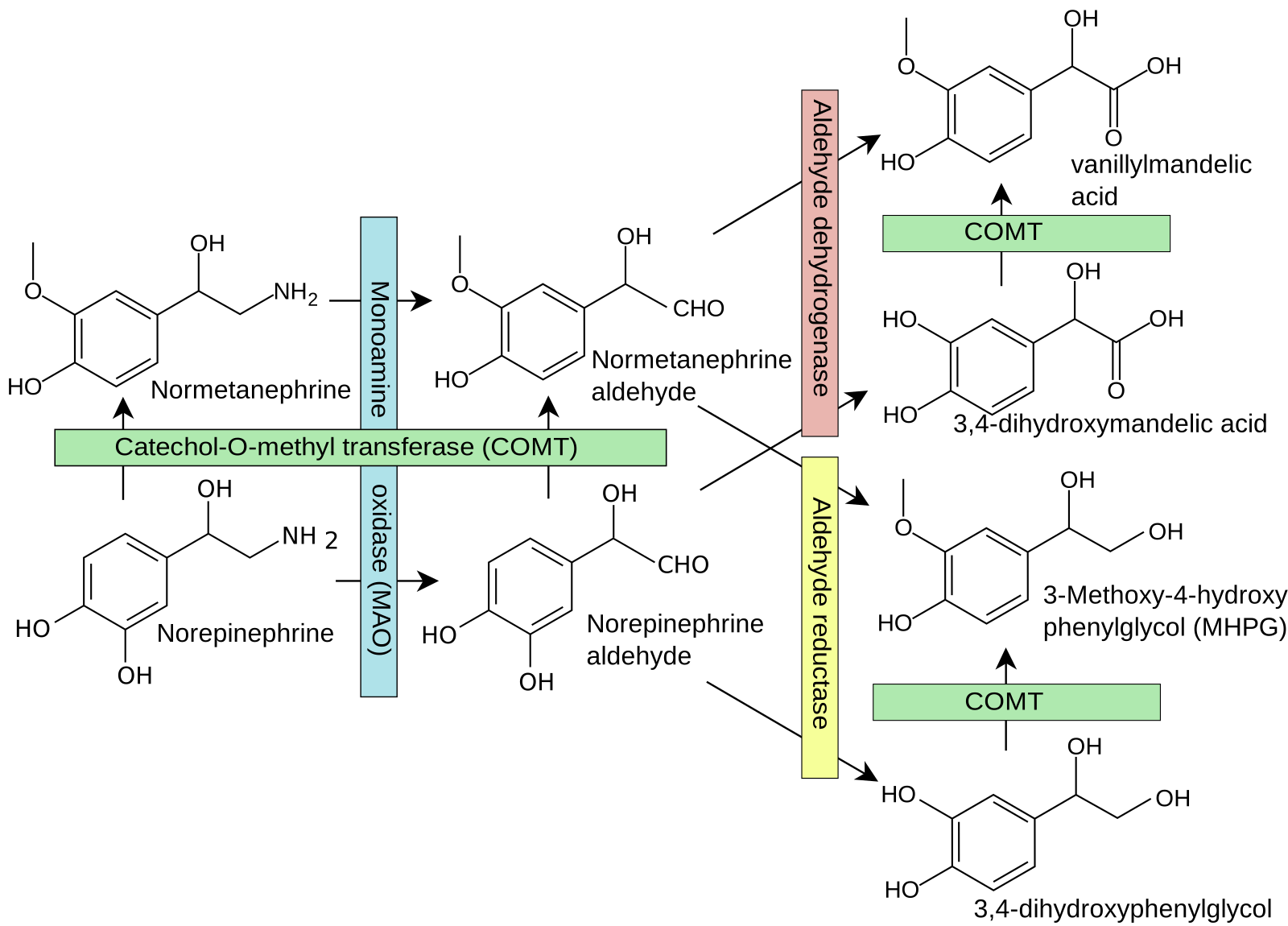
Catechol-O-methyltransferase is involved in the inactivation of the catecholamine neurotransmitters (dopamine, epinephrine, and norepinephrine). The enzyme introduces a methyl group to the catecholamine, which is donated by S-adenosyl methionine (SAM). Any compound having a catechol structure, like catecholestrogens and catechol-containing flavonoids, are substrates of COMT.
Specific reactions catalyzed by COMT include:
- L-DOPA (levodopa) → 3-O-methyldopa
- Dopamine → 3-methoxytyramine
- DOPAC → HVA (homovanillic acid)
- Norepinephrine → normetanephrine
- Epinephrine → metanephrine
- Dihydroxyphenylethylene glycol (DOPEG) → methoxyhydroxyphenylglycol (MOPEG)
- 3,4-Dihydroxymandelic acid (DOMA) → vanillylmandelic acid (VMA)
In the brain, COMT-dependent dopamine degradation is of particular importance in brain regions with low expression of the presynaptic dopamine transporter (DAT), such as the prefrontal cortex (In the PFC, dopamine is also removed by presynaptic norepinephrine transporters (NET) and degraded by monoamine oxidase.). Controversy exists about the predominance and orientation of membrane bound COMT in the CNS, that is, whether this COMT process is active intracellularly in postsynaptic neurons and glia, or oriented outward on the membrane, acting extracellularly on synaptic and extrasynaptic dopamine.
Soluble COMT can also be found extracellularly, although extracellular COMT plays a less significant role in the CNS than it does peripherally. Despite its importance in neurons, COMT is actually primarily expressed in the liver.
Genetics in humans
The COMT protein is coded by the gene COMT. The gene is associated with allelic variants. The best-studied is Val158Met. Others are rs737865 and rs165599 that have been studied, e.g., for association with personality traits, response to antidepressant medications, and psychosis risk associated with Alzheimer's disease. COMT has been studied as a potential gene in the pathogenesis of schizophrenia; however meta-analyses find no association between the risk of schizophrenia and a number of polymorphisms, including Val158Met.
Val158Met polymorphism
A functional single-nucleotide polymorphism (a common normal variant) of the gene for catechol-O-methyltransferase results in a valine to methionine mutation at position 158 (Val158Met) rs4680. In vitro, the homozygous Val variant metabolizes dopamine at up to four times the rate of its methionine counterpart. However, in vivo the Met variant is overexpressed in the brain, resulting in a 40% decrease (rather than 75% decrease) in functional enzyme activity. The lower rates of catabolism for the Met allele results in higher synaptic dopamine levels following neurotransmitter release, ultimately increasing dopaminergic stimulation of the postsynaptic neuron. Given the preferential role of COMT in prefrontal dopamine degradation, the Val158Met polymorphism is thought to exert its effects on cognition by modulating dopamine signaling in the frontal lobes.
The gene variant has been shown to affect cognitive tasks broadly related to executive function, such as set shifting, response inhibition, abstract thought, and the acquisition of rules or task structure.
Comparable effects on similar cognitive tasks, the frontal lobes, and the neurotransmitter dopamine have also all been linked to schizophrenia. It has been proposed that an inherited variant of COMT is one of the genetic factors that may predispose someone to developing schizophrenia later in life. A more recent study cast doubt on the proposed connection between this gene and any alleged causal effect of cannabis on schizophrenia development.
A non-synonymous single-nucleotide polymorphism rs4680 was found to be associated with depressed factor of Positive and Negative Syndrome Scale(PANSS) and efficiency of emotion in schizophrenia subjects. It is increasingly recognised that allelic variation at the COMT gene are also relevant for emotional processing, as they seem to influence the interaction between prefrontal and limbic regions. Research conducted at the Section of Neurobiology of Psychosis, Institute of Psychiatry, King's College London has demonstrated an effect of COMT both in patients with bipolar disorder and in their relatives, but these findings have not been replicated so far.
The COMT Val158Met polymorphism also has a pleiotropic effect on emotional processing. Furthermore, the polymorphism has been shown to affect ratings of subjective well-being. When 621 women were measured with experience sample monitoring, which is similar to mood assessment as response to beeping watch, the met/met form confers double the subjective mental sensation of well-being from a wide variety of daily events. The ability to experience reward increased with the number of Met alleles. Also, the effect of different genotype was greater for events that were felt as more pleasant. The effect size of genotypic moderation was quite large: Subjects with the Val/Val genotype generated almost similar amounts of subjective well-being from a 'very pleasant event' as Met/Met subjects did from a 'bit pleasant event'. Genetic variation with functional impact on cortical dopamine tone has a strong influence on reward experience in the flow of daily life. In one study participants with the met/met phenotype described an increase of positive affect twice as high in amplitude as participants with the Val/Val phenotype following very pleasant or pleasant events.
One review found that those with Val/Val tended to be more extroverted, more novelty-seeking, and less neurotic than those with the Met/Met allele
Temporomandibular joint dysfunction
Temporomandibular joint dysfunction (TMD) does not appear to be a classic genetic disorder, however variations in the gene that codes for COMT have been suggested to be responsible for inheritance of a predisposition to develop TMD during life.
Nomenclature
COMT is the name given to the gene that codes for this enzyme. The O in the name stands for oxygen, not for ortho.
COMT inhibitors
COMT inhibitors include entacapone, tolcapone, opicapone, and nitecapone. COMT inhibitors save levodopa from COMT and prolong the action of levodopa.
Levodopa, a precursor of catecholamines, is an important substrate of COMT. Levodopa is used in the treatment of Parkinson's disease, and suppressing peripheral levodopa metabolism through the COMT pathway is understood to be valuable for reducing end of dose motor fluctuations for those with Parkinson's.{{cite journal | vauthors = Fabbri, Margherita, Ferreira, Joaquim J, Rascol, Olivier | title = COMT inhibitors in the management of Parkinson's disease | journal = CNS Drugs | volume = 36 | issue = 3 | pages = 261-282 | date = 25 February 2022 | pmid = 35217995 | doi = 10.1007/s40263-021-00888-9
Entacapone is a widely used adjunct drug of levodopa therapy. All COMT inhibitors except nitecapone are used in the treatment of Parkinson's disease. Risk of liver toxicity and related digestive disorders restricts the use of tolcapone.
Additional images
File:Dopamine degradation.svg
References
References
- (2007). "Rang & Dale's pharmacology". Churchill Livingstone.
- (2011). "Rang & Dale's Pharmacology". Elsevier Health Sciences.
- "Test ID: COMT: Catechol-''O''-Methyltransferase Genotype". Mayo Clinic: Mayo Medical Laboratories.
- (April 1992). "Chromosomal mapping of the human catechol-''O''-methyltransferase gene to 22q11.1----q11.2". Genomics.
- (February 2002). "catechol-''O''-methyltransferase and Parkinson's disease". Acta Medica Okayama.
- (August 1957). "O-methylation of epinephrine and other catechols in vitro and in vivo". Science.
- (2016). "The Central Nervous System". Oxford University Press.
- (May 2012). "COMT as a drug target for cognitive functions and dysfunctions". CNS & Neurological Disorders Drug Targets.
- (January 2006). "catechol-''O''-methyltransferase polymorphisms and some implications for cognitive therapeutics". NeuroRx.
- (September 2016). "Diversity of Dopaminergic Neural Circuits in Response to Drug Exposure". Neuropsychopharmacology.
- (2010). "Basic Aspects of Catechol-''O''-Methyltransferase and the Clinical Applications of its Inhibitors". Academic Press.
- (October 2011). "Orientation and cellular distribution of membrane-bound catechol-''O''-methyltransferase in cortical neurons: implications for drug development". The Journal of Biological Chemistry.
- (2010). "Membrane-Bound Catechol-O-Methyl Transferase in Cortical Neurons and Glial Cells is Intracellularly Oriented". Frontiers in Psychiatry.
- (2011-12-15). "Principles of pharmacology". Wolters Kluwer Health.
- (January 2014). "Low dopamine function in attention deficit/hyperactivity disorder: should genotyping signify early diagnosis in children?". Postgraduate Medicine.
- (March 2011). "Pharmacogenetics of antidepressant response". Journal of Psychiatry & Neuroscience.
- (2010). "Genetics of psychosis in Alzheimer's disease: a review". Journal of Alzheimer's Disease.
- (May 2009). "Meta-analysis of association between genetic variants in COMT and schizophrenia: an update". Schizophrenia Research.
- (March 2003). "Association between a functional catechol O-methyltransferase gene polymorphism and schizophrenia: meta-analysis of case-control and family-based studies". The American Journal of Psychiatry.
- (August 2005). "Lack of association of the COMT (Val158/108 Met) gene and schizophrenia: a meta-analysis of case-control studies". Molecular Psychiatry.
- (January 2005). "catechol-''O''-methyltransferase gene Val/Met functional polymorphism and risk of schizophrenia: a large-scale association study plus meta-analysis". Biological Psychiatry.
- (October 2016). "COMT val158met moderation of dopaminergic drug effects on cognitive function: a critical review". The Pharmacogenomics Journal.
- (December 2004). "Differential expression of human COMT alleles in brain and lymphoblasts detected by RT-coupled 5' nuclease assay". Psychopharmacology.
- (November 2004). "Functional analysis of genetic variation in catechol-''O''-methyltransferase (COMT): effects on mRNA, protein, and enzyme activity in postmortem human brain". American Journal of Human Genetics.
- (December 2005). "catechol-''O''-methyltransferase (COMT) genotypes and working memory: associations with differing cognitive operations". Biological Psychiatry.
- (December 2009). "Executive functions in children with autism spectrum disorders". Brain and Cognition.
- (January 2004). "Genetic and neurochemical modulation of prefrontal cognitive functions in children". The American Journal of Psychiatry.
- (7 October 2005). "Daniel R. Weinberger to Give Milder Lecture". NIH Record.
- (2003). "The Runners-Up". Science.
- (May 2005). "Moderation of the effect of adolescent-onset cannabis use on adult psychosis by a functional polymorphism in the catechol-''O''-methyltransferase gene: longitudinal evidence of a gene X environment interaction". Biological Psychiatry.
- (October 2020). "The effect of rs1076560 (DRD2) and rs4680 (COMT) on tardive dyskinesia and cognition in schizophrenia subjects". Psychiatric Genetics.
- (April 2011). "The impact of the Val158Met catechol-''O''-methyltransferase genotype on neural correlates of sad facial affect processing in patients with bipolar disorder and their relatives". Psychological Medicine.
- (April 2009). "The effects of gender and COMT Val158Met polymorphism on fearful facial affect recognition: a fMRI study". The International Journal of Neuropsychopharmacology.
- (December 2008). "The catechol-O-methyl transferase Val158Met polymorphism and experience of reward in the flow of daily life". Neuropsychopharmacology.
- (May 2012). "The role of the catechol-''O''-methyltransferase (COMT) gene in personality and related psychopathological disorders". CNS & Neurological Disorders Drug Targets.
- (May 2010). "Pathophysiology of TMD pain--basic mechanisms and their implications for pharmacotherapy". Journal of Oral Rehabilitation.
- (2009). "Analysis of the Molecular Role of COMT in Bipolar Disorder". Journal of Biotech Research.
- (November 1998). "COMT inhibition in the treatment of Parkinson's disease". Journal of Neurology.
- (2007). "catechol-''O''-methyltransferase and its inhibitors in Parkinson's disease". CNS Drug Reviews.
- (January 2013). "Inhibitors of catechol-''O''-methyltransferase in the treatment of neurological disorders". Central Nervous System Agents in Medicinal Chemistry.
This article was imported from Wikipedia and is available under the Creative Commons Attribution-ShareAlike 4.0 License. Content has been adapted to SurfDoc format. Original contributors can be found on the article history page.
Ask Mako anything about Catechol-O-methyltransferase — get instant answers, deeper analysis, and related topics.
Research with MakoFree with your Surf account
Create a free account to save articles, ask Mako questions, and organize your research.
Sign up freeThis content may have been generated or modified by AI. CloudSurf Software LLC is not responsible for the accuracy, completeness, or reliability of AI-generated content. Always verify important information from primary sources.
Report