From Surf Wiki (app.surf) — the open knowledge base
Castilians
People from historical Castile, Spain

People from historical Castile, Spain
| Field | Value | |
|---|---|---|
| group | Castilians | |
| <!-- | pop | Spain |
| region1 | Castile and León | |
| pop1 | est. 2,500,000 | |
| region2 | Madrid | |
| pop2 | est. 6,500,000 | |
| region3 | Castilla-La Mancha | |
| pop3 | est. 2,000,000 | |
| region6 | Cantabria | |
| pop6 | est. 500,000 | |
| region7 | La Rioja (Spain) | |
| pop7 | est. 300,000 | |
| ref7 | the limits of "Castile" are controversial -- | |
| languages | Spanish | |
| religions | Predominantly Latin Catholicism | |
| related_groups | Other Spaniards | |
| (Leonese, Riojans, Extremadurans, Andalusians, Valencians, Murcians) | ||
| Cagots | ||
| popplace | Spain | |
| (Castile and Leon, Castile–La Mancha, Community of Madrid) |
(Leonese, Riojans, Extremadurans, Andalusians, Valencians, Murcians) Cagots (Castile and Leon, Castile–La Mancha, Community of Madrid)
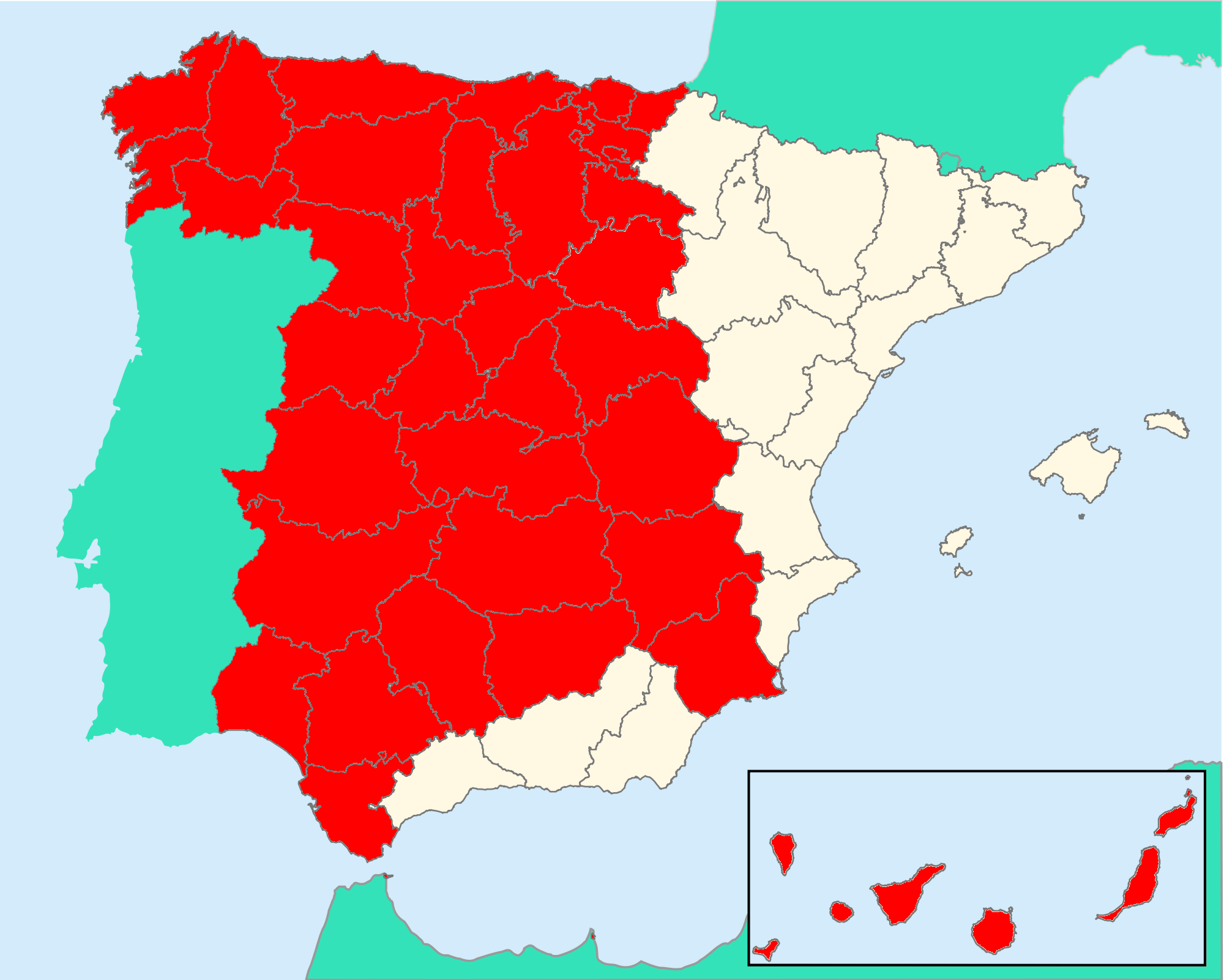
Castilians () are the inhabitants of the historical region of Castile in central Spain. However, the boundaries of the region are disputed.
Not all people in the regions of the medieval Kingdom of Castile or Crown of Castile think of themselves as Castilian. For that reason, the exact limits of what is Castilian today are disputed. The western parts of Castile and León (that is, the Region of León) and Cantabria, La Rioja, the Community of Madrid and La Mancha are often also included in the definition, but that is controversial for historical reasons and for the strong sense of unique cultural identity of those regions. The Province of Albacete and Ciudad Real are also often included. As an ethnicity, Castilians are most commonly associated with the sparsely populated inner plateau of the Iberian peninsula, which is split into two by the Sistema Central mountain range in northern or 'Old Castile' and southern or 'New Castile'.
Language
Castilian (castellano), that is, Spanish, is the native language of the Castilians. Its origin is traditionally ascribed to an area south of the Cordillera Cantábrica, including the upper Ebro valley, in northern Spain, around the 8th and 9th centuries; however, the first written standard was developed in the 13th century in the southern city of Toledo. It is descended from the Vulgar Latin of the Roman Empire, with Arabic influences, and perhaps Basque as well. During the Reconquista in the Middle Ages, it was brought to the south of Spain where it replaced the languages that were spoken in the former Moorish controlled zones, such as the local form of related Latin dialects now referred to as Mozarabic, and the Arabic that had been introduced by the Muslims. In this process Castilian absorbed many traits from these languages, some of which continue to be used today. Outside of Spain and a few Latin American countries, Castilian is now usually referred to as Spanish.
The language was brought to the New World by Castilian Conquistadors during the Spanish colonization of the Americas. Due to this gradual process, the Hispanophone world was created. As Castilian was the language of the Crown, it became the official language of all of Spain, used side by side with other languages in their regions for centuries. During the years of the Francoist State (1939 to 1975), there was an attempt to suppress the regional languages in favour of Castilian as the sole official language, causing a backlash against the use of Castilian in some regions after his death.
In Spanish, the word castellano (Castilian) is often used to refer to the Spanish language, alongside español (Spanish). (See Names given to the Spanish language.)
Demographics
Religion
Castilian identity and culture is strongly connected to Roman Catholicism. It is the religion of the overwhelming majority of Castilians as a result of the settlement of Christian populations and forced assimilation of religious minorities (particularly Judaism and Islam) prior and during the Spanish Inquisition. The presence in the region of minority religions such as Protestantism, Orthodox Christianity, Islam or Judaism are the result of recent conversions or immigration.
References
References
- (2 April 2015). "Interactivo: Creencias y prácticas religiosas en España".
This article was imported from Wikipedia and is available under the Creative Commons Attribution-ShareAlike 4.0 License. Content has been adapted to SurfDoc format. Original contributors can be found on the article history page.
Ask Mako anything about Castilians — get instant answers, deeper analysis, and related topics.
Research with MakoFree with your Surf account
Create a free account to save articles, ask Mako questions, and organize your research.
Sign up freeThis content may have been generated or modified by AI. CloudSurf Software LLC is not responsible for the accuracy, completeness, or reliability of AI-generated content. Always verify important information from primary sources.
Report