From Surf Wiki (app.surf) — the open knowledge base
Castile (historical region)
Historical region of Spain

Historical region of Spain
Castile or Castille (; ) is a territory of imprecise limits located in Spain.{{cite book |last=Moreno Hernández |first=Carlos |date=6 February 2009 |title=En torno a Castilla |trans-title= About Castile |url=https://books.google.com/books?id=hsX2AgAAQBAJ&pg=PA9 |language=es |publisher=Lulu.com |page=9 |quote=''[...] el nombre de Castilla figura como primer título real, por lote de primogenitura, desde Fernando I a Fernando III, lo que origina que pase a designar, por sinécdoque -la parte por el todo- al reino que incluye primero León y luego Toledo y la baja Andalucía. Castilla será siempre, a partir de entonces, o bien el nombre que designa al más grande, rico y poblado de los reinos cristianos peninsulares –los otros son Portugal, Navarra y Aragón- o bien un territorio impreciso, sin fronteras fijas en los mapas, -o con fronteras distintas según el cartógrafo y la época- con una Castilla 'vieja' que puede incluir o no a León y una Castilla 'nueva' y 'novísima' que puede incluir o no unas u otras partes de La Mancha, de Murcia, de Extremadura o de Andalucía. En el siglo XIX, por medio de la extensión de la alfabetización y la enseñanza de la Historia de España en las escuelas, se difundirá una imagen de Castilla y de lo castellano al servicio del centralismo unificador ensayado desde el siglo XVIII por los Borbones que siguen reinando, el que conviene también ahora al nuevo sistema liberal moderado que sigue el modelo francés, aunque rebajado. [...] En paralelo, Castilla va a reinventarse desde las nuevas disciplinas de la Geografía, la Historia y la Lingüística de entonces como ese lugar central, identificado ahora con la meseta o mesetas, que es preciso regenerar, el gran desierto empobrecido sin árboles ni agua alrededor de Madrid, centro y cima de un espacio elevado desde el que se ejerce el poder como núcleo que ha sido y es de la cultura y la lengua española.* |isbn=9781409259923}} The *Encyclopædia Britannica'' defines it as encompassing Old Castile and New Castile, as they were formally defined in the 1833 territorial division of Spain.
Castile's name is generally thought to mean "land of castles" (castle in Spanish is castillo), in reference to the castles built in the area to consolidate the Christian Reconquest from the Moors.
History
Originally an eastern county of the kingdom of León, in the 11th century, Castile became an independent realm with its capital at Burgos. The County of Castile, which originally included most of Burgos and parts of Vizcaya, Álava, Cantabria and La Rioja,{{cite book
The capture of Toledo in 1085 added New Castile to the crown's territories, and the battle of Las Navas de Tolosa (1212) heralded the Moors' loss of most of southern Spain. The kingdom of León was integrated in the Crown of Castile in 1230, and the following decades saw the capture of Córdoba (1236), Murcia (1243) and Seville (1248). By the Treaty of Alcaçovas with Portugal on March 6, 1460, the ownership of the Canary Islands was transferred to Castile.
The dynastic union of Castile and Aragon in 1469, when Ferdinand II of Aragon wed Isabella I of Castile, would eventually lead to the formal creation of Spain as a single entity in 1516 when their grandson Charles V assumed both thrones. See List of Spanish monarchs and Kings of Spain family tree. The Muslim Kingdom of Granada (roughly encompassing the modern day provinces of Granada, Malaga and Almeria) was conquered in 1492, formally passing to the Crown of Castile in that year.
Geography
Since it lacks official recognition, Castile does not have clearly defined borders. Historically, the area consisted of the Kingdom of Castile. After the kingdom merged with its neighbours to become the Crown of Castile and later the Kingdom of Spain, when it united with the Crown of Aragon and the Kingdom of Navarre, the definition of what constituted Castile gradually began to change. Its historical capital was Burgos. In modern Spain, it is generally considered to comprise Castile and León and Castile–La Mancha, with Madrid as its centre. West Castile and León, Albacete, Cantabria and La Rioja are sometimes included in the definition (controversial for historical, political, and cultural reasons).
Since 1982 there have been two nominally Castilian autonomous communities in Spain, incorporating the toponym in their own official names: Castile and Leon and Castile-La Mancha. A third, the Community of Madrid is also regarded as part of Castile, by dint of its geographic enclosure within the entity and, above all, by the statements of its Statute of Autonomy, since its autonomic process originated in national interest and not in popular disaffection with Castile."En efecto, la negativa de las provincias castellano-manchegas a la integración de Madrid en su región, su falta de entidad regional histórica, su existencia como Área Metropolitana y, el ser la Villa de Madrid la capital del Estado significaron que la provincia madrileña partiese de cero en el camino de su autonomía, sin trámites intermedios, sin régimen preautonómico". "La falta de entidad regional histórica de Madrid, hizo preciso acudir a la vía del artículo 144, apartado a) de la Norma Fundamental: "Las Cortes Generales, mediante ley orgánica, podrán por motivos de interés nacional: a)Autorizar la constitución de una Comunidad Autónoma cuando su ámbito territorial no supere el de una provincia y no reúna las condiciones del apartado 1 del artículo 143." |access-date= 2009-12-26 |url-status= dead |archive-url= https://web.archive.org/web/20091211230846/http://narros.congreso.es/constitucion/estatutos/sinopsis.jsp?com=74 |archive-date= 2009-12-11
Other territories in the former Crown of Castile are left out for different reasons. The territory of the Castilian Crown actually comprised all other autonomous communities within Spain with the exception of Aragon, Balearic Islands, Valencia and Catalonia, all belonging to the former Crown of Aragon, and Navarre, offshoot of the older Kingdom of the same name. Castile was divided between Old Castile in the north, so called because it was where the Kingdom of Castile was founded, and New Castile, called the Kingdom of Toledo in the Middle Ages. The Leonese region, part of the Crown of Castile from 1230, was from medieval times considered a region in its own right on a par with the two Castiles, and appeared on maps alongside Old Castile until the two joined as one region - Castile and Leon - in the 1980s. In 1833, Spain was further subdivided into administrative provinces.
Two non-administrative, nominally Castilian regions existed from 1833 to 1982: Old Castile, including Santander (autonomous community of Cantabria since 1981), Burgos, Logroño (autonomous community of La Rioja since 1982), Palencia, Valladolid, Soria, Segovia and Ávila, and New Castile consisting of Madrid (autonomous community of Madrid since 1983), Guadalajara, Cuenca, Toledo and Ciudad Real.
Language
The language of Castile emerged as the primary language of Spain—known to many of its speakers as castellano and in English sometimes as Castilian, but generally as Spanish. See Names given to the Spanish language. Historically, the Castilian Kingdom and people were considered to be the main architects of the Spanish State by a process of expansion to the South against the Moors and of marriages, wars, assimilation, and annexation of their smaller Eastern and Western neighbours. From the advent of the Bourbon Monarchy following the War of the Spanish Succession until the arrival of parliamentary democracy in 1977, the Castilian language was the only one with official status in the Spanish state.
Castilian identity and cultural expansion
.jpg)
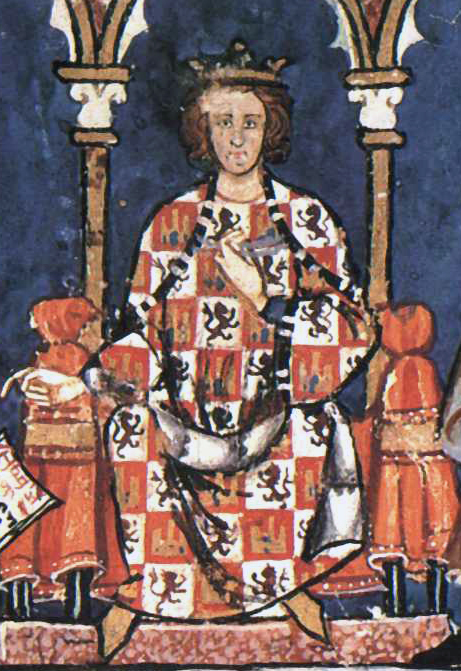
Castilians are defined as a community with a shared culture and history. Their origin is, as well as most of other parts of Spain, a heterogeneous mixture of peoples who settled the area over millennia. Thus, it is not correct to establish a strict common origin, but a common cultural identity. Over time, most Castilians have mixed with other Spaniards due to their past political dominance, and present-day cultural dominance. Castilians and their cultural influence spread throughout the entire plateau of central Spain during the Reconquista, carried out principally by the Kingdom of Toledo which was renamed New Castile. Castilian ethnicity is the product of the conquest, by a small kingdom in northern Spain, of vast tracts of sparsely populated lands (the central "mesetas"). These lands were populated, during the reconquest, by peoples from all over the peninsula, even from southern Spain (see exile of Mozarabs from Al Andalus and even the dispersal of Moriscos from Granada in the 16th century).
At present, Castilians are known as the inhabitants of those regions of Spain where there is no regional identity which conflicts with that of Castilians. The Castilian territories roughly coincide with the plateaus of north-central Spain, historically sparsely populated harsh highlands.
Castilian identity is ambiguous: since Castilian nationalism was the first to have been suppressed by the Spanish Crown during the revolt and war of the Castilian War of the Communities against the Spanish Monarchy, between 1520 and 1521, a strong sense of identity cannot be found in Castilians and there are differences about what can be considered Castile.
Castilian identity is thus excluded from the historical nationalities of Spain such as Catalonia, Galicia and the Basque Country, but also other autonomous communities of Spain which due to historical reasons have their own strong identities, such as Andalusia, Asturias, Aragon, Balearic Islands, Canary Islands and the Valencian Community. Both Andalusia and the Canary Islands experienced an early Castilian colonisation and subsequent immigration, but the survival and absorption of by the large local populations allowed for characteristics and separate identities particular to those regions to survive. Certain regions are not considered Castilian, such as Valencia and the Balearic Islands because historically they belong to the Crown of Aragon and because their local languages are Catalan dialects. Galicians are not considered to be Castilian, although the former Kingdom of Galicia was annexed by the Crown of Castile.
Their language, Galician, is akin to Portuguese, and they possess a local culture and identity. Navarre, a former kingdom, has a culture that is mainly Basque in the north and closer to that of Old Castile in the south, especially in La Rioja and Aragon, in the south. Extremadura, a region in western Spain, is usually not considered to be Castilian; it has a strong link to neighbouring Andalusia. Murcia has always been a region of its own. The Leonese region was a separate region before democracy in the 1970s, and had its own language, Leonese, which is moribund. However, Castile and León (Spanish: Castilla y León) had the Spanish conjunction y ('and') inserted as the León region is not considered to be in Castile (the north half) but joint with it in this autonomous community.
Leonese regionalists want Castile and León to be dissolved and become an autonomous community in its own right as the Leonese Country. Cantabria was previously considered as part of Old Castile, but it has its own identity and had achieved independence from Castile in the 1970s and is now a comunidad autonoma in its own right. Madrid had been in New Castile until the 1970s and has traditionally been considered Castilian. However, its status as the capital of Spain, meant that it gained its own autonomous community. Also, its people are not all Castilian as there have been immigration from other regions in Spain and indeed the world. In terms of cultural identity, there is a divide and controversy. Older Madrid people as well as Castilians nationalist in the region consider their city to be in Castile (cultural identity). Younger Madrid people, look at the modern reality of the administration, and do not consider it to be in Castile, as there is no reference to it in the name or the symbols of the autonomous community. However, the folk culture in the Madrid region is Castilian, even though the city itself has its own folklore, the chotis. As for La Mancha, they are still in Castile as their autonomous community is called Castile–La Mancha. However, their cultural identity focuses on the La Mancha rather than on the Castile. They have their own identity even though they are recognised as fully Castilian, for example, they had no language of their own, unlike, León.
--
Maps
File:506-Castile 1210.png|Kingdom of Castile in 1210 File:Corona de Castilla 1400 en.svg|The kingdoms of the Crown of Castile in 1400. Note how Old Castile was called Kingdom of Castile and New Castile was called the Kingdom of Toledo. File:España y Portugal (1770).jpg|Castile and other Iberian regions in 1770 File:Kastilien 1833.svg|The regions of Old Castile and New Castile (1833 until the early 1980s). File:Estados República Federal Española 1873.jpg|Federal states proposed in the 1st Spanish Republic according to Constitution in 1873. There is an Old and New Castile. File:Kastilien heute.svg|Autonomous communities that use "Castile" in their names (since the 1980s), plus the community of Madrid. The Leonese region joined with Old Castile, Albacete region joined with New Castile, while Cantabria, La Rioja and Madrid became administrative regions of their own.
References
References
- Lotha, Gloria. (20 July 1998). "Castile (region, Spain)". [[Encyclopedia Britannica, Inc.]].
This article was imported from Wikipedia and is available under the Creative Commons Attribution-ShareAlike 4.0 License. Content has been adapted to SurfDoc format. Original contributors can be found on the article history page.
Ask Mako anything about Castile (historical region) — get instant answers, deeper analysis, and related topics.
Research with MakoFree with your Surf account
Create a free account to save articles, ask Mako questions, and organize your research.
Sign up freeThis content may have been generated or modified by AI. CloudSurf Software LLC is not responsible for the accuracy, completeness, or reliability of AI-generated content. Always verify important information from primary sources.
Report