From Surf Wiki (app.surf) — the open knowledge base
Casino
Gambling facility
.jpg)
Gambling facility
establishments for gambling
A casino is a facility for gambling. Casinos are often built near or combined with hotels, resorts, restaurants, retail shopping, cruise ships, and other tourist attractions. Some casinos are also known for hosting live entertainment, such as stand-up comedy, concerts, and sporting events. The term casino is of Italian origin, from the root word casa meaning "house." Originally, the term referred to a small country villa, summerhouse, or social club. During the 19th century, casino came to encompass other public buildings where pleasurable activities took place.
The precise origin of gambling is unknown, but it is believed to have existed in nearly every society in history. The first known European gambling house, the Ridotto, was established in Venice, Italy, in 1638 to provide controlled gambling during the carnival season. In the United States, early gambling establishments were known as saloons. In the early 20th century, gambling was outlawed in the US by state legislation. However, in 1931, gambling was legalized in Nevada, leading to the rise of Las Vegas as a major gambling center. In 1976, New Jersey allowed gambling in Atlantic City, which is now the second-largest gambling city in the US.
Casinos offer a variety of games of chance, which in some cases involve an element of skill. Common games include craps, roulette, baccarat, blackjack, and video poker. All casino games have a mathematically determined advantage for the house, known as the house edge, which ensures that the casino will make a profit in the long run. The percentage of funds returned to players as winnings is known as the payout. Slot machines have become one of the most popular forms of gambling in casinos. The design of a casino, including factors like sound, odour, and lighting, is often carefully controlled to encourage gambling.
Globally, there are several major casino markets. Macau is the largest gambling market in the world, having surpassed Las Vegas in terms of revenue. Other significant gambling centers include Singapore, Monte Carlo, and various locations in Europe and the United States. Some of the most famous casinos in the world include the Monte Carlo Casino, The Venetian Macao, and Caesars Palace. The casino industry is a major part of the tourism and leisure industry, with the largest casino operator companies generating tens of billions of dollars in revenue annually.
Etymology and usage
Casino is of Italian origin; the root casa means a house. The term casino may mean a small country villa, summerhouse, or social club. During the 19th century, casino came to include other public buildings where pleasurable activities took place; such edifices were usually built on the grounds of a larger Italian villa or palazzo, and were used to host civic town functions, including dancing, gambling, music listening, and sports. Examples in Italy include Villa Farnese and Villa Giulia, and in the US the Newport Casino in Newport, Rhode Island. In modern-day Italian, a is a brothel (also called casa chiusa, literally "closed house"), a mess (confusing situation), or a noisy environment; a gambling house is spelt , with an accent.
Not all casinos are used for gambling. The Catalina Casino, on Santa Catalina Island, California, has never been used for traditional games of chance, which were already outlawed in California by the time it was built. The Copenhagen Casino was a Danish theatre which also held public meetings during the 1848 Revolution, which made Denmark a constitutional monarchy.
In military and non-military usage, a (Spanish) or (German) is an officers' mess.
History of gambling houses

The precise origin of gambling is unknown. It is generally believed that gambling in some form or another has been seen in almost every society in history. From Ancient Mesopotamia, Greeks and Romans to Napoleon's France and Elizabethan England, much of history is filled with stories of entertainment based on games of chance.
The first known European gambling house, not called a casino although meeting the modern definition, was the Ridotto, established in Venice, Italy, in 1638 by the Great Council of Venice to provide controlled gambling during the carnival season. It was closed in 1774 as the city government felt it was impoverishing the local gentry.
In American history, early gambling establishments were known as saloons. The creation and importance of saloons was greatly influenced by four major cities: New Orleans, St. Louis, Chicago and San Francisco. It was in the saloons that travelers could find people to talk to, drink with, and often gamble with. During the early 20th century in the US, gambling was outlawed by state legislation. However, in 1931, gambling was legalized throughout the state of Nevada, where the United States's first legalized casinos were set up. In 1976 New Jersey allowed gambling in Atlantic City, now the United States's second largest gambling city.
Gambling in casinos

Most jurisdictions worldwide have a minimum gambling age of 18 to 21.
Customers gamble by playing games of chance, in some cases with an element of skill, such as craps, roulette, baccarat, blackjack, and video poker. Most games have mathematically determined odds that ensure the house has at all times an advantage over the players. This can be expressed more precisely by the notion of expected value, which is uniformly negative (from the player's perspective). This advantage is called the house edge. In games such as poker where players play against each other, the house takes a commission called the rake. Casinos sometimes give out complimentary items or comps to gamblers.
Payout is the percentage of funds ("winnings") returned to players. Video lottery machines (slot machines) have become one of the most popular forms of gambling in casinos. investigative reports have started calling into question whether the modern-day slot-machine is addictive.
Design
Factors influencing gambling tendencies include sound, odour and lighting. Natasha Dow Schüll, an anthropologist at the Massachusetts Institute of Technology, highlights the decision of the audio directors at Silicon Gaming to make its slot machines resonate in "the universally pleasant tone of C, sampling existing casino soundscapes to create a sound that would please but not clash".
Alan Hirsch, founder of the Smell & Taste Treatment and Research Foundation in Chicago, studied the impact of certain scents on gamblers, discerning that a pleasant albeit unidentifiable odor released by Las Vegas slot machines generated about 50% more in daily revenue. He suggested that the scent acted as an aphrodisiac, causing a more aggressive form of gambling.
Markets
The following lists major casino markets in the world with casino revenue of over US$1 billion as published in PricewaterhouseCoopers's report on the outlook for the global casino market:
By region
| Rank | Region | Revenue (US$M) | 2009 | 2010 | |
|---|---|---|---|---|---|
| Projected | 2011 | ||||
| Projected | |||||
| 1 | United States | 57,240 | 56,500 | 58,030 | |
| 2 | Asia Pacific | 21,845 | 32,305 | 41,259 | |
| 3 | Europe, Middle East, Africa | 17,259 | 16,186 | 16,452 | |
| 4 | Canada | 3,712 | 3,835 | 4,045 | |
| 5 | Latin America | 425 | 528 | 594 | |
| Total | 100,481 | 109,354 | 120,380 |
By market
| Rank | Location | No. of | |||||||
|---|---|---|---|---|---|---|---|---|---|
| casinos | Revenue (US$billion) | 2009 | 2010 | ||||||
| projected | 2011 | ||||||||
| projected | 2019 | 2020 | 2021 | ||||||
| 1 | Macau Macau, China | 33 | 14.95 | 22.44 | 28.38 | 29 | 7.57 | 10.86 | |
| 2 | USA Las Vegas, Nevada | 122 | 10.25 | 9.95 | 10.30 | 11.96 | 7.8 | 13.4 | |
| 3 | Singapore Singapore | 2 | 2.12 | 2.75 | 5.48 | - | - | 1.67 | |
| 4 | France France | 189 | 3.96 | 3.91 | 3.96 | 11.46 | 10.36 | 11.48 | |
| 5 | USA Atlantic City, New Jersey | 12 | 3.94 | 3.55 | 3.33 | 3.29 | 2.65 | 4.73 | |
| 6 | AUS Australia | 11 | 2.70 | 2.77 | 2.85 | 6.6 | - | - | |
| 7 | South Korea South Korea | 17 | 2.40 | 2.43 | 2.51 | 8.2 | - | - | |
| 8 | Germany Germany | 76 | 2.07 | 2.05 | 2.08 | 11.52 | 10.52 | 6.51 | |
| 9 | South Africa South Africa | 36 | 1.84 | 1.78 | 2.01 | 1.78 | 1.89 | 1.34 | |
| 10 | UK United Kingdom | 141 | 1.21 | 1.19 | 1.21 | 17.22 | 15.4 | 17.09 | |
| 11 | Poland Poland | 36 | 1.09 | 1.09 | 1.13 | - | - | - | |
| 12 | Canada Niagara Falls, Ontario | 2 | 1.10 | 1.11 | 1.20 | 4.8 | 4.27 | 2.18 |
By company
According to Bloomberg, accumulated revenue of the biggest casino operator companies worldwide amounted to almost US$55 billion in 2011. SJM Holdings Ltd. was the leading company in this field, earning $9.7 billion in 2011, followed by Las Vegas Sands Corp. at $7.4 billion. The third-biggest casino operator company (based on revenue) was Caesars Entertainment, with revenue of US$6.2 billion.
Significant sites
While there are casinos in many places, a few places have become well known specifically for gambling. Perhaps the place almost defined by its casino is Monte Carlo, but other places are known as gambling centers.
Monte Carlo, Monaco
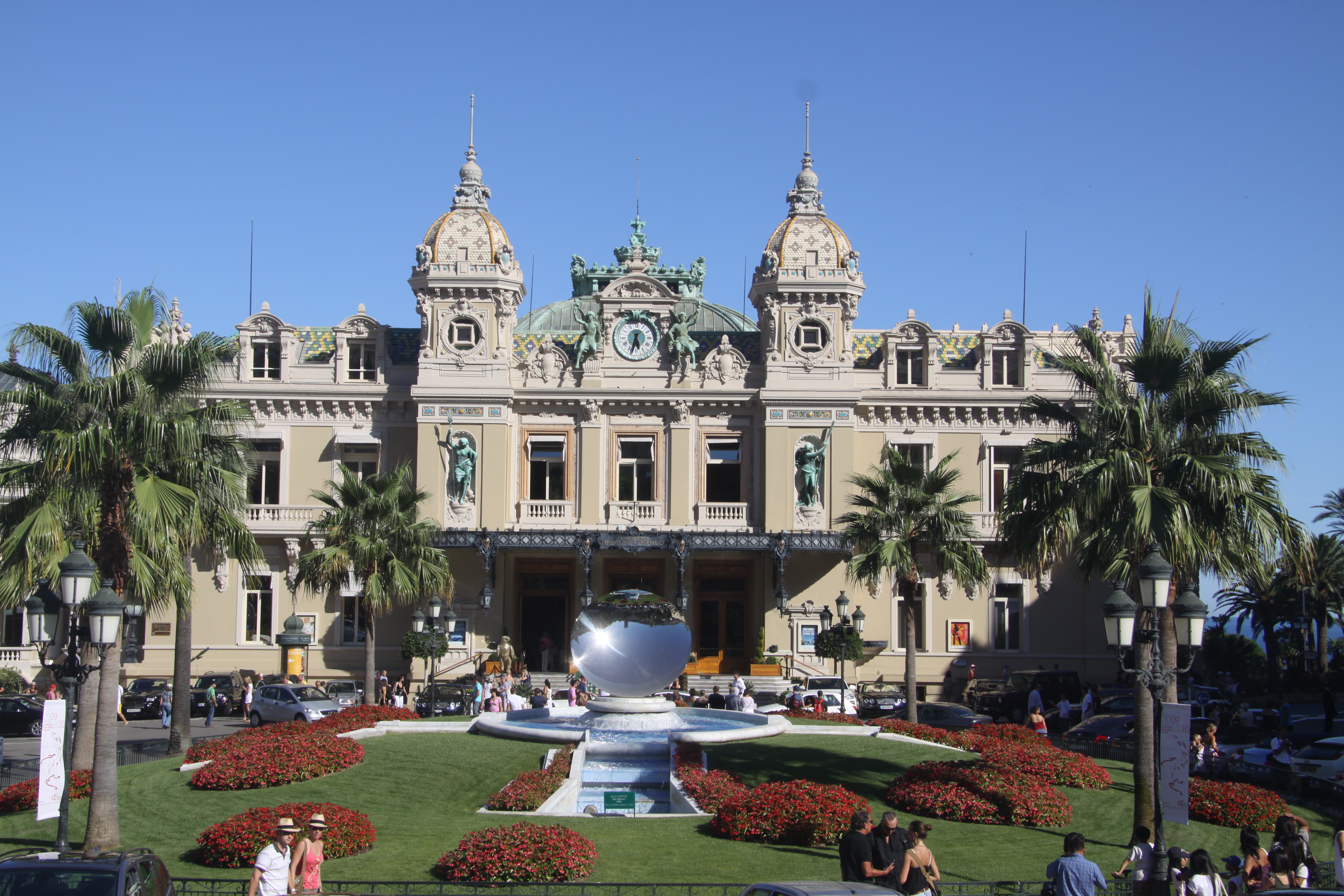
Main article: Monte Carlo Casino
Opened in 1865, Monte Carlo Casino, located in Monte Carlo city, in Monaco, is a casino and a tourist attraction.
Monte Carlo Casino has been depicted in books, songs and films. It features prominently in the James Bond films Never Say Never Again (1983) and GoldenEye (1995). Casinos feature throughout the Bond series, with the character introducing himself to the world at Les Ambassadeurs Club in Mayfair, London with the line "Bond, James Bond" in Dr. No (1962).
The Monte Carlo Casino is mentioned in the 1891 British music hall song "The Man Who Broke the Bank at Monte Carlo" as well as the 1935 film of the same name. The song was inspired by the exploits of English trickster Charles Wells, who in 1891 "broke the bank" on many occasions on the first two of his three trips to the casino.
The Monte Carlo Casino features in Ben Mezrich's 2005 book Busting Vegas, where a group of students beat the casino out of nearly $1 million. This book is based on real people and events; however, many of those events are contested by main character Semyon Dukach.
Campione d'Italia

Main article: Casinò di Campione
Casinò di Campione is located in the tiny Italian enclave of Campione d'Italia, within Ticino, Switzerland. The casino was founded in 1917 as a site to gather information from foreign diplomats during the First World War. Today it is owned by the Italian government, and operated by the municipality. With gambling laws being less strict than in Italy and Switzerland, it is among the most popular gambling destination besides Monte Carlo. The income from the casino is sufficient for the operation of Campione without the imposition of taxes, or obtaining of other revenue. In 2007, the casino moved into new premises of more than 55000 m2, making it the largest casino in Europe. The new casino was built alongside the old one, which dated from 1933 and has since been demolished.
Malta
The archipelago of Malta is a particularly famous place for casinos, standing out mainly with the historic casino located at the princely residence of Dragonara. Dragonara Palace was built in 1870. Its name comes from the Dragonara Point, the peninsula where it is built. On 15 July 1964, the palace opened as a casino.
Macau
Main article: Gambling in Macau
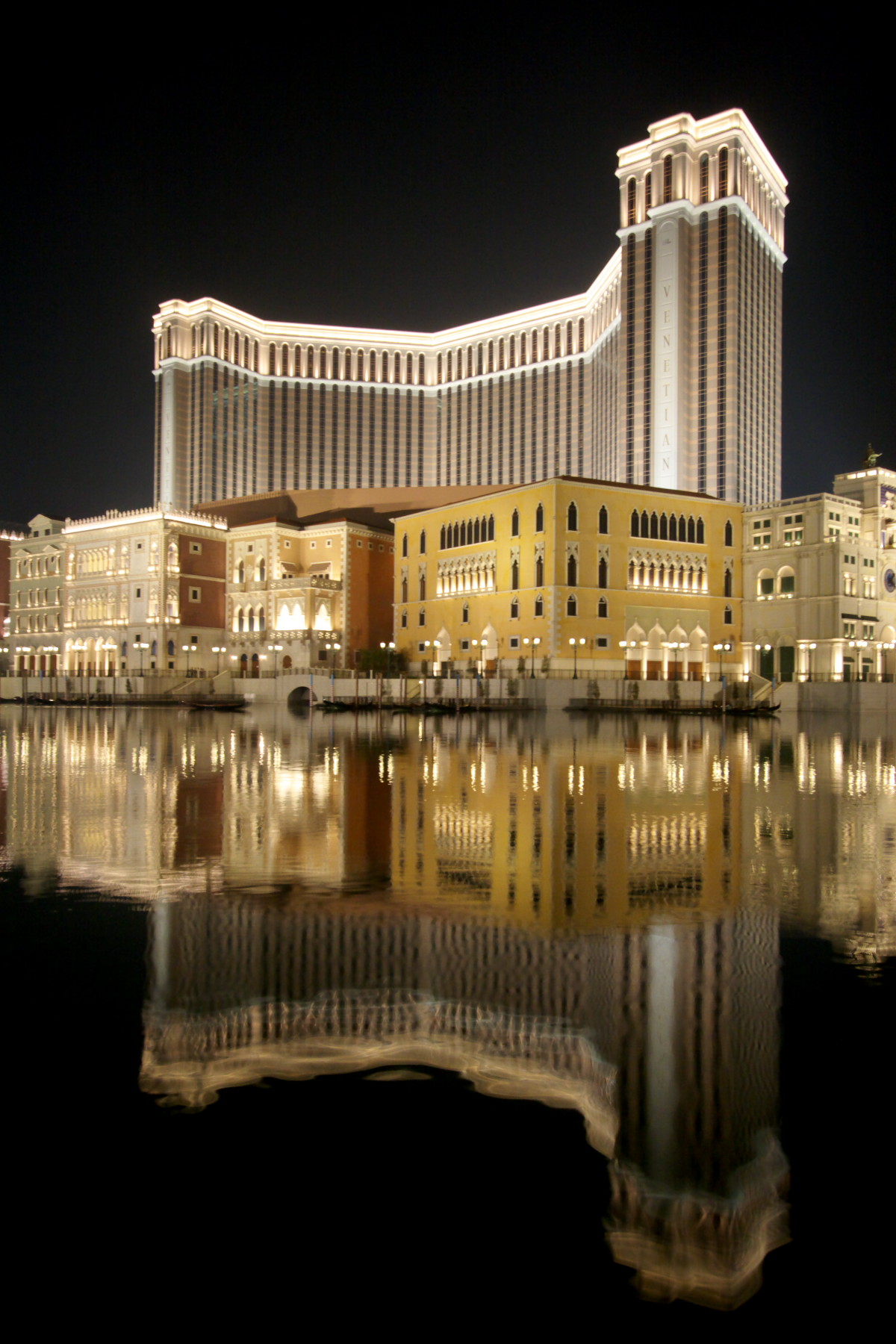
The former Portuguese colony of Macau, a special administrative region of the People's Republic of China since 1999, is a popular destination for visitors who wish to gamble. This started in Portuguese times, when Macau was popular with visitors from nearby Hong Kong, where gambling was more closely regulated. The Venetian Macao is currently the largest casino in the world. Macau also surpassed Las Vegas as the largest gambling market in the world.
Germany
Machine-based gaming is only permitted in land-based casinos, restaurants, bars and gaming halls, and only subject to a licence. Online slots are, at the moment, only permitted if they are operated under a Schleswig-Holstein licence. AWPs are governed by federal law, namely the Trade Regulation Act and the Gaming Ordinance.
Portugal
Main article: Casino Estoril

The Casino Estoril, located in the municipality of Cascais, on the Portuguese Riviera, near Lisbon, is the largest casino in Europe by capacity.
During the World War II, it was reputed to be a gathering point for spies, dispossessed royals, and wartime adventurers; it became an inspiration for Ian Fleming's James Bond 007 novel Casino Royale.
Russia
Main article: Gambling in Russia
There are four legal gaming zones in Russia: "Siberian Coin" (Altay), "Yantarnaya" (Kaliningrad region), "Azov-city" (Rostov region) and "Primorie" (Primorie region).
Singapore

Main article: Gambling in Singapore
Singapore is an up-and-coming destination for visitors wanting to gamble, although there are currently only two casinos (both foreign owned), in Singapore. The Marina Bay Sands is the second most expensive standalone casino in the world, at a price of US$6.8 billion, and is among the world's ten most expensive buildings.
United States
Main article: Gambling in the United States

With currently over 1,000 casinos, the United States has the largest number of casinos in the world. The number continues to grow steadily as more states seek to legalize casinos. 40 states now have some form of casino gambling. Interstate competition, such as gaining tourism, has been a driving factor to continuous legalization. Relatively small places such as Las Vegas are best known for gambling; larger cities such as Chicago are not defined by their casinos in spite of the large turnover.
The Las Vegas Valley has the largest concentration of casinos in the United States. Based on revenue, Atlantic City, New Jersey, ranks second, and the Chicago region third.
Top American casino markets by revenue (2022 annual revenues):
- Las Vegas Strip $7.05 billion
- Atlantic City $2.57 billion
- Chicago region $2.01 billion
- Baltimore–Washington Metropolitan Area $2.00 billion
- Mississippi Gulf Coast $1.61 billion
- New York City $1.46 billion
- Philadelphia $1.40 billion
- Detroit $1.29 billion
- St. Louis $1.03 billion
- Boulder Strip $967 million
- Reno/Sparks $889 million
- Kansas City $861 million
- The Poconos $849 million
- Lake Charles, Louisiana $843 million
- Black Hawk/Central City $812 million
- Downtown Las Vegas $731 million
- Tunica/Lula $696 million
- Cincinnati $655 million
- Shreveport/Bossier City $646 million
- Pittsburgh/Meadowlands $630 million
The Nevada Gaming Control Board divides Clark County, which is coextensive with the Las Vegas metropolitan area, into seven market regions for reporting purposes.
Native American gaming has been responsible for a rise in the number of casinos outside of Las Vegas and Atlantic City.
Vietnam
In Vietnam, the term "casinos" encompasses gambling activities within the country. Unofficially defined, a "casino" typically denotes a well-established and professional gambling establishment that is generally lawful but exclusively caters to foreign players. On the other hand, "gambling houses" or "gambling dens" are smaller, illicit gambling venues.
As of 2022, Vietnam has 9 operating casinos, including: Đồ Sơn casino (Hải Phòng), Lợi Lai casino, Hoàng Gia casino (Quảng Ninh), Hồng Vận casino (Quảng Ninh), Lào Cai casino (Lào Cai), Silver Shores casino (Đà Nẵng), Hồ Tràm casino (Bà Rịa – Vũng Tàu), Nam Hội An casino (Quảng Nam), Phú Quốc casino in Kien Giang.
In a survey conducted by the Vietnamese Institute for Sustainable Regional Development and released on September 30, 2015, it was found that 71% of the respondents held the belief that allowing Vietnamese individuals to access casinos would result in an increase in the number of players. Furthermore, 47.4% of the participants expressed the view that engaging in rewarding recreational activities has a positive impact on job opportunities for residents. Additionally, 46.2% of the respondents believed that such activities contribute positively to Vietnam's ability to attract investments.
Security
Main article: Casino security

Given the large amounts of currency handled within a casino, both patrons and staff may be tempted to cheat and steal, in collusion or independently; casinos have security measures to prevent this. Security cameras located throughout the casino are the most basic measure.
Modern casino security is usually divided between a physical security force and a specialized surveillance department. The physical security force usually patrols the casino and responds to calls for assistance and reports of suspicious or definite criminal activity. A specialized surveillance department operates the casino's closed-circuit-television system, known in the industry as the eye in the sky. Both of these specialized casino security departments work very closely with each other to ensure the safety of both guests and the casino's assets, and have been quite successful in preventing crime. Some casinos also have catwalks in the ceiling above the casino floor, which allow surveillance personnel to look directly down, through one way glass, on the activities at the tables and slot machines.
When it opened in 1989, The Mirage was the first casino to use cameras full-time on all table games.
In addition to cameras and other technological measures, casinos also enforce security through rules of conduct and behavior; for example, players at card games are required to keep the cards they are holding in their hands visible at all times.
Business practices
Over the past few decades, casinos have developed many different marketing techniques for attracting and maintaining loyal patrons. Many casinos use a loyalty rewards program used to track players' spending habits and target their patrons more effectively, by sending mailings with free slot play and other promotions. Casino Helsinki in Helsinki, Finland, for example, donates all of its profits to charity.
Environmental issues
Modern casinos frequently replace gambling equipment. For example, each deck of cards is only used for 2-4 hours before being destroyed, and dice are replaced approximately every 8 hours. Globally, over 500,000 sets of dice cups are discarded annually, with casinos contributing 70% of this waste. Frequent replacement of gambling equipment exacerbates energy waste and also causes environmental problems. Poker cards are mainly made of plastic-coated paper, which is difficult to degrade, resulting in a large amount of waste. The replacement cycle for intelligent equipment such as slot machines and electronic gambling tables has shortened from 5-6 years to 3-4 years, mainly due to technological iterations (such as VR interaction and blockchain settlement) and regulatory upgrades (such as anti-money laundering systems). Globally, over 100,000 units of discarded casino equipment are generated annually, containing large amounts of metals (steel, aluminum), electronic components (circuit boards, chips), and plastics. Circuit boards contain heavy metals such as lead, mercury, and cadmium, and the electrolyte in capacitors may leak, polluting soil and water sources. Traditional ABS plastics require 500 years to degrade, and incineration produces dioxins.
Crime
Casinos have been linked to organised crime, with early casinos in Las Vegas originally dominated by the American Mafia and in Macau by Triad syndicates.
According to some police reports, local incidence of reported crime often doubles or triples within three years of a casino's opening. In a 2004 report by the US Department of Justice, researchers interviewed people who had been arrested in Las Vegas and Des Moines and found that the percentage of problem or pathological gamblers among the arrestees was three to five times higher than in the general population.
It has been said that economic studies showing a positive relationship between casinos and crime usually fail to consider the visiting population: they count crimes committed by visitors but do not count visitors in the population measure, which overstates the crime rate. Part of the reason this methodology is used, despite the overstatement, is that reliable data on tourist count are often not available.
Occupational health and safety
Main article: Occupational health and safety in the casino industry
Casinos are subject to specific regulations for worker safety, as casino employees are both at greater risk for cancers resulting from exposure to second-hand tobacco smoke and musculoskeletal injuries from repetitive motions while running table games over many hours. These are not the extent of the hazards casino workers may be exposed to, but every location is different. Most casinos do not meet the requirements for certain protective measures, such as protection against airborne metal dusts from coins or hearing protection against high noise levels, though these measures are still implemented when evaluated and determined necessary.
Gallery
File:Leicester Square, London.jpg|The Empire at Leicester Square in London also includes a casino. File:Casino at RWS.jpg|Entrance to the casino at Resorts World Sentosa, Singapore File:Galaxy Macau Night.jpg|The Galaxy Macau at night in Cotai, Macau File:Wynn 2 (2).jpg|Wynn Las Vegas in Paradise, Nevada, United States File:Casino-Funchal.jpg|The Casino da Madeira in Funchal, Madeira, Portugal File:Mikonkatu 19.jpg|The Casino Helsinki at night in Helsinki, Finland File:The Parisian Macao at night.jpg|The Parisian Macao is a casino resort on the Cotai Strip in Cotai, Macau, which features a half-scale Eiffel Tower as one of its landmarks File:Genting 01.jpg|The casino in Genting Highlands, Malaysia owned by Genting Group File:Wynn Palace Night 2016.jpg|Wynn Palace, a luxury integrated resort from developer Wynn Resorts, located in Macau, China File:MGM COTAI Macau.jpg|MGM Cotai owned by MGM Resorts International, located in Cotai, Macau File:Borgata Slots, Atlantic City, Feb 2016.jpg|Slot machines at the Borgata Hotel Casino & Spa in Atlantic City, New Jersey, United States
References
References
- (2015). "Gambling in America: An Encyclopedia of History, Issues, and Society". Abc-Clio.
- {{cite OED. Casino
- (2014). "Il vero italiano: Your Guide To Speaking "Real" Italian".
- James, Falling. (January 7, 2020). "The Last Picture Show: Southern California's Most Beautiful Movie Theater Closes". [[LA Weekly]].
- "Special catalogues in the Drama Collection". The Royal Library.
- (2014). "Liminality and the Modern: Living Through the In-Between". Ashgate Publishing, Ltd..
- (June 4, 2020). "Report: Commercial casino industry tops $43.6 billion in gaming revenues in 2019".
- (November 2023). ["Futures at Stake: Youth, Gambling, and Society"](https://books.google.com/books?id=fk0DGWFiW6QC&pg=PA147}}{{Dead link). University of Nevada Press.
- [https://www.cbsnews.com/news/slot-machines-the-big-gamble-07-01-2011/ "Slot Machines: The Big Gamble"], (Jan. 10, 2011). ''[[CBS 60 Minutes]]'', Retrieved 7/20/2011.
- [https://www.theguardian.com/society/2013/jun/08/slot-machine-lose-lose-situation S] {{Webarchive. link. (2017-10-20 l [https://www.theguardian.com/society/2013/jun/08/slot-machine-lose-lose-situation Slot machines: a lose-lose situation] (June 8, 2013). ''[[The Guardian]]'', Retrieved 2/9/2013.)
- (August 24, 2011). "The psychology behind casino design".
- [http://www.pwc.com/gx/en/entertainment-media/pdf/pwc-playing-to-win.pdf "Playing to Win: The Outlook for the Global Casino and Online Gaming Market to 2014"] (2010). {{webarchive. link. (May 12, 2011 . ''[[PricewaterhouseCoopers). PwC]]''. Retrieved May 15, 2022.
- (January 2021). "Macau casino GGR falls 79pct in full year 2020: govt".
- "Nevada Casinos: Departmental Revenues, 1984-2021".
- (27 April 2022). "French Gambling Market Generates Gross Gambling Revenue of €10.7B in 2021".
- "Economic Contribution Australasian Gaming Council".
- "South Korea Casinos & Gambling".
- (29 November 2022). "Evolution of the Commercial Casino Industry".
- "Casinos".
- "Gambling Sector Performance in South Africa".
- "Industry Statistics – November 2022".
- "Poland Gambling Casinos A-K".
- "Gambling in Canada: Statistics 2020-2021".
- (22 October 2012). "Las Vegas and Macau Casinos Revenue - Travel and Gamble - Online Magazine about Gambling and Travelling".
- (2002). "James Bond: The Legacy". Boxtree.
- "The Man Who Broke the Bank at Monte Carlo — music hall hit was inspired by a shady character". Financial Times.
- Coborn, Charles. (1928). "The Man Who Broke the Bank: Memories of the Stage and Music Hall". Hutchinson.
- "ThePOGG Interviews - Semyon Dukach - MIT Card Counting Team Captain".
- Frank Jacobs. (May 15, 2012). "Enclave-Hunting in Switzerland". [[The New York Times]].
- (21 September 2013). "Gambling: Losing streak". The Economist.
- "Casinó Campione d'Italia". VRWAY Communication.
- Whitehead, Kate. (2018-01-14). "Macau's best casinos: A 2018 guide". [[CNN]].
- Wigham, Martin. (2018-10-27). "Out of this world: The disorientating delights of Singapore".
- Harjani, Ansuya. (2011-05-01). "World's Most Expensive Casino Properties".
- (January 2010). "Determinants of the probability and timing of commercial casino legalization in the United States". Public Choice.
- "State of the States 2022".
- Hutt, David. (October 8, 2018). "Short on cash, Vietnam punts on gambling". Asia Times.
- Cohen, Muhammad. (February 9, 2017). "How Vietnam Is Changing Its Gambling Rules To Win Foreign Investment". Forbes.
- (October 17, 2022). "Will Vietnamese people have 'open door' to play casino domestically?"%20v%C3%A0%20Ph%C3%BA%20Qu%E1%BB%91c%20(Ki%C3%AAn).
- (2022-02-28). "Continuing the pilot for Vietnamese people to play casino".
- Master, Farah. (April 20, 2018). "In Vietnam, a mega casino rises with the help of a Macau junket company". reuters.
- (October 12, 2022). "Proposal to extend the time for Vietnamese people to play casino".
- [http://vietnamnet.vn/vn/kinh-doanh/264897/dot-1-379-ty-dong-giai-khuay-trong-song-bai-viet-nam.html 'Burning' 1,379 billion VND to relieve in Vietnamese casinos], vietnamnet, 30/09/2015
- "Casino Management and Operations". Gambling Info.
- Knightly, Arnold M.. (February 2007). "Blink and you'll miss him". Casino City Times.
- [http://archive.boston.com/news/local/connecticut/articles/2009/08/27/tribes_to_pay_conn_25m_in_slot_accord/ "Tribes to pay Conn. $25m in slot accord"], (August 27, 2009). ''[[The Boston Globe]]'', Retrieved July 20, 2011.
- [https://www.helsinkitimes.fi/finland/finland-news/domestic/15955-veikkaus-casinos-still-strong-despite-fierce-online-competition.html Veikkaus casinos still strong despite fierce online competition] {{Webarchive. link. (2023-04-03 - ''[[Helsinki Times]]'')
- [https://www.helsinkitimes.fi/207-themes/player-one/16329-how-finland-s-state-led-gambling-sector-unintentional-creating-a-global-model.html How Finland's state-led gambling sector is unintentionally creating a global model] {{Webarchive. link. (2023-04-18 - ''[[Helsinki Times]]'')
- 人人文库. "2024-2030年中国赌场游戏设备行业市场发展趋势与前景展望战略分析报告-20240715.docx".
- Kenrick, Lloyd. (2024-11-28). "骰子的物理学:物理学如何影响掷骰子的结果".
- "2025至2030年塑料骰盅项目投资价值分析报告.docx-原创力文档".
- "废弃博彩设备绿色处置".
- Doug McKinlay. (2010-12-07). "When the mob ruled Vegas". Financial Times.
- Jeff German. (2014-03-09). "From Siegel to Spilotro, Mafia influenced gambling, regulation in Las Vegas". Las Vegas Review-Journal.
- Katie Hunt. (2013-06-18). "The dark side of Asia's gambling Mecca". CNN.
- Emma Reynolds. (2016-10-19). "Murky world of Chinese high-rollers and organised crime". New Zealand Herald.
- [http://www.pittsburghlive.com/x/pittsburghtrib/news/s_742867.html#ixzz1Qbh6hiXF "Gambling addiction leads many down criminal road"] {{webarchive. link. (2011-06-25, [[Jeremy Boren]], (June 19, 2011). ''[[The Pittsburgh Tribune-Review]]'', Retrieved 7/20/2011.)
- McCorkle, Richard C., "Gambling and Crime Among Arrestees: Exploring the Link" (July 2004). ''U.S. Department of Justice''. Retrieved 7/20/2011.
- Walker, Douglas M. "Do Casinos Really Cause Crime?" (Jan 2008). ''Econ Journal Watch'' [http://econjwatch.org/articles/do-casinos-really-cause-crime] {{Webarchive. link. (2010-07-16)
- "ASHRAE Position Document on Environmental Tobacco Smoke".
- (2018-11-30). "CDC - NIOSH Health Hazard Evaluations (HHEs)".
- "SPPH 565 Worksite Evaluation Casino Table Games Dealers".
- "NIOSH Health Hazard Evaluation Report: HETA #2003-0157-2934: Spirit Mountain Casino, Grand Ronde, Oregon". [[Centers for Disease Control and Prevention]].
This article was imported from Wikipedia and is available under the Creative Commons Attribution-ShareAlike 4.0 License. Content has been adapted to SurfDoc format. Original contributors can be found on the article history page.
Ask Mako anything about Casino — get instant answers, deeper analysis, and related topics.
Research with MakoFree with your Surf account
Create a free account to save articles, ask Mako questions, and organize your research.
Sign up freeThis content may have been generated or modified by AI. CloudSurf Software LLC is not responsible for the accuracy, completeness, or reliability of AI-generated content. Always verify important information from primary sources.
Report