From Surf Wiki (app.surf) — the open knowledge base
Carroll rearrangement
Chemical reaction

Chemical reaction
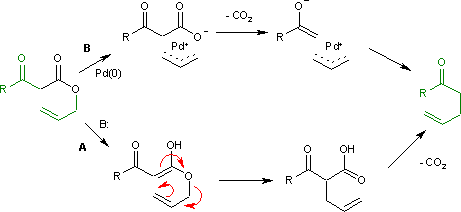
The Carroll rearrangement is a rearrangement reaction in organic chemistry and involves the transformation of a β-keto allyl ester into a α-allyl-β-ketocarboxylic acid. This organic reaction is accompanied by decarboxylation and the final product is a γ,δ-allylketone. The Carroll rearrangement is an adaptation of the Claisen rearrangement and effectively a decarboxylative allylation.
The Carroll rearrangement (1940) in the presence of base and with high reaction temperature (path A) takes place through an intermediate enol which then rearranges in a sigmatropic Claisen rearrangement. The follow-up is a decarboxylation. This rearrangement is used in the conversion of linalool to geranylacetone.
Palladium-catalyzed processes
With palladium(0) as a catalyst, the reaction (Tsuji, 1980) is much milder (path B) with an intermediate allyl cation / carboxylate organometallic complex.
Decarboxylation precedes allylation as evidenced by this reaction catalyzed by tetrakis(triphenylphosphine)palladium(0):

Asymmetric decarboxylative allylation
By introducing suitable chiral ligands, the reaction becomes enantioselective.
The first reported asymmetric rearrangement is catalyzed by tris(dibenzylideneacetone)dipalladium(0) and the Trost ligand:

A similar reaction uses additional naphthol.

This reaction delivers the main enantiomer with 88% enantiomeric excess. It remains to be seen if this reaction will have a wide scope because the acetamido group appears to be a prerequisite.
The same catalyst but a different ligand is employed in this enantioconvergent reaction:

The scope is extended to asymmetric α-alkylation of ketones masked as their enol carbonate esters:Palladium-Catalyzed Asymmetric Allylic α-Alkylation of Acyclic Ketones Barry M. Trost and Jiayi Xu J. Am. Chem. Soc.; 2005; 127(49) pp 17180 - 17181; (Communication)

References
References
- Carroll, M. F. "131. Addition of α,β-unsaturated alcohols to the active methylene group. Part I. The action of ethyl acetoacetate on linalool and geraniol". ''[[Journal of the Chemical Society]]'' '''1940''', 704–706. {{doi. 10.1039/JR9400000704
- Charles S. Sell. (2013). "Kirk-Othmer Chemical Technology of Cosmetics". John Wiley & Sons.
- ''Palladium-catalyzed rearrangement of allylic esters of acetoacetic acid to give γ,δ-unsaturated methyl ketones'' [[Tetrahedron Letters]], Volume 21, Issue 33, '''1980''', Pages 3199-3202 Isao Shimizu, Toshiro Yamada and [[Jiro Tsuji]] {{doi. 10.1016/S0040-4039(00)77444-2
- ''Enantioselective Palladium-Catalyzed Decarboxylative Allylic Alkylations'' Shu-Li You and Li-Xin Dai [[Angew. Chem. Int. Ed.]] '''2006''', 45, 5246 – 5248 {{doi. 10.1002/anie.200601889
- ''Asymmetric Allylic Alkylation of Ketone Enolates: An Asymmetric Claisen Surrogate'' Erin C. Burger and Jon A. Tunge [[Org. Lett.]]; '''2004'''; 6(22) pp 4113 - 4115; (Letter) {{doi. 10.1021/ol048149t
- Kuwano, R.; Ishida N.; Murakami, M. "Asymmetric Carroll rearrangement of allyl α-acetamido-β-ketocarboxylates catalysed by a chiral palladium complex". ''[[Chemical Communications]]'' '''2005''', (31), 3951–3952. {{doi. 10.1039/b505105c
- ''Deracemization of Quaternary Stereocenters by Pd-Catalyzed Enantioconvergent Decarboxylative Allylation of Racemic b-Ketoesters'' Justin T. Mohr, Douglas C. Behenna, Andrew M. Harned, and Brian M. Stoltz Angew. Chem. Int. Ed. '''2005''', 44, 6924 –6927 {{doi. 10.1002/anie.200502018
This article was imported from Wikipedia and is available under the Creative Commons Attribution-ShareAlike 4.0 License. Content has been adapted to SurfDoc format. Original contributors can be found on the article history page.
Ask Mako anything about Carroll rearrangement — get instant answers, deeper analysis, and related topics.
Research with MakoFree with your Surf account
Create a free account to save articles, ask Mako questions, and organize your research.
Sign up freeThis content may have been generated or modified by AI. CloudSurf Software LLC is not responsible for the accuracy, completeness, or reliability of AI-generated content. Always verify important information from primary sources.
Report