From Surf Wiki (app.surf) — the open knowledge base
Carrion
Dead and decaying flesh of an animal
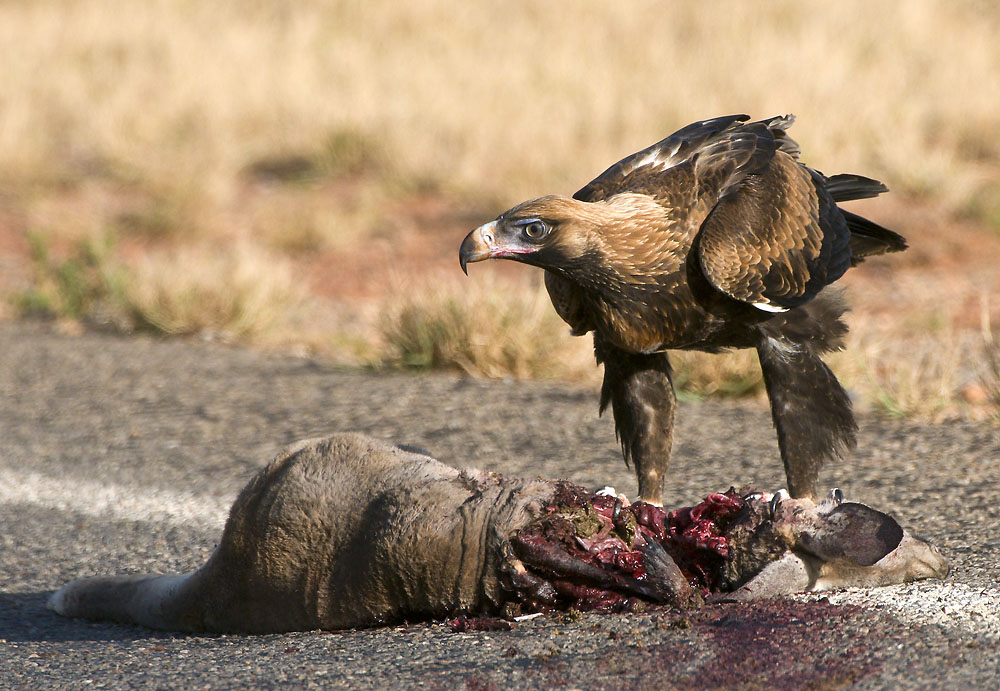
Dead and decaying flesh of an animal
Carrion (), also known as a carcass, is the decaying flesh of dead animals. Carrion may be of natural or anthropic origin (e.g. wildlife, human remains, livestock), and enters the food chain via different routes (e.g. animals dying of disease or malnutrition, predators and hunters discarding parts of their prey, collisions with automobiles).
Carrion is an important food source for large carnivores and omnivores in most ecosystems. Examples of carrion-eating animals include vultures, eagles, hyenas, Virginia opossum, Tasmanian devils, and coyotes. Many invertebrates, for example carrion beetles, burying beetles, blow-fly maggots, and flesh-fly maggots, also eat carrion. All of these animals, together with microbial decomposers, help to recycle nitrogen and carbon in animal remains.
The act of eating carrion is termed necrophagy or necrophagia, and animals that do this are described as necrophages or carrion feeders. The term scavenger is widely used to describe carrion-eating animals too, but this term is broader in scope, encompassing also the consumption of refuse and dead plant material.
Carrion begins to decay at the moment of the animal's death, and it will increasingly attract insects and breed bacteria. Not long after the animal has died, its body will begin to exude a foul odor caused by the presence of bacteria and the emission of cadaverine and putrescine.
Disease transmission
.jpg)
Carrion can harbor many infectious and disease-causing agents including viruses (e.g. rabies virus, West Nile virus), bacteria (e.g. Bacillus anthracis, Clostridium botulinum, Francisella tularensis, Listeria monocytogenes, Pasteurella multocida, Yersinia pestis), bacterial toxins (e.g. botulinum) and helminths (e.g. Trichinella species).
Several outbreaks of disease, attributed to direct or indirect contact with carrion, have been reported in humans and animals.
Consumption as food
Consumption by invertebrates

Hundreds of invertebrate animals feed on carrion. In terrestrial settings, some ant species eat carrion (e.g. red imported fire ants), as do some bees (i.e. vulture bees), and many beetles (e.g. burying beetles, dermestid beetles, silphine beetles) and flies (e.g. bone skippers, blow flies, flesh flies). Several species rely on carrion for survival or reproduction, including the vulture bee Trigona crassipes, the burying beetle Nicrophorus vespilloides, and the bone skipper fly Thyreophora cynophila.
Many aquatic animals also eat carrion. Necrophagous marine invertebrates include cephalopods (e.g. Octopus vulgaris), hermit crabs (e.g. Coenobita clypeatus), star fish (e.g. Luidia ciliaris), whelks (e.g. Tritia reticulata), amphipods (e.g. Eurythenes atacamensis), and annelids (e.g. zombie worms). Necrophagous freshwater invertebrates include the horse leech Haemopis marmorata, the crayfish Procambarus clarkii, and the diving beetle Thermonectus succinctus.
Consumption by vertebrates

Large numbers of vertebrate animals feed on carrion, including different species of birds (e.g. cinereous vultures, red-tailed hawks, carrion crows), fish (e.g. black hagfish, abyssal grenadiers), mammals (e.g. spotted hyenas, wild boars), reptiles (e.g. Komodo dragons, brown tree snakes) and even amphibians (e.g. midwife toad larvae, túngara frog larvae).
With the possible exception of some hagfish species, the only vertebrates known to rely on carrion for survival are the New World vultures (e.g. black vultures) and Old World vultures (e.g. cinereous vultures).
Most of the animals that eat carrion opportunistically are carnivores (e.g. spotted hyenas, abyssal grenadiers) or omnivores (e.g. wild boars), but some herbivores (e.g. Egyptian mastigures) also eat carrion in times of food scarcity.
Consumption by early hominins
Early hominins (e.g. Homo habilis, Homo erectus) are thought to have obtained at least some of the protein and fat in their diet by scavenging meat and bone marrow from the carcasses of large mammals abandoned by predators. This is based on several observations. First, tools of the Early Pleistocene (e.g. Oldowan choppers) were more suited to butchering carcasses than hunting. Second, at many archaeological sites, animal bones have been recovered where tool cuts made by H. habilis are present over tooth marks made by carnivores. In addition, it has been observed that current-day predators (e.g. lions) leave large portions of their kills intact, and it is thought that saber-toothed cats in the Middle Pleistocene would have done likewise.
Later in the Quaternary period, hominins turned more to hunting for food. At what stage this happened is unclear. Some researchers propose that Homo neanderthalensis was more a hunter than a scavenger based on stable isotope analyses and other evidence. However, this interpretation of the isotopic data has been questioned. Later still, hominins turned to herding wild animals and the husbandry of domesticated animals.
Consumption by modern humans
Carrion consumption by modern humans (Homo sapiens) has been documented on several occasions. Examples of carrion eaten include predator kills (e.g. zebra, wildebeest, impala, giraffe), beached marine mammals (e.g. dead whale) and dead livestock (e.g. water buffalo). At least two outbreaks of disease (anthrax and botulism) have been reported, one in 1987, the other in 2002. According to the U.S. Centers for Disease Control and Prevention (CDC), additional (unpublished) outbreaks of botulism have occurred from marine carrion consumption.
Unlike vultures, coyotes and other carrion-eating animals, humans are extremely sensitive to botulinum toxin. This toxin is produced by Clostridium botulinum, a bacterium found in soil and seabeds that can colonize animal bodies after they’ve died.
Among modern-day hunter-gatherer communities who regularly eat carrion as part of their diet, some precautionary behaviors have been documented. These include prioritizing reaching carcasses quickly after death, butchering and disemboweling the carcass, and cooking or sun-drying the meat and viscera recovered.
In religious literature
In Noahide law
Main article: Noahide laws
The thirty-count laws of Ulla (Talmudist) include the prohibition of humans consuming carrion. This count is in addition to the standard seven law count and has been recently published from the Judeo-Arabic writing of Shmuel ben Hophni Gaon after having been lost for centuries.
In Islam
Animals killed by strangling, a violent blow, a headlong fall, being gored to death, or from which a predatory animal has partially eaten are considered types of carrion, and are forbidden in Islam.
In English literature
Sometimes carrion is used to describe an infected carcass that is diseased and should not be touched. An example of carrion being used to describe dead and rotting bodies in literature may be found in William Shakespeare's play Julius Caesar (III.i):
Cry 'Havoc,' and let slip the dogs of war; That this foul deed shall smell above the earth With carrion men, groaning for burial.
Another example can be found in Daniel Defoe's Robinson Crusoe when the title character kills an unknown bird for food but finds "its flesh was carrion, and fit for nothing".
Carrion flowers and stinkhorn mushrooms
Some plants and fungi smell like decomposing carrion and attract insects that aid in reproduction. Plants that exhibit this behavior are known as carrion flowers. Stinkhorn mushrooms are examples of fungi with this characteristic.
Other images
File:Totes Wildkaninchen.jpg|Rabbit carrion in Germany. File:Lizard roadkill that other animals eat, helping out to clean the environment.jpg|Butterfly puddling on lizard carrion. File:Example of a pig carcass in the bloat stage of decomposition.jpg|Dead pig in the bloat stage of decomposition. File:Dead dog in Ulaanbaatar.jpg|Dog carrion in Mongolia. File:Flies settle on a sheep carrion.jpg|Flies settling on sheep carrion. File:Decomposing possum.jpg|Heavily colonized opossum carrion.
References
References
- (2025}} See also: {{cite web). "Carrion (in Merriam-Webster Dictionary)". [[Merriam-Webster]].
- (2008). "Ecosystem services provided by birds". Annals of the New York Academy of Sciences.
- Muñoz-Lozano, C; Martín-Vega, D; Martínez-Carrasco, C; Sánchez-Zapata, JA; Morales-Reyes, Z; Gonzálvez, M; Moleón M. (2019). "Avoidance of carnivore carcasses by vertebrate scavengers enables colonization by a diverse community of carrion insects". PLOS ONE.
- Hovenden, F. (2003). "The carrion eaters". Comox Valley Naturalists Society.
- (2025). "Striped hyena (''Hyaena hyaena'')". [[San Diego Zoo Wildlife Alliance]].
- McDougall, L. (November 2023). "The Encyclopedia of Tracks and Scats: A Comprehensive Guide to the Trackable Animals of the United States and Canada". Globe Pequot Press.
- (2025). "Tasmanian devil (''Sarcophilus harrisii'')". San Diego Zoo Wildlife Alliance.
- Stegemann, E. (2006). "Skull science". [[New York State Department of Environmental Conservation]].
- [[John George Wood. (1892). "Insects abroad: Being a popular account of foreign insects; their structure, habits and transformations". [[Longmans, Green and Co.]].
- (2003). "Low temperature episodes in development of blowflies: implications for postmortem interval estimation". Medical and Veterinary Entomology.
- DeBruyn, JM; Keenan, SW; Taylor, LS. (2025). "From carrion to soil: microbial recycling of animal carcasses". Trends in Microbiology.
- (2025}} See also: {{cite web). "Necrophagy (in Merriam-Webster Dictionary)". Merriam-Webster.
- (2007). "Necrophage (in A Dictionary of Environment and Conservation)". [[Oxford University Press]].
- (2026). "Carrion feeder (in Collins English Dictionary)". HarperCollins.
- (2025}} See also: {{cite web). "Scavenger (in Merriam-Webster Dictionary)". Merriam-Webster.
- (2012). "The ecology of carrion decomposition". Nature Education Knowledge.
- (1983). "The viability of rabies in carrion". Great Plains Wildlife Damage Control Workshop Proceedings.
- (2007). "Avian mortality surveillance for West Nile virus in Colorado". American Journal of Tropical Medicine and Hygiene.
- (2025). "Necrophages and necrophiles: a review of their antibacterial defenses and biotechnological potential". Critical Reviews in Biotechnology.
- (1998). "Epidemiology, Diagnosis and Control of Helminth Parasites of Swine". Food and Agriculture Organization of the United Nations.
- (1990). "Infectivity of ''Trichinella pseudospiralis'' isolated from carrion". Journal of Parasitology.
- (1990). "Outbreak of anthrax in Thailand". Annals of Tropical Medicine & Parasitology.
- (2003). "Outbreak of botulism type E associated with eating a beached whale--Western Alaska, July 2002". Morbidity and Mortality Weekly Report.
- (2000). "Type C botulism in dairy cattle from feed contaminated with a dead cat". Journal of Veterinary Diagnostic Investigation.
- (2010). "Relationships between local carcass density and risk of mortality in molting mallards during avian botulism outbreaks". Journal of Wildlife Diseases.
- (2001). "Forensic Entomology: The Utility of Arthropods in Legal Investigations". CRC Press.
- Silva-Soares, T. (2019). "Necrophagy on ''Rhinella granulosa'' (Amphibia, Anura, Bufonidae) by the aquatic beetle families Hydrophilidae and Dytiscidae (Insecta, Coleoptera) in Caatinga environment, Northeastern Brazil". Herpetology Notes.
- (2011). "First evidence of scavenging behaviour in the herbivorous lizard ''Uromastyx aegyptia microlepis''". Journal of Arid Environments.
- (2022). "Introduction to Evolution & Human Behavior: An Anthropological and Comparative Approach". Boise State University.
- (2025). "Early humans may have scavenged more than they hunted".
- (2015). "New actualistic data on the ecology and energetics of hominin scavenging opportunities". Journal of Human Evolution.
- (2023). "Computer simulation of scavenging by hominins and giant hyenas in the late Early Pleistocene". Scientific Reports.
- (2000). "Neanderthal diet at Vindija and Neanderthal predation: the evidence from stable isotopes". Proceedings of the National Academy of Sciences of the United States of America.
- (2014). "Humans and scavengers: the evolution of interactions and ecosystem services". BioScience.
- (2017). "Putrid meat and fish in the Eurasian Middle and Upper Paleolithic: are we missing a key part of Neanderthal and Modern Human diet?". PaleoAnthropology.
- (2021). "Biological Toxins and Bioterrorism". Springer.
- (2007). "Compounds against botulinum neurotoxin". Proceedings of the National Academy of Sciences of the United States of America.
- (September 2024). "Antibacterial discovery: how scavengers avoid infection and what we can learn from them". [[The Conversation (website).
- (1988). "Hadza hunting, butchering, and bone transport and their archaeological implications". Journal of Anthropological Research.
- (1988). "Hadza scavenging: implications for Plio/Pleistocene hominid subsistence". Current Anthropology.
- Talmud, Hullin 92b
- [[Mossad HaRav Kook]] edition of Gaon's commentary to Genesis.
- (2019). "The Halal Food Handbook". John Wiley & Sons, Inc.
- [http://shakespeare.mit.edu/julius_caesar/julius_caesar.3.1.html The Life and Death of Julius Caesar]. Scene I. Rome. Before the Capitol; the Senate sitting above.
- (2010). "Convergent evolution of carrion and faecal scent mimicry in fly-pollinated angiosperm flowers and a stinkhorn fungus". South African Journal of Botany.
This article was imported from Wikipedia and is available under the Creative Commons Attribution-ShareAlike 4.0 License. Content has been adapted to SurfDoc format. Original contributors can be found on the article history page.
Ask Mako anything about Carrion — get instant answers, deeper analysis, and related topics.
Research with MakoFree with your Surf account
Create a free account to save articles, ask Mako questions, and organize your research.
Sign up freeThis content may have been generated or modified by AI. CloudSurf Software LLC is not responsible for the accuracy, completeness, or reliability of AI-generated content. Always verify important information from primary sources.
Report