From Surf Wiki (app.surf) — the open knowledge base
Carnot (crater)
Crater on the Moon
Crater on the Moon
| Field | Value |
|---|---|
| image | Carnot crater LROC.jpg |
| caption | LRO image |
| coordinates | |
| diameter | 126.06 km |
| depth | Unknown |
| colong | 146 |
| eponym | Nicolas L. S. Carnot |

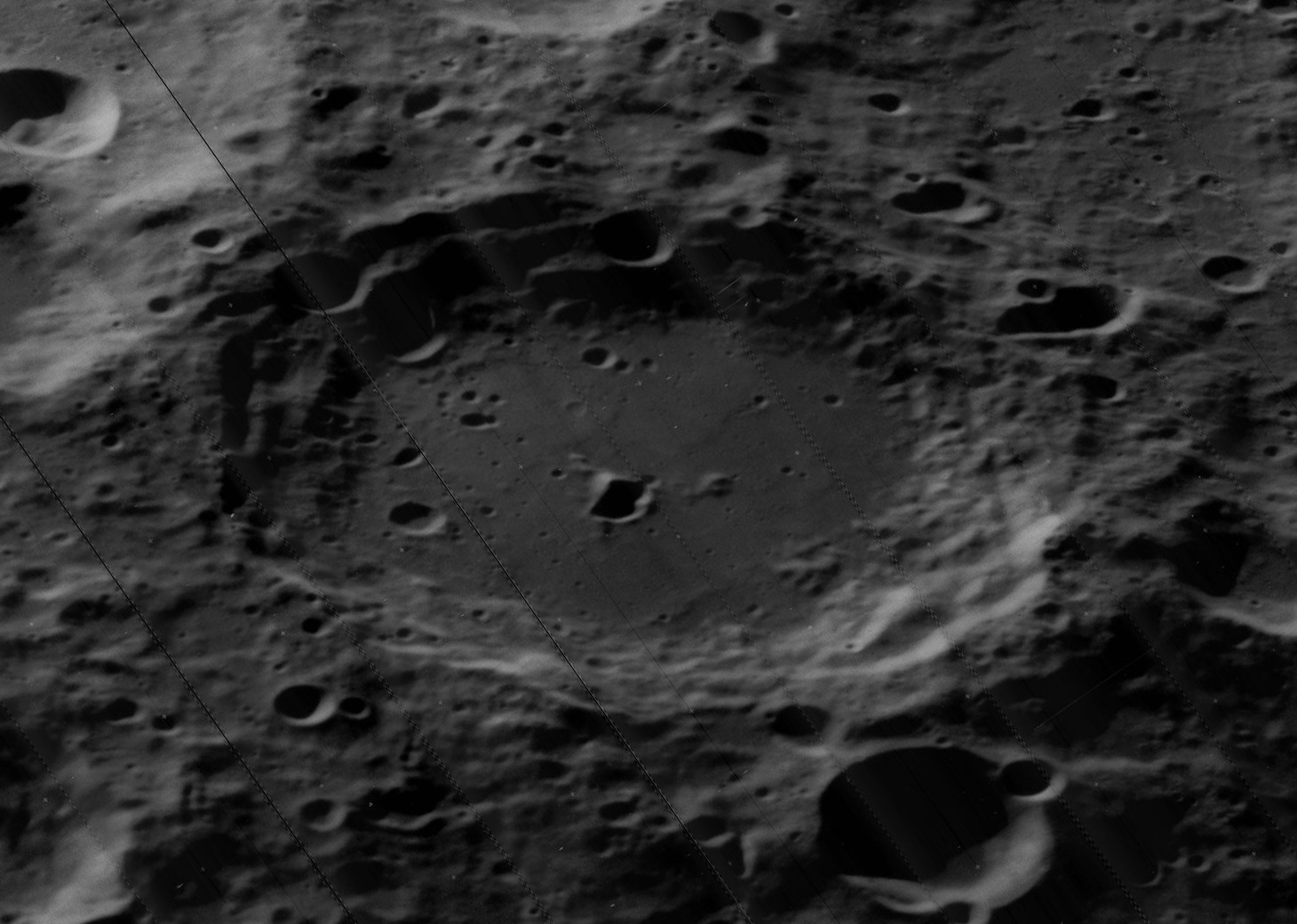
Carnot is a large crater in the northern part of the Moon's far side. It was named after Nicolas L. S. Carnot by the IAU in 1970.
The outer rim of Carnot has a somewhat hexagonal form, particularly in the southern half. The northern rim has an irregular inner wall, while the southern face is terraced and has a sharper outer edge. There is some slumping along the rim edge to the southeast, producing outward bulges in the perimeter. The western inner wall is partly overlaid by three small, cup-shaped craters. Within the rim, the crater floor is flat and level, at least in comparison to the rugged terrain around the exterior. Just to the southeast of the crater midpoint is a central peak formation. The interior floor is marked by several small and numerous tiny craters. The most prominent of the craters on the floor is a small, shallow crater near the southern inner wall.
Carnot intrudes into the southern rim of the huge walled plain Birkhoff. To the west-southwest of Carnot is the crater Paraskevopoulos.
Carnot is a crater of Nectarian age.
Satellite craters
By convention these features are identified on lunar maps by placing the letter on the side of the crater midpoint that is closest to Carnot.
| Carnot | Latitude | Longitude | Diameter |
|---|---|---|---|
| F | 52.5° N | 138.9° W | 35 km |
References
- {{cite book | author-link2 = Ewen Whitaker
- {{cite web | access-date = 2007-08-05
- {{cite book | author-link1 = Ben Bussey | author-link2 = Paul Spudis
- {{cite book
- {{cite web | access-date = 2007-10-24 | archive-date = 2012-02-08 | archive-url = https://web.archive.org/web/20120208141804/http://host.planet4589.org/astro/lunar/ | url-status = dead
- {{cite book | author-link = Patrick Moore
- {{cite book
- {{cite book | author-link = Antonín Rükl
- {{cite book | author-link = Thomas William Webb
- {{cite book | author-link = Ewen Whitaker
- {{cite book
References
- [https://planetarynames.wr.usgs.gov/Feature/1023 Carnot], Gazetteer of Planetary Nomenclature, International Astronomical Union (IAU) Working Group for Planetary System Nomenclature (WGPSN)
- [https://pubs.er.usgs.gov/publication/pp1348 The geologic history of the Moon]. [[USGS]] Professional Paper 1348. By [[Don Wilhelms. Don E. Wilhelms]], John F. McCauley, and Newell J. Trask. U.S. Government Printing Office, Washington: 1987. Table 9-4.
This article was imported from Wikipedia and is available under the Creative Commons Attribution-ShareAlike 4.0 License. Content has been adapted to SurfDoc format. Original contributors can be found on the article history page.
Ask Mako anything about Carnot (crater) — get instant answers, deeper analysis, and related topics.
Research with MakoFree with your Surf account
Create a free account to save articles, ask Mako questions, and organize your research.
Sign up freeThis content may have been generated or modified by AI. CloudSurf Software LLC is not responsible for the accuracy, completeness, or reliability of AI-generated content. Always verify important information from primary sources.
Report