From Surf Wiki (app.surf) — the open knowledge base
Caribbean Community
Regional intergovernmental organisation
Regional intergovernmental organisation
| Field | Value | |||
|---|---|---|---|---|
| name | {{collapsible list | |||
| titlestyle | text-align:center;line-height:normal;font-size:84%; | |||
| title | ||||
| subbox | yes | |||
| bodystyle | font-size:77%;font-weight:normal; | |||
| rowclass1 | mergedrow | |||
| label1 | Dutch: | |||
| data1 | Caribische Gemeenschap | |||
| rowclass2 | mergedrow | |||
| label2 | French: | |||
| data2 | Communauté caribéenne | |||
| rowclass3 | mergedrow | |||
| label3 | Spanish: | |||
| data3 | Comunidad del Caribe | |||
| flag_caption | Flag | |||
| image_symbol | CARICOM logo official.svg | |||
| symbol_type | Official Logo | |||
| image_flag | Flag of CARICOM.svg | |||
| anthem | "Celebrating CARICOM" | |||
| image_map | Caricom Member states 2024.png | |||
| map_caption | ||||
| org_type | Supranational union | |||
| government_type | Intergovernmental | |||
| membership_type | Member states | |||
| membership | {{collapsible list | |||
| titlestyle | text-align:left;font-weight:normal;white-space:nowrap; | |||
| title | 15 full members | |||
| {{flagcountry | Saint Kitts and Nevis | name | Saint Kitts and Nevis}} | |
| {{nowrap | {{flagcountry | Saint Vincent and the Grenadines | name | Saint Vincent and the Grenadines}}}} |
| titlestyle | text-align:left;font-weight:normal;white-space:nowrap; | |||
| title | 7 associates | |||
| {{nowrap | {{flagcountry | Turks and Caicos Islands | name | Turks and Caicos Islands}}}} |
| titlestyle | text-align:left;font-weight:normal;white-space:nowrap; | |||
| title | 7 observers | |||
| admin_center_type | Seat of Secretariat | |||
| admin_center | Georgetown, Guyana | |||
| largest_settlement | Port-au-Prince, Haiti | |||
| largest_settlement_type | city | |||
| official_languages | English | |||
| languages_type | Working language | |||
| languages | {{hlist | Dutch | ||
| Spanish}}<ref name | "auto3" | |||
| languages2_type | Other languages | |||
| languages2 | {{collapsible list | |||
| framestyle | text-align:left;border:0;padding:0;line-height:16px; | |||
| titlestyle | text-align:left;font-weight:normal; | |||
| title | 34 languages | |||
| hlist | true | |||
| framestyle | text-align:left;border:0;padding:0;line-height:16px; | |||
| titlestyle | text-align:left;font-weight:normal; | |||
| title | 16 Native non- | |||
| extinct languages | ||||
| hlist | true | |||
| leader_title2 | Chairman | |||
| leader_name2 | Terrance Drew | |||
| leader_title1 | Secretary-General | |||
| leader_name1 | Carla Barnett | |||
| established_event1 | Treaty of Chaguaramas | |||
| established_date1 | 4 July 1973 | |||
| established_event2 | Revised Treaty of Chaguaramas | |||
| established_date2 | 2001 | |||
| ethnic_groups | In full member states: {{unbulleted list | |||
| ethnic_groups_ref | ||||
| demonym | Caribbean people | |||
| area_km2 | 458,480 | |||
| area_sq_mi | 177,020 | |||
| area_label | Total | |||
| population_estimate | 18,482,141 (in full member states) | |||
| 239,251,864 (in all states) | ||||
| population_estimate_year | 2019 | |||
| population_density_km2 | 40.3 | |||
| population_density_sq_mi | 104 | |||
| GDP_PPP | $145.3 billion | |||
| GDP_PPP_year | 2020 | |||
| GDP_PPP_per_capita | $18,289 | |||
| GDP_nominal | $81.987 billion | |||
| GDP_nominal_year | 2019 | |||
| GDP_nominal_per_capita | $12,608 | |||
| Gini_change | ||||
| Gini | ||||
| HDI_year | 2023 | |||
| HDI_change | increase | |||
| HDI | 0.765 | |||
| HDI_ref | ||||
| currency | {{plainlist | |||
| official_website | https://caricom.org/ |
| {{Infobox |Antigua and Barbuda |Bahamas |Barbados |Belize |Dominica |Grenada |Guyana |Haiti | |Jamaica |Montserrat |Saint Kitts and Nevis |Saint Lucia | |Suriname |Trinidad and Tobago |Anguilla |Bermuda |British Virgin Islands |Cayman Islands |Curaçao | |Martinique|
|Aruba |Colombia |Dominican Republic |Mexico |Puerto Rico |Sint Maarten | Venezuela |English | French |Spanish}} |Anguillian English Creole |Antillean French Creole|Arabic | Bajan English | Bajan English Creole | Bahamian English Creole | Belizean English Creole | Belizean Spanish | Caribbean Hindustani | Caribbean Spanish || Cayman Islands English | Chinese | Dominican French Creole | Grenadian English Creole | Guyanese English Creole | Jamaican English | Jamaican Patois | Martinican Creole | Montserrat English Creole | Ndyuka | Papiamento | Plautdietsch German | Saint Kitts Creole | Saint Lucian French Creole | Saramaccan | Sranan Tongo | Surinamese Dutch | Tobagonian English Creole | Trinidadian English Creole | Trinidadian and Tobagonian English | Turks and Caicos English Creole | Venezuelan Spanish | Vincentian English Creole | Virgin Islands English Creole extinct languages](indigenous-languages-of-the-americas) |Arawak (Lokono) | Carib (Kari'nja) | Garifuna (Karif) | Kapóng |Macushi | Mawayana (Mapidian) | Mopan | Pemon (Arekuna) | Qʼeqchiʼ (Kʼekchi) | Sikiana (Kashuyana) | Tiriyó | Yucatec | Waiwai | Wapishana | Warao (Guarauno) | Wayana}} |73.78% Afro-Caribbean |8.3% Multiracial |6.09% Indian |0.49% European |0.39% Indigenous (Amerindian) |0.12% Chinese |10.83% Others 239,251,864 (in all states)
- Bahamas Bahamian dollar (BSD)
- Barbados Barbadian dollar (BBD)
- Belize Belize dollar (BZD)
- Bermuda Bermudian dollar (BMD)
- Cayman Islands Cayman Islands dollar (KYD)
- [[File:Flag of Eastern Caribean.png|24px]] Eastern Caribbean dollar (XCD)
- Guyana Guyanese dollar (GYD)
- Haiti Haitian gourde (HTG)
- Jamaica Jamaican dollar (JMD)
- Curaçao Sint Maarten Caribbean guilder (XCG)
- Suriname Surinamese dollar (SRD)
- Trinidad and Tobago Trinidad and Tobago dollar (TTD)
- British Virgin Islands Turks and Caicos Islands United States dollar (USD)
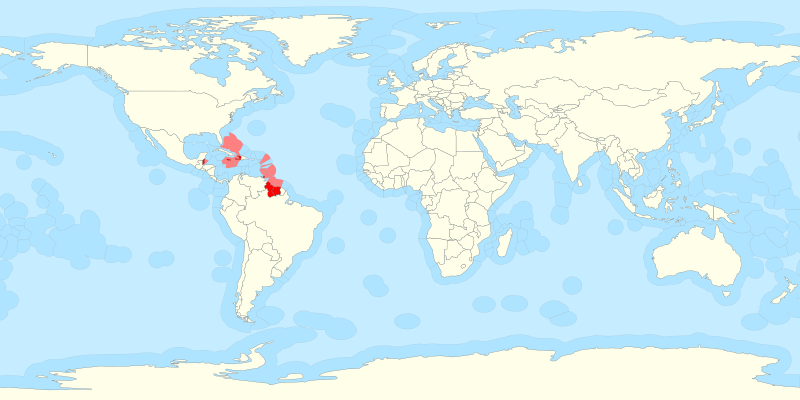
The Caribbean Community (abbreviated as CARICOM or CC) is an intergovernmental organisation that is a political and economic union of 15 member states (14 nation-states and one dependency) and five associated members throughout the Americas, the Caribbean and Atlantic Ocean. It has the primary objective to promote economic integration and cooperation among its members, ensure that the benefits of integration are equitably shared, and coordinate foreign policy. The organisation was established in 1973, by its four founding members signing the Treaty of Chaguaramas.
The secretariat headquarters is in Georgetown, Guyana. CARICOM has been granted the official United Nations General Assembly observer status.
History
CARICOM, originally The Caribbean Community and Common Market, was established by the Treaty of Chaguaramas which took effect on 1 August 1973. Founding states were Barbados, Jamaica, Guyana and Trinidad and Tobago.
The Caribbean Community superseded the 1965–1972 Caribbean Free Trade Association organised to provide a continued economic linkage between the English-speaking countries of the Caribbean after the dissolution of the West Indies Federation, which lasted from 3 January 1958 to 31 May 1962.
A revised Treaty of Chaguaramas established The Caribbean Community including the CARICOM Single Market and Economy, security, foreign exchange and was signed by the CARICOM Heads of Government of the Caribbean Community on 5 July 2001 at their Twenty-Second Meeting of the Conference in Nassau, The Bahamas. The revised treaty cleared the way to transform the idea of a common market CARICOM into the Caribbean (CARICOM) Single Market and Economy.
Haiti's membership in CARICOM remained effectively suspended from 29 February 2004 through early June 2006 following the 2004 Haitian coup d'état and the removal of Jean-Bertrand Aristide from the presidency.{{cite news |access-date=25 March 2011 |archive-date=24 September 2020 |archive-url=https://web.archive.org/web/20200924063446/https://www.cbc.ca/news/world/aristide-accuses-u-s-of-forcing-him-out-1.502442 |url-status=live |access-date=25 March 2011 |archive-date=9 December 2011 |archive-url=https://web.archive.org/web/20111209032804/http://news.bbc.co.uk/2/hi/americas/3587777.stm |url-status=live |access-date=25 March 2011 |archive-date=22 September 2009 |archive-url=https://web.archive.org/web/20090922080811/http://www.trinidadandtobagonews.com/forum/webbbs_config.pl/noframes/read/1721 |url-status=live
Since 2013 the CARICOM-bloc and with the Dominican Republic have been tied to the European Union via an Economic Partnership Agreements signed in 2008 known as CARIFORUM. The treaty grants all members of the European Union and CARIFORUM equal rights in terms of trade and investment. Under Article 234 of the agreement, the European Court of Justice handles dispute resolution between CARIFORUM and European Union states.
On 1 October 2025, four Caricom members—Barbados, Belize, Dominica, and St. Vincent and the Grenadines—implemented full freedom of movement, going beyond the freedom of movement only for skilled workers that other Caricom members have implemented.
Agenda and goals
CARICOM was established by the English-speaking countries of the Caribbean and currently includes all the independent Anglophone island countries plus Belize, Guyana, Montserrat and Suriname, as well as all other British Caribbean territories and Bermuda as associate members. English was its sole working language into the 1990s. The organisation became multilingual with the addition of Dutch and Sranan Tongo-speaking Suriname in 1995 and the French and Haitian Creole-speaking Haiti in 2002. Furthermore, it added Spanish as the fourth official language in 2003. In July 2012, CARICOM announced they considered making French and Dutch official languages. In 2001, the Conference of Heads of Governments signed a revised Treaty of Chaguaramas that cleared the way to transform the idea of a common market CARICOM into the CARICOM Single Market and Economy. Part of the revised treaty establishes and implements the Caribbean Court of Justice. Its primary activities involve:
- Coordinating economic policies and development planning.
- Devising and instituting special projects for the less-developed countries within its jurisdiction.
- Operating as a regional single market for many of its members (Caricom Single Market).
- Handling regional trade disputes.
Organisational structure
The following is the overall structure of Caribbean Community (CARICOM).
Administration and staff
| Institution | Abbreviation | Location | Country |
|---|---|---|---|
| Secretariat of the Caribbean Community | CCS | Georgetown | Guyana |
| Caricom heads of government | PCC | variable | |
| Conference of Heads of Governments | HGC | variable | |
| Assembly of Caribbean Community Parliamentarians | ACCP | variable | |
| Caribbean Community Administrative Tribunal | CCAT | Port of Spain | Trinidad and Tobago |
Chairmanship
The post of Chairman (Head of CARICOM) is held in rotation by the regional Heads of Government of CARICOM's 15 member states. These include Antigua and Barbuda, Belize, Dominica, Grenada, Haiti, Montserrat, St. Kitts and Nevis, St. Lucia, St. Vincent and the Grenadines, The Bahamas, Barbados, Guyana, Jamaica, Suriname, Trinidad and Tobago.
Heads of government
CARICOM contains a quasi-Cabinet of the individual Heads of Government. These heads are given specialised portfolios of responsibility for regional development and integration.
Secretariat
The Secretariat of the Caribbean Community is the Chief Administrative Organ for CARICOM. The Secretary-General of the Caribbean Community is the chief executive and handles foreign and community relations. Five years is the term of office of the Secretary-General, which may be renewed. The Deputy Secretary-General of the Caribbean Community handles human and Social Development. The General Counsel of the Caribbean Community handles trade and economic integration.
The goal statement of the CARICOM Secretariat is: "To contribute, in support of Member States, to the improvement of the quality of life of the People of the Community and the development of an innovative and productive society in partnership with institutions and groups working towards attaining a people-centred, sustainable and internationally competitive Community."
Organs and bodies
| Organ | Description |
|---|---|
| CARICOM Heads of Government | Consisting of the various heads of Government from each member state |
| Standing Committee of Ministers | Ministerial responsibilities for specific areas, for example the Standing Committee of Ministers responsible for Health will consist of Ministers of Health from each member state |
Community Council
The Community Council comprises ministers responsible for community affairs and any other Minister designated by the member states at their discretion. It is one of the community's principal organs; the other is the Conference of the Heads of Government. Four other organs and three bodies support it.
| Secondary organ | Abbreviation |
|---|---|
| Council for Finance and Planning | COFAP |
| Council for Foreign and Community Relations | COFCOR |
| Council for Human and Social Development | COHSOD |
| Council for Trade and Economic Development | COTED |
| Body | Description | |
|---|---|---|
| Legal Affairs Committee of the Caribbean Community | Legal Affairs Committee | provides legal advice |
| Budget Committee of the Caribbean Community | Budget Committee | examines the draft budget and work programme of the Secretariat and submits recommendations to the Community Council. |
| Committee of the Central Bank Governors | provides recommendations to the COFAP on monetary and financial matters. |
Institutions
The following institutions are founded by or affiliated to the Caricom:
Caricom Institutions
| Institution | Abbreviation | Location | Country |
|---|---|---|---|
| Caribbean Centre for Renewable Energy and Energy Efficiency | CCREEE | Bridgetown | Barbados |
| Caricom Development Fund | CDF | Bridgetown | Barbados |
| Caribbean Telecommunications Union | CTU | Port of Spain | Trinidad and Tobago |
| Caribbean Community Climate Change Centre | CCCCC | Belmopan | Belize |
| Caricom Regional Organisation for Standards and Quality | CROSQ | Bridgetown | Barbados |
| Caribbean Meteorological Organisation | CMO | Port of Spain | Trinidad and Tobago |
| Caribbean Regional Fisheries Mechanism | CRFM | Belize City | Belize |
| Caricom Implementation Agency for Crime and Security | IMPACS | Port of Spain | Trinidad and Tobago |
| Caribbean Institute for Meteorology and Hydrology | CIMH | Bridgetown | Barbados |
| Caribbean Examinations Council | CXC | Bridgetown | Barbados |
| Caribbean Court of Justice | CCtJ/CCJ | Port of Spain | Trinidad and Tobago |
| Caricom Competition Commission | CCC | Paramaribo | Suriname |
| Caribbean Disaster Emergency Management Agency | CDEMA | Saint Michael | Barbados |
| Caribbean Agricultural Health and Food Safety Agency | CAHFSA | Paramaribo | Suriname |
| Caribbean Aviation Safety and Security Oversight System | CASSOS | Kingston | Jamaica |
| Caribbean Public Health Agency | CARPHA | Port of Spain | Trinidad and Tobago |
| Caribbean Centre for Development Administration | CARICAD | Saint Michael | Barbados |
| Caribbean Agriculture Research and Development Institute | CARDI | Saint Augustine | Trinidad and Tobago |
| Caribbean Organisation of Tax Administrators | COTA | Georgetown | Guyana |
Functional cooperation
| Institution | Abbreviation | Location | Country | ||
|---|---|---|---|---|---|
| Caribbean Tourism Organization | CTO | Saint Michael | Barbados | ||
| Caribbean Council of Legal Education | CLE | several | |||
| Caribbean Export Development Agency | Caribbean Export | Saint Michael | Barbados | ||
| Caribbean Regional Information and Translation Institute | CRITI | Paramaribo | Suriname |
Associate
| Institution | Abbreviation | Location | Country |
|---|---|---|---|
| Caribbean Congress of Labour | CCL | Saint Michael | Barbados |
| Caricom Private Sector Organization | CPSO | Saint Michael | Barbados |
| University of the West Indies | UWI | several | |
| University of Guyana | UG | Georgetown | Guyana |
| Caribbean Law Institute | CLI | Saint Michael | Barbados |
| Caribbean Development Bank | CDB | Saint Michael | Barbados |
Cancelled
The following institutions have been cancelled or merged into other ones:
| Institution | Abbreviation | Location | Country |
|---|---|---|---|
| Regional Educational Programme for Animal Health Assistants | REPAHA | New Amsterdam | Guyana |
| Caribbean Food Corporation | CFC | Saint Augustine | Trinidad and Tobago |
| Caribbean Environmental Health Institute | CEHI | Castries | Saint Lucia |
| The Caribbean Epidemiology Centre | CAREC | Port of Spain | Trinidad and Tobago |
| Caribbean Food and Nutrition Institute | CFNI | Kingston | Jamaica |
| Caribbean Health Research Council | CHRC | Saint Augustine | Trinidad and Tobago |
| Caribbean Regional Drug Testing Laboratory | CRDTL | Georgetown | Guyana |
Relationship to other supranational Caribbean organisations
Association of Caribbean States
CARICOM was instrumental in the formation of the Association of Caribbean States (ACS) on 24 July 1994. The original idea for the Association came from a recommendation of the West Indian Commission, established in 1989 by the CARICOM heads of state and government. The Commission advocated both deepening the integration process (through the CARICOM Single Market and Economy) and complementing it through a separate regional organisation encompassing all states in the Caribbean.
CARICOM accepted the commission's recommendations and opened dialogue with other Caribbean states, the Central American states and the Latin American nations of Colombia, Venezuela and Mexico which border the Caribbean, for consultation on the proposals of the West Indian Commission.
At an October 1993 summit, the heads of state and government of CARICOM and the presidents of the then-Group of Three (Colombia, Mexico and Venezuela) formally decided to create an association grouping all states of the Caribbean basin. A work schedule for its formation was adopted. The aim was to create the association in less than a year, an objective which was achieved with the formal creation of the ACS.
Community of Latin American and Caribbean States
CARICOM was also involved in the formation of the Community of Latin American and Caribbean States (CELAC) on 3 December 2010. The idea for CELAC originated at the Rio Group–Caribbean Community Unity Summit on 23 February 2010 in Mexico. This act caters to the integration of the Americas process, complimenting well-established initiatives of the Organization of American States.{{cite web |access-date=25 May 2012 |url-status=dead |archive-url=https://web.archive.org/web/20120426015931/http://www.mexidata.info/id2573.html |archive-date=26 April 2012 |archive-date=9 June 2019 |access-date=13 June 2016 |archive-url=https://web.archive.org/web/20190609074022/http://hosted.ap.org/dynamic/stories/A/AML_GEN_CUMBRE_SPLA-?SITE=WFMZ&SECTION=ASIA&TEMPLATE=DEFAULT&CTIME=2010-02-23-11-44-02 |url-status=dead |access-date=13 June 2016 |archive-date=22 February 2022 |archive-url=https://web.archive.org/web/20220222185222/https://elpais.com/internacional/2010/02/23/actualidad/1266879601_850215.html |url-status=live
European Union: Economic Partnership Agreements
Since 2013, the CARICOM-bloc and the Dominican Republic have been tied to the European Union via an Economic Partnership Agreements known as CARIFORUM signed in 2008. The treaty grants all members of the European Union and CARIFORUM equal rights in terms of trade and investment. Within the agreement under Article 234, the European Court of Justice also carries dispute resolution mechanisms between CARIFORUM and the states of the European Union.
OHADAC Project
In May 2016, Caricom's court of original jurisdiction, the CCJ, signed a memorandum of understanding (MOU) with the ACP Legal Association based in Guadeloupe recognising and supporting the goals of implementing a harmonised business law framework in the Caribbean through ACP Legal Association's OHADAC Project.
OHADAC is the acronym for the French "Organisation pour l'Harmonisation du Droit des Affaires en les Caraïbes", which translates into English as "Organisation for the Harmonisation of Business Law in the Caribbean". The OHADAC Project takes inspiration from a similar organisation in Africa and aims to enhance economic integration across the entire Caribbean and facilitate increased trade and international investment through unified laws and alternative dispute resolution methods.
Member states
CARICOM has 15 full members, seven associate members and eight observers. The associated members are five British Overseas Territories, one constituent county of the Kingdom of the Netherlands and one French Overseas Territory. It is currently not established what the role of the associate members will be. The observers are states which engage in at least one of CARICOM's technical committees.
Under Article 4 CARICOM breaks its 15 member states into two groups: Less Developed Countries (LDCs) and More Developed Countries (MDCs).
The countries of CARICOM which are designated as Less Developed Countries (LDCs) are as follows:
- Antigua and Barbuda
- Belize
- Commonwealth of Dominica
- Grenada
- Republic of Haiti
- Montserrat
- Federation of St. Kitts and Nevis
- St Lucia
- St Vincent and the Grenadines
The countries of CARICOM which are designated as More Developed Countries (MDCs) are:
- Commonwealth of The Bahamas
- Barbados
- Co-operative Republic of Guyana
- Jamaica
- Republic of Suriname
- Republic of Trinidad and Tobago
| Status | Name | Join date | Notes |
|---|---|---|---|
| Full member | 4 July 1974 | ||
| 4 July 1983 | Not a part of the customs union | ||
| 1 August 1973 | One of the four founding members | ||
| 1 May 1974 | |||
| 1 August 1973 | One of the four founding members | ||
| 2 July 2002 | Provisional membership on 4 July 1998 | ||
| 1 August 1973 | One of the four founding members | ||
| 1 May 1974 | British overseas territory | ||
| 26 July 1974 | Joined as Saint Christopher-Nevis-Anguilla | ||
| 1 May 1974 | |||
| 1 May 1974 | |||
| 4 July 1995 | |||
| 1 August 1973 | One of the four founding members | ||
| Associate | 4 July 1999 | British overseas territory | |
| 2 July 2003 | |||
| 2 July 1991 | |||
| 16 May 2002 | |||
| 28 July 2024 | Constituent country of the Kingdom of the Netherlands | ||
| 20 February 2025 | French overseas territory | ||
| 2 July 1991 | British overseas territory | ||
| Observer | Constituent country of the Kingdom of the Netherlands | ||
| Unincorporated territory of the United States | |||
| Constituent country of the Kingdom of the Netherlands |
Thousands of Caricom nationals live within other member states of the Community.
An estimated 30,000 Jamaicans legally reside in other CARICOM member states, mainly in The Bahamas (6,200), Antigua & Barbuda (estimated 12,000), Barbados and Trinidad & Tobago). Also, an estimated 150 Jamaicans live and work in Montserrat. A 21 November 2013 estimated put 16,958 Jamaicans residing illegally in Trinidad & Tobago, as according to the records of the Office of the Chief Immigration Officer, their entry certificates would have since expired. By October 2014, the estimated Jamaicans residing illegally in Trinidad and Tobago was 19,000 along with an estimated 7,169 Barbadians and 25,884 Guyanese residing illegally. An estimated 8,000 Trinidadians and Tobagonians live in Jamaica.
Barbados hosts a large diaspora population of Guyanese, of whom (in 2005) 5,032 lived there permanently as citizens, permanent residents, immigrants (with immigrant status) and Caricom skilled nationals; 3,200 were residing in Barbados temporarily under work permits, as students, or with "reside and work" status. A further 2,000–3,000 Guyanese were estimated to be living illegally in Barbados at the time. Migration between Barbados and Guyana has deep roots, going back over 150 years, with the most intense period of Barbadian migration to then-British Guiana occurring between 1863 and 1886, although as late as the 1920s and 1930s Barbadians were still leaving Barbados for British Guiana.
Migration between Guyana and Suriname also goes back a number of years. An estimated 50,000 Guyanese had migrated to Suriname by 1986 In 1987 an estimated 30–40,000 Guyanese were in Suriname. Many Guyanese left Suriname in the 1970s and 1980s, either voluntarily or by expulsion. Citing a national security concern, over 5,000 were expelled in January 1985 alone. In the instability Suriname experienced following independence, both coups and civil war. In 2013, an estimated 11,530 Guyanese had emigrated to Suriname and 4,662 Surinamese to Guyana.{{cite web |access-date=21 April 2015 |archive-date=27 April 2015 |archive-url=https://web.archive.org/web/20150427124722/http://esa.un.org/MigGMGProfiles/indicators/files/Guyana.pdf |url-status=live
Relationship with Cuba
In 2017, the Republic of Cuba and CARICOM signed the "CARICOM-Cuba Trade and Economic Cooperation Agreement" to facilitate closer trade ties. In December 2022, President of Cuba Miguel Díaz-Canel met in Bridgetown, Barbados with the Heads of State and Government of CARICOM. On the occasion of the 8th CARICOM-Cuba Summit to commemorate the 50th Anniversary of establishing diplomatic relations with the independent States of CARICOM and Cuba and the 20th Anniversary of CARICOM-Cuba Day. Cuba also accepted CARICOM's offer to deepen bilateral cooperation and to join robust discussions in the bloc's regional 'Joint Ministerial Taskforce on Food production and Security'.
Dialogue partners / accreditation to CARICOM
A number of global partners have established diplomatic representation to the Caribbean Community (CARICOM) Secretariat located in Georgetown, Guyana. Nations with non-resident representatives to CARICOM in italics:
- African Union Non accreditation, but as dialogue partner
- Argentina
- Australia
- Austria
- Belgium
- Botswana
- Brazil
- Canada
- Chile
- Colombia
- Costa Rica
- Cuba
- El Salvador
- European Union
- Finland
- France
- Germany
- Greece
- India
- Indonesia
- Ireland
- Israel
- Italy
- Japan
- Korea
- Latvia
- Lithuania
- Mexico
- Netherlands
- New Zealand
- Panama
- Portugal
- Romania
- Singapore
- Slovenia
- Sweden
- Switzerland
- Turkey
- United Kingdom
- United States of America
- Venezuela
Free-trade agreements
- List of bilateral free-trade agreements#CARICOM
Statistics
| Member | Membership | title=The World Factbook | publisher=Central Intelligence Agency | url=https://www.cia.gov/library/publications/the-world-factbook/fields/2147.html | access-date=23 December 2017 | language=en | chapter=Land area rankings | archive-date=20 October 2018 | archive-url=https://web.archive.org/web/20181020000737/https://www.cia.gov/library/publications/the-world-factbook/fields/2147.html | url-status=dead}} | Population (2019) | GDP (PPP) Millions USD (2017) | GDP Per Capita (PPP) USD (2017) | url=https://hdr.undp.org/content/human-development-report-2025 | title=Human Development Report 2025 - A matter of choice: People and possibilities in the age of AI | date=6 May 2025 | publisher=United Nations Development Programme | isbn= | publication-date=6 May 2025 | pages= | access-date=6 May 2025 | archive-url=https://web.archive.org/web/20250506064128/https://hdr.undp.org/content/human-development-report-2025 | archive-date=6 May 2025}} | Full members | members only | 432,510 | 18,400,316 | 130,711 | 15,247 | 0.751 |
|---|---|---|---|---|---|---|---|---|---|---|---|---|---|---|---|---|---|---|---|---|---|---|---|---|---|---|---|---|---|---|
| Anguilla | associate | 91 | 15,174 | 175.4 | 12,200 | – | ||||||||||||||||||||||||
| Antigua and Barbuda | full member | 442.6 | 104,084 | 2,390 | 26,300 | 0.851 | ||||||||||||||||||||||||
| The Bahamas | full member | 10,010 | 385,340 | 9,339 | 25,100 | 0.820 | ||||||||||||||||||||||||
| Barbados | full member | 430 | 287,010 | 4,919 | 17,500 | 0.811 | ||||||||||||||||||||||||
| Belize | full member | 22,806 | 398,050 | 3,230 | 8,300 | 0.721 | ||||||||||||||||||||||||
| Bermuda | associate | 54 | 63,779 | 5,198 | 85,700 | – | ||||||||||||||||||||||||
| British Virgin Islands | associate | 151 | 32,206 | 500 | 42,300 | – | ||||||||||||||||||||||||
| Cayman Islands | associate | 264 | 64,420 | 2,507 | 43,800 | – | ||||||||||||||||||||||||
| Dominica | full member | 751 | 74,679 | 851 | 12,000 | 0.761 | ||||||||||||||||||||||||
| Grenada | full member | 344 | 108,825 | 1,590 | 14,700 | 0.791 | ||||||||||||||||||||||||
| Guyana | full member | 214,970 | 786,508 | 6,367 | 8,300 | 0.776 | ||||||||||||||||||||||||
| Haiti | full member | 27,560 | 11,242,856 | 19,880 | 1,800 | 0.554 | ||||||||||||||||||||||||
| Jamaica | full member | 10,831 | 2,728,864 | 26,200 | 9,200 | 0.720 | ||||||||||||||||||||||||
| Montserrat | full member | 102 | 5,220 | 43.8 | 8,500 | – | ||||||||||||||||||||||||
| Saint Kitts and Nevis | full member | 261 | 56,345 | 1,528 | 26,800 | 0.840 | ||||||||||||||||||||||||
| Saint Lucia | full member | 606 | 180,454 | 2,384 | 13,500 | 0.748 | ||||||||||||||||||||||||
| Saint Vincent and the Grenadines | full member | 389 | 109,803 | 1,281 | 11,600 | 0.798 | ||||||||||||||||||||||||
| Suriname | full member | 156,000 | 573,085 | 7,928 | 13,900 | 0.722 | ||||||||||||||||||||||||
| Trinidad and Tobago | full member | 5,128 | 1,359,193 | 42,780 | 31,200 | 0.807 | ||||||||||||||||||||||||
| Turks and Caicos Islands | associate | 948 | 37,910 | 632 | 29,100 | – |
Symbols
Standard
The flag of the Caribbean Community was chosen and approved in November 1983 at the Conference of Heads of Government Meeting in Port of Spain, Trinidad. The original design by the firm of WINART Studies in Georgetown, Guyana was substantially modified at the July 1983 Meeting of the Conference of Heads of Government. The flag was first flown on 4 July 1984 in Nassau, The Bahamas at the fifth Meeting of the Conference of Heads of Government.
The flag features a blue background, but the upper part is a light blue representing sky and the lower, a darker blue representing the Caribbean Sea. The yellow circle in the centre represents the sun on which is printed in black the logo of the Caribbean Community, two interlocking Cs. The two Cs are in the form of broken links in a chain, symbolising both unity and a break with the colonial past. The narrow ring of green around the sun represents the vegetation of the region.
Song
For CARICOM's 40th anniversary, a competition to compose an official song or anthem for CARICOM was launched in April 2013 to promote choosing a song that promoted unity and inspired CARICOM identity and pride. A regional panel of judges comprising independent experts in music was nominated by member states and the CARICOM Secretariat. Three rounds of competition condensed 63 entries to a final three, from which judges chose Celebrating CARICOM by Michele Henderson of Dominica in March 2014. Henderson won a US$10,000 prize. Her song was produced by her husband, Roland Delsol Jr., and arranged by Earlson Matthew. It also featured Michael Ferrol on drums and choral input from the St. Alphonsus Choir. It was re-produced for CARICOM by Carl Beaver Henderson of Trinidad and Tobago.
A second-place entry titled My CARICOM came from Jamaican Adiel Thomas who won US$5,000, and a third-place song titled One CARICOM by Carmella Lawrence of St. Kitts and Nevis, won US$2,500. The other songs from the top-ten finalists (in no particular order) were:
- One Region one Caribbean from Anguilla,
- One Caribbean Family from Jamaica,
- CARICOM’s Light from St. Vincent & the Grenadines,
- We Are CARICOM from Dominica,
- Together As one from Dominica,
- Blessed CARICOM from Jamaica,
- Together We Rise from Jamaica.
The first official performance of Celebrating CARICOM by Henderson took place on Tuesday 1 July 2014 at the opening ceremony for the Thirty-Fifth Regional Meeting of the Conference of Heads of Government in Antigua and Barbuda.
Celebration
CARICOM Day
The celebration of CARICOM Day is the selected day some Caribbean Community (CARICOM) countries officially recognise the commemorative date of signing of the Treaty of Chaguaramas, the agreement that established CARICOM on 4 July 1973. The Treaty was signed in Chaguaramas, Trinidad & Tobago by then leaders of: Barbados, Guyana, Jamaica, and Trinidad and Tobago. CARICOM Day is recognised as an official public holiday in Guyana where the secretariat is based, and is observed on the first Monday of July. The government of Antigua and Barbuda has also implemented CARICOM Day as a holiday.
The day features activities that are organised by government entities such as parades, pageants, and campaigns to educate people about CARICOM.
Caribbean Festival of Arts – CARIFESTA
Caribbean Festival of Arts, commonly known as CARIFESTA, is an annual festival for promoting arts of the Caribbean with a different country hosting the event each year. It was started to provide a venue to "depict the life of the people of the Region, their heroes, morals, myths, traditions, beliefs, creativity and ways of expression" by fostering a sense of Caribbean unity, and motivating artists by showing the best of their home country. It began under the auspices of Guyana's then President Forbes Burnham in 1972, who was inspired by other singular arts festivals in the region.
References
References
- (2024). "Caribbean Community (CARICOM)". [[Union of International Associations]].
- "Our Symbols — Caribbean Community (CARICOM)".
- [https://web.archive.org/web/20071016135704/http://student.dcu.ie/~mulloom2/CARICOM.html EU Style Structure Evident in CARICOM]
- "Spanish agreed as CARICOM second language".
- "Who we are".
- "Our Culture".
- "The World Factbook – Central Intelligence Agency".
- "CARICOM – Caribbean Community 2021".
- "GDP, current prices. Purchasing power parity; billions of international dollars".
- [[List of countries by HDI]]
- Ramjeet, Oscar. (16 April 2009). "CARICOM countries will speak with one voice in meetings with US and Canadian leaders". Caribbean Net News.
- "Intergovernmental Organizations".
- "Original Treaty of Chaguaramas".
- "Revised Treaty of Chaguaramas".
- "Haiti suspends ties with CARICOM".
- (2006-02-10). "Haiti could return to CARICOM". [[The Gleaner]].
- "BBCCaribbean.com | Haitian results in next two days".
- (2006-10-08). "Caricom and Haiti: The raising of the Caribbean's 'Iron Curtain'". [[The Gleaner]].
- Gibbs, Anselm. (2025-10-01). "Four Caribbean nations sign deal allowing citizens to move freely without visas or work permits".
- [http://www.caricom.org/jsp/pressreleases/press_releases_2012/pres185_12.jsp "Communiqué Issued at the Conclusion of the Thirty-Third Regular Meeting of the Conference of Heads of Government of the Caribbean Community, 4–6 July 2012, Gros Islet, Saint Lucia"] {{Webarchive. link. (16 January 2013, "Heads of Government recognized that, although English was the official language of the Community, the facility to communicate in their languages could enhance the participation of Haiti and Suriname in the integration process. They therefore requested the conduct of a study to examine the possibilities and implications, including costs, of introducing French and Dutch.")
- "CARICOM (Revised Treaty)".
- (13 March 2007). "Organisational structure".
- (2 May 2008). "Regional Portfolios of CARICOM Heads of Government".
- (19 September 2023). "Overview- CARICOM Secretariat".
- [https://web.archive.org/web/20070609083722/http://www.caricomlaw.org/ Caricom Law]: Website and online database of the CARICOM Legislative Drafting Facility (CLDF)
- Caricom, [https://caricom.org/institutions/ Institutions] {{Webarchive. link. (4 May 2023)
- [http://www.crosq.org/ CARICOM Regional Organisation for Standards and Quality] (CROSQ)
- "Evolution of the Association of Caribbean States".
- "Rio Group approves its expansion at Unity Summit".
- link. (17 June 2013 , Peter Richards, Tuesday 12 April 2011)
- (2009-10-08). "Letter: Privy Council and EPA". [[The Gleaner]].
- (20 May 2016). "CCJ signs MOU on harmonising business law in Caribbean".
- (2017). "CIA World Factbook". [[Central Intelligence Agency]].
- "Revised Treaty of Chaguaramas".
- "30,000 Jamaicans residing in other CARICOM member states".
- (7 July 2008). "PM Golding Calls on Jamaicans in Antigua & Barbuda to Co-Operate with Government & People There".
- (26 November 2013). "Close to 17,000 Jamaicans residing illegally in Trinidad, newspapers says".
- (16 October 2014). "7 000 illegal Bajans in T&T".
- (17 April 2015). "Bissessar celebrates new Trinidad &Tobago high commission". [[The Gleaner]].
- "Guyanese, British and Americans among illegal immigrants living in Barbados".
- (1 August 2011). "Mudheads in Barbados: A Lived Experience".
- "Languages of Suriname".
- "Guyanese vital in Suriname".
- (5 November 2008). "Nervous neighbours: Guyana and Suriname".
- "CARICOM-Cuba Trade and Economic Cooperation Agreement".
- (14 June 2019). "CARICOM-Cuba: Only integration will allow us to prosper". CubaDebate.cu.
- (December 2024). "AMBASSADORS ACCREDITED TO THE CARIBBEAN COMMUNITY (CARICOM)".
- (2 February 2025). "Foreign Heads Of Missions Resident In Guyana".
- (September 7, 2025). "AUC Chairperson met with H.E. Mia Amor Mottley, Prime Minister of Barbados". [[African Union]].
- (24 October 2024). "CARICOM-African Union Memorandum of Understanding".
- "Embassy of Argentina in Guyana".
- "Australian High Commission Trinidad and Tobago".
- "CARICOM and Botswana strengthen diplomatic ties".
- "Canada and the Caribbean Community (CARICOM)".
- (9 February 2025). "Relations".
- "Embassy of Indonesia in Paramaribo".
- "Embassy of Israel, Panama".
- "Countries and Regional Organizations the Embassy of Japan in T&T Covers".
- "About the ambassador of MX to Guyana".
- "MX Embassy to Guyana".
- "NZ Embassies and consular services for Caribbean".
- "NZ and the Americas".
- "Singapore Plenipotentiary Representative to the Caribbean Community (Caricom)".
- "Türkiye’s Relations with the Caribbean Community (CARICOM) / Republic of Türkiye Ministry of Foreign Affairs".
- [http://www.caricomstats.org/ CARICOM Statistics]: Statistical information compiled through the CARICOM Secretariat
- "The World Factbook". Central Intelligence Agency.
- link. (2015-02-09 " (2013). ''World Economic Outlook Database 2014''. International Monetary Fund. {{Retrieved)
- (6 May 2025). "Human Development Report 2025 - A matter of choice: People and possibilities in the age of AI". United Nations Development Programme.
- "CARICOM: Our Symbols".
- "Caribbean Community and Common Market".
- "History created as new CARICOM song is launched".
- "CARICOM Song Competition: Terms of Reference".
- (3 July 2014). "WORD Version of CARICOM song competition Fact Sheet".
- "History of CARIFESTA".
This article was imported from Wikipedia and is available under the Creative Commons Attribution-ShareAlike 4.0 License. Content has been adapted to SurfDoc format. Original contributors can be found on the article history page.
Ask Mako anything about Caribbean Community — get instant answers, deeper analysis, and related topics.
Research with MakoFree with your Surf account
Create a free account to save articles, ask Mako questions, and organize your research.
Sign up freeThis content may have been generated or modified by AI. CloudSurf Software LLC is not responsible for the accuracy, completeness, or reliability of AI-generated content. Always verify important information from primary sources.
Report