From Surf Wiki (app.surf) — the open knowledge base
Cardboard
Heavy-duty paper of varying strengths
.jpg)
Heavy-duty paper of varying strengths
Cardboard is a generic term for heavy paper-based products ranging from a thick paper known as paperboard to corrugated fiberboard.
Description
Cardboard is a generic term for heavy paper-based products whose construction can range from a thick paper known as paperboard to corrugated fiberboard, made of multiple plies of material. Natural cardboards can range from grey to light brown in color, depending on the specific product; dyes, pigments, printing, and coatings are available.
The word cardboard has general use in English and French, but the term is deprecated in commerce and industry as not adequately defining a specific product. Material producers, container manufacturers, packaging engineers, and standards organizations, use more specific terminology.
Usage statistics
In 2020, the United States hit a record high in its yearly use of cardboard. Over 120 billion pieces were used that year, with around 80 percent of all the products sold in the United States being packaged in cardboard. In the same year, over 13,000 separate pieces of consumer cardboard packaging were thrown away by American households, combined with all paper products, and this constitutes almost 42 percent of all solid waste generated by the United States annually. In an effort to reduce this environmental impact, many households have started repurposing cardboard boxes for eco-friendly purposes.
However, despite the sheer magnitude of paper waste, the vast majority of it is composed of one of the most successful and sustainable packaging materials of modern times: corrugated cardboard, known industrially as corrugated fiberboard.
Types

Various card stocks
Main article: Card stock
Various types of cards are available, which may be called cardboard. Included are: thick paper (of various types) or pasteboard used for business cards, aperture cards, postcards, playing cards, catalog covers, binder's board for bookbinding, scrapbooking, and other uses which require higher durability than regular paper.
Paperboard
Main article: Paperboard

Paperboard is a paper-based material, usually more than about ten mils (0.010 in) thick. It is often used for folding cartons, set-up boxes, carded packaging, etc. Configurations of paperboard include:
- Containerboard, used in the production of corrugated fiberboard.
- Folding boxboard, comprising multiple layers of chemical and mechanical pulp.
- Solid bleached board, made purely from bleached chemical pulp and usually has a mineral or synthetic pigment.
- Solid unbleached board, typically made of unbleached chemical pulp.
- White lined chipboard, typically made from layers of waste paper or recycled fibers, most often with two to three layers of coating on the top and one layer on the reverse side. Because of its recycled content it will be grey from the inside.
- Binder's board, a paperboard used in bookbinding for making hardcovers. Currently, materials falling under these names may be made without using any actual paper.

Corrugated fiberboard
Main article: Corrugated fiberboard
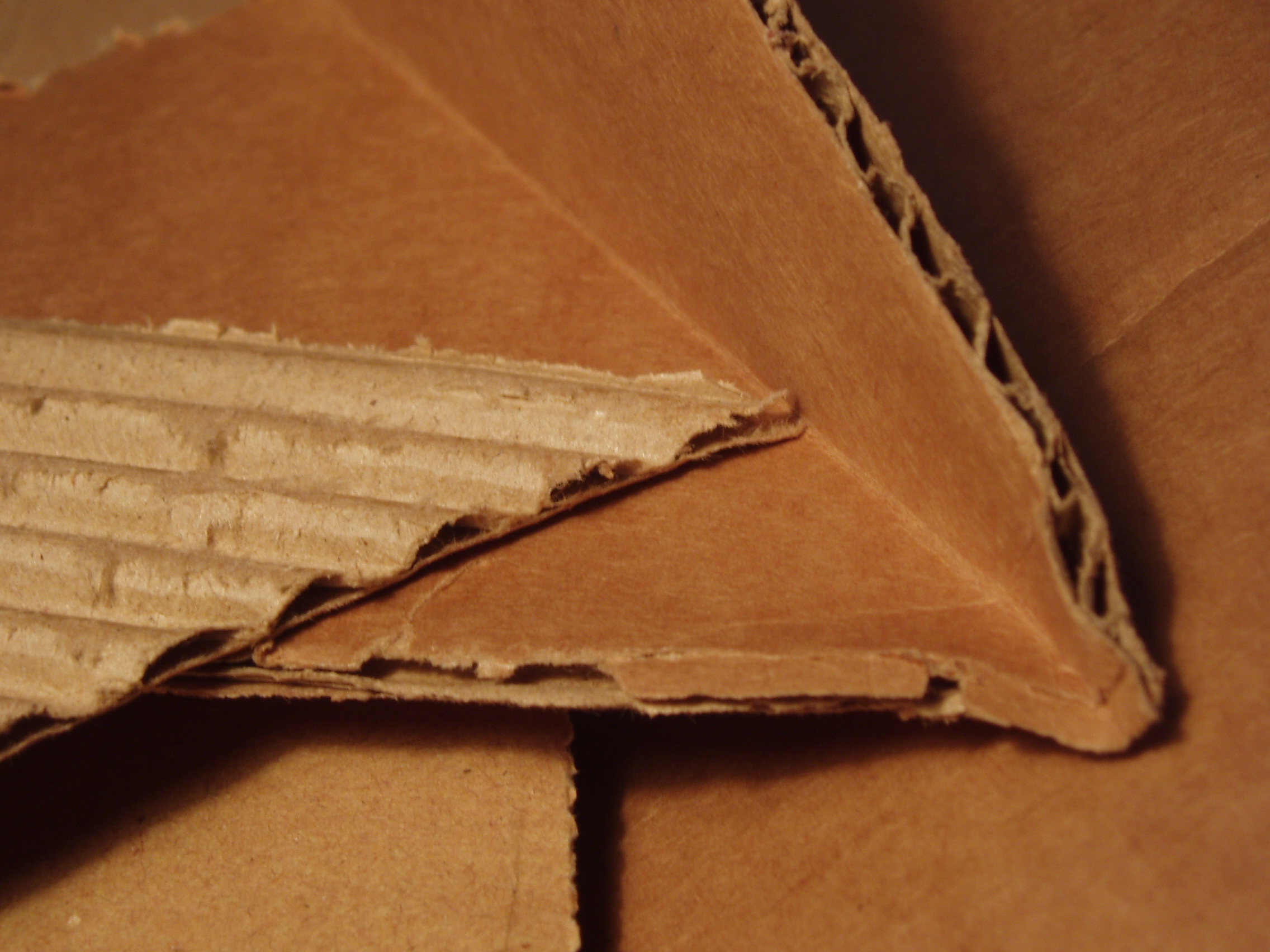
Corrugated fiberboard is a combination of paperboards, usually two flat liners and one inner fluted corrugated medium. It is often used for making corrugated boxes for shipping or storing products. This type of cardboard is also used by artists as original material for sculpting.
Recycling
Most types of cardboard are recyclable. Boards that are laminates, wax coated, or treated for wet-strength are often more difficult to recycle. Clean cardboard (i.e., cardboard that has not been subject to chemical coatings) "is usually worth recovering, although often the difference between the value it realizes and the cost of recovery is marginal". Cardboard can be recycled for industrial or domestic use. For example, cardboard may be composted or shredded for animal bedding.
History
The term cardboard has been used since at least 1848, when Anne Brontë mentioned it in her novel The Tenant of Wildfell Hall. The Kellogg brothers first used paperboard cartons to hold their flaked corn cereal, and later, when they began marketing it to the general public, a heat-sealed bag of wax paper was wrapped around the outside of the box and printed with their brand name. This development marked the origin of the cereal box, though in modern times the sealed bag is plastic and is kept inside the box. The Kieckhefer Container Company, run by John W. Kieckhefer, was another early American packaging industry pioneer. It excelled in the use of fiber shipping containers, particularly the paper milk carton.
Examples of different end use
File:Aloha nui cook.jpg|A postcard from 1908 File:NRC Honors Montgomery County Science Fair Students in Rockville, Md. (13537087363).jpg|Posters and display boards at science fair File:Die Oberlausitz - Exemplarisches Muster eines Nachschlagewerkes aus Inhalten der Wikipedia (Fokus auf die Bindung).JPG|Hardcover book File:Blue-punch-card-front-horiz.png|Punch card, early digital storage File:Arsexpo- Passe-partout.jpg|Mat used for framing picture File:Archief Kruisherenklooster Maastricht (RHCL)-2.jpg|Corrugated box used for storage of archives File:Carmin Hotel *** - vizitka.jpg|Business cards File:Rotolini.jpg|Fiber tubes for roll of paper File:Puzzle.jpg|Paperboard jigsaw puzzle
References
References
- (21 June 2023). "Definition of CARDBOARD".
- "Oxford Languages | the Home of Language Data".
- Walter Soroka, [https://books.google.com/books?id=L2OtF9ea0g0C&q=cardboard Illustrated Glossary of Packaging Terminology], p. 154.
- "What is Corrugated?". Fibre Box Association.
- US EPA, OLEM. (2017-09-07). "Containers and Packaging: Product-Specific Data".
- (28 November 2022). "Where Does All the Cardboard Come From? I Had to Know". The New York Times.
- Mani, Karthik. (May 10, 2023). "5 ways Cardboard Safety Matches are used in Business".
- Art, Langan. "Langan Art".
- AGR Manser, Alan Keeling, ''Practical Handbook of Processing and Recycling Municipal Waste'' (1996), p. 298, 8.1.2.
- Nicky Scott, ''Reduce, Reuse, Recycle: An Easy Household Guide'' (2007), p. 31.
- {{Cite OED
This article was imported from Wikipedia and is available under the Creative Commons Attribution-ShareAlike 4.0 License. Content has been adapted to SurfDoc format. Original contributors can be found on the article history page.
Ask Mako anything about Cardboard — get instant answers, deeper analysis, and related topics.
Research with MakoFree with your Surf account
Create a free account to save articles, ask Mako questions, and organize your research.
Sign up freeThis content may have been generated or modified by AI. CloudSurf Software LLC is not responsible for the accuracy, completeness, or reliability of AI-generated content. Always verify important information from primary sources.
Report