From Surf Wiki (app.surf) — the open knowledge base
Carcinoembryonic antigen
Biochemistry concept
Biochemistry concept
| Field | Value |
|---|---|
| Symbol | CEACAM |
| Name | Carcinoembryonic antigen |
| image | PBB Protein CEACAM5 image.jpg |
| caption | Structure of extracellular domains of CEACAM based on |
| Membranome family | 211 |
Carcinoembryonic antigen (CEA) describes a set of highly-related glycoproteins involved in cell adhesion. CEA is normally produced in gastrointestinal tissue during fetal development, but the production stops before birth. Consequently, CEA is usually present at very low levels in the blood of healthy adults (about 2–4 ng/mL). However, the serum levels are raised in some types of cancer, which means that it can be used as a tumor marker in clinical tests. Serum levels can also be elevated in heavy smokers.
CEA are glycosyl phosphatidyl inositol (GPI) cell-surface-anchored glycoproteins whose specialized sialo fucosylated glycoforms serve as functional colon carcinoma L-selectin and E-selectin ligands, which may be critical to the metastatic dissemination of colon carcinoma cells. Immunologically they are characterized as members of the CD66 cluster of differentiation. The proteins include CD66a, CD66b, CD66c, CD66d, CD66e, CD66f.
History
CEA was first identified in 1965 by Phil Gold, a Canadian physician, scientist and professor and Samuel O. Freedman who is also a Canadian professor of immunology in human colon cancer tissue extracts.
Diagnostic significance
The CEA blood test is not reliable for diagnosing cancer or as a screening test for early detection of cancer. Most types of cancer do not result in a high CEA level.
Serum from individuals with colorectal carcinoma often has higher levels of CEA than healthy individuals (above approximately 2.5 ng/mL). CEA measurement is mainly used as a tumor marker to monitor colorectal carcinoma treatment, to identify recurrences after surgical resection, for staging or to localize cancer spread through measurement of biological fluids. CEA levels may also be raised in gastric carcinoma, pancreatic carcinoma, lung carcinoma, breast carcinoma, and medullary thyroid carcinoma, as well as some non-neoplastic conditions like ulcerative colitis, pancreatitis, cirrhosis, COPD, Crohn's disease, hypothyroidism as well as in smokers. Elevated CEA levels should return to normal after successful surgical removal of the tumor and can be used in follow up, especially of colorectal cancers.
CEA elevation is known to be affected by multiple factors. It varies inversely with tumor grade; well-differentiated tumors secrete more CEA. CEA is elevated more in tumors with lymph node and distant metastasis than in organ-confined tumors and, thus, varies directly with tumor stage. Left-sided tumors generally tend to have higher CEA levels than right-sided tumors. Tumors causing bowel obstruction produce higher CEA levels. Aneuploid tumors produce more CEA than diploid tumors. Liver dysfunction increases CEA levels as the liver is the primary site of CEA metabolism.
Antibodies
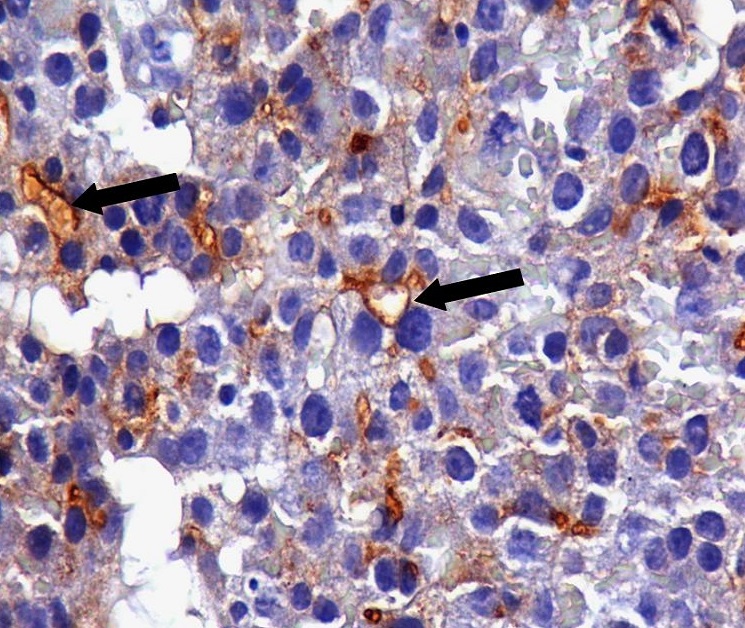
An anti-CEA antibody is an antibody against CEA. Such antibodies to CEA are commonly used in immunohistochemistry to identify cells expressing the glycoprotein in tissue samples. In adults, CEA is primarily expressed in cells of tumors (some malignant, some benign) but they are particularly associated with the adenocarcinomas, such as those arising in the colon, lung, breast, stomach, or pancreas. It can therefore be used to distinguish between these and other similar cancers. For example, it can help to distinguish between adenocarcinoma of the lung and mesothelioma, a different type of lung cancer which is not normally CEA positive. Because even monoclonal antibodies to CEA tend to have some degree of cross-reactivity, occasionally giving false positive results, it is commonly employed in combination with other immunohistochemistry tests, such as those for BerEp4, WT1, and calretinin. For cancers that highly express CEA, targeting CEA through radioimmunotherapy is one of the therapy approaches. Engineered antibodies such as single-chain Fv antibodies () or bispecific antibodies have been used for targeting and therapy of CEA expressing tumors both in vitro and in vivo with promising results. Regions of high CEA levels in the body can be detected with the monoclonal antibody arcitumomab.
Genetics
CEA and related genes make up the CEA family belonging to the immunoglobulin superfamily.
In humans, the carcinoembryonic antigen family consists of 29 genes, 18 of which are normally expressed. The following is a list of human genes which encode carcinoembryonic antigen-related cell adhesion proteins: CEACAM1, CEACAM3, CEACAM4, CEACAM5, CEACAM6, CEACAM7, CEACAM8, CEACAM16, CEACAM18, CEACAM19, CEACAM20, CEACAM21.
Clinical trials
CEA is expressed in many different types of cancer like lung, gastric, pancreatic and colorectal cancer. Many clinical trials have been performed.
CEA is used as tumor biomarker that can be used for Targeted Radionuclide Therapy. The cT84.66 is a chimeric antibody of murine origin that has been tested in phase I clinical trials with 111-In and 90-Yttrium. 111-In and 90-Y are β- emitters that are used in clinics for imaging and therapy respectively. The results were promising but a number of patients demonstrated immune responses and they had to withdraw from participating in the clinical trial. The cT84.66 antibody was huminized and in 2020, a phase I clinical trial was performed during which 18 cancer patients received an injection of 90Y-DOTA-M5A. The results of this trial demonstrated a stable disease for 10/18 patients ( 56%) and had no immunogenic response.
M5A-DOTA was coupled with 225-Ac, which is an alpa emitter, and an in vivo study was performed where cytokine therapy was combined with a-therapy. The result of the study revealed the benefit of combining these two treatments. Based on the results of this study, an ongoing clinical phase I study is currently underway (NCT05204147). The goal of this study is to establish the safety level and THE possible benefit of administrating M5A-DOTA-225-Ac.
References
References
- (June 2000). "Structural models for carcinoembryonic antigen and its complex with the single-chain Fv antibody molecule MFE23". FEBS Letters.
- (28 October 2011). "A sandwich electrochemical immunosensor using magnetic DNA nanoprobes for carcinoembryonic antigen". International Journal of Molecular Sciences.
- Duffy, Michael J. (1 April 2001). "Carcinoembryonic Antigen as a Marker for Colorectal Cancer: Is It Clinically Useful?". Clinical Chemistry.
- (June 2008). "Carcinoembryonic antigen and CD44 variant isoforms cooperate to mediate colon carcinoma cell adhesion to E- and L-selectin in shear flow". The Journal of Biological Chemistry.
- (2009). "Cancer cells in transit: the vascular interactions of tumor cells". Annual Review of Biomedical Engineering.
- (2009). "Identification, characterization and utilization of tumor cell selectin ligands in the design of colon cancer diagnostics". Biorheology.
- (March 1965). "Demonstration of tumor-specific antigens in human colonic carcinomata by immunological tolerance and absorption techniques". The Journal of Experimental Medicine.
- (April 2003). "Clinical utility of biochemical markers in colorectal cancer: European Group on Tumour Markers (EGTM) guidelines". European Journal of Cancer.
- (June 2016). "Elevated Level of Serum Carcinoembryonic Antigen (CEA) and Search for a Malignancy: A Case Report". Cureus.
- (1995). "Carcinoembryonic antigen in staging and follow-up of patients with solid tumors". Tumour Biology.
- (April 2001). "Carcinoembryonic antigen as a marker for colorectal cancer: is it clinically useful?". Clinical Chemistry.
- (January 1998). "The effect of benign and malignant liver disease on the tumour markers CA19-9 and CEA". Annals of Clinical Biochemistry.
- De Mais, Daniel. (2009). "ASCP Quick Compendium of Clinical Pathology". ASCP Press.
- (December 2007). "Carcinoembryonic antigen (CEA) levels in hookah smokers, cigarette smokers and non-smokers". The Journal of the Pakistan Medical Association.
- (2005). "Carcinoembryonic antigen in the staging and follow-up of patients with colorectal cancer". Cancer Investigation.
- "Carcinoembryonic Antigen (CEA) Exeter Clinical Laboratory International".
- (2003). "Tumor Markers". BC Decker.
- Machado-Netto MC, Lacerda EC, Heinke T, Maia DC, Lowen MS, Saad ED. (2006). "Massive orbital metastasis of hepatocellular carcinoma.". Clinics (Sao Paulo).
- (2023). "Carcinoembryonic Antigen". StatPearls Publishing.
- (2003). "Manual of Diagnostic Cytology". Greenwich Medical Media, Ltd..
- (April 2006). "A phase I trial of (90)Y-DOTA-anti-CEA chimeric T84.66 (cT84.66) radioimmunotherapy in patients with metastatic CEA-producing malignancies.". Cancer Biotherapy & Radiopharmaceuticals.
- (19 July 2000). "Recombinant anti-carcinoembryonic antigen antibodies for targeting cancer". Cancer Chemotherapy and Pharmacology.
- (1 July 2016). "A Novel Carcinoembryonic Antigen T-Cell Bispecific Antibody (CEA TCB) for the Treatment of Solid Tumors". Clinical Cancer Research.
- (2013). "Molecular Imaging and Contrast Agent Database (MICAD)". National Center for Biotechnology Information (US).
- (April 1999). "The carcinoembryonic antigen (CEA) family: structures, suggested functions and expression in normal and malignant tissues". Seminars in Cancer Biology.
- (1 December 1997). "Clinical Evaluation of Indium-111-Labeled Chimeric Anti-CEA Monoclonal Antibody". Journal of Nuclear Medicine.
- (15 April 2009). "A Phase I Study of a Combination of Yttrium-90 labeled Anti-CEA Antibody and Gemcitabine in Patients with CEA Producing Advanced Malignancies". Clinical Cancer Research.
- (February 2020). "Phase I Study of Yttrium-90 Radiolabeled M5A Anti-Carcinoembryonic Antigen Humanized Antibody in Patients with Advanced Carcinoembryonic Antigen Producing Malignancies". Cancer Biotherapy & Radiopharmaceuticals.
- (30 June 2022). "Improved Tumor Responses with Sequential Targeted α-Particles Followed by Interleukin 2 Immunocytokine Therapies in Treatment of CEA-Positive Breast and Colon Tumors in CEA Transgenic Mice". Journal of Nuclear Medicine.
This article was imported from Wikipedia and is available under the Creative Commons Attribution-ShareAlike 4.0 License. Content has been adapted to SurfDoc format. Original contributors can be found on the article history page.
Ask Mako anything about Carcinoembryonic antigen — get instant answers, deeper analysis, and related topics.
Research with MakoFree with your Surf account
Create a free account to save articles, ask Mako questions, and organize your research.
Sign up freeThis content may have been generated or modified by AI. CloudSurf Software LLC is not responsible for the accuracy, completeness, or reliability of AI-generated content. Always verify important information from primary sources.
Report